
What Gen Z Wants from Banks May Surprise You
By Jessica Kendall, Contributor at The Financial Brand
Simple Subscribe
Subscribe Now!
Gen Z is rapidly becoming one of the most important growth segments in retail banking. According to recent YouGov research, more than one-quarter of Gen Z adults are employed full-time, and this growing financial independence is translating into stronger banking engagement.
Many Gen Z consumers are now actively shopping for banking products. The research reveals how younger consumers evaluate financial institutions compared to older counterparts. While low fees remain important, Gen Z places greater emphasis on security, reliability, and brand trust than many industry stereotypes suggest.
Traditional institutions such as Bank of America, Capital One, and Chase continue to hold strong positions with younger consumers, while digital-native brands like Cash App and Chime have built meaningful affinity through mobile-first experiences.
Key insight: Winning Gen Z requires more than digital convenience. Institutions that combine strong brand trust with intuitive digital experiences are making the strongest impression among the next generation of banking customers.
Need to Know:
- Gen Z is actively shopping for banking relationships, with account opening and switching intentions significantly higher than those of the broader employed population. In fact, 12% of employed Gen Z consumers are considering switching their primary savings provider, versus 6% of the broader workforce.
- Trust matters more than many banks assume. Security, reliability, and brand reputation rank among Gen Z’s most important decision factors.
- Digital experiences are expected rather than differentiated. Mobile apps and online banking capabilities have become baseline requirements.
- Bank of America earns the highest positive impression score among employed Gen Z consumers, followed by Capital One, Chase, and Cash App.
Gen Z Enters the Market
YouGov’s analysis shows a growing share of Gen Z consumers moving into full-time employment and greater financial independence. As income rises and financial responsibilities expand, younger consumers are establishing banking relationships that could shape their financial lives for decades.
Gen Z is not only on the market for banking relationships. Many are actively evaluating alternatives. The research found that employed Gen Z consumers are nearly twice as likely as the broader workforce to consider switching their primary savings account provider.
Historically, banks have viewed primary account relationships as relatively sticky. Once customers establish direct deposit, bill payments, and savings habits, switching becomes less common. Gen Z may challenge that assumption more than previous groups.
Key insight: Digital onboarding, mobile account opening, and a growing comfort with fintech platforms have lowered barriers that once protected incumbent institutions.
Trust As a Core Differentiator
Conventional wisdom often portrays Gen Z as prioritizing convenience above all else. While convenience remains important, YouGov’s data suggests trust-related attributes carry substantial weight in banking decisions.
Nearly 3 in 10 Gen Z consumers cite a reputation for security and reliability as an important factor when choosing a bank. Brand reputation and trustworthiness rank closely behind. And both measures score meaningfully higher among employed Gen Z consumers than among employed Americans overall.
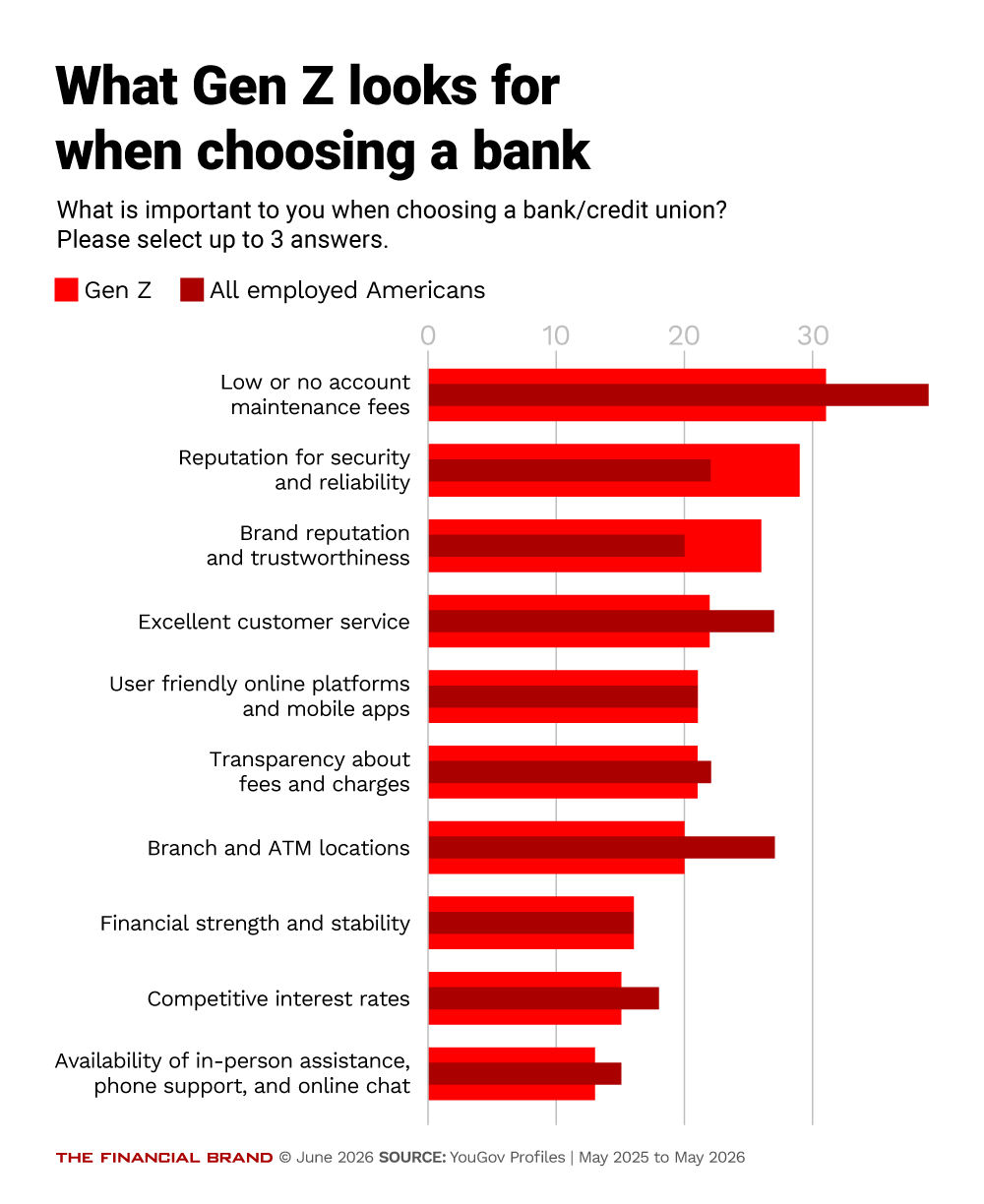
This finding arrives at a notable moment for the industry. Younger consumers have grown up during a period marked by high-profile data breaches, online fraud, identity theft, and growing concerns around digital privacy. As a result, trust has become an active consideration during provider selection.
Key insight: Banks that effectively communicate how they protect customer data, prevent fraud, and safeguard financial information may find themselves better positioned with younger audiences than institutions that focus exclusively on features and convenience.
Digital Experiences Have Become Table Stakes
The report also highlights how rapidly consumer expectations have evolved.
About 1 in 5 employed Gen Z consumers identify user-friendly online platforms and mobile apps as important factors when selecting a bank. However, the percentage is virtually identical to that of the broader employed population.
Digital experiences no longer create meaningful differentiation on their own. Consumers increasingly assume competent mobile banking functionality as a prerequisite for consideration.
The institutions making the strongest impression among Gen Z reflect this reality. Traditional banks such as Bank of America, Capital One, and Chase continue to rank highly despite competition from digital-native brands. At the same time, fintech-oriented platforms such as Cash App and Chime significantly outperform their standing among the broader workforce.
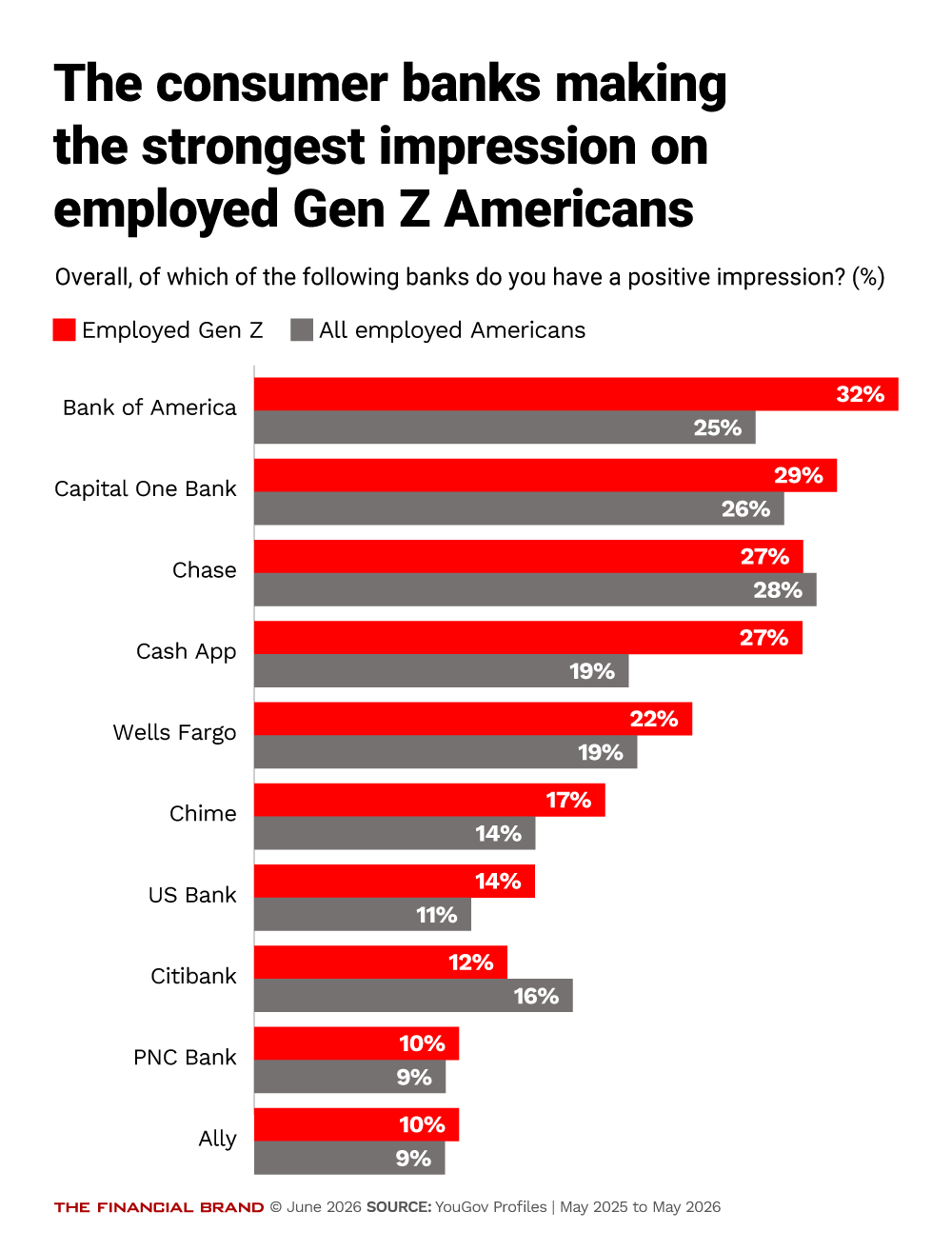
Key insight: The common denominator among those consumer banks making the strongest impression is not whether an institution began as a bank or a fintech. It is whether customers perceive the experience as simple, accessible, and aligned with their expectations.
While improving digital experiences remains essential, competitive advantage increasingly comes from combining digital excellence with brand trust, product relevance, and customer confidence.
What Banking Leaders Should Do Next
The findings point toward several practical actions for retail banking teams.
- Review Gen Z acquisition strategies through a trust lens. Many campaigns emphasize rewards, convenience, or digital features while dedicating little attention to security, reliability, and institutional credibility.
- Examine onboarding experiences for younger consumers. If Gen Z customers are actively shopping and switching, reducing friction during account opening becomes increasingly important.
- Revisit brand positioning. The strongest-performing institutions demonstrate that established banks can remain highly relevant to younger audiences when they modernize their experiences without abandoning the trust advantages they have spent decades building.
- Recognize that Gen Z does not represent a future growth segment. They are opening accounts, evaluating providers, and forming banking preferences today. The institutions that build relationships during these early financial milestones are likely to influence customer behavior long after Gen Z’s first paycheck becomes a mid-career salary.


