
Don’t Mistake Gen Z’s Financial Stress for Financial Apathy
By Jessica Kendall, Contributor at The Financial Brand
Simple Subscribe
Subscribe Now!
Gen Z’s financial story in 2026 is more complicated than headlines about economic anxiety imply. Many young adults are struggling with affordability, debt, and day-to-day expenses. Yet they are also showing signs of growing financial maturity.
Bank of America’s latest report on Gen Z and the Cost of Adulting finds that Gen Z is increasingly saving, budgeting, and making deliberate tradeoffs to manage higher living costs. Many are open about financial stress, comfortable discussing money with friends, and willing to adjust spending habits to stay afloat. For a generation often characterized as financially anxious, Gen Z appears increasingly willing to treat money as something discussed openly rather than privately managed.
Key takeaways: The findings suggest Gen Z wants financial guidance, but only if it feels practical, transparent, and grounded in everyday reality. Institutions that position themselves as partners in everyday money management — rather than simply product providers — may be better positioned to deepen engagement as Gen Z moves further into adulthood and financial independence.
Need to Know:
- Financial pressure remains intense, especially during early adulthood. 42% of Gen Z report living paycheck to paycheck, including 51% of those ages 23 to 25 years old as housing, debt, and independence collide.
- Financial maturity is increasing despite economic stress. Two-thirds of Gen Z report actively saving, retirement contributions are growing, and reliance on parental financial support continues to decline.
- 69% of Gen Z respondents have changed financial behavior due to higher living costs, including dining out less, skipping social events, and shopping more affordably.
- Money conversations are becoming normalized. Six in 10 Gen Z adults discuss finances with friends, and 42% practice “loud budgeting,” openly declining social spending they cannot afford.
- 43% cite irresponsible spending habits as a romantic dealbreaker, highlighting the growing role of financial values in relationships..
The Cost of Growing Up
For Gen Z, adulthood has arrived with a receipt attached.
Bank of America’s report paints a picture of a generation navigating persistent financial strain as rising costs continue to shape everyday decisions. Nearly half of Gen Z identifies the high cost of living as a major barrier to financial success, while 42% report living paycheck to paycheck.
Yet the data also complicates familiar assumptions about younger consumers. Rather than disengaging from financial responsibility, many Gen Z adults appear increasingly focused on adapting to financial realities through budgeting, saving, and spending adjustments.
Just as notably, many appear more comfortable discussing financial realities openly. Conversations about affordability, debt, and spending are increasingly part of friendships and relationships, suggesting Gen Z views money less as a private subject and more as a shared reality to navigate.
Key insight: One of the report’s more revealing findings is how financial pressure intensifies during the transition to adulthood. Gen Z adults ages 23 to 25 years old report the highest levels of paycheck-to-paycheck living, outpacing both younger and older peers. This middle cohort appears caught between diminishing family support and rising real-world obligations such as rent, transportation, and debt.

Housing costs stand out as a growing challenge. Nearly one-third of Gen Z cite rent or housing expenses as a major barrier to financial success, while those spending more than half of monthly income on housing continue to rise (up to 17% from 13% in 2025).
This moment of transition represents an important inflection point. Consumers in their early twenties are forming money habits that may persist for decades — opening accounts, building credit, establishing savings routines, and deciding which institutions they trust.
What this means: Messaging centered only on long-term wealth building may miss the practical concerns shaping daily financial behavior. More immediate guidance around budgeting, emergency savings, and managing irregular expenses may resonate more strongly.
Growing Signs of Financial Maturity
Despite affordability concerns, Gen Z is showing measurable progress toward financial independence.
Sixty-six percent now report actively saving money, a notable increase over recent years. More are contributing to workplace retirement accounts, using high-yield savings accounts, and automatically directing portions of paychecks into savings.
At the same time, financial dependence on parents appears to be declining. Just over one-third of Gen Z still receive financial assistance from parents or family members, down meaningfully from prior years (39% in 2025, 46% in 2024). Age appears to be an important factor. More than half of the youngest Gen Z cohort (ages 18–22) still receive financial support from parents or family members.
What this means: This combination of less financial support from family and improving saving habits matters. It suggests Gen Z should not be viewed exclusively through the lens of economic vulnerability. Many are making intentional financial decisions, even when resources are limited.
The report also highlights how Gen Z has adapted behavior in response to economic pressure. Nearly 7 in 10 changed spending patterns over the last year due to higher costs. Common responses included reducing restaurant spending, skipping social outings, and switching to lower-cost grocery options.
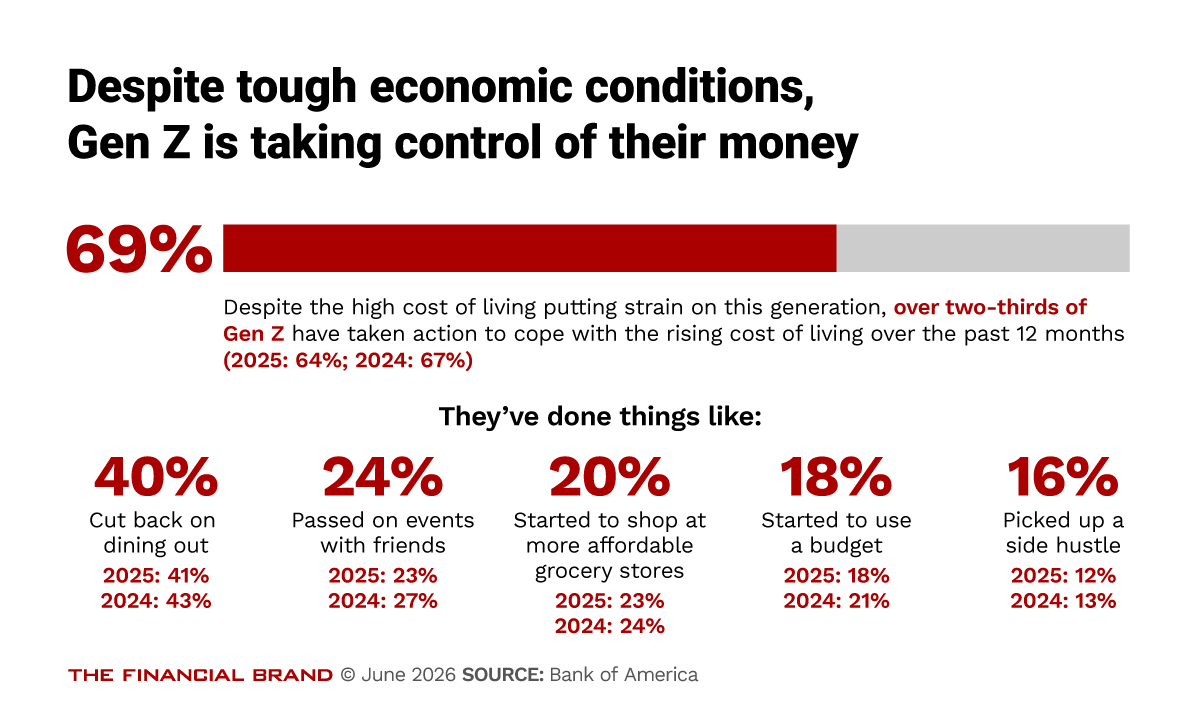
Key insight: These behaviors point to an audience receptive to practical financial tools — particularly digital experiences that make saving feel manageable rather than aspirational. Features such as automated savings, spending insights, short-form educational content, and goal-based account experiences may feel especially relevant for consumers still learning financial routines.
Money Has Become More Social
One of the more distinctive themes in the research is Gen Z’s openness around money.
Six in 10 discuss finances with friends, talking candidly about affordability, income, rent, and financial stress. More than 4 in 10 practice “loud budgeting,” openly declining plans because they cannot afford them.
For Gen Z, money increasingly functions as a social topic rather than a private burden. That shift has implications for how banks approach education and engagement. Traditional financial literacy efforts have often assumed consumers prefer private, formal learning. Gen Z may respond better to conversational, socially relevant content that acknowledges financial tradeoffs without judgment.
At the same time, financial stress remain substantial. Nearly one-third of Gen Z report ongoing financial stress, often tied to living costs, insufficient income, and lack of emergency savings.
Emotional tension shows up in contradictory ways. While 41% report feeling financial guilt at least weekly, 92% still buy themselves “little treats,” and more than half indulge at least weekly.
And, while many take positive actions when they feel stressed about their finances, Gen Z is most likely to avoid thinking about their finances entirely compared to other generations.
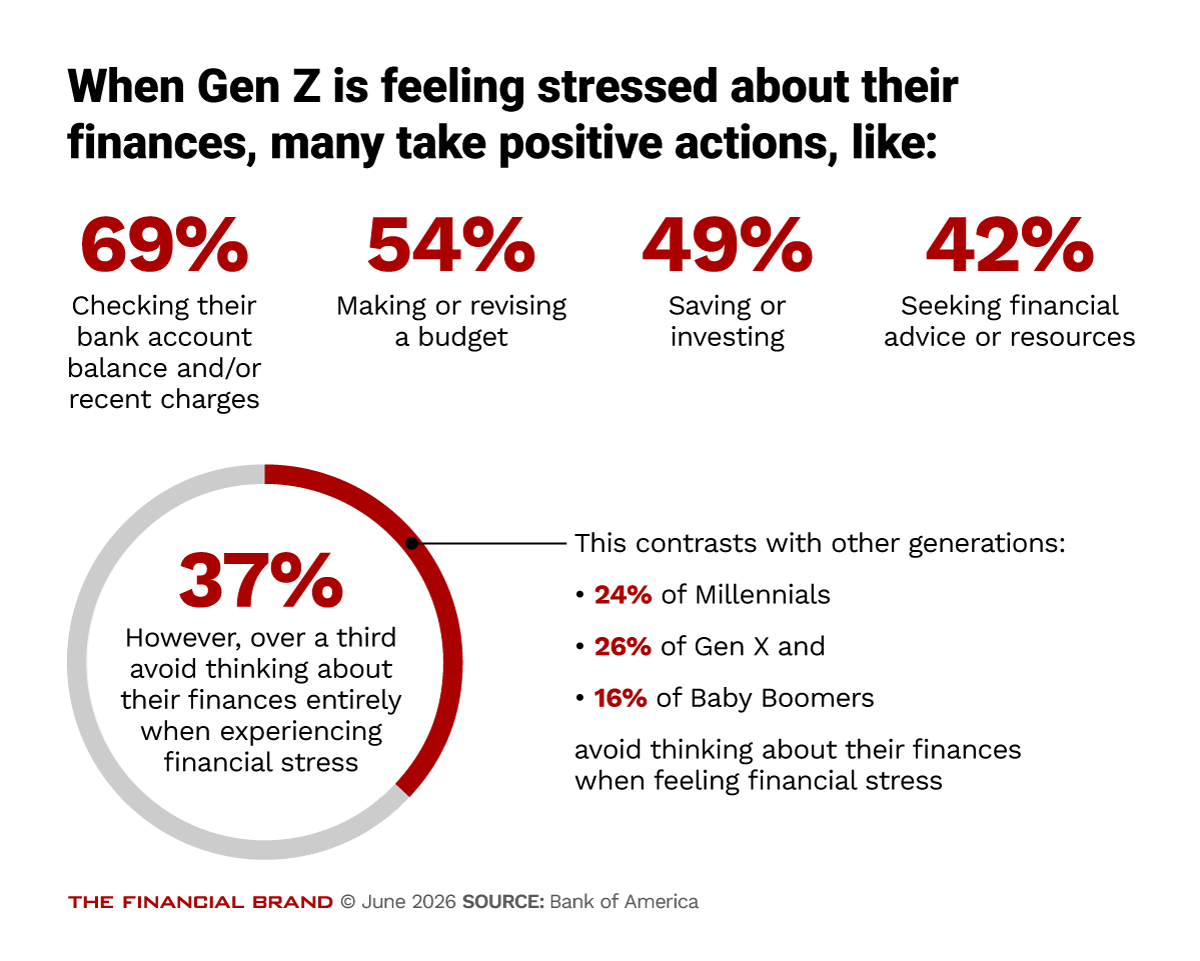
Key takeaway: Financial wellness messaging that assumes purely rational behavior can feel disconnected from lived reality. Consumers often make emotional spending decisions, particularly during stressful periods. At the same time, financial avoidance continues to rise among younger generations. The institutions most likely to earn trust may be those that recognize this tension while helping customers build healthier habits incrementally.
Financial Values Shape Relationships
Money is influencing Gen Z relationships in increasingly visible ways. Romantic relationships are increasingly shaped by financial compatibility — even as Gen Z keeps dating costs low.
In fact, more than half report no monthly dating expenses at all. At the same time, nearly one-quarter say financial circumstances have delayed some aspect of dating or relationship progress.
But financial compatibility matters deeply. Gen Z overwhelmingly values responsibility, financial security, and healthy money habits in romantic partners. Irresponsible spending ranks among the generation’s top relationship dealbreakers.
Bottom line: Credit, savings habits, budgeting, and financial confidence increasingly influence identity, relationships, and long-term life decisions. That dynamic extends to Gen Z’s expectations of financial providers. Institutions that help make financial progress feel achievable — particularly during the messy, expensive transition into adulthood — may be better positioned to earn trust that lasts well beyond Gen Z’s early banking years.


