
Institutions No Longer Control Financial Education. Algorithms Do
By Caroline Hroncich, Contributor at The Financial Brand
Simple Subscribe
Subscribe Now!
Younger consumers now search for money guidance on platforms like TikTok and YouTube before they ever consider a bank website. Kelly Ball, CEO of Pathfinders and assistant teaching professor at the University of Notre Dame, argues there is no structural reason financial institutions cannot take a leading role in the attention economy and reclaim influence with modern consumers.
“You have to commit that this is important. Then go figure out how to make it work,” he says.
Bottom line: Financial education is a competitive growth channel. Institutions that treat it as strategic infrastructure rather than marketing filler will win relevance with the next generation of accountholders. Those that do not risk becoming invisible at the exact moment consumers form lifelong financial habits.
Need to Know:
- Only 17% of young people report receiving financial education from their bank, leaving a major opportunity for institutions to engage early and build trust.
- Financial creators win attention by posting consistently with relatable guidance, banks that match this cadence can turn internal expertise into visible, trusted content.
- ROI is measurable when success is defined across engagement, awareness, and long-term influence, not just last-click conversions.
The Attention Economy Is Rewriting Financial Trust
Financial institutions have long assumed that customers will come to them for guidance, but that model is fading. Roughly 28.5% of Americans who seek financial advice now turn to social media — a larger share than those relying on employer programs, traditional media, or podcasts. For younger audiences, that number is even higher, highlighting the growing influence of TikTok, YouTube, Instagram, and LinkedIn in shaping financial knowledge and decisions, according to a survey from the Federal Reserve Bank of Philadelphia.
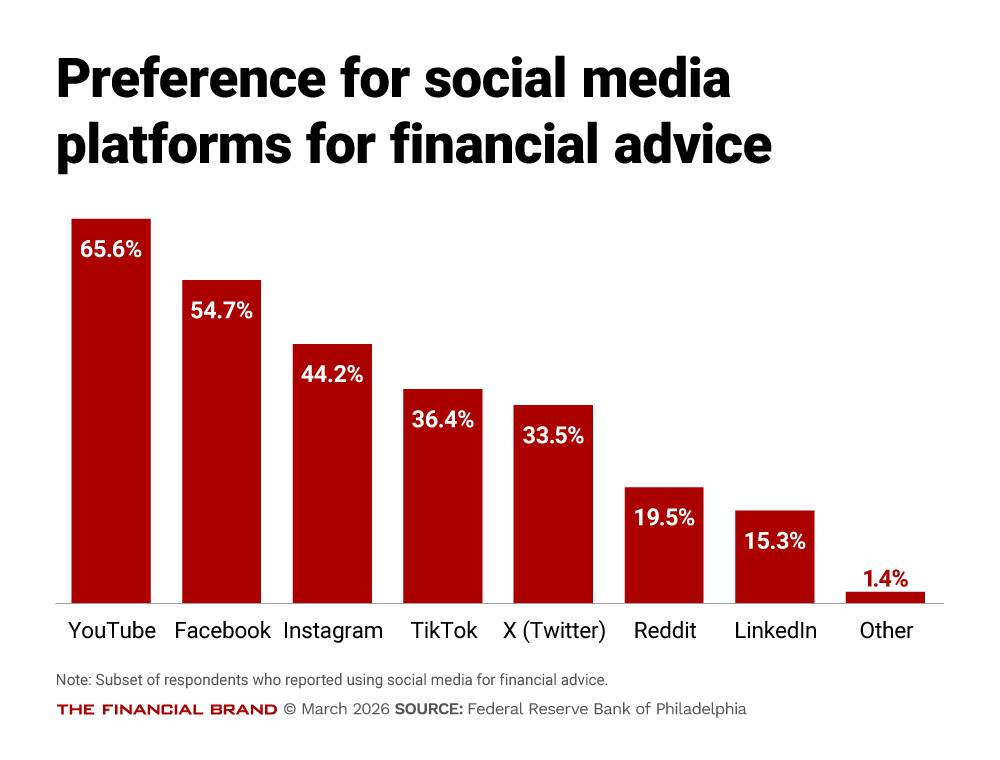
“What holds organizations back isn’t capability. It’s the instinct to wait until something is perfect instead of showing up consistently with useful guidance,” Ball says.
To remain relevant, financial institutions must meet consumers where they are. That means building a consistent presence on the social and digital platforms that their audiences actually use. Research underscores the opportunity: less than 20% of young people report receiving financial education from their bank, according to Santander Bank. That gap represents both a risk and a market opportunity — if institutions do not fill it, someone else will, and that someone may not be qualified.
To compete, leaders should:
- Audit where target segments search for financial answers.
- Compare their content visibility against independent creators.
- Identify high-volume questions customers already ask frontline staff.
- Map content topics directly to product education gaps.
Influencers Are Applying Persuasion Science Better Than Banks
Financial creators succeed by applying persuasion principles studied by behavioral expert and psychology professor Robert Cialdini, using social proof, authority, and relatability to make content simple, consistent, emotionally engaging, and highly effective. Institutions can achieve similar results by putting knowledgeable staff in the spotlight. When employees share expertise publicly, their guidance reaches audiences and is favored by algorithms.
AI and automation tools can help with research, drafting, and topic ideation, but they cannot replace judgment, compliance oversight, or credibility. Used wisely, these tools free teams to focus on strategy, personalization, and audience engagement.
Financial institutions can close the gap by:
- Prioritizing recognizable internal experts as public educators.
- Building repeatable content series rather than one-off posts, supported by tech for research and drafting.
- Simplifying language to match audience comprehension levels.
- Designing content for mobile-first consumption while using technology to streamline production without sacrificing oversight.
Consistency Beats Perfection
Influencers succeed by posting consistently on topics their audiences care about. Banks and credit unions could do the same with a regular series, such as “Financial Tip Friday,” to build visibility, engagement, and trust with their own voices, Ball says.
Yet, many institutions already dabble in financial education. They post a blog or run a campaign, then go quiet. Meanwhile, creators post daily, reinforcing familiarity and trust. Online, consistency often matters as much as credibility — regular content signals relevance, while sporadic posting makes an institution easy to overlook.
How to close the gap:
- Commit to a simple cadence, like weekly financial tips
- Use an editorial calendar tied to seasonal money decisions
- Assign ownership to a dedicated team or leader
- Treat education as an ongoing program, not a one-off campaign
Large institutions also weaken their impact when local updates are mixed with broad content. A branch announcement in one state may not resonate elsewhere. Segmentation or dedicated education-only channels can fix this. Some banks and credit unions create profiles focused solely on financial literacy, keeping education separate from marketing and setting clear audience expectations, Ball says.
Measurement Isn’t Broken, Strategy Is
Many leaders hesitate to invest in financial education because it’s hard to link directly to revenue. Educational content rarely drives immediate sales, but it shapes awareness, trust, and later customer decisions. Instead of judging success by immediate conversions, leaders should track a mix of outcomes that reflect influence and contribution over time:
- Engagement quality: Depth of interaction matters more than raw views. Metrics like time on page, scroll depth, and repeat visits show whether content resonates and delivers real value.
- Brand and awareness lift: A consistent, visible presence builds trust and positions the institution for long-term influence. Metrics like branded search growth, organic reach, and share of voice capture this effect.
- Contribution to customer behaviors: Financial education content helps guide decisions over time. Multi-touch attribution and qualitative tracking reflect this broader impact.
Correlation with business outcomes: Track over time how content aligns with brand sentiment, retention, or account growth. This approach shows strategic, long-term impact rather than relying on last-click metrics.
The key is to define success up front and measure against that framework. Treat financial education as a strategic engine that builds trust, strengthens brand perception, and drives long-term customer value.
“Start small, be consistent, and use your own voice,” Ball says. “That is how you win back attention and trust.”


