
Small Businesses Are Ready and Willing to Switch Banks for Better Support
By Jessica Kendall, Contributor at The Financial Brand
Simple Subscribe
Subscribe Now!
Small businesses remain ambitious, but their definition of success is shifting. Now, they’re focused on sustainable growth, dependable customer relationships, and greater control over day-to-day operations.
Mastercard’s recent *Dreamonomics* report, based on a survey of 6,615 business owners and decisionmakers across 18 markets, finds that financial stability and adaptability increasingly shape how small and medium-sized enterprises (SMEs) choose to grow.
Business owners want faster payments, clearer cash-flow visibility, integrated technology, embedded cybersecurity, and financial products that deliver tangible value. Yet many still rely on personal accounts and credit cards to run their businesses, often because dedicated business products feel complicated or poorly suited to their needs.
Key insight: To drive growth, financial institutions need to build business banking relationships around the realities of running a company, make everyday financial management easier, and give customers clear reasons to consolidate more of their business with the bank.
Need to Know
- Build around sustainable growth. Business owners increasingly value stability, customer loyalty, and personal wellbeing alongside revenue growth.
- Make financial control a core benefit. Real-time payments, cash-flow visibility, and reconciliation tools can help businesses manage uncertainty. In fact, 84% are interested in real-time payments.
- Embed security into everyday banking. Seventy-one percent prioritize protection from cyber threats, yet only 37% currently use cybersecurity tools. SME customers want protection that supports digital adoption without adding operational complexity.
- Make business products easier to adopt. Transparent pricing, relevant rewards, and flexible features can address barriers to switching from personal financial tools.
- Tailor the relationship to business maturity. Growing companies need more integrated capabilities, while smaller businesses need accessible products that solve immediate problems.
Growth Means More Than Getting Bigger
For many small businesses, success increasingly means building a company that can withstand uncertainty while continuing to grow. Mastercard’s research finds that 61% of SMEs would rather deepen customer relationships than maximize customer reach. The same share identifies a balance between work and personal well-being as a priority, while 61% emphasize building a trusted reputation as a growth-related goal.
Business owners increasingly value relationships that generate repeat business and protect the reputation they have worked to establish. Financial providers can support those goals by making everyday transactions more dependable, helping owners understand their financial position, and offering products that fit how their businesses actually operate.
The preference for stability is equally clear. Sixty-eight percent prioritize stability over rapid growth, and 54% actively avoid unnecessary financial risk.
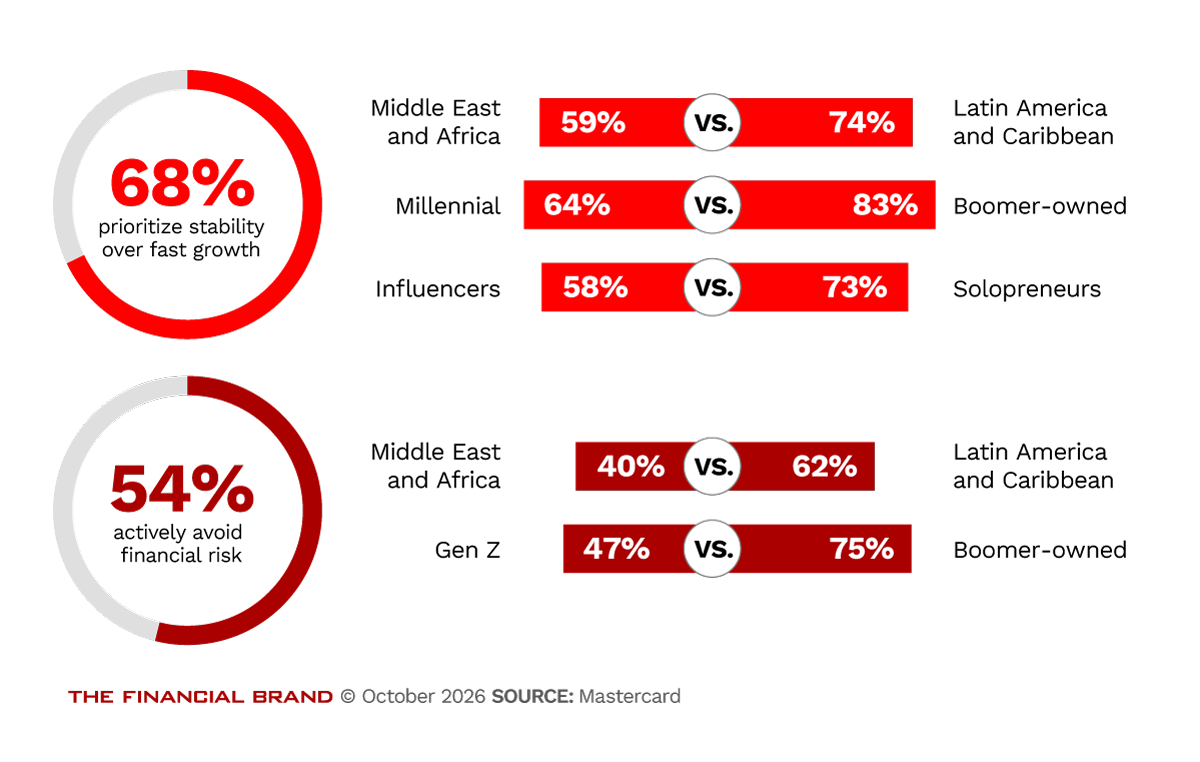
Rising costs are a concern for 54% of SMEs, while 49% cite economic uncertainty and 52% point to intensifying competition. For microbusinesses, rising costs are an even greater concern, affecting 63% of small businesses.
Key insight: These pressures do not eliminate ambition. They change how business owners pursue it. Banks have an opportunity to position business banking around the confidence and control that help owners make better decisions, rather than relying on growth-oriented messaging alone. That means demonstrating how a financial relationship helps customers manage the business they have today while preparing for its next stage.
Stability Depends on Financial Flexibility
When revenue fluctuates and expenses rise, stability depends partly on how quickly owners can understand and respond to changes in their finances. A majority (84%) of SMEs are interested in real-time payments, while more than a third want payment management and reconciliation tools that help them coordinate transactions across accounts, connect banking data, and automate alerts or reminders.
For banks, this is a strong case for treating cash-flow visibility and payment speed as core business banking benefits. Faster access to funds can help owners respond to immediate needs. Clear transaction information and reconciliation tools can reduce the work required to understand where money is moving. Together, these capabilities can make financial management more predictable even when business conditions are not.
Needs also change as companies mature. The report finds that 51% of medium-sized businesses use premium business card solutions, compared with 36% of small businesses and 18% of microbusinesses. Premium users are also more likely than other users to adopt bundled solutions and tools for analytics, employee spending, reconciliation, and flexible payments.
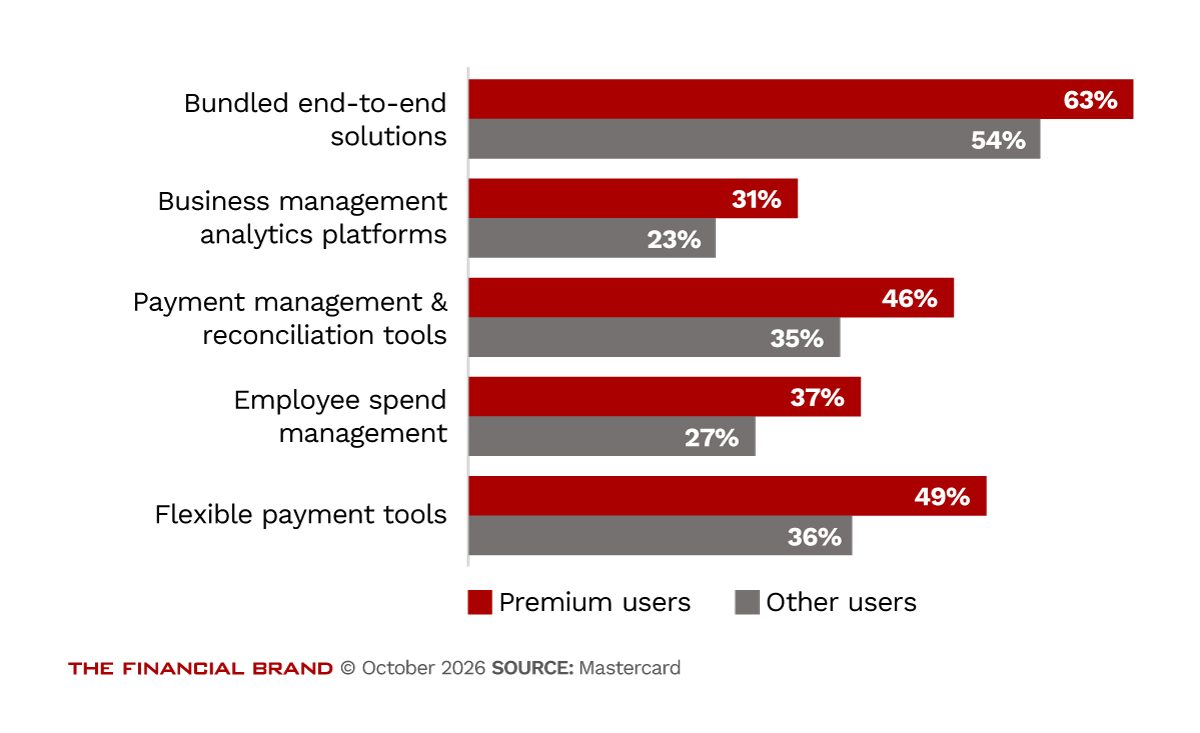
Key insight: Banks should use these differences to shape their product strategies. Larger, more complex businesses may value integrated capabilities that give finance teams greater oversight. Smaller businesses may need a simpler entry point, with the option to add controls and functionality as their operations expand. A single business banking package will struggle to serve both equally well.
Security Supports Confidence and Growth
As businesses rely more heavily on digital tools, security becomes part of the customer experience. Seventy-one percent of SMEs prioritize protection from cyber threats, yet only 37% currently use cybersecurity tools. Mastercard also cites its 2025 research, which found that 46% of SMEs had experienced a cyberattack in recent years, with an average resulting loss of $25,000.
The gap between concern and adoption gives banks a clear area to address. Business owners may recognize the importance of security without knowing which protections they need or wanting to manage another standalone service. Banks can respond by making relevant safeguards easier to access and understand within the business banking experience.
The same principle applies to artificial intelligence and automation. Seventy percent of SMEs are excited about AI’s potential, and respondents see possible applications in fraud and security protection, smart invoicing, and expense management. Yet the report points to a broader technology challenge: businesses already use multiple digital solutions, and 78% say integrated solutions are critical.
Key takeaway: Prioritize useful capabilities within familiar workflows. Security alerts, fraud monitoring, and automated financial insights are more likely to help when customers can act on them without navigating disconnected systems. Banks can also explain protections in concrete terms, linking them to the transactions, accounts, and business activities customers want to safeguard.
Business Products Must Earn Their Place
Many small businesses still use personal financial products to manage business expenses. Mastercard finds that 62% use personal credit cards for business spending, while 54% use at least some personal accounts for business purposes. Among creators, the latter figure rises to 75%.
The report identifies practical reasons for this behavior. Thirty-one percent say business-specific products can feel complicated, and an equal share believe they are better suited to larger organizations. Cost and product relevance also shape adoption. Twenty-nine percent would be more likely to adopt a business card if fees and conditions were clear and reasonable; 28% want to separate personal and business spending; and 26% want rewards or benefits comparable to those offered by personal cards.
Banks should address these barriers directly. Clear pricing, relevant rewards, straightforward onboarding, and flexible controls can make dedicated business products more appealing. Digital payment solutions that offer features such as instant issuance, adjustable limits, or single-use cards may also meet needs that traditional business cards do not.
Bottom line: The commercial stakes are significant: 51% of small businesses say they are willing to switch financial providers for better support. Banks can strengthen their position by making the value of business banking tangible, then expanding the relationship as customer needs evolve.


