
Small Business Owners Need More from Your Bank Than Ever
By Jessica Kendall, Contributor at The Financial Brand
Simple Subscribe
Subscribe Now!
Small and midsize businesses remain focused on growth, but economic pressures are influencing how they invest, borrow, and manage their operations.
Bank of America’s 2026 Business Owner Report finds that business owners continue to invest in growth even as they navigate persistent inflation, higher costs and economic uncertainty. Demand for financing is growing, traditional bank lending is gaining traction, and AI adoption is becoming increasingly widespread.
These trends present retail banks with an opportunity to deepen business banking relationships by delivering more relevant financing options, practical financial guidance, and digital capabilities that address customers’ evolving needs.
Key takeaway: Banks that understand the pressures facing business owners can do more than provide access to capital. They can become trusted partners in helping businesses navigate uncertainty, invest strategically, and achieve sustainable growth.
Need to Know:
- Business owners remain growth-minded, but more cautious. Revenue expectations and expansion plans have declined year over year, while inflation, commodity prices, health care costs, and interest rates continue to weigh on business decisions.
- Demand for financing is increasing. Eighty-five percent of business owners plan to obtain financing in the next 12 months, and the share considering traditional bank loans or lines of credit has increased substantially.
- AI adoption is creating new expectations. Eighty-four percent of business owners already use AI, with applications spanning marketing, analytics, operations, and customer service. Many also expect technology investments to contribute to revenue growth.
- Workforce investment remains a priority. Business owners are raising wages, hiring, and investing in professional development, creating opportunities for banks to support both business and employee financial needs.
- Business banking relationships can extend beyond lending. Cash flow management, technology investments, succession planning, and operational resilience all represent opportunities for more proactive engagement.
Business Owners Remain Optimistic, but Cautious
Despite persistent economic uncertainty, business owners continue to invest in their companies. However, the 2026 findings suggest a more measured approach to growth than in the previous year.
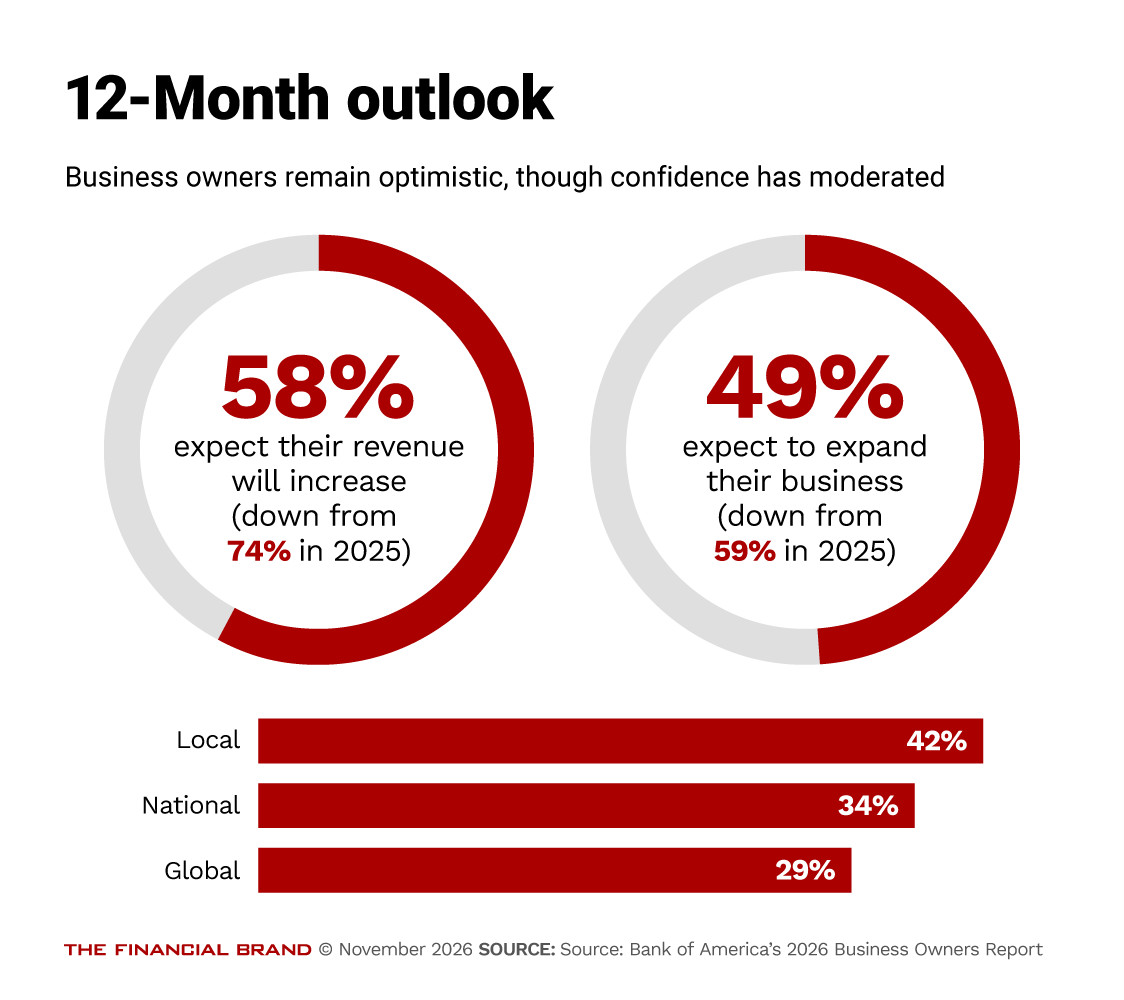
Just 58% of business owners expect revenue to increase over the next 12 months, compared with 74% in 2025. Similarly, 49% plan to expand their businesses, down from 59%. Confidence in the broader economy also varies considerably depending on perspective. Forty-two percent expect their local economy to improve, compared with 34% for the national economy and 29% for the global economy.
Inflation remains the leading economic concern, cited by 75% of respondents, up from 70% last year. Concern about commodity prices, including oil and gas, increased particularly sharply, rising from 55% to 71%. Health care costs (66%), interest rates (63%), and recession concerns (63%) also rank among the leading challenges.
These pressures are showing up in business operations. Ninety-one percent of owners say their costs increased over the past year, compared with 77% in 2025. The average reported increase was 17%. Meanwhile, 93% report at least one business impact from inflation, with nearly two-thirds responding by raising prices for their products or services.
What this means: These findings reinforce the importance of understanding the financial pressures behind customers’ day-to-day decisions. Banks can strengthen relationships by bringing conversations to customers proactively, rather than waiting for a loan application or a request for assistance.
The opportunity is particularly relevant for community and regional banks with strong local business relationships. Business owners express more confidence in their local economies than in the national or global outlook. Banks that understand local industries, employment conditions, and business cycles are well positioned to provide relevant advice and establish deeper relationships.
Financing Demand Creates New Opportunities
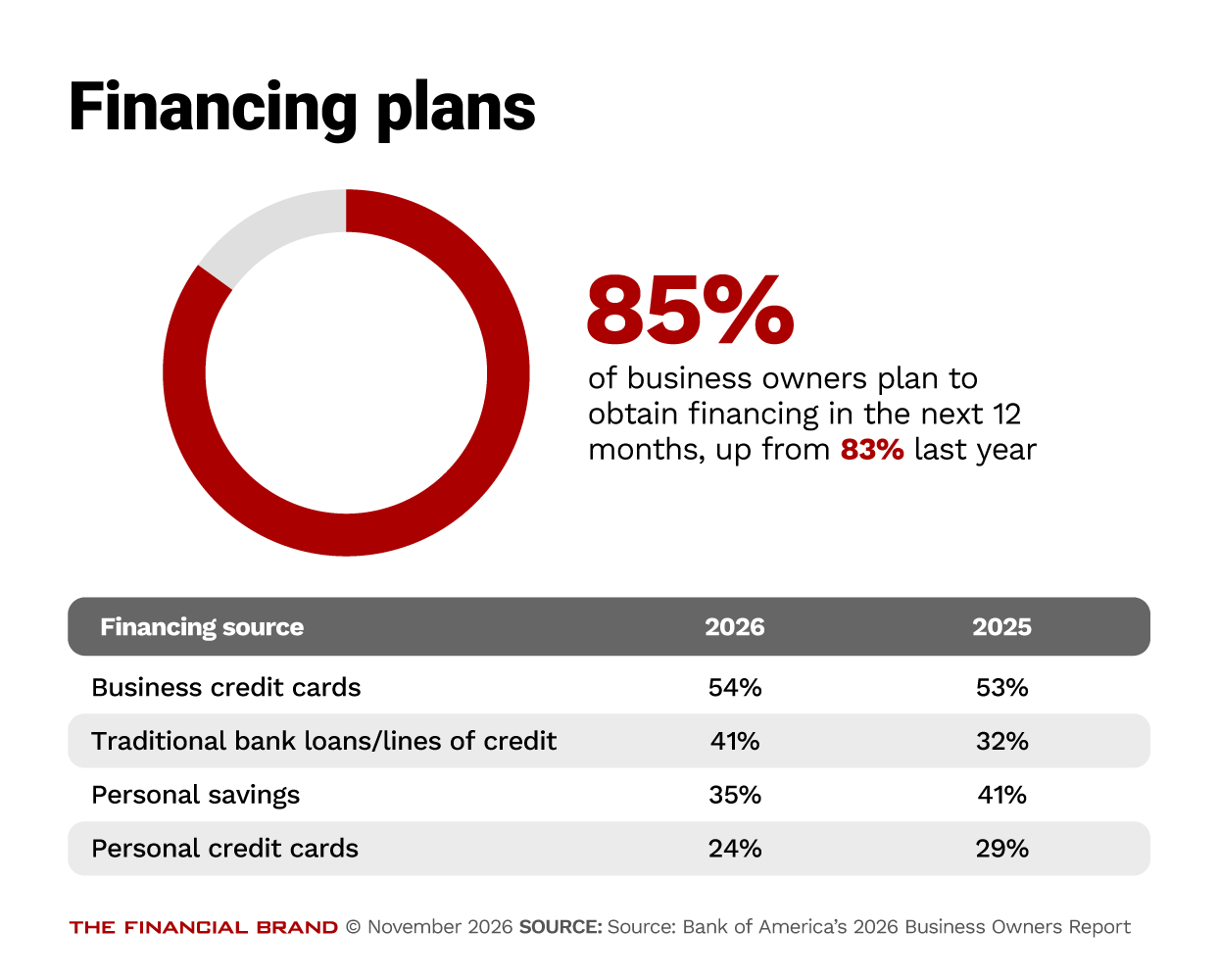
Even as business owners approach expansion more cautiously, their demand for financing is increasing. Eighty-five percent plan to obtain financing over the next 12 months, up from 83% in 2025. Half have applied for a business loan or line of credit within the past two years, compared with 45% in the previous survey, and 93% of recent applicants were approved.
Traditional bank loans and lines of credit are gaining traction. Forty-one percent of business owners identify them as a financing source, up from 32% in 2025. Business credit cards remain the most commonly cited source, at 54%, while reliance on personal savings declined from 41% to 35%.
The intended uses of bank financing also offer insight into where business owners need support. Marketing and promotion lead the list, cited by 50% of those planning to seek a traditional bank loan or line of credit. Operating expenses follow at 49%, payroll and staffing needs at 43%, equipment at 40%, and technology investments at 35%.
Key takeaway: This is an opportunity to connect lending products with the specific business objectives behind borrowing decisions. Understanding distinctions in how funding will be used can help relationship managers recommend appropriate products, structure financing around business needs, and identify opportunities for additional services.
It also creates a compelling case for stronger integration between business banking and treasury management. Business owners are dealing with rising costs and changing cash flow requirements, making visibility into balances, payments, and upcoming obligations increasingly valuable. Banks that combine access to credit with practical cash management capabilities can provide more comprehensive support.
AI Is Changing Business Expectations
Digital tools are playing a growing role in how business owners manage and grow their companies. Sixty-one percent of business owners say their use of digital tools increased over the past year, and 89% plan at least one digital investment in the next 12 months.
AI leads the investment priorities, cited by 50% of business owners. This is followed by marketing technology at 43%, website development and maintenance at 28%, and customer relationship management tools at 23%.
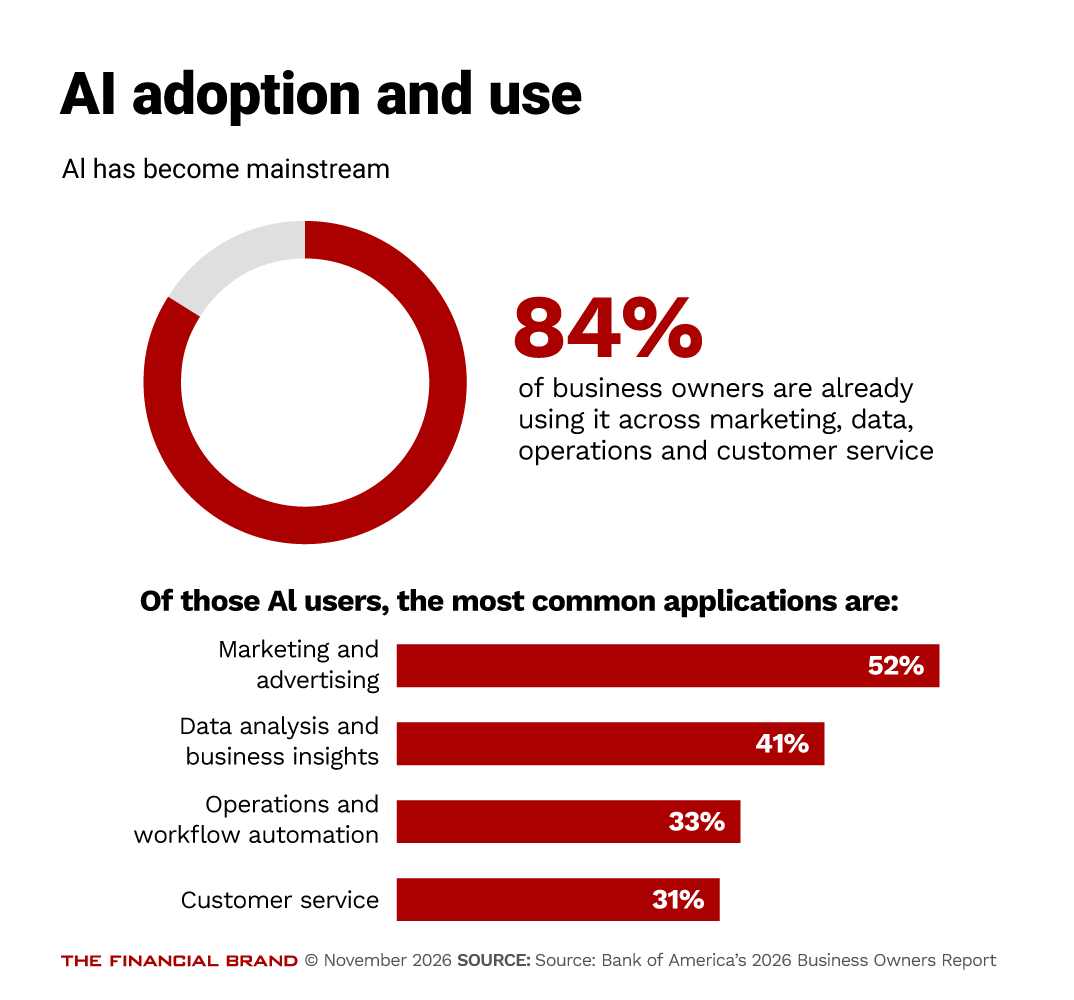
And AI adoption is already widespread. 84% of respondents say they use AI in some capacity. Marketing and advertising are the most common applications, cited by 52% of AI users, followed by data analysis and business insights (41%), operations and workflow automation (33%), and customer service (31%).
What’s more, reported benefits are encouraging. Ninety-four percent of AI users say the technology has contributed positively to their business in at least one way. Fifty-five percent report improved operational efficiency, 40% cite enhanced employee productivity, and 36% report improved customer experience. Among owners using or planning to use AI, 68% expect it to increase sales and revenue over the next year.
Key takeaway: These findings create an opening for banks to rethink how they support business customers’ technology investments. Financing digital transformation is one piece of the equation, but business owners may also benefit from guidance on managing technology expenses, evaluating vendors, and integrating digital tools into their operations.
Banks should also recognize that AI adoption brings workforce and security considerations. Sixty percent of business owners using or planning to use AI expect employees to move into new or redesigned roles, while 52% anticipate hiring additional staff to manage AI tools. Yet just 41% express concern about cybersecurity threats to their businesses, suggesting that many owners may benefit from greater awareness of the security implications of expanding their digital capabilities.
Providing relevant education and connecting business owners with trusted technology resources can strengthen relationships while helping customers make more informed investment decisions.
People and continuity remain priorities
Technology investments are occurring alongside continued investment in employees. Thirty-nine percent of business owners plan to hire additional staff over the next year, while 49% expect to maintain current staffing levels. Just 4% anticipate reducing headcount.
But recruitment and retention remain challenges. Fifty-five percent say labor shortages are affecting their businesses, although that figure has declined from 61% in 2025. Nearly two-thirds (66%) increased wages, benefits, or both over the past year. Competitive pay remains the leading workforce priority, cited by 67% of business owners, followed by flexible work hours at 42%.
Skills development is another important consideration. Eighty-six percent identify at least one area where employees could improve, with AI and emerging technology skills leading the list at 36%. Marketing and sales skills follow at 33%. Among those identifying skill gaps, 60% are investing in training or professional development.
Longer-term business continuity also deserves attention. Sixty-four percent of owners report having a succession plan, up from 60% in 2025. Among those with plans, 29% expect to transition their businesses to family members, while 25% anticipate selling to a strategic buyer.
Succession planning creates an opportunity for banks to engage business owners well before a transition occurs. Financing, wealth management, estate planning, and business valuation considerations can involve multiple financial relationships. Banks that coordinate these services can provide continuity for owners while establishing relationships with the next generation of business leaders.
Bottom line: Ultimately, the report points to a business banking market in which customers continue to pursue growth but need more flexibility and support in deciding how to achieve it. Banks have an opportunity to make those relationships more valuable by aligning financing, technology, and advisory services with the realities business owners face every day.


