
Credit Unions Can’t Afford to Let Growing SMBs Outgrow Them
By Jessica Kendall, Contributor at The Financial Brand
Simple Subscribe
Subscribe Now!
Small and midsize businesses could become a stronger growth engine for credit unions, particularly as more businesses look for financial partners that can support them through different stages of growth.
Reality check: Velera’s 2026 Credit Union Growth Outlook, conducted with Visa among 600 U.S. SMB owners and decision makers, shows why retaining those relationships can become more difficult. As businesses grow, their financial needs become more complex. Micro and small businesses place greater value on transparent fees, personal service, and access to credit. Meanwhile, lower middle market businesses place greater emphasis on security, financial reporting, payments, and other capabilities.
This difference creates a gap that credit unions need to address. Credit unions have room to deepen relationships by building the capabilities businesses need as they scale.
Need to Know:
- Credit unions have a natural advantage with smaller businesses. Their performance on service, transparent fees, digital banking, and other relationship-oriented attributes gives them a strong foundation for acquiring SMB relationships.
- 42% of micro and small businesses use personal accounts for business needs, compared with 22% of lower middle market businesses. As businesses grow, they increasingly move toward dedicated business accounts and more sophisticated solutions.
- 86% of SMBs use multiple banking partners, with an average of 2.8 financial institutions used for business banking.
- Customer service is the top satisfaction motivator for micro and small businesses across credit and payment services, where credit unions and community banks outperform larger banks.
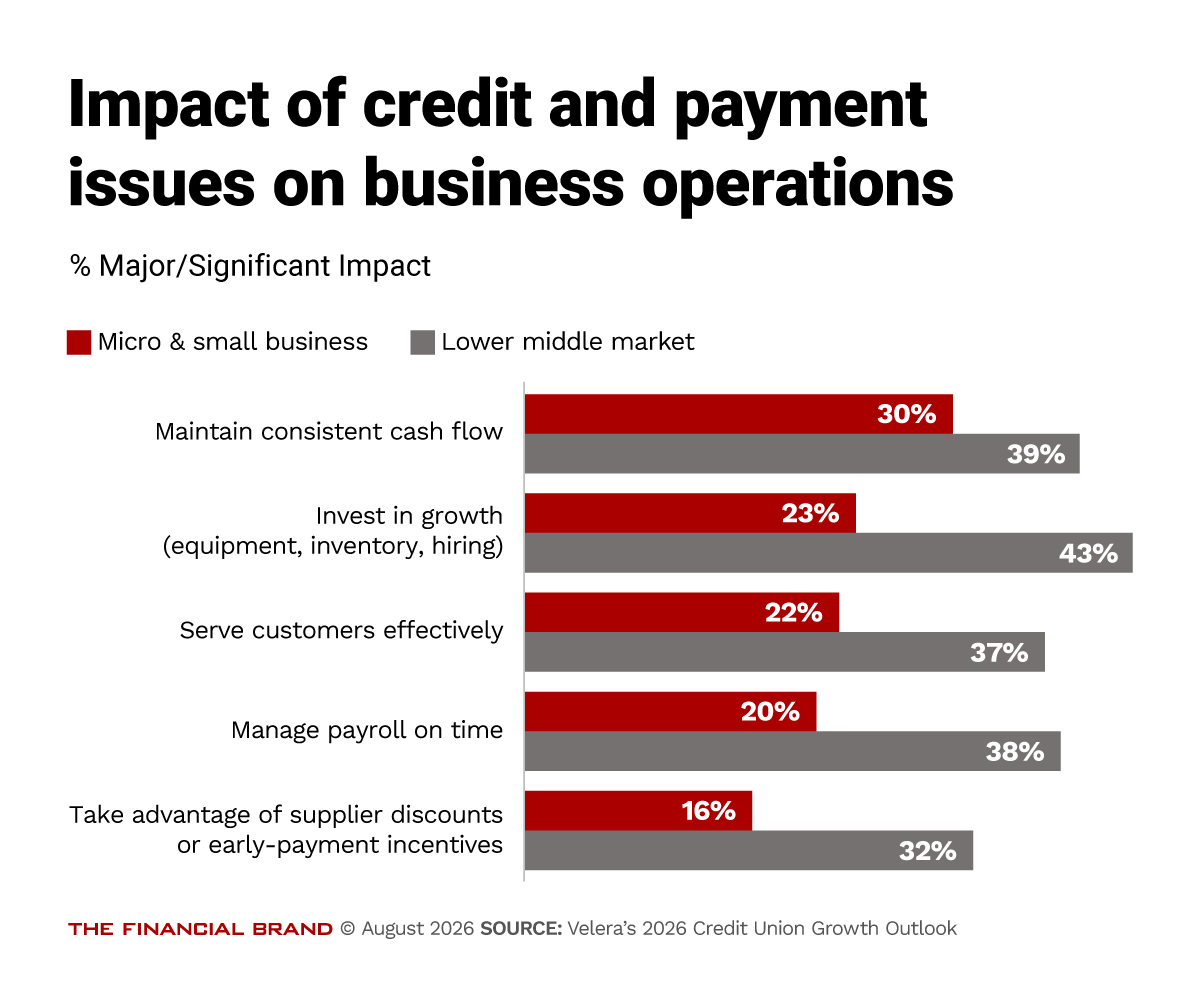
- 39% of lower middle market businesses say credit and payment issues have a major or significant impact on investing in growth. Those issues also affect other operational areas, including serving customers and managing payroll.
SMBs Build Banking Relationships in Layers
The typical SMB banking relationship starts relatively simply. For a new business, an early step is opening a business checking and debit relationship with a financial institution. For many micro and small businesses, that is likely to be the credit union or bank where the owner already has a personal relationship.
But relationships rarely stay with one product. They add financial services based on their operational needs throughout their growth. Micro and small businesses are more likely to use their primary financial institution for deposits, business expenses, and excess cash or savings. Lower middle market businesses are more likely to use their primary institution for business credit cards, payment processing, payroll, and financial advisory services.
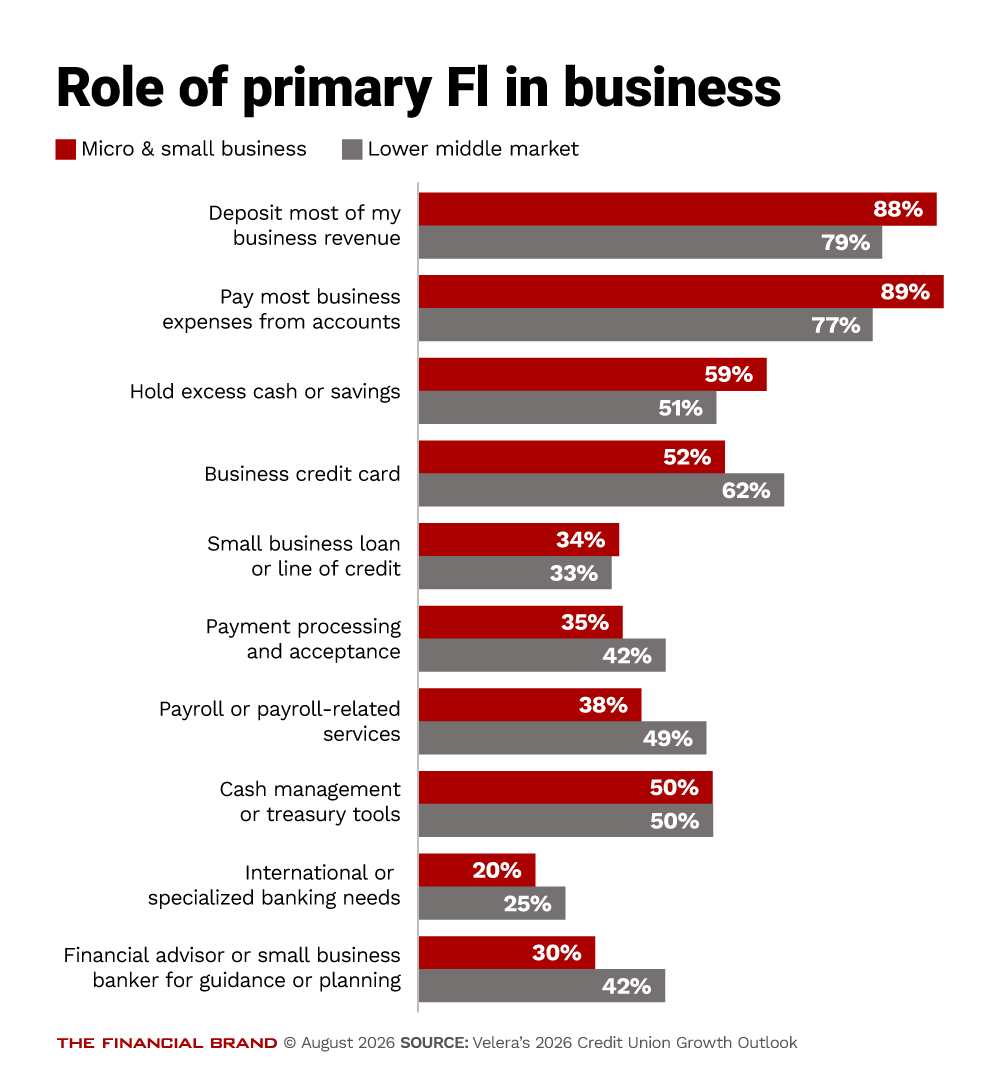
Key insight:The use of personal accounts also declines as businesses mature. Forty-two percent of micro and small businesses use personal accounts to support their business needs, compared with 22% of lower middle market businesses. Among those using personal credit cards for business, better rewards or benefits are the leading reason. Lower middle market businesses also cite higher credit limits and lower fees.
That evolution helps explain the fragmentation in SMB banking. Eighty-six percent of SMBs use multiple banking partners, with an average of 2.8 financial institutions used for business banking.
Velera says businesses often assemble a patchwork of providers to meet their needs, particularly as they mature and seek capabilities they perceive local financial institutions lack. For credit unions, the fragmented landscape creates multiple entry points for building SMB relationships.
Find the Gaps Between Needs and Satisfaction
For micro and small businesses, low and transparent fees are the top factor in choosing a financial institution. Credit unions and community banks already outperform larger financial institutions in this area, and SMBs that name a credit union or community bank as their primary financial institution report high satisfaction with those fees. Velera says the gap is less about product-market fit and more about awareness, perception, and accessibility.
Customer service is another important strength. It is the top satisfaction motivator for micro and small businesses across credit and payment services, and community financial institutions outperform larger banks on many of the factors that influence satisfaction.
But these strengths do not guarantee loyalty. Velera also asked SMBs what could prompt them to consider switching their primary financial institution. The responses point to a mix of relationship and product-level issues, giving credit unions a useful view of where service improvements can protect existing relationships.
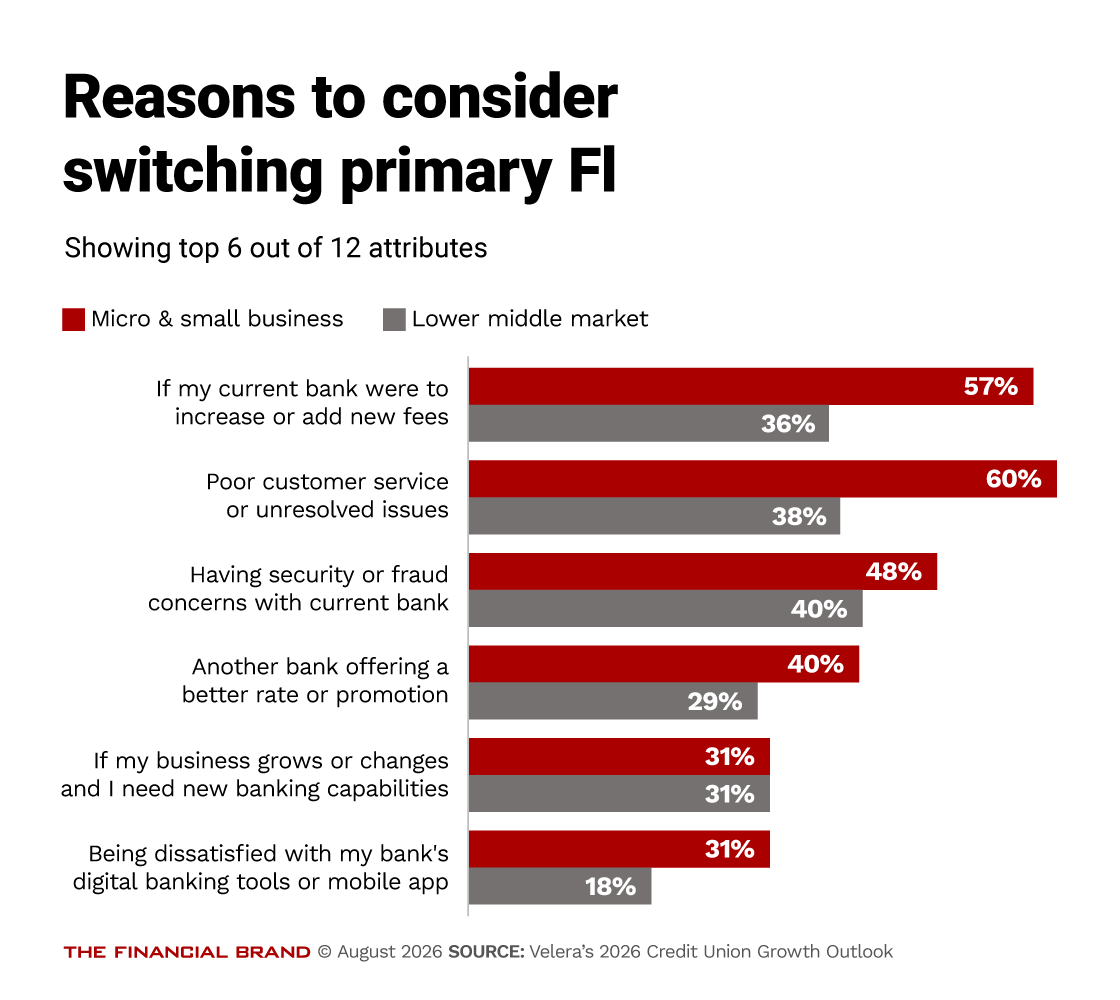
The switching triggers reinforce the importance of both service and product value. For credit unions, the findings point to specific areas where improving the customer experience or strengthening the offering could help protect the relationship.
The report also identifies areas where credit unions can improve. Greater access to credit and competitive interest rates on deposits are opportunities for micro and small businesses. Across credit and payment services, payment processing fees, rate types, speed of credit approval, and credit limits are areas where improvements could increase satisfaction.
Key insight:The priorities look different for lower middle market businesses. Security and fraud protection is the top factor in choosing a financial institution. Credit unions and community banks outperform larger providers on low or transparent fees and digital banking, but lag regional banks on security and fraud protection, access to a personal banker, access to credit, and real-time transaction monitoring.
For credit and payment services, lower middle market businesses place the greatest importance on the quality of financial reporting and transaction data. Customer service, digital access, and payment settlement speed are considered table stakes, while speed of credit approval represents another area where faster service could increase satisfaction.
Build Relationships That Grow With SMBs
The attributes that help attract smaller businesses remain important, but growing companies expect their financial institution to add more sophisticated capabilities as their needs change.
Payments are one place to start. The report calls payments the “heartbeat” of small business. Yet, one in three SMBs say credit and payment friction have a high impact on their ability to maintain steady cash flows and invest in growth. A comprehensive payments ecosystem can give credit unions more frequent engagement with business members while addressing a need that directly affects day-to-day operations.
Credit unions should also take a close look at their business credit card offerings. Velera identifies unattractive rewards and high processing fees as common SMB pain points. Better rewards could encourage businesses to move from personal cards to business cards, particularly among micro and small businesses that are more likely to use personal cards.
Credit is another area where credit unions can differentiate. The report cites a separate study finding that one in five SMBs that switched their banking relationship had been turned down for a loan. The report argues that credit unions’ community relationships can position them to make relationship-based underwriting decisions that look beyond the credit score.
The same principle applies to the capabilities surrounding those transactions. As SMBs grow, credit unions need to be able to support more sophisticated digital banking, treasury, financial control and reporting needs. The report says speed and flexibility are key attributes for SMBs and that credit unions that become leaders in these areas can build deeper relationships.
Finally, credit unions should engage SMB members early and often. As firms scale, their priorities shift from basic needs such as quality service toward more sophisticated requirements such as robust data and financial reporting. Velera recommends engaging micro and small businesses as they emerge from the startup phase and begin their growth trajectory, creating an opportunity to discuss their evolving needs and how the credit union can support them.
This is important because credit unions already have a foothold with smaller businesses. Twenty-eight percent of micro and small businesses name a credit union or community bank as their primary financial institution. Among lower middle market businesses, that figure drops to 12%.
Bottom line:The challenge is turning that initial relationship into one that can support the business at its next stage. For credit unions, that means extending their existing strengths in service and relationship banking into the payments, credit, digital, security, and reporting capabilities SMBs need as they grow.


