
A Real SMB Slowdown Is Underway. Here’s How Banks Should Retool
By Jessica Kendall, Contributor at The Financial Brand
Simple Subscribe
Subscribe Now!
Small businesses are navigating a series of cost shocks that are reshaping how they operate, hire, and invest.
New Bank of America Institute data shows a sharp rise in fuel expenses, triggering broader increases across transportation, inventory, and input costs. At the same time, hiring patterns are shifting: Payroll growth has turned negative for three consecutive months, even as spending on contract and specialized labor rises in select sectors.
What this means: Despite these pressures, balance sheets remain relatively stable and profitability is still growing modestly. The bigger shift is behavioral. Many small businesses are choosing flexibility over expansion, pulling back on capital investment and avoiding external financing. This data signals a change in SMB client priorities for banks — from growth enablement to cash flow management, cost control, and short-term resilience.
Need to Know:
- Gasoline spending per small business client rose 23% YoY in March 2026, increasing transportation, inventory, and input expenses across multiple sectors.
- Payroll growth declined for three consecutive months, the first such stretch since 2021.
- Small business owners are prioritizing liquidity and flexibility, delaying expansion and capital investment decisions.
- Stable balance sheets provide a buffer, but growth expectations are moderating as uncertainty persists.
- Total small business payments increased just 1.0% YoY, signaling slowed activity.
Cost Pressures Reshape Small Business Operations
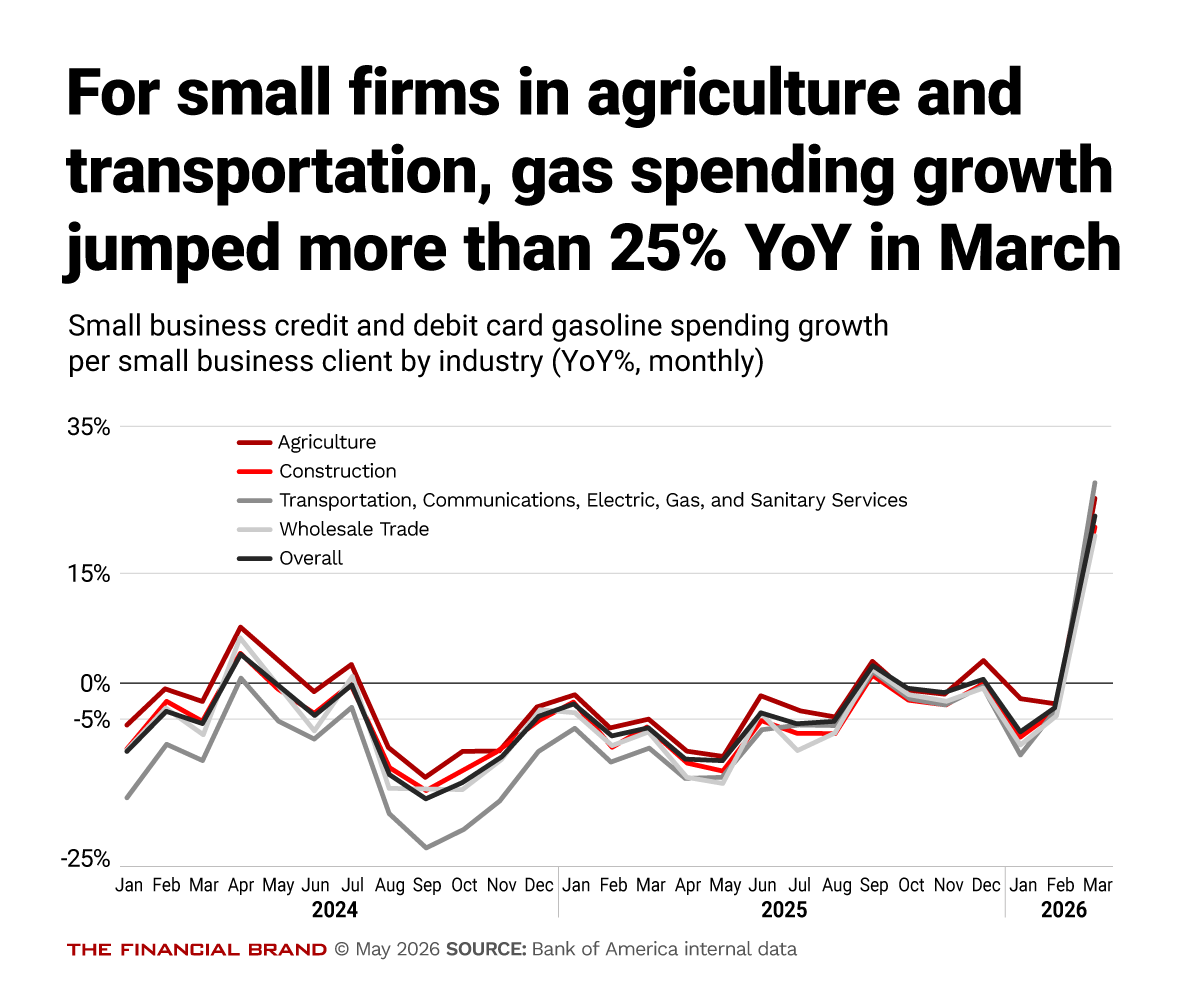
The most immediate story in the data is the surge in fuel costs — and the ripple effects that follow. Gasoline spending jumped 23% year-over-year in March, reversing earlier declines and marking one of the sharpest increases in recent years.
For industries like agriculture and transportation, where fuel is central to operations, the impact is even more pronounced. These sectors saw spending increases exceed 25%, and fuel now represents a growing share of overall expenses.
Beyond paying at the pump, higher fuel costs feed directly into freight, logistics, and supplier pricing. Following geopolitical disruptions, U.S. freight costs surged, including nearly 50% for trucking and up to 17% for ocean transport.
For agricultural businesses, the pressure compounds further. Fertilizer costs, tied closely to global energy markets, are rising alongside transportation expenses. Deposit growth among these firms is already weakening compared to other sectors, suggesting margin compression is taking hold.
What this means: This data creates a clear picture of client stress. Financial institutions that can translate these signals, like rising operating costs, into proactive outreach — such as working capital solutions or expense management tools — will be better positioned to support their small business portfolios.
Inventory and Tariffs Add New Strain
While fuel dominates headlines, inventory and trade-related costs are creating a second layer of pressure. Small wholesalers experienced a 62.6% year-over-year increase in inventory-related expenses in March — the largest jump recorded in the dataset.
These costs include logistics, storage, and distribution, all of which are sensitive to fuel prices and supply chain disruptions. At the same time, tariff-related payments surged to nearly 95% above 2024 average levels for affected firms.
The result is a measurable pullback in forward-looking behavior. Fewer business owners are planning inventory investments, and capital expenditure intentions have dropped to levels not seen since 2009.
Even where tariff relief is emerging, smaller firms are slower to feel the benefit than larger enterprises with more diversified supply chains.
What this means: For financial institutions, this highlights a shift in demand. Small businesses are less focused on scaling inventory and more concerned with managing volatility. Lending strategies tied purely to expansion may miss the mark; solutions that help clients navigate fluctuating costs and preserve margin are likely to resonate more.
Hiring Patterns Signal Strategic Retrenchment
The report’s labor data reveals payroll growth has declined for three consecutive months, indicating that many small businesses are reducing or delaying full-time hiring.
At the same time, spending on hiring firms, including staffing agencies and contract labor providers, has turned positive for the first time in nearly a year. In construction and manufacturing, these payments are running nearly 40% above 2023 averages.
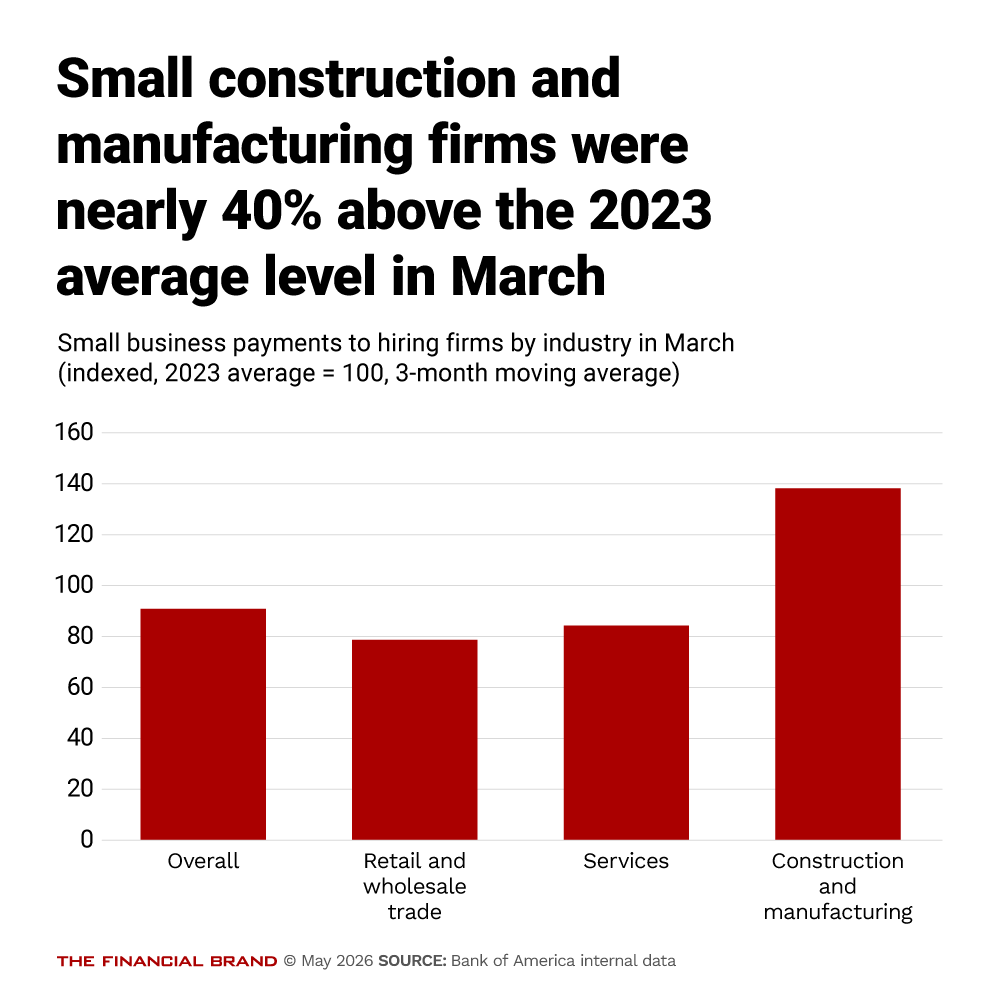
This suggests a more targeted approach to workforce management. Instead of committing to permanent headcount increases, small businesses are opting for flexibility and bringing in labor where needed without long-term obligations.
External factors are also shaping this dynamic. Labor supply constraints, influenced in part by immigration policy shifts, are contributing to hiring challenges in certain sectors. Meanwhile, pockets of economic activity — such as manufacturing — are still generating demand for workers.
What this means: This introduces an opportunity for banks to rethink how workforce-related insights are used. Transaction data tied to payroll and staffing payments can serve as an early indicator of business sentiment. Institutions that incorporate these signals into client engagement strategies can move from reactive support to informed guidance.
Bottom Line: “Stability” Masks a Shift Toward Caution
Despite rising gasoline costs and declining payroll numbers, small business finances appear stable. Profitability grew modestly in the first quarter, and credit utilization remains close to pre-pandemic norms, suggesting limited financial stress.
But underlying behaviors tell a different story. Payment growth has slowed to just 1% year-over-year, and more businesses are opting not to seek external financing than at any point in two decades.
This likely reflects a deliberate shift in priorities. Rather than pursuing aggressive expansion, many small businesses are focusing on maintaining liquidity and preserving optionality.
This means that traditional growth-oriented messaging may feel misaligned with current client needs. Instead, there is an opportunity to reposition around stability, efficiency, and financial control. Tools that can help businesses monitor cash flow in real time, manage expenses, and adapt to cost volatility are likely to gain traction.
What Banks Should Do Next
The throughline in this data is recalibration. Small businesses are still operating, still hiring selectively, and still generating modest profit growth. But the decision-making framework has shifted from expansion to preservation. That has direct implications for how banks show up in the relationship. Here are 4 things to think about for your small business portfolios:
1. Stop treating volatility as a temporary condition that sits outside the core client strategy.
It’s now embedded in day-to-day operating behavior. Fuel-driven cost swings, supply chain shocks, and uneven labor dynamics are showing up in transaction data in near real time. Institutions that can surface these signals early can move from periodic check-ins to continuous relevance.
2. Product alignment matters more than product breadth.
Traditional SMB playbooks tend to emphasize credit expansion and growth financing. That is not where most clients are operating right now. The more immediate demand is for tools that stabilize cash flow.
3. Segmentation needs to become more precise.
The report makes it clear that stress is not evenly distributed. Agriculture, transportation, and wholesale firms are experiencing materially different cost dynamics than services or retail. A one-size-fits-all SMB strategy will miss where pressure is actually building and where opportunity still exists.
4. Your relationship strategy must evolve from reactive support to anticipatory guidance.
Payroll trends, hiring payments, inventory spend, and tariff exposure are already signaling behavioral shifts before they show up in traditional credit metrics. Banks that operationalize these signals can engage clients earlier — before liquidity tightens or investment plans are reconsidered.
Key takeaway: Small business clients are not stepping back. They are tightening control over how they move forward. Banks that mirror that mindset will be better positioned to stay relevant as conditions continue to shift.


