
Banks Must Act Now as Consumer Credit Stress Begins to Spread
By Jessica Kendall, Contributor at The Financial Brand
Simple Subscribe
Subscribe Now!
U.S. household debt has continued to expand through the end of 2025 — reaching $18.8 trillion in the fourth quarter with growth spread across mortgages, credit cards, auto loans, and home equity lines, according to the Federal Reserve Bank of New York’s Household Debt and Credit report for Q4 2025. At the same time, early signs of stress are re-emerging in several segments, particularly student loans and revolving credit.
What this means for retail banks: This environment presents a mix of opportunity and exposure: consumers are borrowing and seeking credit, but repayment performance is beginning to soften. The data also shows a consumer base that remains active and engaged with credit products, yet increasingly segmented by age, credit score, and loan type.
Banks that respond with tighter risk monitoring, more targeted marketing, and improved lifecycle management will be better positioned to capture growth while protecting portfolio performance in 2026.
Need to Know:
- Total household debt rose by $191 billion in Q4 2025, bringing the total to $18.8 trillion.
- Credit card balances and limits are both rising, indicating continued consumer demand for liquidity despite higher interest rates.
- Student loan delinquency remains the most severe stress point with balances at $1.66 trillion.
- Credit quality at mortgage origination remains strong, while auto lending shows signs of gradual loosening.
- Early-stage delinquency is increasing across several loan types, suggesting banks should expect rising charge-offs later in the credit cycle.
The Credit Cycle Is Shifting
The final quarter of 2025 marked another milestone in the post-pandemic expansion of U.S. consumer borrowing. Total household debt reached $18.8 trillion, continuing a steady climb that has added more than $4.6 trillion since the end of 2019.
For retail banks, the significance isn’t just about the size of the balance sheet but in its composition. Mortgage debt still dominates, exceeding $13 trillion, yet growth is occurring across every major category, including credit cards, auto loans, and home equity lines of credit. This broad-based expansion suggests that households are relying on multiple forms of credit simultaneously, increasing the complexity of risk assessment and customer relationship management.

The environment is best characterized as late-cycle but still expansionary. Consumers are continuing to borrow, lenders are still extending credit, and originations remain healthy. However, the gradual rise in delinquency rates indicates that repayment performance is beginning to weaken. Historically, this pattern has preceded periods of tightening credit conditions and higher loss provisioning.
What this means: Retail banking leaders can use these signals to re-examine underwriting thresholds, portfolio monitoring, and early-intervention strategies rather than as an immediate sign of contraction.
Consumer Liquidity Needs on the Rise
Revolving credit tells an especially clear story about consumer behavior. Credit card balances increased by $44 billion during the fourth quarter alone, while credit limits also expanded by $95 billion.
This combination suggests that banks are still competing aggressively for wallet share and consumers continue to rely on revolving credit to manage day-to-day expenses. Rising balances alongside rising limits typically indicate that utilization rates are stable rather than spiking, which helps explain why charge-offs have not yet accelerated at the same pace as balances.
Marketing takeaway: This environment rewards precise targeting rather than broad-based acquisition. Customers with strong repayment histories remain attractive prospects for premium card offers, balance transfer promotions, and line increases. At the same time, customers who are beginning to revolve balances after a period of paying in full represent an early signal of financial stress and should be routed into proactive engagement programs.
Banks that integrate credit bureau, real-time liability data, internal transaction signals, and behavioral analytics into a unified customer view will be better equipped to differentiate between profitable revolvers and emerging risk segments.
Student Loans Remain the Largest Stress Point
Among all major credit categories, student loans show the highest level of repayment distress. As of the fourth quarter of 2025, 9.6% of student loan balances were at least 90 days delinquent.
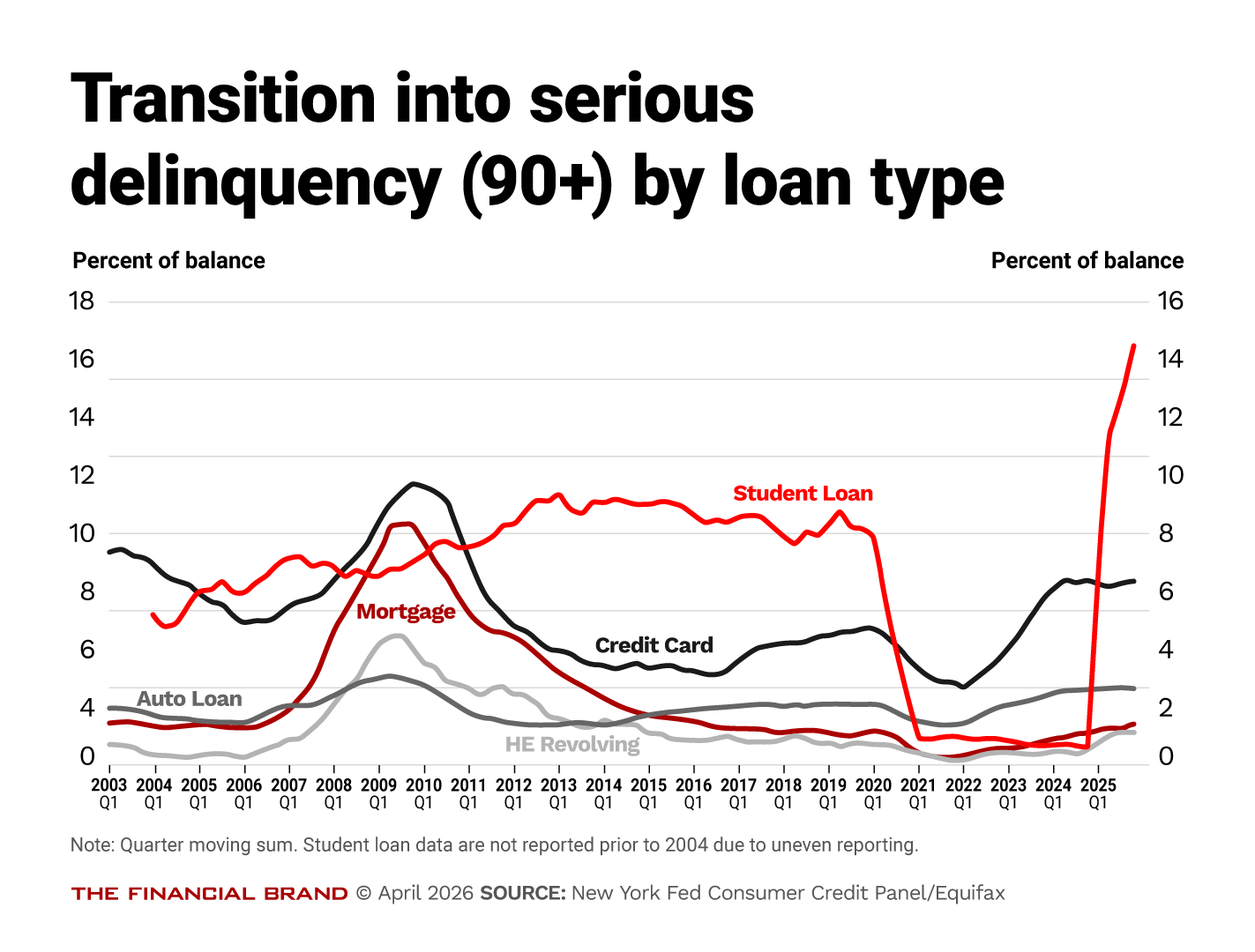
This elevated delinquency rate reflects the long-tail effects of the pandemic-era payment pause and the administrative challenges of re-introducing millions of borrowers into active repayment. A significant number of seriously delinquent loans were transferred to the Department of Education’s Default Resolution Group, masking some of the underlying stress in headline balance figures.
For banks, student loan performance matters even when they do not directly originate these loans. High student debt burdens constrain borrowers’ capacity to qualify for mortgages, auto loans, and unsecured credit products. They also affect cross-sell effectiveness and long-term customer profitability.
Key takeaway: Marketing teams should incorporate student loan data into segmentation models, especially when targeting younger consumers. Offers structured around lower initial payments, flexible repayment features, or financial planning tools may resonate more strongly with borrowers managing multiple obligations.
Credit Quality Trends Diverge
The data also shows a notable divergence between mortgage and auto lending in terms of borrower credit profiles. Mortgage originations continued to skew toward high-credit-score borrowers, with a median score of 775, indicating that lenders remain conservative in housing finance.
By contrast, auto lending showed a slight decline in median origination scores, suggesting a gradual expansion of credit access to lower-score borrowers. While this supports vehicle affordability and sales volumes, it also introduces greater credit risk into bank and captive finance portfolios.
This divergence has implications for product strategy and risk-based pricing. Mortgage portfolios may remain stable even in a softer economic environment due to their strong borrower profiles and accumulated home equity. Auto portfolios, however, are more sensitive to shifts in employment and used-vehicle prices.
What This All Means for Retail Banks Through the End of 2026
This latest household debt data signals a more fragile equilibrium. Borrowers are still active, credit demand remains steady, and balances continue to grow. At the same time, early-stage delinquency trends and the uneven performance across loan types suggest that portfolio outcomes will depend less on macro conditions alone and more on how precisely banks manage risk and customer engagement at the segment level.
For retail banks, the priority should be sharpening visibility into customer obligations beyond their own balance sheets. As consumers juggle mortgages, auto loans, student debt, and revolving balances across multiple institutions, understanding total debt exposure becomes essential for accurate underwriting, line management, and marketing decisions. Institutions that rely solely on internal data risk overestimating customer capacity and mispricing risk in a late-cycle environment.
The divergence between stable mortgage performance and softening trends in auto loans and student debt also reinforces the need for product-specific strategies. A single credit policy or acquisition approach is unlikely to perform consistently across portfolios. Instead, banks should align pricing, credit box parameters, and marketing investment with the risk and demand dynamics of each product category.
Most important: The next phase of consumer credit will be defined by segmentation rather than broad expansion. Growth opportunities remain, particularly in revolving credit and home equity, but they are increasingly concentrated among borrowers with stronger income stability and credit histories. Capturing that growth without absorbing disproportionate losses will require tighter targeting, earlier intervention when payment behavior changes, and more disciplined credit line management.


