
Your AI Strategy Will Fail Without Fixing Your Data Quality First
By Steve Cocheo, Senior Executive Editor at The Financial Brand
Simple Subscribe
Subscribe Now!
In a new report, Cornerstone Advisors’ Ron Shevlin urges executives to resist AI hype and stay focused on their core challenges.
AI is a tool, not a goal.
“Stop asking ‘What do we do with AI?,’ and/or ‘What about the risks of AI?’,” Shevlin writes. “Focus on ‘What business issues and challenges need to be addressed, and which technology can help?’ If the technologies that can help are AI-related technologies, so be it.”
Need to Know:
- The percentage of banks that have deployed GenAI going into 2026 trebled over 2025, to 49%, per the study.
- Of the rest of the banks, three in 10 plan to invest in GenAI in 2026. More than one in four will invest in agentic AI in 2026.
- The trend is even stronger among credit unions, 59% of which say they have put GenAI in place, and 17% of which are involved in agentic AI in some way. More investment in both is coming among credit unions.
Cornerstone’s report, “What’s Going On in Banking 2026,” makes liberal use of verbatim quotes from bankers and credit union execs who responded to the firm’s survey. One respondent complained about current hype in this way:
“Every company is using AI as a sales pitch. That can mean anything from machine learning to generative to agentic. It can cause confusion for people unfamiliar with AI and adds more work. When it turns out a company is selling just a smarter version of Excel, it can be frustrating.” [Emphasis added.]
Reality check: Shevlin thinks projections that AI will slash banking’s operational costs by as much as 30% to be “wildly, overly optimistic projections.”
Yet Shevlin sees further implementation of generative AI and agentic AI to have strong potential if applied intelligently, subject to a huge caveat.
The spoiler: data quality. The report warns that AI’s utility and efficacy hinges on the availability of internal data that can be readily and dependably fed into AI.
Shevlin is very skeptical about claims by both banks and credit unions that their data quality is ready and up to the standards that AI needs to produce reliable output.
The risk: wasted time and money. Absent data readiness in a given area — from credit analysis to sales and marketing — “AI initiatives related to that function will fail,” according to Shevlin. “There is no AI strategy without an effective data strategy.”
Barriers to success: Getting data quality to the right place takes commitment and money and Shevlin says “impeders” among management can sink this effort. Likewise, missing skillsets.
Shevlin says: “Many marketers in mid-size financial institutions are strong in branding and advertising, but not strong in database marketing and analytics.”
Read more:
Where Banks and Credit Unions are Placing GenAI and Agentic Bets
Banks and credit unions have their own priorities for GenAI deployment, according to the study’s findings. As shown in the pair of charts below, credit unions are looking to GenAI for help with contact centers much more than banks are, while both are prioritizing fraud management, lending, marketing and back-office operations.
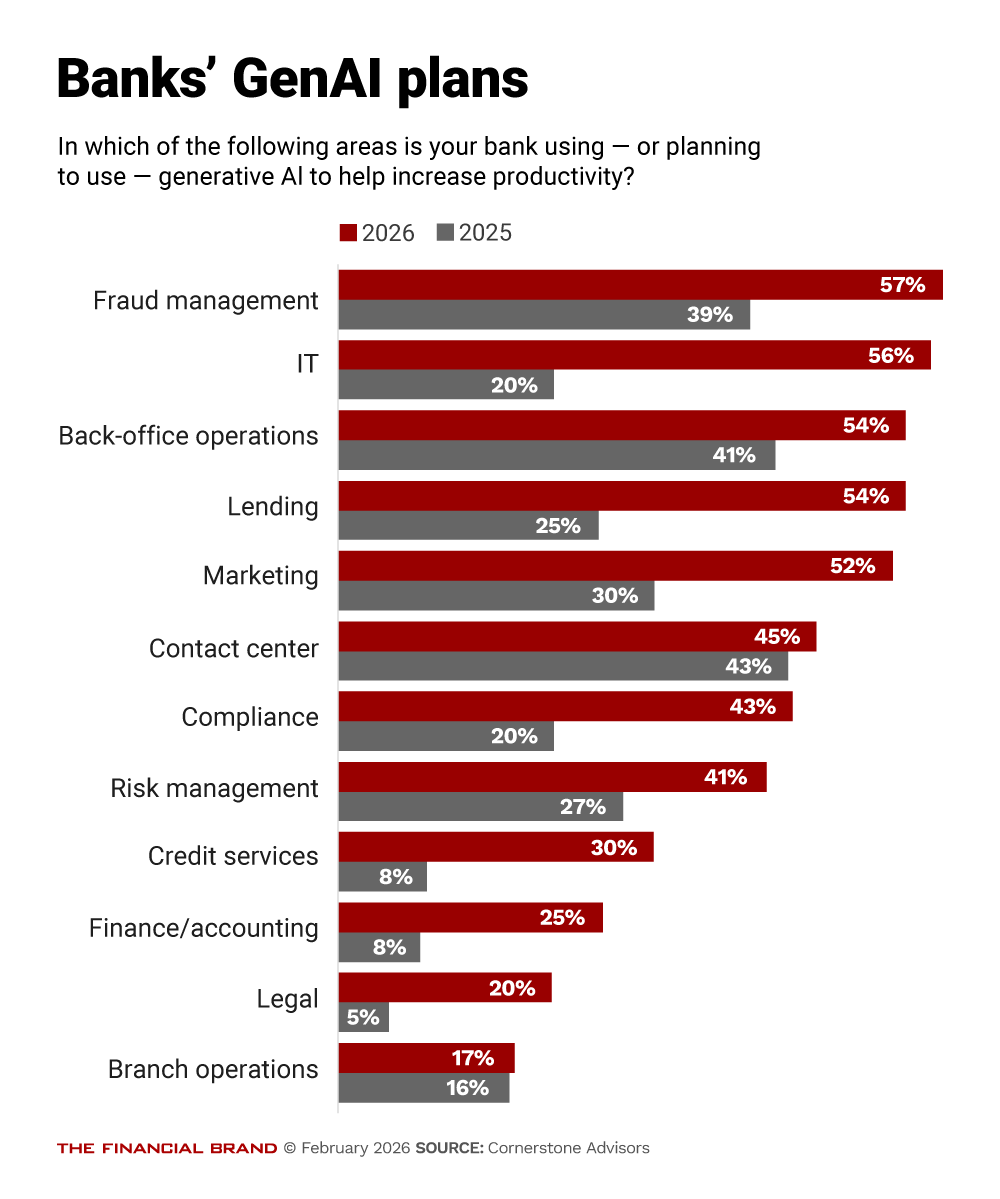
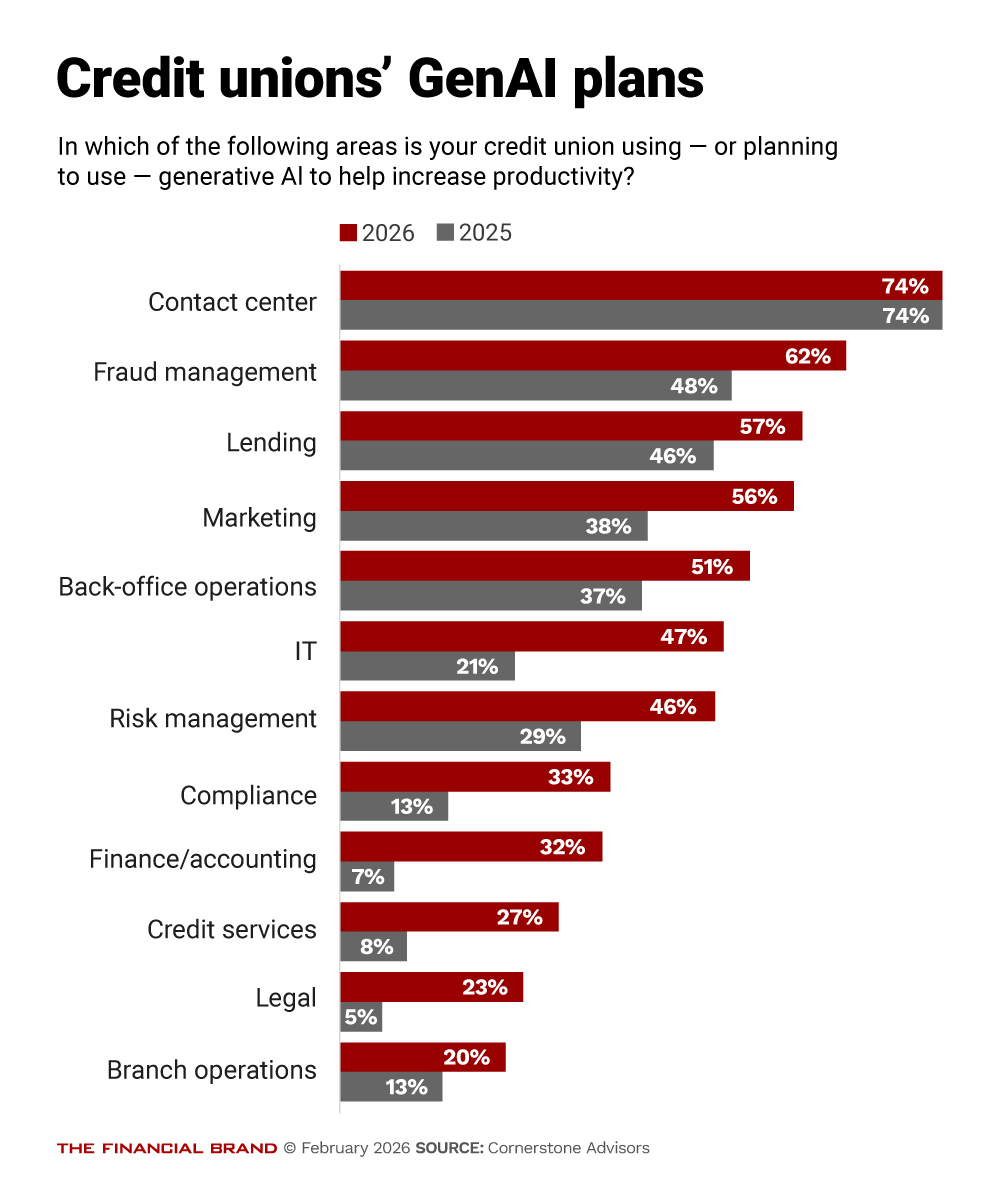
Banks lag on GenAI adoption. Notably, almost a quarter of banks — about 23% — don’t have any plans for GenAI. Only 8% of the responding credit unions were in the same place.
Holding out on agentic AI. Among banks, 53% haven’t gone beyond discussions at the board or executive level, while 13% say the tech isn’t even being discussed. Among credit unions, 44% haven’t gone beyond top-level discussions, and 14% don’t even have it on the table.
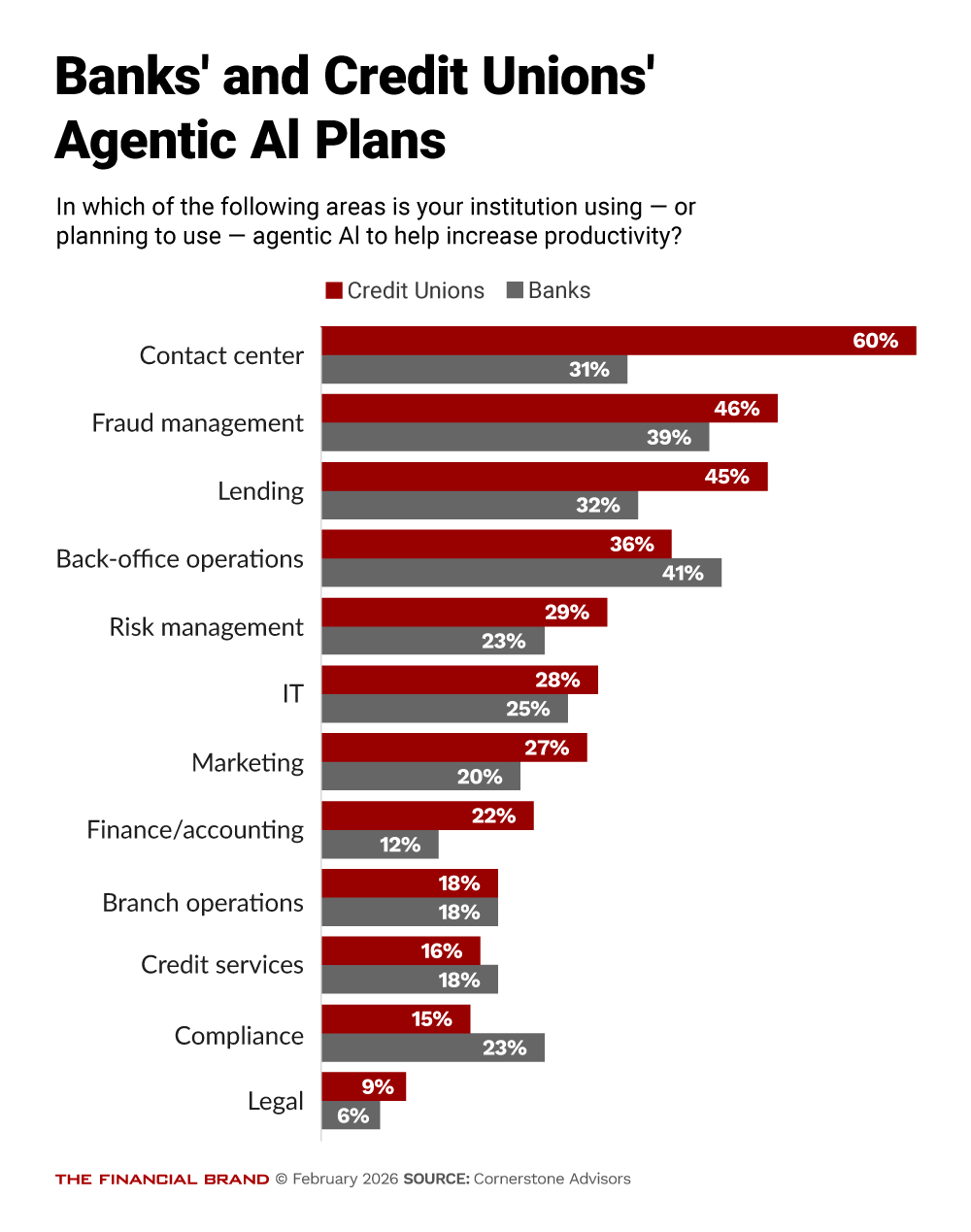
That said, as shown in the chart below, banks and credit unions that are moving ahead with agentic AI implementation share common areas of focus.
Among credit unions, the emphasis on contact centers in GenAI continues into plans for agentic. Six out of 10 credit unions involved in agentic want to bring the tech to their contact centers, versus only 31% of the banks. Credit unions are also ahead of banks in agentic AI plans for fraud management, lending and finance and accounting.
The emphasis on contact centers and similar applications for all types of AI makes sense to Shevlin.
“If there’s one thing that frustrates frontline staff (and customers), it’s waiting for an answer,” he writes. “Digging through PDFs, manuals or intranet pages doesn’t cut it anymore. AI-powered knowledge assistants are changing the game by delivering fast, accurate answers in seconds.”
The payoff: Shevlin notes that Magnifi Financial Credit Union introduced a GenAI-based assistant named “Maggie” that is saving employees as many as 10 minutes daily apiece — “a small but meaningful efficiency gain that adds up over time.”
Read more: Is AI Learning the Job Faster Than Banks Can Redefine It?
What Agentic AI Needs to Take Off in Banking
Skeptical Shevlin warns against taking agentic AI hype too seriously, saying it “isn’t as close to being ready-for-prime-time as some folks make it out to be.”
The missing, critical key: model context protocol, or MCP.
Here’s why: “It solves the problem of how AI models can access external information — like databases, APIs, file systems or real-time data sources — beyond their training data.”
Shevlin believes MCP will drive major improvements in what agentic AI can do for financial services. It can add precision, reduce hallucinations, and yield better AI personalization, Shevlin says.
Beware: MCP presents risks, including potential data leakage and compliance challenges, exposure to reverse-engineering, and unintentional bias when models inadvertently pick up discriminatory patterns.
Read next: Inside Grasshopper’s First-of-Its-Kind MCP-Powered Offering for SMBs


