
Customers Say They Want Control — But That’s Not What Drives Adoption
By Jessica Kendall, Contributor at The Financial Brand
Simple Subscribe
Subscribe Now!
Agentic AI is quickly moving from back-office capability to front-line experience in banking and wealth management. But new research from Prophet shows that adoption will be determined by more than just functionality. What matters more is how AI feels to customers.
Across 1,800 banking and wealth clients, the report shows engagement is driven by warmth, responsiveness, and personalized guidance that reflects real-life context.
The study also highlights a critical strategic choice: whether AI shows up visibly in the customer experience or operates behind the scenes. Each approach shapes trust, perceived value, and willingness to pay differently.
Key takeaway: Banks that position AI as a relational experience rather than a technology upgrade will see stronger adoption, deeper trust, and greater commercial impact.
Need to Know:
- Customers adopt AI when it feels helpful, human, and relevant to their lives. In fact, “warm, friendly interactions” are the strongest predictor of adoption, outranking security and human oversight.
- 80% of marketing and experience leaders expect to actively promote Agentic AI in their value proposition within two years.
- Account monitoring ranks among the most requested features — but one of the weakest drivers of actual behavior.
- Psychological traits and mindset are better predictors of adoption than traditional segments like age or wealth.
- Institutions that integrate AI into their brand story — not just their tech stack — are more likely to strengthen trust and differentiation
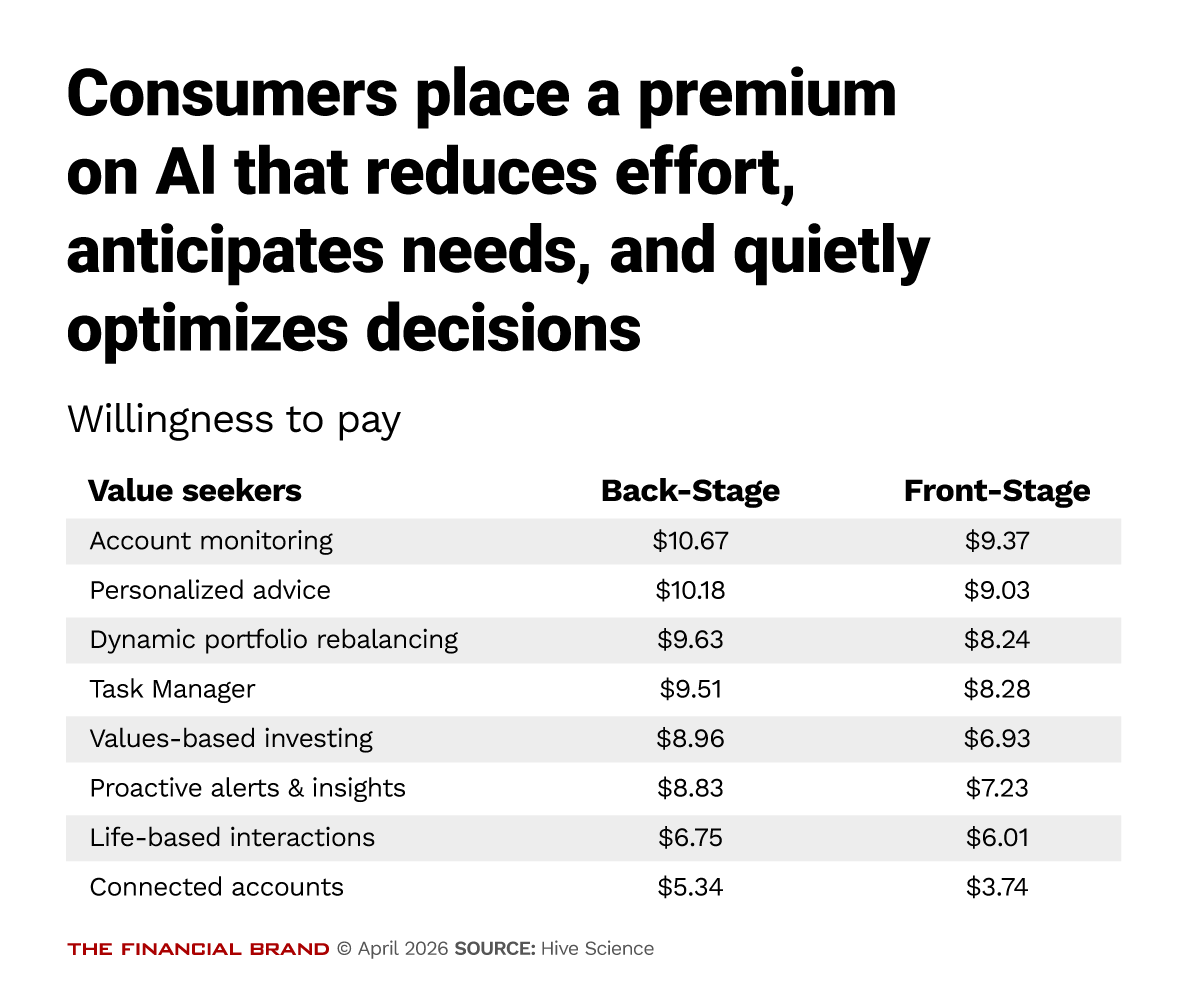
- Customers assign approximately 19% higher value to AI that works behind the scenes compared to front-facing experiences.
The Front-Stage vs. Back-Stage Decision
One of the most important strategic choices any financial institution must make is how visible AI should be in the customer experience.
Front-stage AI interacts directly with customers by answering questions, making recommendations, and executing tasks. Back-stage AI operates behind the scenes, enhancing advisor performance or automating complex processes without direct exposure.
Each model creates a different kind of value.
Front-stage experiences work best when they feel conversational and responsive. Customers who gravitate toward these interactions tend to treat AI as a social extension — something that helps them process decisions quickly and move forward with confidence.
Back-stage implementations appeal to a different mindset. These customers place higher value on stability, consistency, and human relationships. They want better outcomes without disrupting the existing experience.
While both models play a role, customers consistently assign higher value to AI that reduces effort without demanding attention. And, they are more willing to pay for these features. In fact, back-stage capabilities command roughly 19% higher willingness to pay, even when feature sets are similar.
The Shift from Features to Feelings
When ATMs spread across the U.S. in the 1980s, many expected bank tellers to disappear. Instead, the opposite happened. Banks reduced cost per branch, expanded into new markets, and repositioned human employees toward higher-value interactions.
The lesson still applies. Technology changes delivery but value is defined by how that delivery is framed and experienced.
Agentic AI introduces a similar inflection point. These systems can communicate, recommend, and increasingly act on behalf of the customer. That makes them part of a bank’s brand experience rather than just an infrastructure component.
So, it’s not surprising to see that while security, monitoring, and control rank highly in surveys, they rarely trigger adoption. Instead, customers respond to AI — whether it’s front-stage facing or back stage — that feels warm, relational, context-aware, and outcome-focused.
Why Personalization Beats Monitoring
Account monitoring, alerts, and connected accounts are widely expected. Nearly every respondent says they matter. But they rank near the bottom in predicting real engagement.
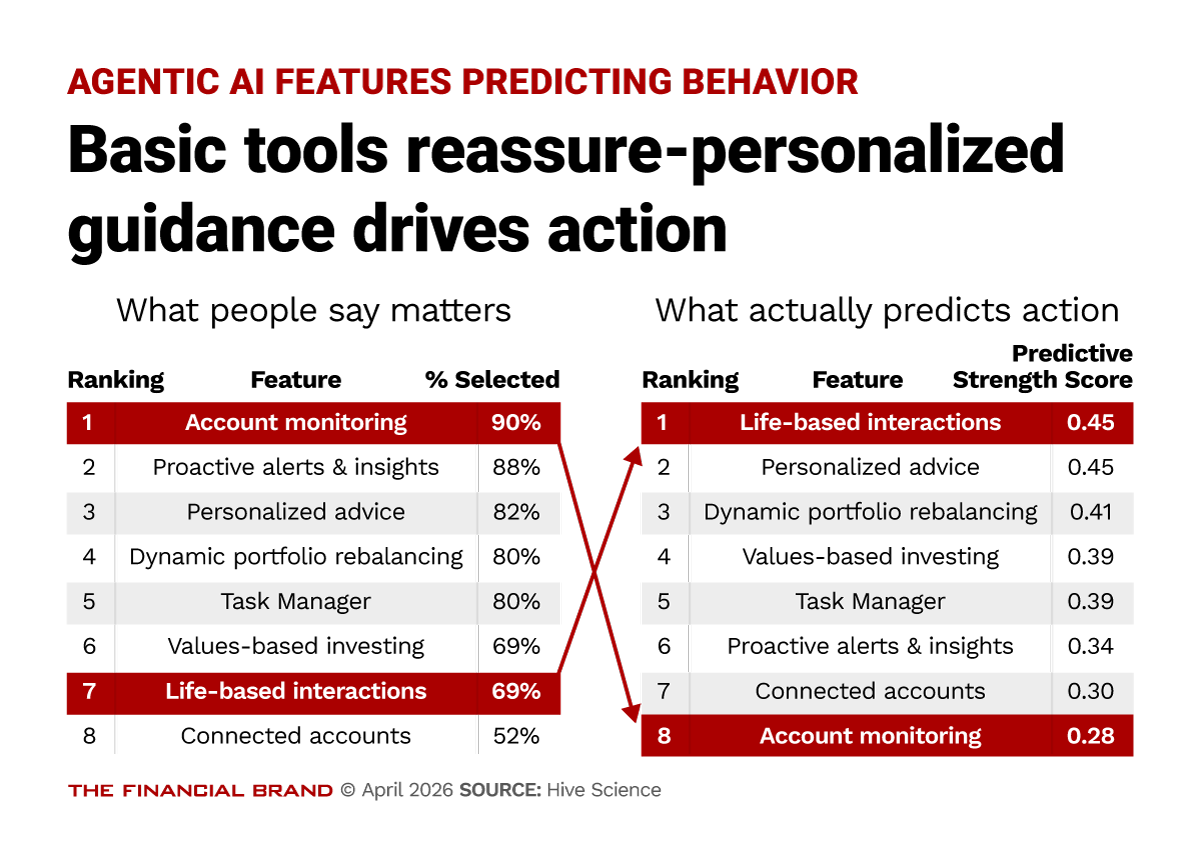
What drives action instead is guidance, especially when it reflects real-life context.
Examples include:
- Advice tied to life events rather than account activity
- Proactive recommendations that anticipate needs
- Interactions that evolve based on user behavior
Yet, many AI experiences are still positioned around visibility and control: “see everything,” “track everything,” “stay informed.” The data suggests a different approach performs better: “we’ll help you decide,” “we’ll guide you,” “we’ll take care of this.”
That shift — from information to assistance — is where adoption happens.
Segment Strategy Needs a Reset
Adoption of agentic AI reflects differences in financial complexity and wealth levels:
- At the high end of wealth, expectations are clear. Ultra-high-net-worth clients value discretion and human relationships. AI is most effective when it enhances advisor performance without becoming the focal point.
- Affluent clients are more open to direct interaction, especially for planning and decision support. They respond well to tools that balance autonomy with guidance.
- Mass affluent retail banking customers show the highest receptivity to front-facing AI — but only when it feels intuitive and supportive rather than complex or authoritative.
More interestingly, psychological traits matter more than demographics across each of these segments. Some customers seek efficiency and autonomy. Others prioritize reassurance and consistency. These differences should shape how AI behaves — and how companies design for mindset rather than personas. This will lead to better alignment between experiences and expectations.
Where Brand Strategy Comes In
Three groups stand out as the institutions seeing the strongest upside from agentic AI:
- Established institutions with strong trust positions, where AI reinforces existing credibility
- Hybrid players that successfully combine traditional strengths with modern digital experiences
- Select digital innovators that pair usability with sufficient scale and trust
What they have in common is that AI is integrated into how they present value rather than treated as a feature.
This includes clearly articulating what the AI does and why it matters, defining boundaries between human and machine roles, and creating a consistent tone and behavior across interactions.
Next steps: For brand, marketing and experience leaders, there a few practical shifts you can make today to successfully adopt AI:
- Start by rethinking how AI is framed. Leading with security, automation, or efficiency are table stakes. Instead, emphasize outcomes, guidance, and ease instead.
- Be intentional about where AI shows up. Some experiences benefit from visibility. Others create more value when they stay in the background.
- Prioritize personalization that reflects real context, not just account data. Relevance beats volume when it comes to engagement.
- And finally, align AI with the broader brand experience. Tone, responsiveness, and interaction design carry as much weight as underlying models.
The institutions that get this right will deliver a version of banking that feels more useful, more intuitive, and — somewhat ironically — more human.


