
Customer Context Is Your Missing Link Between Data and Growth
By Jessica Kendall, Contributor at The Financial Brand
Simple Subscribe
Subscribe Now!
Banks have more customer data than at any point in history, yet many still struggle to deliver experiences that feel genuinely personal.
That’s the central tension running through Personetics’ 2026 Global Banker Survey. While banking leaders overwhelmingly agree that digital engagement should drive revenue, retention, and customer growth, fewer than half of customers receive timely, context-aware recommendations based on their financial behavior.
Key insight: The report argues that the problem isn’t a shortage of technology or even AI capability. Instead, disconnected data, campaign-centric operating models, and slow execution continue to prevent banks from acting on the customer intelligence they already possess. For banking executives evaluating their digital strategy, operational excellence may create more value than another wave of digital innovation.
Need to Know:
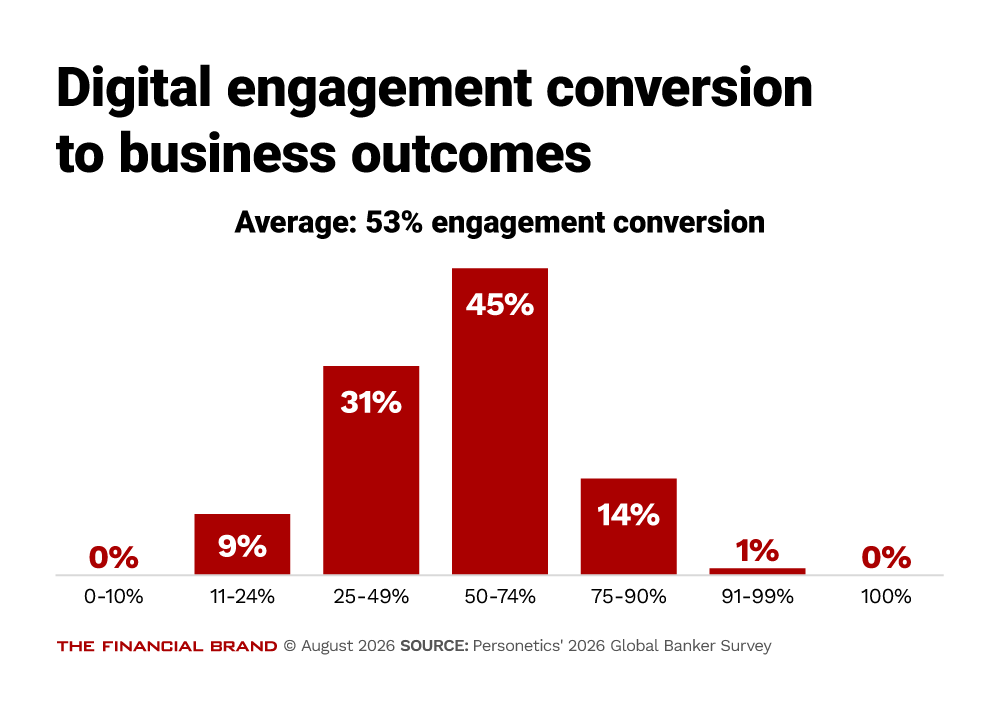
• 86% of banking executives say linking digital engagement to measurable business outcomes is very or extremely important, but institutions only convert an average of 53% of engagement into business results.
• Data fragmentation and disconnected customer profiles remain the biggest obstacles to delivering personalized experiences at scale.
• 56% cite data silos between business lines and 55% cite the inability to build a unified customer profile as their biggest personalization barriers. Only 11% blame a lack of AI or machine learning capabilities.
• Banks report that only 48% of customers receive timely, personalized recommendations based on predicted needs and real-time transaction data.
• Many banks continue to rely on marketing calendars instead of responding to customers’ real-time financial situations.
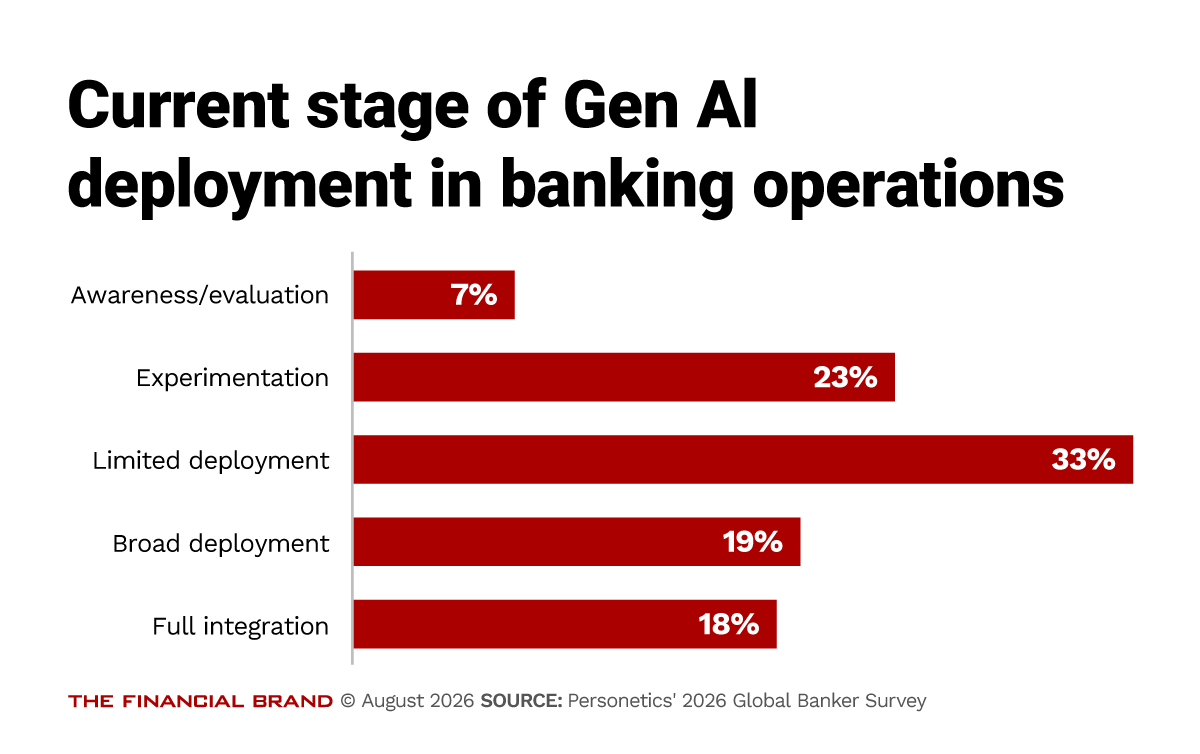
• 79% of respondents believe fully operationalized generative AI represents a significant or transformational opportunity, yet only 18% have fully integrated it into day-to-day operations.
• Slow deployment cycles prevent institutions from delivering relevant offers when customers are most likely to act. It takes the average institution 12 weeks to launch a new personalized offer or customer insight.
Digital Metrics Meet Business Reality
Banks are measuring digital success differently than they once did. Respondents place product sales and conversation rates, customer retention, and revenue growth ahead of traditional metrics like customer engagement or satisfaction when evaluating digital performance.
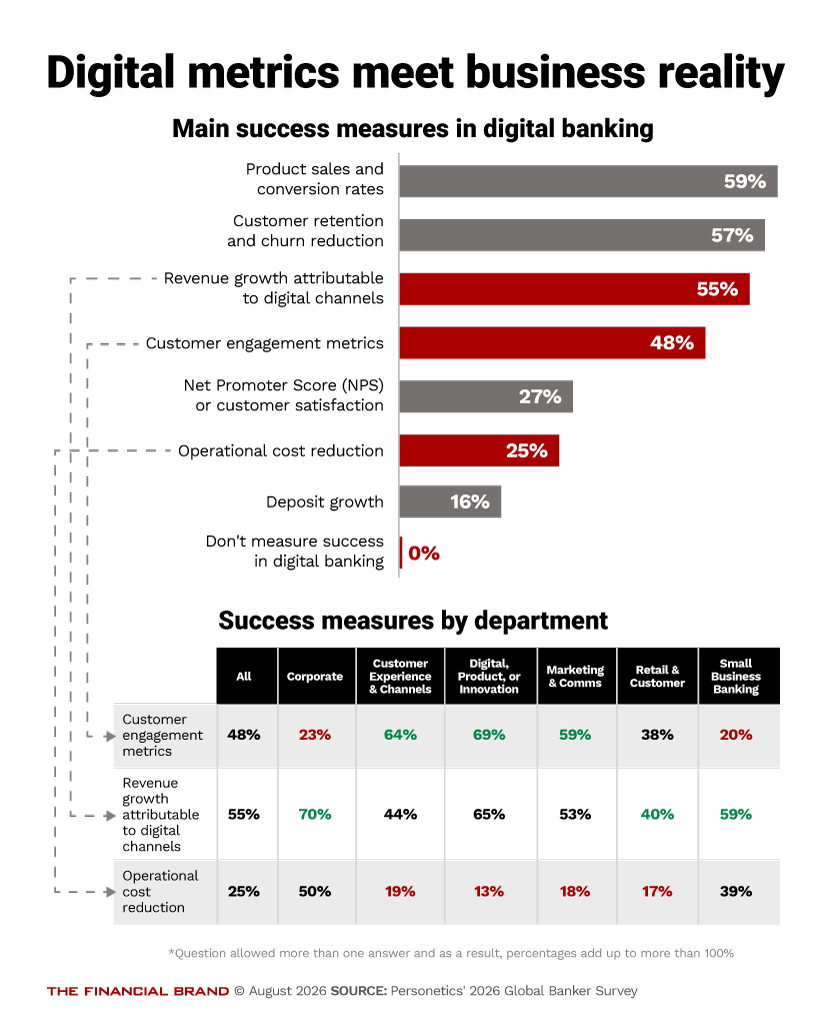
In other words, digital is increasingly expected to contribute directly to business results rather than simply improve the customer experience. But, many institutions struggle to convert digital engagement into measurable business outcomes. Nearly one-third convert fewer than half of customer interactions into outcomes such as new product adoption, cross-sell, or stronger retention, while only 14% report conversion rates above 75%.
The data also suggests that execution improves with scale. Larger institutions are considerably more likely to convert digital engagement into business value than smaller organizations, likely reflecting investments in customer data, analytics, and operational maturity. That doesn’t mean community and regional banks cannot compete. It does suggest that the institutions generating the strongest returns are treating digital engagement as an enterprise capability rather than a collection of disconnected channels.
Key insight: Opportunity lies in extracting more value from digital engagement already taking place. Every customer interaction that fails to translate into a relevant recommendation, product conversation, or stronger relationship represents unrealized potential that existing channels should already be able to support.
Personalization Still Falls Short
The report paints a consistent picture across several measures: banks understand personalization’s value but struggle to deliver it when customers actually need it.
Institutions estimate that fewer than half of customers receive relevant recommendations based on real-time financial behavior. Even more telling, only 42% of customer engagement is triggered by what customers are experiencing financially at that moment. Most outreach continues to follow internal campaign schedules instead of responding to customer events. That distinction matters.
A customer preparing to purchase a home, managing rising expenses, or accumulating savings for a large purchase creates a natural opportunity for relevant guidance or product recommendations. Messages delivered weeks later through a scheduled campaign often miss that moment entirely.
The survey reinforces this point when examining campaign performance. Respondents identify poor alignment with customers’ financial needs and insufficient personalization as the leading reasons campaigns fail to convert. Timing, channel selection, and analytics trail behind relevance itself.
Key insight: Better campaign performance may depend less on increasing campaign volume and more on improving customer context. Banks already possess substantial customer data. The challenge is transforming that information into timely, relevant interactions that feel genuinely helpful rather than promotional.
The Foundation Matters More Than AI
Many organizations assume better AI will solve personalization challenges. The survey points somewhere else.
When respondents identify their biggest barriers to contextual customer engagement, AI capability ranks near the bottom. Instead, data silos, fragmented customer information, regulatory requirements, legacy processing infrastructure, and disconnected marketing technology dominate the list.
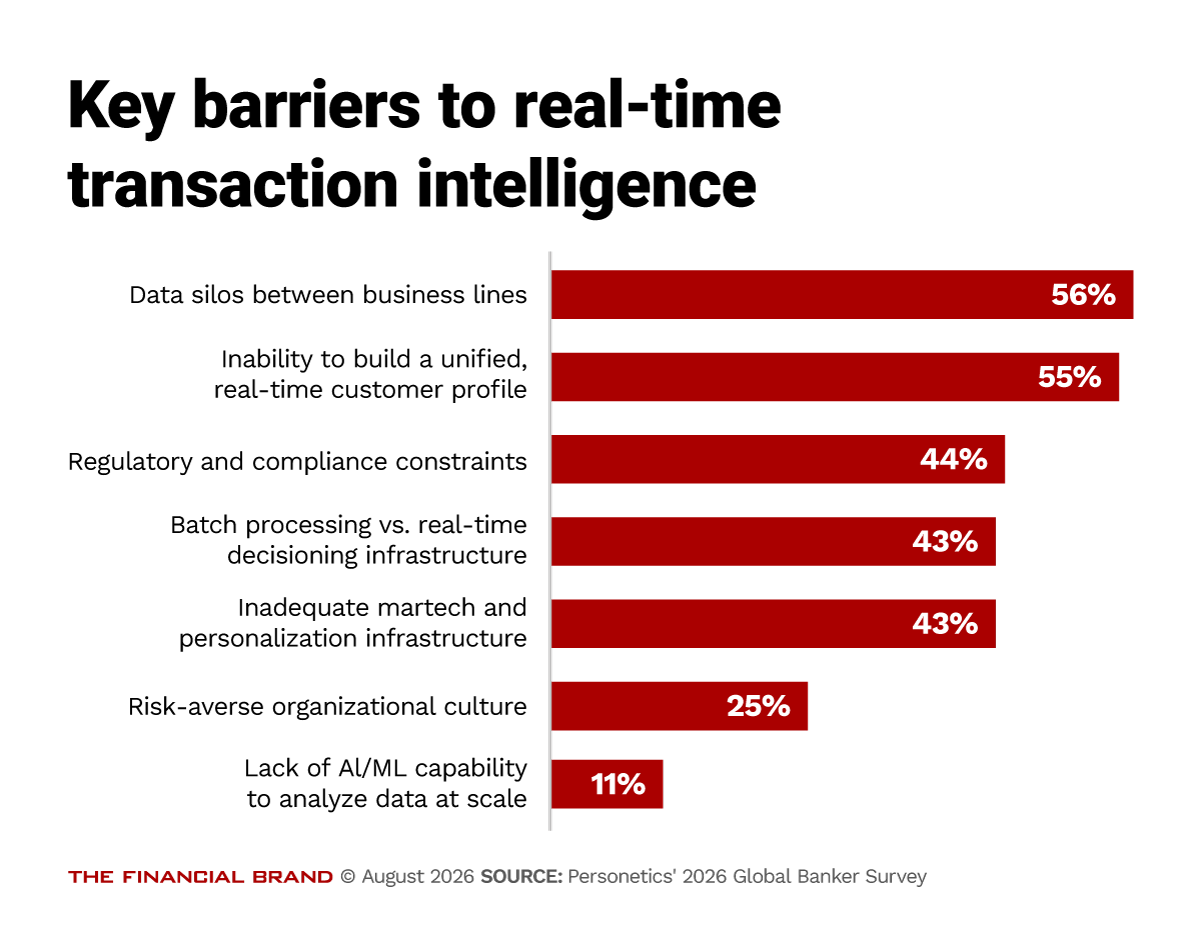
Those same operational constraints appear throughout the report. For instance, launching a new personalized experience takes an average of 12 weeks. Data integration challenges and compliance reviews are cited more frequently than technology limitations or lack of internal expertise.
Key insight: Many institutions have ideas they cannot operationalize quickly enough to capitalize on customer moments. Why? The survey suggests executives may achieve greater returns by addressing foundational capabilities first: creating unified customer profiles, improving data accessibility across business lines, reducing approval bottlenecks, and enabling business teams to launch experiences without lengthy development cycles.
These investments benefit every customer interaction, regardless of which personalization engine or AI application ultimately sits on top.
AI Will Reward Operational Readiness
Generative AI is one area where industry optimism is unmistakable.
Nearly 8 in 10 respondents describe fully operationalized GenAI as either a significant or transformational opportunity for banking. At the same time, only 18% report full operational integration, while most institutions remain in experimentation or limited deployment.
The barriers reveal why. Respondents point first to confidence in AI outputs, including accuracy, reliability, and regulatory compliance. Technology integration and data quality follow. Interestingly, very few identify internal AI expertise as the limiting factor.
It’s clear that AI innovation challenges are not separate from personalization challenges. Both depend on the same operational foundation.
Banks with fragmented customer data, disconnected systems, and slow governance processes will encounter the same obstacles regardless of how sophisticated their AI models become. Conversely, institutions that invest in trusted data, integrated customer intelligence, and streamlined execution create an environment where AI can generate measurable business value rather than isolated pilot projects.
Bottom line:Most institutions already recognize where the industry is heading. The competitive advantage will come from building the operational capabilities that consistently translate digital engagement into stronger customer relationships and better business performance.


