
Why the Future of Commercial Payments Is Different Than What Banks Expected
By Jessica Kendall, Contributor at The Financial Brand
Simple Subscribe
Subscribe Now!
Commercial payments are evolving, but not in the way many expected. According to Citizens’ 2026 Payment Trends survey of more than 300 treasury and finance leaders at midsize companies, businesses are looking beyond payment speed alone.
They want payment capabilities that fit naturally into their existing workflows, improve financial visibility, strengthen cash management, and reduce operational complexity. Real-time payments continue to gain momentum, APIs are making embedded finance more practical, and businesses increasingly rely on banks — not fintechs — to connect these capabilities into their treasury operations. At the same time, traditional payment methods like checks remain relevant because customer and supplier preferences continue to shape payment decisions.
Key insight: Winning commercial relationships depends less on offering every new payment innovation and more on delivering flexibility, integration, and trusted guidance that helps businesses manage increasingly complex payment ecosystems.
Need to Know:
- Businesses increasingly evaluate payment solutions based on how well they integrate into existing treasury workflows.
- Banks remain the preferred partner for core payment services despite growing fintech competition. 80% of businesses implementing embedded finance partner with banks, compared with 68% partnering with fintechs.
- 76% of midsize companies use bank APIs to embed payment processes into their ERP systems.
- Real-time payments continue expanding, but payment choice remains just as important as payment speed.
- 97% of companies using instant payments utilize the RTP network.
- Embedded finance is becoming a practical expectation rather than an emerging capability.
- AI-powered fraud prevention appears to reduce payment fraud, even if many businesses no longer recognize it operating behind the scenes.
- Companies using AI or machine learning for fraud mitigation reported fraud rates of 40%, compared with 46% across all respondents.
Payments Must Fit Existing Workflows
For years, conversations about commercial payments centered on digitization. Organizations wanted to replace paper with electronic processes, accelerate settlement, and eliminate manual work. Those priorities remain, but the Citizens survey suggests the conversation has matured.
Today, treasury leaders are less concerned with adding another payment option than with making payments work seamlessly within the systems they already use.
Key insight: More than half of survey respondents said digitization has improved cash management efficiency, financial visibility, and cash flow forecasting. Among those benefits, improved cash management showed the largest year-over-year increase, suggesting businesses increasingly view payment modernization as an operational advantage rather than simply a technology upgrade.
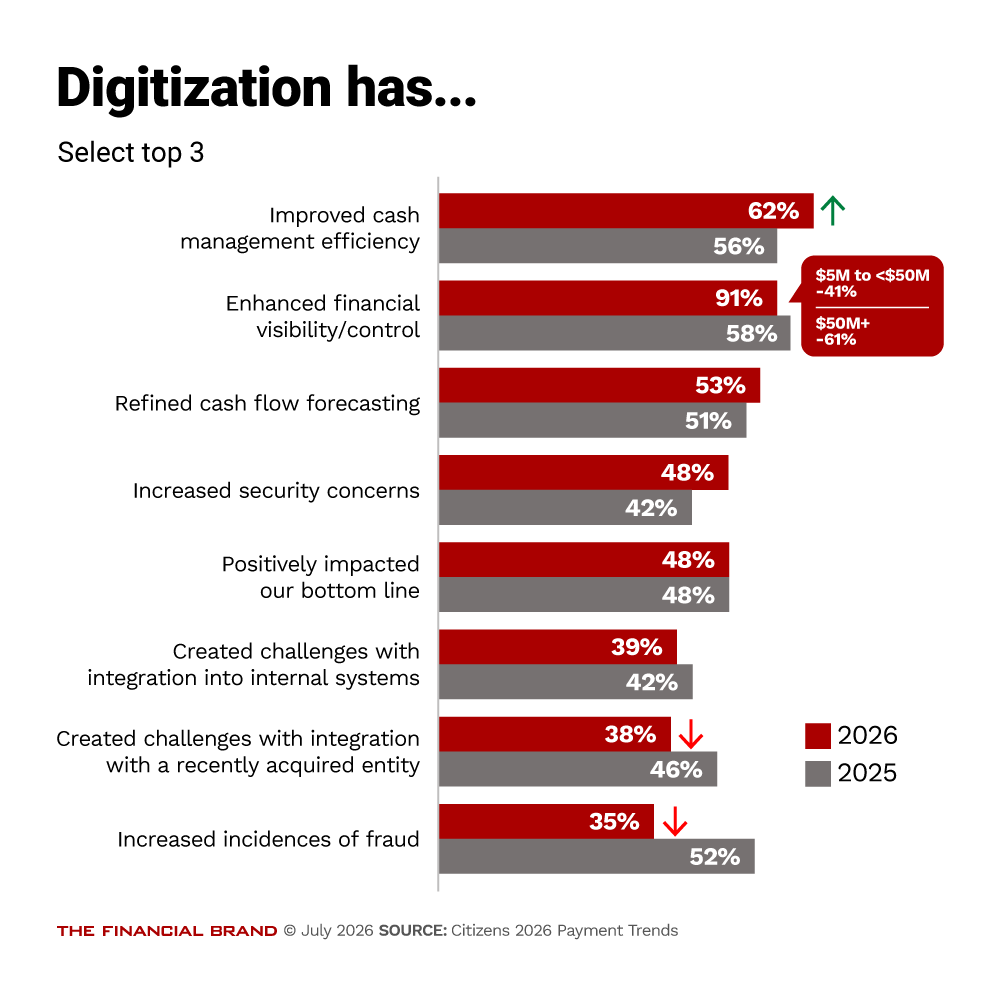
That shift explains why APIs have become so important. Nearly three-quarters of respondents now use APIs provided by their financial institution to embed payment capabilities directly into enterprise resource planning (ERP) systems. Instead of asking treasury teams to log into separate banking portals, businesses increasingly expect payment initiation, reconciliation, reporting, and cash visibility to exist within the software they already use every day.
This represents an important change in how commercial clients evaluate treasury relationships. Businesses are no longer comparing individual payment products. They’re evaluating how well banks fit into broader financial operations.
The institutions creating the most value will be those that reduce friction between payments, treasury management, accounting, and forecasting instead of treating each capability as a separate service.
Faster Payments Matter, But Flexibility Matters More
Real-time payments continue gaining traction, although the broader payment landscape has become more nuanced.
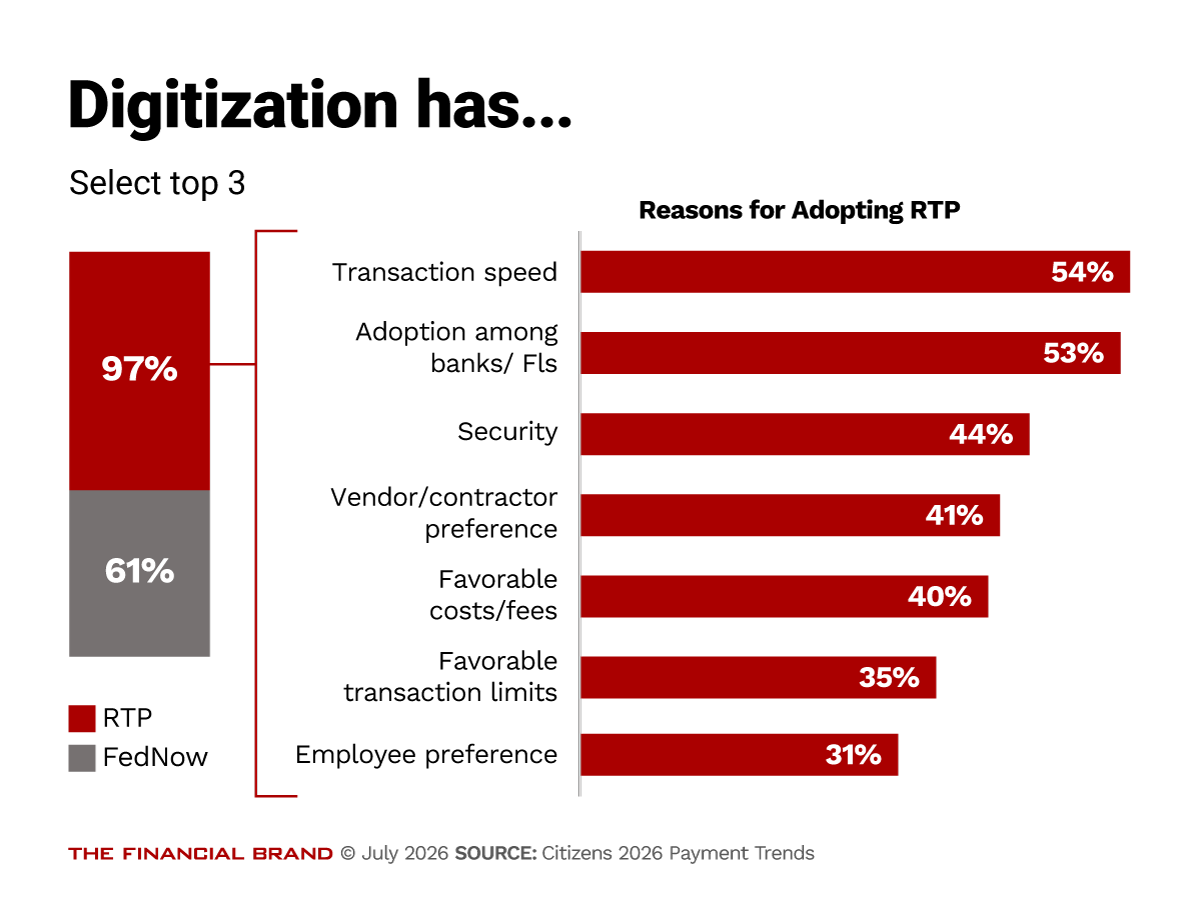
Among businesses using instant payments, the RTP network strengthened its leadership position, with adoption climbing to 97% of respondents using instant payment capabilities. Survey participants cited transaction speed and increasing bank enablement as the primary reasons for adopting RTP.
But the report also highlights an important reality that sometimes gets overlooked during conversations about payment modernization: businesses rarely standardize on a single payment method.
Checks remain surprisingly resilient. While only a small percentage of respondents described checks as critical, nearly two-thirds said they still provide meaningful value for paying vendors, contractors, and business partners. Vendor preferences remain one of the biggest reasons organizations continue issuing paper checks, particularly among larger midsize companies.
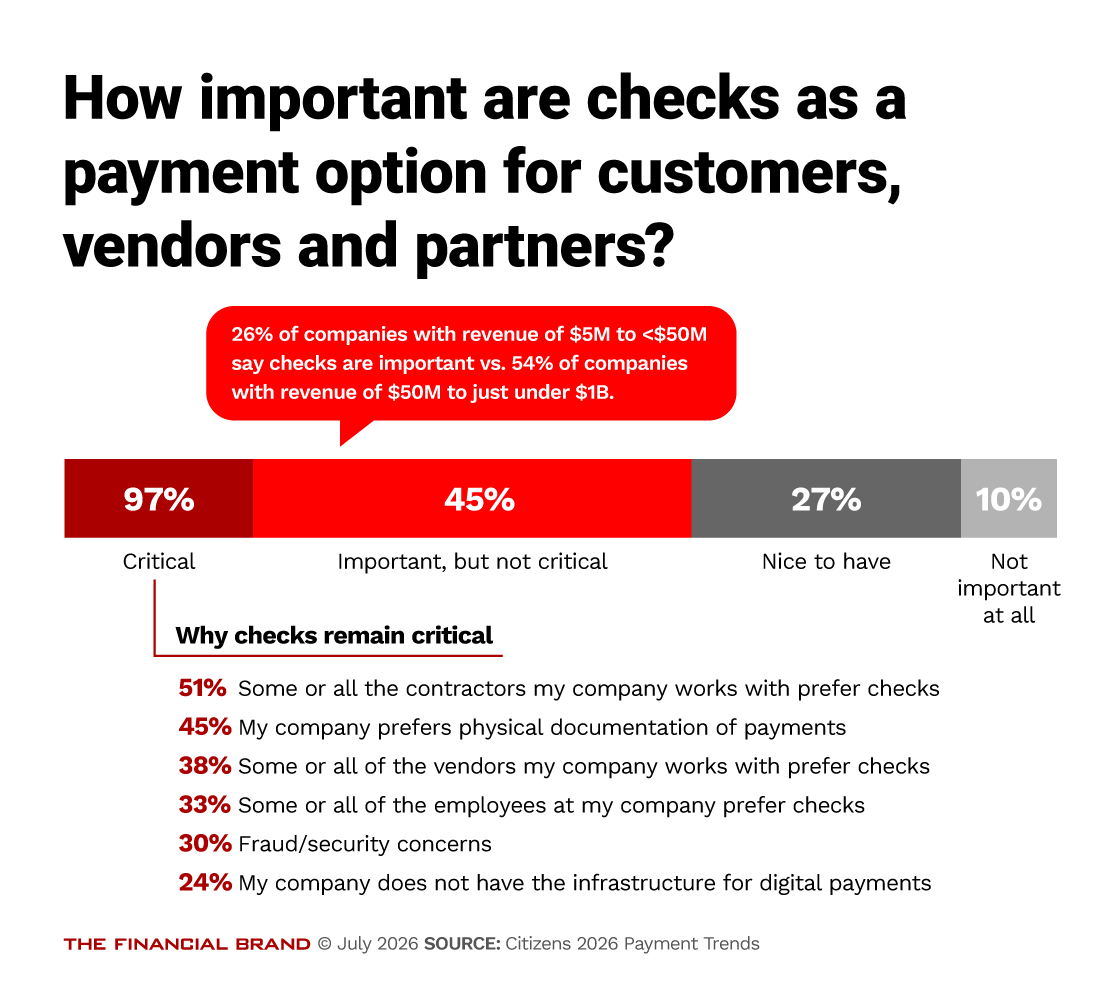
Key insight: Rather than viewing this as resistance to innovation, banks should see it as evidence that commercial payments are driven by business relationships. Companies don’t always choose the fastest payment option. They choose the option their counterparties are willing to accept.
That means successful payment strategies increasingly emphasize flexibility instead of replacement. Treasury leaders want the ability to initiate ACH payments, RTP transactions, cards, checks, and emerging payment rails from a single workflow while allowing vendors and customers to receive payments through their preferred channels.
Offering more payment choices without adding operational complexity has become a competitive differentiator.
Banks Still Hold the Advantage
Predictions that fintech companies would dominate commercial payments have become a familiar narrative over the past decade. The Citizens survey tells a more balanced story.
Businesses continue relying primarily on banks for many core payment services, particularly sending and receiving payments. More than six in ten respondents said they use banks rather than third-party providers for these functions.
The same pattern appears in embedded finance.
Among organizations embedding payment capabilities into business systems, banks remain the preferred implementation partner. Eighty percent reported working with financial institutions, compared with 68% partnering with fintech providers. Only a small percentage said they were building embedded finance capabilities internally.
These findings suggest that trust remains one of banks’ strongest competitive advantages.
Key insight: Commercial clients aren’t simply looking for payment technology. They’re looking for partners capable of connecting payments, treasury services, fraud controls, and financial expertise into cohesive operating environments.
For retail banks expanding commercial banking relationships, this creates an opportunity to strengthen customer loyalty by positioning treasury services as part of broader operational transformation. APIs, embedded finance, and integrated payment experiences become more valuable when paired with advisory support that helps businesses determine which payment methods best fit different use cases.
Fraud Prevention Is Becoming Less Visible
Payment fraud remains a significant concern for treasury leaders. Two-thirds of respondents expressed concern about fraud, and nearly half experienced payment fraud during the previous year.
The survey’s most interesting finding, however, involves artificial intelligence.
Reported use of AI and machine learning for fraud mitigation has declined steadily over the past three years. Today, only 43% say they use machine learning and AI to mitigate fraud, compared to 51% in 2025. At first glance, that appears to suggest organizations are stepping away from intelligent fraud detection. But, the results tell a different story.
Companies using AI-powered fraud mitigation reported lower fraud incidence than the overall survey population.
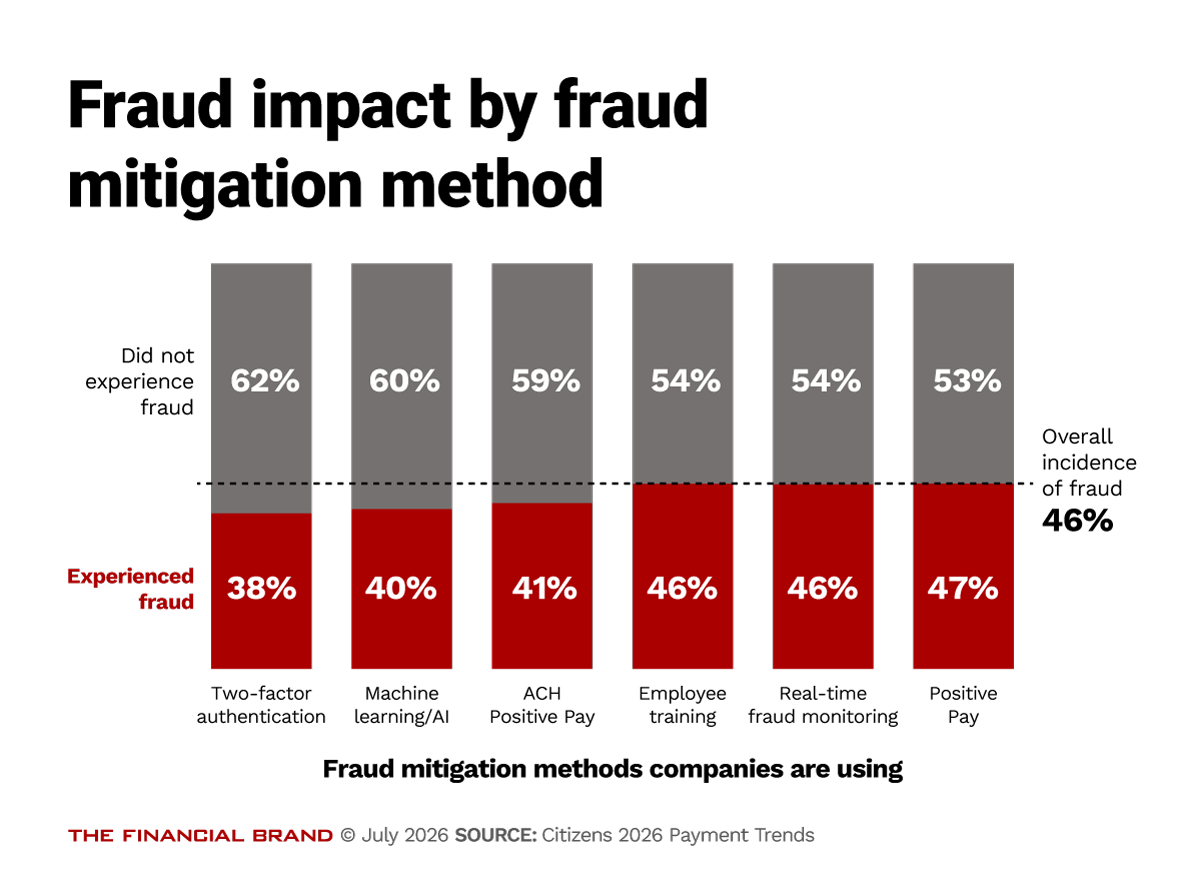
Citizens suggests many businesses may simply be less aware that AI is operating behind the scenes because fraud monitoring increasingly comes bundled into banking services and outsourced technology platforms.
As fraud prevention becomes more automated, commercial clients may spend less time evaluating specific detection technologies and more time evaluating outcomes. Banks that deliver effective protection without disrupting payment experiences can create meaningful differentiation even when customers rarely see the technology working.
Bottom line: Ultimately, the report points to a broader shift in commercial banking. Businesses are moving beyond conversations about faster payments toward conversations about better payment experiences. They want payment capabilities that integrate into existing workflows, support multiple payment options, strengthen visibility, and reduce operational effort.
For banks, that means the future of commercial payments won’t be defined by offering the newest rail or the fastest transaction. It will be defined by helping businesses move money more intelligently within the way they already work.


