
Why Banks Are Leaving Revenue on the Table with Open Finance
By Jessica Kendall, Contributor at The Financial Brand
Simple Subscribe
Subscribe Now!
Open banking infrastructure is now an active competitive variable in both retail and commercial banking. Two new industry reports make this same essential argument from different directions:
Open banking is generating real revenue for the institutions that treat it as a growth strategy and increasing competitive pressure on those that don’t.
A new report from Cornerstone Advisors and Ninth Wave zeroes in on six commercial banking revenue opportunities that open banking enables, from cash flow-based lending to direct fee income from API access. Mastercard’s 2026 State of Open Finance report provides the broader market context: 75% of executives say open finance has directly grown their revenue, and companies are missing an estimated 4.6% in additional annual revenue because they can’t access necessary consumer permissions.
Together, the two reports form a clear picture: The institutions that get the data infrastructure right and earn consumer trust will define the next phase of financial services competition.
Need to Know:
- Open finance leaders are translating connectivity into revenue, not just compliance or customer experience improvements. The majority of finance executives globally say open finance initiatives have directly improved their organization’s revenue levels in the past year. Among those most actively investing in open finance, that figure rises to 84%.
- Open banking is scaling rapidly, with API calls projected to reach 722 billion by 2029, up from 137 billion in 2025.
- Customers will leave for better data experiences. In the consumer market, 76% say they would switch providers for digital features that make managing finances easier — and more than half already have. Commercial customers are showing similar behavior, maintaining relationships across multiple providers.
- Lending, payments, and financial management are the highest-impact use cases for near-term ROI.
- Consumer trust is the gating factor for open finance adoption. The top barrier to open finance revenue growth is consumers withholding data permissions.
Open Banking Revenue Is No Longer Theoretical
Both reports agree on a point that banks have debated for years: open finance is now producing measurable revenue, not just strategic potential.
The Mastercard report quantifies the impact at a macro level. Three-quarters of executives say open finance initiatives have already driven revenue growth, with an average uplift of 3.3% across organizations.
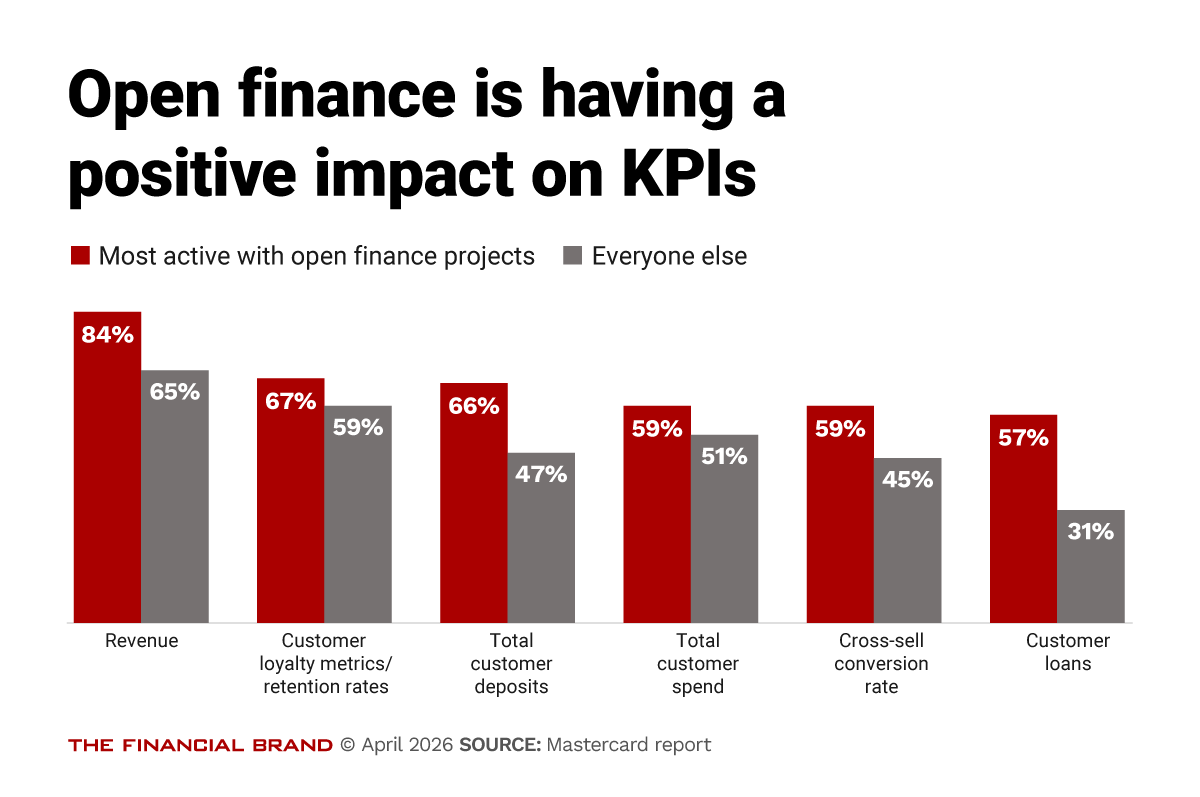
Cornerstone’s report complements this by showing where that revenue is coming from. Instead of treating open banking as a single capability, it breaks monetization into six distinct opportunities, including lending, payments, data aggregation, and API-based fee income.
Taken together, the message is more precise: revenue is not coming from “open banking” as a concept. It is coming from specific use cases that embed financial data into products customers use every day.
Why this distinction matters. The Mastercard data shows that many institutions are already seeing financial impact. The Cornerstone analysis explains why some are seeing more than others: they are further along in translating connectivity into product-level execution.
Three Use Cases that Drive Real Returns
Despite different lenses — commercial monetization versus global market dynamics — both reports converge on the same high-impact use cases.
1. Lending. Cornerstone highlights cash flow–based underwriting as a structural shift, replacing static financial statements with real-time transaction data. Mastercard reinforces the demand side: consumers are willing to share data specifically to improve loan approvals and access better terms.
The alignment is hard to miss. One report shows supply (better underwriting) while the other shows demand (willingness to share data for better outcomes). Together, they point to a near-term growth lever that is both technically feasible and customer-supported.
2. Payments. Cornerstone frames payment initiation as a way to reduce friction and generate transaction-based revenue. Mastercard’s report shows that faster, simpler payment experiences are among the top drivers of customer satisfaction and switching behavior.
Again, the pattern holds: operational efficiency on one side, customer expectation on the other.
3. Financial management and aggregation. . Cornerstone focuses on multi-bank visibility and data aggregation as monetizable services, while Mastercard shows that consumers increasingly expect consolidated views, personalized insights, and real-time financial guidance.
Across both reports, the highest-performing use cases share three traits: real-time data access, clear customer value, and a direct path to revenue.
Customer Expectations Will Reset the Market
Where the Cornerstone report emphasizes opportunity, the Mastercard report introduces urgency based on customer behavior.
Consumers are actively seeking out new financial experiences that offer them the types of use cases they want. More than three-quarters would switch providers for better digital features or more control over their data. A significant portion already has.
That behavior mirrors what Cornerstone describes on the commercial side. Businesses are increasingly maintaining relationships across multiple institutions, often turning to fintech providers for specific capabilities like lending or payments.
Key takeaway: In both segments, fragmentation is increasing — and it is driven by unmet expectations. Open finance is enabling new products but it’s also reshaping how customers evaluate providers. Speed, integration, and relevance are becoming baseline expectations rather than differentiators.
Data Access Is The Constraint — Not The Use Case
Both reports identify the same bottleneck: access to usable, permissioned data.
Mastercard’s report quantifies the impact. Organizations estimate they are losing 4.6% of potential annual revenue because they cannot obtain the necessary customer permissions. Cornerstone points to integration complexity, inconsistent data access, and reliance on fragmented systems as barriers to execution.
Put together, it’s clear the industry struggles to consistently access and operationalize the data required to execute open finance innovation.
This is where infrastructure decisions start to matter more than product strategy. API reliability, data standardization, and integration models directly determine how quickly banks can launch and scale revenue-generating capabilities.
Trust Is the Deciding Variable
If infrastructure determines what banks can do, trust determines what customers will allow them to do.
The Mastercard report calls out that a primary reason organizations fail to capture open finance value is that customers withhold data permissions. But the nuance is important.
Most customers are not opposed to sharing data. In fact, 89% say they are willing in principle. The largest segment simply wants clarity on how their data will be used and what they will receive in return.
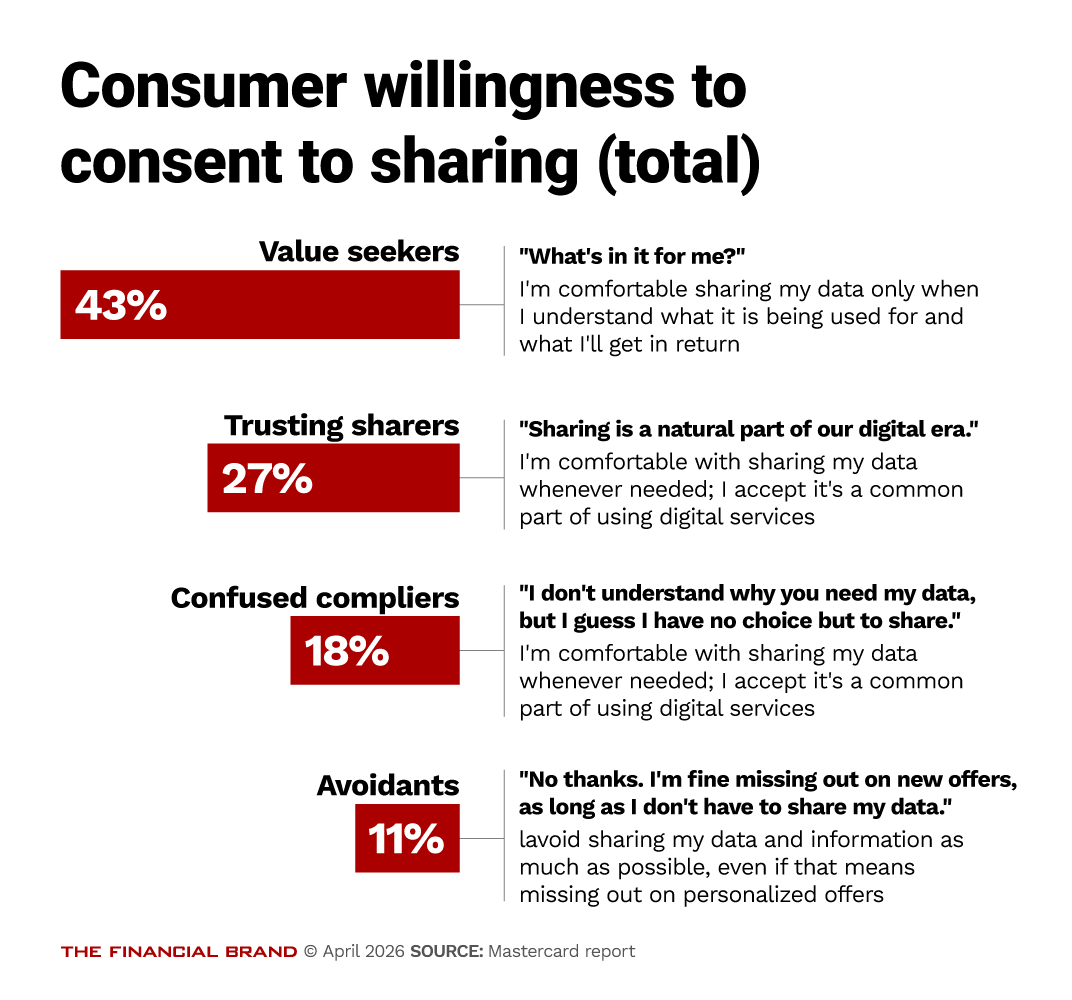
That aligns with Cornerstone’s findings in a different way. The most successful commercial use cases — lending, payments, aggregation — are also the ones where the value exchange is easiest to explain. Faster approvals, easier payments, consolidated cash views.
The connection between the two reports is subtle but points to the need for clear use cases where the value of sharing data is immediately visible. Banks that struggle with consent are often struggling with value articulation.
5 Steps to Accelerate Open Finance Value
The combined insights from both reports point to a focused set of priorities. Here are 5 things banks should consider now on their open finance journey:
1. Concentrate on use cases with direct revenue impact. Lending, payments, and financial management consistently deliver both customer value and measurable returns.
2. Embed data into core workflows. The advantage of open finance is speed and context. That only materializes when data flows directly into underwriting, payments, and engagement systems.
3. Redesign the consent experience around articulating the value consumers will receive in exchange for consent. Customers are willing to share data when the benefit is clear, immediate, and relevant to their needs.
4. Invest in API and data infrastructure with the same urgency as front-end innovation. Execution speed depends on it.
5. Treat trust as an operating principle. Transparency, control, and security directly influence how much data customers are willing to share — and therefore how much value banks can create.


