
Embed Investing Inside Everyday Banking Apps to Win Younger Customers
By Jessica Kendall, Contributor at The Financial Brand
Simple Subscribe
Subscribe Now!
For years, financial institutions competed for younger consumers through checking accounts, rewards programs, and digital experiences. New research from Cornerstone Advisors, commissioned by InvestiFi, suggests those tactics are becoming less effective because consumer behavior has fundamentally changed.
Zillennials, the combined generational group of Gen Z and Millennials, increasingly move money between banking, investing, and digital asset platforms as part of their everyday financial routines. Fintech companies have capitalized on those behaviors by creating experiences that make investing as simple as making a payment. As a result, money that once remained in checking and savings accounts is flowing elsewhere.
This shift is less about abandoning traditional financial institutions and more about changing consumer expectations. Younger consumers want a single destination where they can spend, save, and invest without moving between disconnected applications.
Key takeaway: Rather than chasing every emerging trend, banks and credit unions should focus on integrating investing into their existing digital experiences and reducing friction between accounts. Institutions that simplify how customers manage and grow their money may be better positioned to strengthen relationships with younger consumers before fintechs become their default financial destination.
Need to Know:
- Consumer money movement habits are changing. Younger consumers increasingly shift funds between banking and investing platforms as part of their normal financial routines.
- Fintechs are winning through product design. Simplicity, embedded education, and seamless money movement matter more than marketing campaigns.
- 56% of new checking and payments accounts in 2025 were opened with fintechs, up from 49% in 2024.
- Nearly two-thirds of Zillennial investors moved money out of deposit accounts during the past year to fund investment activity.
- Banks need integrated experiences. 67% of Zillennials say an all-in-one app that combines banking and investing would make a credit union more compelling.
- Partnerships can accelerate progress. Few institutions can build these capabilities internally at the speed consumers expect.
Zillennials Manage Money Differently
Financial institutions have spent decades trying to become consumers’ primary financial providers. Historically, that meant winning the checking account relationship. If an institution could capture a paycheck deposit, it often gained opportunities to deepen relationships over time through lending, credit cards, and wealth management products.
Cornerstone Advisors suggests that formula is becoming less reliable with younger consumers. The firm’s latest research found that fintechs captured 56% of all new checking and payments accounts in 2025, up from 49% the year prior. Meanwhile, many Gen Z and Millennial consumers increasingly rely on fintechs and digital banks for their day-to-day financial needs.
The reason is not dissatisfaction with traditional financial institutions. It is changing consumer behavior. Consumers have become more active managers of their money, regularly moving funds between accounts based on their immediate goals. Money that once remained in checking and savings accounts is now routinely transferred into stocks, exchange-traded funds, robo-advisory accounts, and digital assets.
Key takeaway: Today, banking providers need to create enough value that customers choose to keep more of their financial activities within a single relationship. Institutions that continue to treat payments, savings, and investing as separate product lines may struggle to meet those expectations.
Investing Is Now Part of Everyday Banking
Today, nearly half of Zillennials own stocks or ETFs through a digital application, while another 22% use robo-advisory through a digital app.
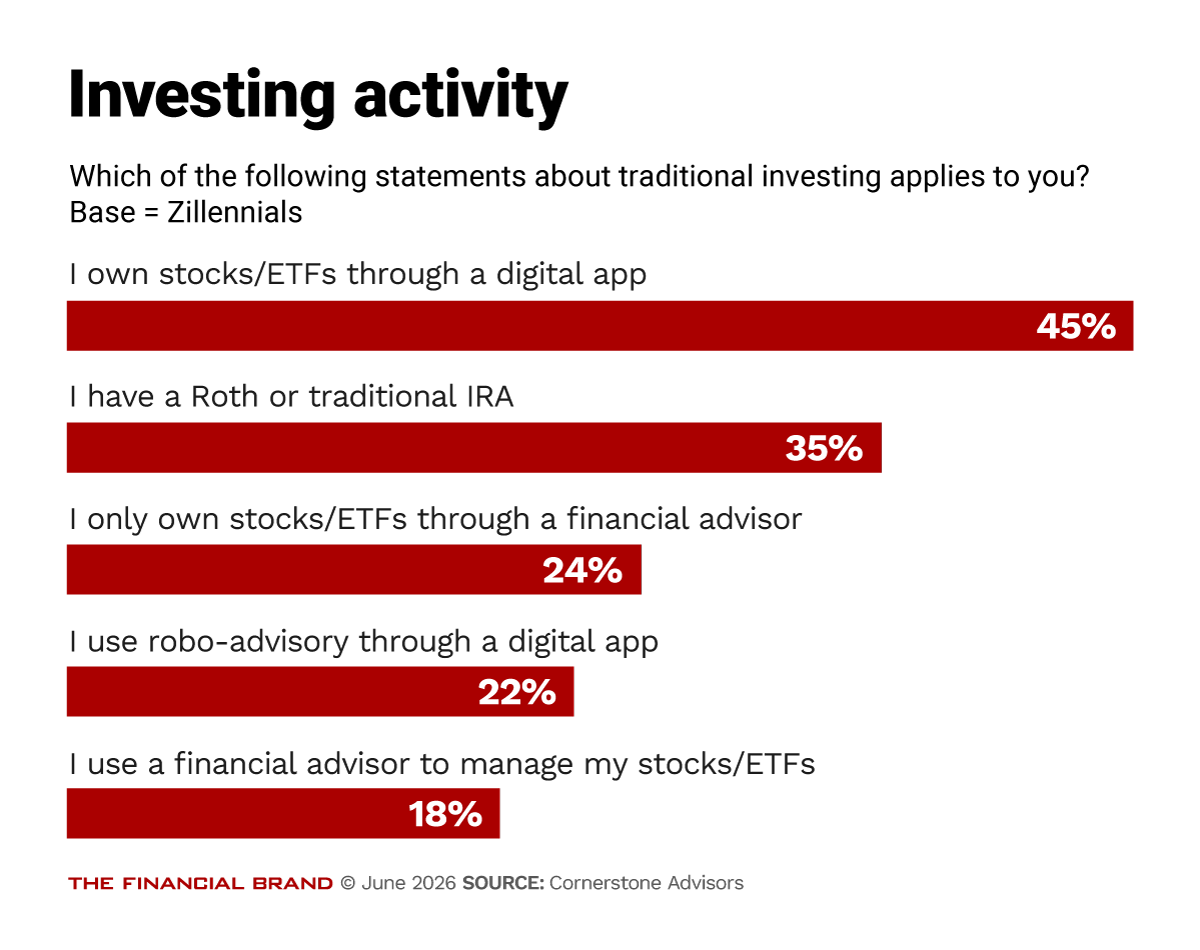
At the same time, 43% have moved deposits to an account for stocks, ETFs, crypto, or type investing in the past 12 months. Consumers no longer view investing as a separate event reserved for long-term financial planning. Instead, investing has become part of routine money management.
Key takeaway: This creates an opportunity for banks and credit unions. Three-quarters of younger investors said they would be interested in investing directly from their checking account. The demand for integrated experiences clearly exists. The challenge is delivering an experience that feels intuitive.
For instance, while cryptocurrency ownership has climbed, the report found that consumers showed limited enthusiasm for institutions offering only crypto products. They were similarly unimpressed by institutions offering only traditional investing.
Don’t Let Crypto Become A Distraction
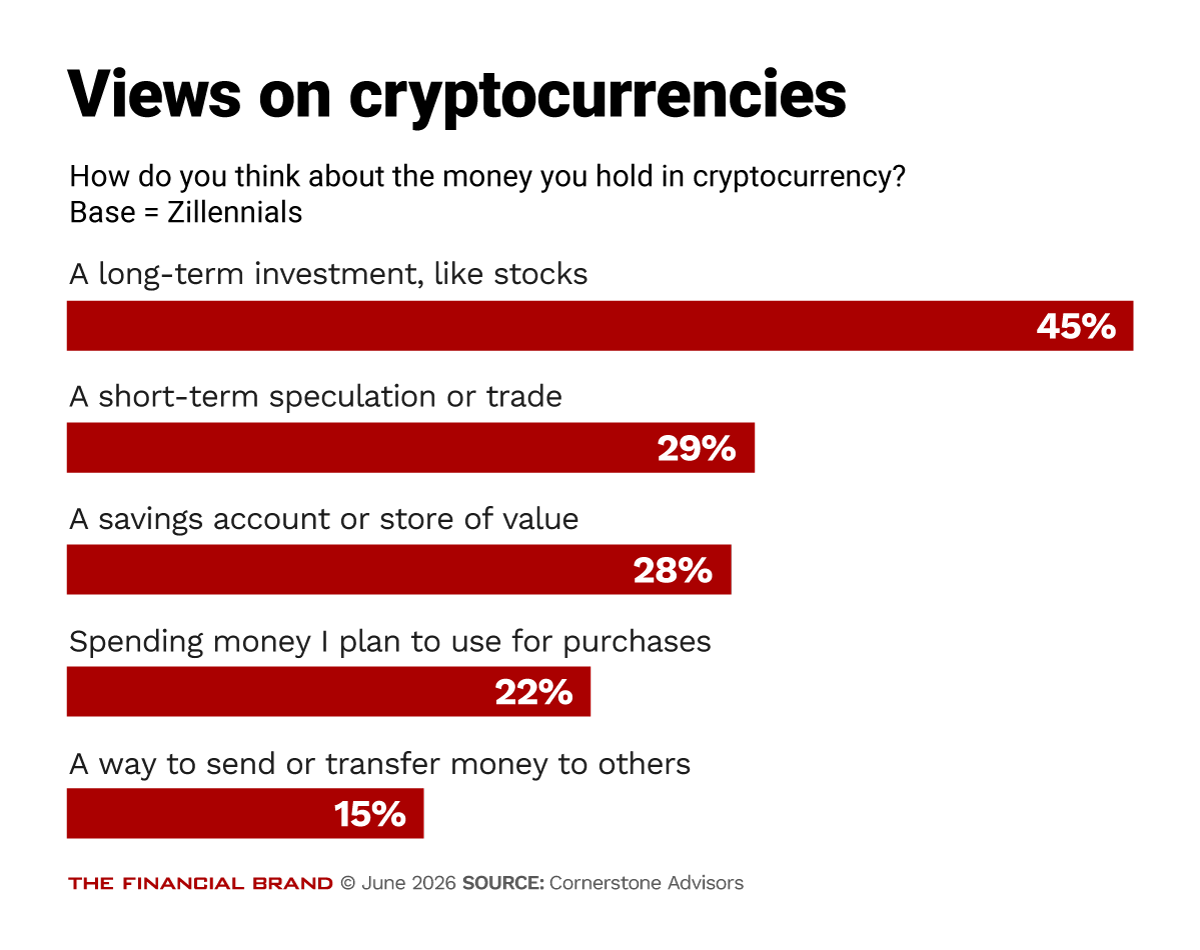
The report devotes considerable attention to cryptocurrency, stablecoins, and the growing role digital assets may play in consumers’ financial lives. One-third of Zillennials currently hold cryptocurrencies either directly or indirectly.
But launching a crypto offering will not solve challenges with younger consumers. For most institutions, traditional investing remains the more practical place to start. In fact, nearly half (45%) of Zillennials consider crypto another long-term investment, like stocks.
Key takeaway: Customers are not asking for another standalone crypto wallet or a separate digital asset application. They are asking for simpler ways to manage their money. Sixty-seven percent of Zillennials believe a modern, all-in-one mobile experience that includes banking, crypto, stocks/ETFs, robo-advisory, and stablecoins would make credit unions more compelling for their day-to-day investing needs.
The institutions that succeed will likely treat crypto as an extension of a broader wealth-building experience rather than the centerpiece of their digital strategy.
Customers Want Frictionless Experiences
Beyond the data, the report also offers useful lessons from Robinhood and Coinbase that extend far beyond investing. Both companies built experiences around reducing friction.
Robinhood removed barriers to entry through fractional shares and intuitive mobile design. Consumers no longer needed thousands of dollars or extensive financial knowledge to begin investing.
Coinbase tackled education differently by integrating learning directly into the product. Consumers watch short videos, complete quizzes, and receive small amounts of cryptocurrency as rewards.
The common denominator is convenience. Neither company expects customers to seek out educational content independently. Guidance is delivered at the moment consumers need it.
That approach increasingly reflects how younger consumers expect all financial products to work. Instead of standalone resource centers and educational libraries, institutions should embed guidance directly into digital experiences.
Key takeaway: Simple prompts can help customers make decisions in context. For example, institutions could identify excess cash balances, suggest recurring investments, or model how monthly contributions could grow over time. The objective is to make financial decisions easier rather than provide more information.
What Banking Leaders Should Prioritize
Consumers are not choosing fintechs because of superior advertising. They are choosing products that better align with how they manage money today. For retail banking leaders, the report points to several ways credit unions can compete in this environment:
- Build investing directly into digital banking experiences rather than offering separate applications and disconnected portals.
- Establish a long-term digital asset strategy that includes cryptocurrency alongside traditional investing, as well as establish stablecoin credibility early.
- Use partnerships to accelerate capabilities that would be difficult to build internally.
- Encourage investing as a habit through recurring transfers, round-ups, milestone-based prompts, and personalized recommendations.
- Consider incentives and rewards to further drive behavior, such as matching contributions on IRAs.
- Embed financial advice and education into the experience at the moment consumers need it.
For years, success was measured by who held consumers’ deposits. Increasingly, success may be determined by who helps consumers move, manage, and grow their money most seamlessly. Banks and credit unions that can connect spending, saving, and investing into a unified experience may be better positioned to deepen relationships with younger consumers before fintech platforms become their default destination.


