
Why M&A Is Less and Less about Assets, More and More about Capabilities
By Jessica Kendall, Contributor at The Financial Brand
Simple Subscribe
Subscribe Now!
Mergers and acquisitions (M&A) in U.S. banking have moved from periodic consolidation to a structural strategy for survival and growth. According to a new SRM Perspectives report, financial institutions are using M&A to solve a shared set of constraints: rising technology costs, regulatory complexity, margin compression, and customer expectations shaped by digital-first competitors.
Key takeaway: Scale is no longer just an efficiency lever. It determines whether institutions can fund modernization, compete on product experience, and maintain acceptable unit economics.
Recent deal activity shows a clear shift toward larger, faster, and more strategic transactions, often involving strong institutions combining to achieve capabilities neither could build quickly on their own. Regulatory conditions and faster closing timelines have added momentum, but the underlying driver is economic necessity.
Need to Know:
- Scale has become the primary determinant of whether institutions can sustain technology investment, compliance obligations, and competitive pricing.
- Deal activity is increasingly driven by capability expansion rather than distress, with strong institutions combining to accelerate strategy. U.S. banking saw approximately 181 deals in the prior year, up roughly 45% year-over-year.
- Payments infrastructure and digital experience are emerging as decisive factors in customer and member acquisition and retention.
- Execution quality, especially in technology integration and cultural alignment, determines whether deals create or destroy value.
- Vendor and contract rationalization is one of the most underused but material sources of merger-driven financial upside.
Scale Becomes Economic Requirement
The modern U.S. banking model is being reshaped by a simple constraint: fixed costs are rising faster than many institutions can scale revenue. Technology replacement cycles, compliance obligations, and risk management requirements now demand investment levels that smaller balance sheets struggle to sustain.
As a result, scale has shifted from a strategic advantage to an operational requirement. Institutions that cannot spread costs across a larger asset base face shrinking flexibility to invest in customer acquisition, digital channels, and product innovation.
Key takeaway: This pressure is visible in both banks and credit unions. A small number of large institutions now control the majority of system assets, with those above the $5B threshold accounting for roughly 90% of U.S. banking assets. The implication is clear: competitive intensity is increasingly concentrated among fewer, larger players.
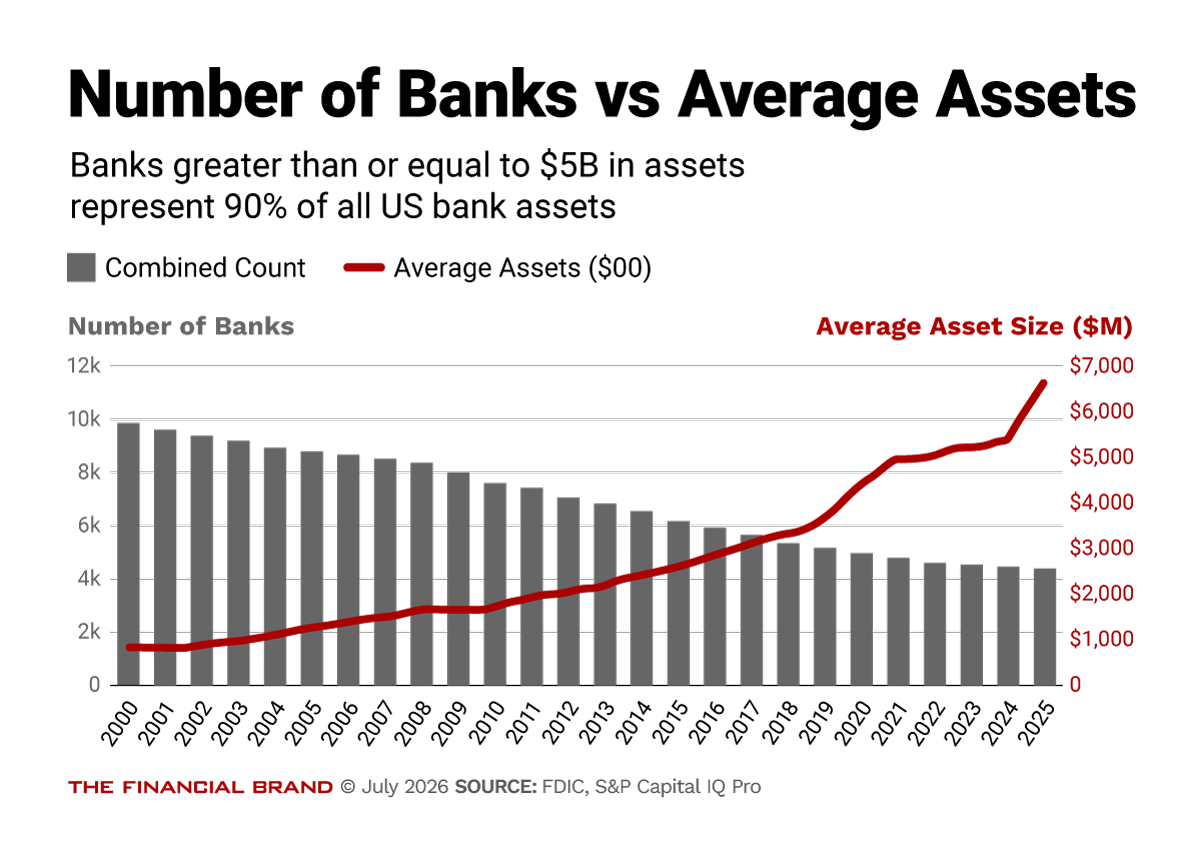
At the same time, consumer expectations have been reset by fintechs and digital-first competitors. Customers now expect instant payments, low fees, and seamless digital servicing. Meeting those expectations requires infrastructure investments that scale only efficiently at size.
Deal Activity Is Accelerating
M&A activity has shifted into a higher gear, both in volume and in ambition. Regulatory conditions have supported faster approvals, with median closing timelines falling significantly in recent years. Deal flow has increased meaningfully, and transaction size is trending upward.
Institutions are no longer treating acquisitions as defensive cost plays. Instead, many deals are framed around growth acceleration, technology modernization, and market expansion. This is particularly evident in “merger-of-equals” combinations, where strong institutions combine to reach a scale neither could achieve independently.
Recent transactions illustrate this shift:
- Capital One acquisition of Discover Financial Services centered on building payments network scale
- PNC Financial Services acquisition of FirstBank focused on deposit base and geographic expansion
- Fifth Third Bank acquisition of Comerica Incorporated reflecting consolidation among large regionals
- Banco Santander acquisition of Webster Financial Corporation highlighting cross-border strategic interest
What these deals share is intent. They are not primarily about cost reduction. They are about creating platforms capable of competing in payments, commercial banking, and digital experience at scale.
Capability Gaps Drive Acquisition Strategy
A growing share of M&A activity is best understood as capability acquisition. Institutions are using deals to fill gaps that would take years to build internally. The most common capability gaps include:
- Commercial and small business banking infrastructure
- Real-time payments and digital wallet integration
- Treasury management and cash flow tools
- Data infrastructure for analytics, fraud detection, and personalization
These capabilities are difficult to build organically because they require more than just technology, but also specialized talent, embedded customer relationships, and operational maturity.
Acquisition compresses timelines for these capabilities dramatically. What might take 5 to 7 years to build internally can be integrated in roughly a year through a well-executed deal. This time advantage is a major driver of current deal logic.
Credit unions and regional banks are increasingly combining to access the scale needed to invest in these capabilities. At the same time, fintech-bank combinations are emerging as institutions seek to bridge gaps in product experience and distribution.
Execution Determines Value Creation
While strategy drives dealmaking, execution determines outcomes. The most consistent failure point in M&A is integration discipline.
Technology integration is the most critical risk factor. Institutions that delay planning until after close consistently underperform. Poor integration leads to customer disruption, attrition, and regulatory scrutiny. In contrast, institutions that fully define their integration architecture before close are more likely to realize projected synergies.
Cultural integration is equally important but often mismanaged. It is frequently treated as a human resources initiative rather than a governance responsibility. Successful integrations treat culture as a structured system involving:
- Pre-close cultural diagnostics
- Joint operating principles
- Leadership-aligned execution models
- Measurable cultural performance indicators
Vendor and contract rationalization is another underleveraged lever. Merged institutions gain negotiation leverage that can materially reduce costs across core systems, payments infrastructure, and technology vendors. In some cases, this has produced hundreds of millions in savings, particularly in large-scale combinations.
Finally, measurement discipline matters. Institutions that evaluate success across multiple dimensions — operational stability, financial synergies, customer retention, and cultural alignment — consistently outperform those focused only on cost reduction.
M&A as One Path to Growth
The report ultimately argues that the institutions gaining the most from today’s M&A environment are approaching acquisitions with a clearly defined strategic objective. Rather than viewing a merger as an end in itself, they begin by identifying the capabilities they need to compete over the next decade and then determine whether those capabilities are best acquired, built internally, or accessed through partnerships.
That distinction matters because M&A is only one path to growth. For some institutions, the right answer may be a merger. For others, a fintech partnership, vendor modernization effort, or targeted investment may accomplish the same objective with less complexity.
Key takeaway: The common denominator is strategic clarity. As technology costs continue to rise and competition intensifies, the institutions that first define the capabilities they need — and then choose the right path to acquire them — will be better positioned to compete regardless of whether that path includes an acquisition.


