
Prepare Your Wealth Strategy for the New Generation of Affluent Clients
By Jessica Kendall, Contributor at The Financial Brand
Simple Subscribe
Subscribe Now!
New research suggests the affluent market is entering a period of structural change driven by generational wealth transfer, evolving investment preferences, and rising expectations for personalized advice.
Surveying more than 1,400 Americans with at least $3 million in investable assets, Bank of America found younger wealthy investors approaching wealth differently than previous generations. They are more comfortable with artificial intelligence, more interested in alternative investments, more engaged in philanthropy, and more likely to inherit substantial assets.
At the same time, ultra-high-net-worth investors increasingly resemble institutional investors by using sophisticated advisory teams, private-market investments, and strategic lending.
What this means: These findings point toward a broader shift in client expectations. Competitive differentiation will depend less on investment performance alone and more on delivering integrated advice across investing, business ownership, estate planning, credit, and longevity planning.
Need to Know:
- Younger affluent clients are redefining wealth management through greater adoption of AI, alternative investments, and values-driven financial planning.
- Alternative assets continue moving into the mainstream, although investors increasingly expect advisors to help navigate their complexity.
- Ultra-high-net-worth investors increasingly manage wealth like institutions, relying on specialized advisory teams and strategic leverage.
- Longevity planning has quickly become a core wealth conversation, creating new opportunities for advisors to deepen client relationships.
- 64% of wealthy Gen Z and Millennial investors come from legacy wealth backgrounds, while 74% receive regular trust distributions.
- 96% of ultra-high-net-worth investors work with a financial advisor, while 77% use multiple advisors.
Younger Investors Are Reshaping Wealth
For years, discussions about the “great wealth transfer” have focused on the sheer volume of assets expected to move between generations. But the bigger story may be what happens after those assets arrive.
Younger affluent investors are bringing different priorities into wealth management. Financial security remains their primary objective, but they also place unusually high value on innovation, entrepreneurship, philanthropy, and building their own legacy.
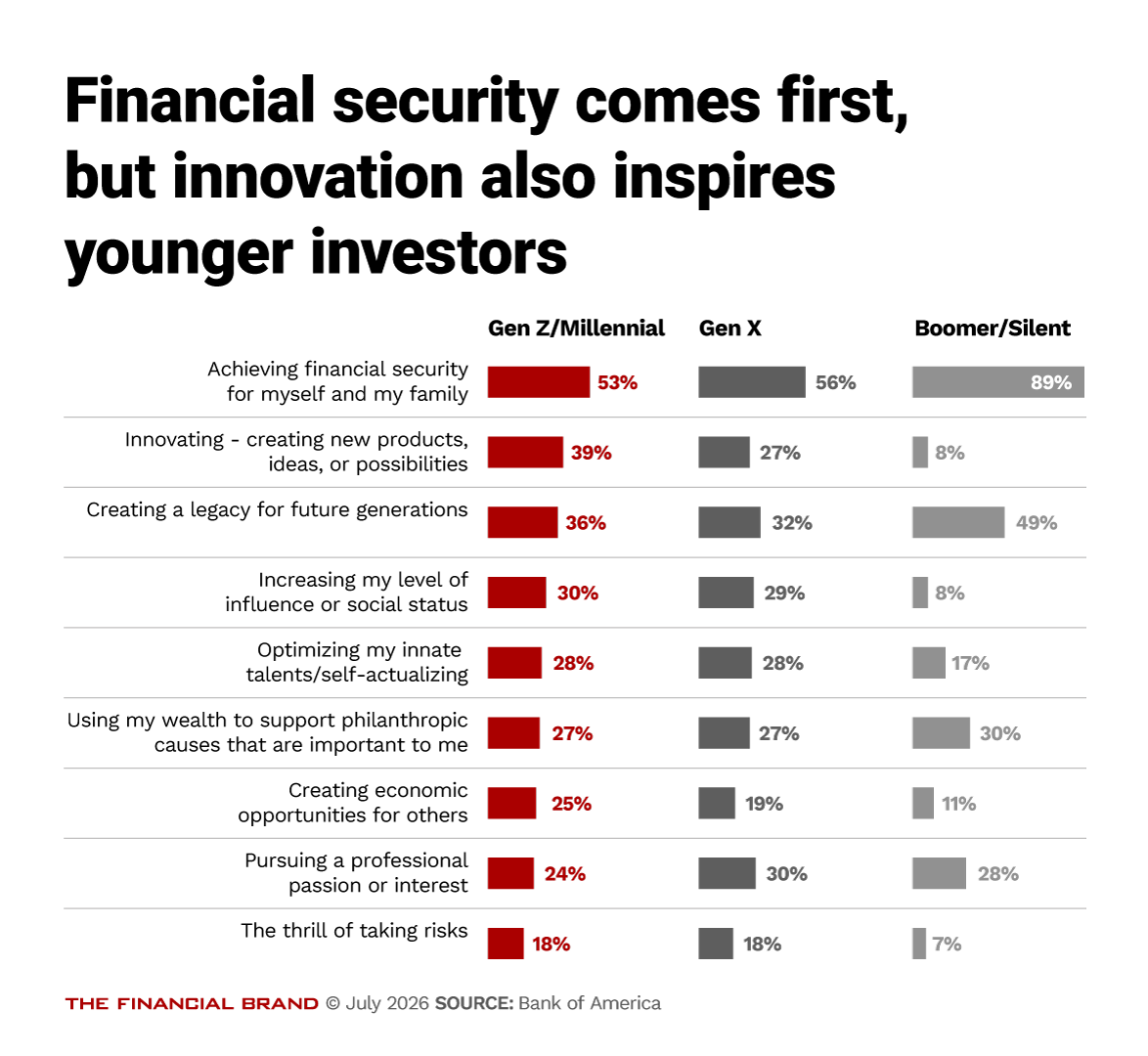
Nearly two-thirds (64%) come from legacy wealth backgrounds, yet 76% also identify themselves as wealth creators rather than simply wealth inheritors.
Their investment behavior reflects those priorities. Younger investors devote significantly larger portions of their portfolios to alternative assets and cryptocurrency than older generations. They also increasingly believe traditional stock-and-bond portfolios alone will not generate above-average returns.
Alternative Assets Become More Mainstream
Those changing investment preferences also explain why alternative assets continue gaining traction. Traditional equities and fixed income still represent nearly three-quarters of wealthy investors’ portfolios. Yet younger investors increasingly view real estate, private equity, cryptocurrencies, and other alternatives as necessary components of long-term wealth creation.
Real estate remains the most widely owned and most desired alternative investment across nearly every wealth segment. Cryptocurrency continues gaining acceptance as well, particularly among younger investors, while Generation X has become the fastest-growing crypto investor cohort.
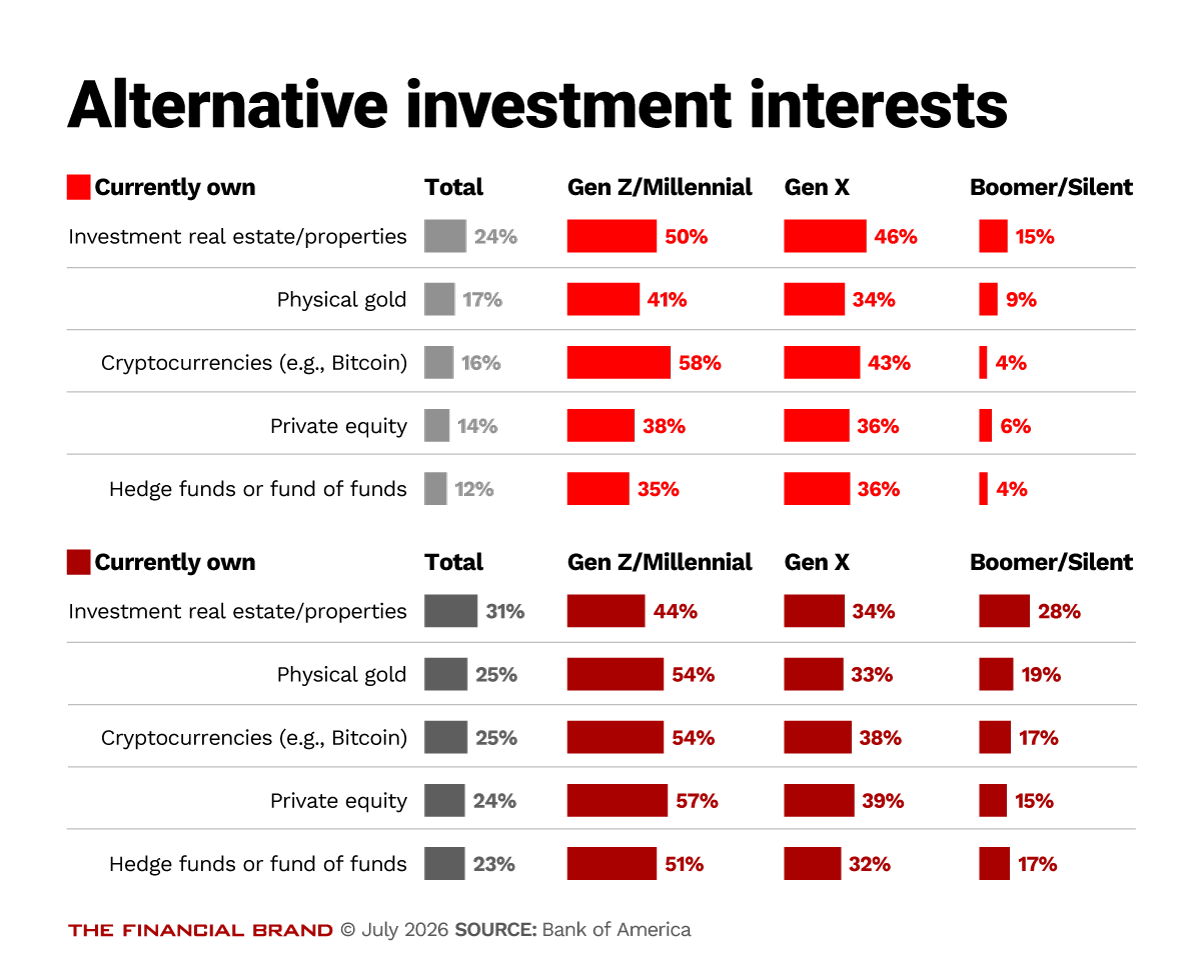
But the enthusiasm comes with important caveats. Investors consistently cite fees, administrative complexity, illiquidity, valuation challenges, and tax considerations as obstacles to broader adoption. Among Gen Z and Millennial investors, minimum investment thresholds is also a key pain point.
As portfolios become more diversified and sophisticated, advisors who help clients understand when alternatives fit — and when they do not — may become more valuable than those simply expanding product menus.
Wealth Management Is Becoming More Holistic
Investment choices aren’t the only expectations changing. Wealthy clients increasingly expect advice that extends beyond portfolio management. The report also suggests affluent clients increasingly expect financial advice to extend well beyond investment management.
Business ownership remains a major driver of wealth creation, with roughly one-third of respondents currently owning or previously owning businesses. More inherited businesses, greater family involvement, and growing succession challenges are making financial planning increasingly interconnected with estate planning and governance.
Longevity has emerged as another major planning consideration. More than 9 in 10 wealthy Americans believe longevity belongs in wealth planning, yet fewer than half have completed the basic elements of an estate plan. Many investors also want more conversations about elder care, family wealth transfer, trusts, and long-term financial preparedness.
Philanthropy is also becoming a larger part of the advisory conversation, particularly among younger affluent investors. While charitable giving has long been a component of wealth planning, the survey found that younger generations are more likely to view philanthropy as part of their broader financial strategy and personal legacy. Many also want guidance on structuring charitable giving to maximize both impact and tax efficiency. For advisors, these conversations represent another opportunity to strengthen relationships by helping clients align their financial decisions with their long-term values and goals.
Key takeaway: These findings reinforce a broader shift occurring throughout wealth management. Clients increasingly expect advisors to coordinate conversations spanning taxes, retirement, estate planning, philanthropy, healthcare planning, and family governance instead of treating each discipline independently.
Technology Is Now Part of the Advisory Relationship
Delivering that broader relationship increasingly depends on technology. Digital capabilities have become an expected part of premium wealth experiences, particularly among younger affluent households.
Among wealthy Generation Z and Millennial investors, 86% say they regularly use artificial intelligence, compared with 42% of wealthy Americans overall. Nearly 9 in 10 believe AI will improve their quality of life, and most say it has the potential to improve investment returns.
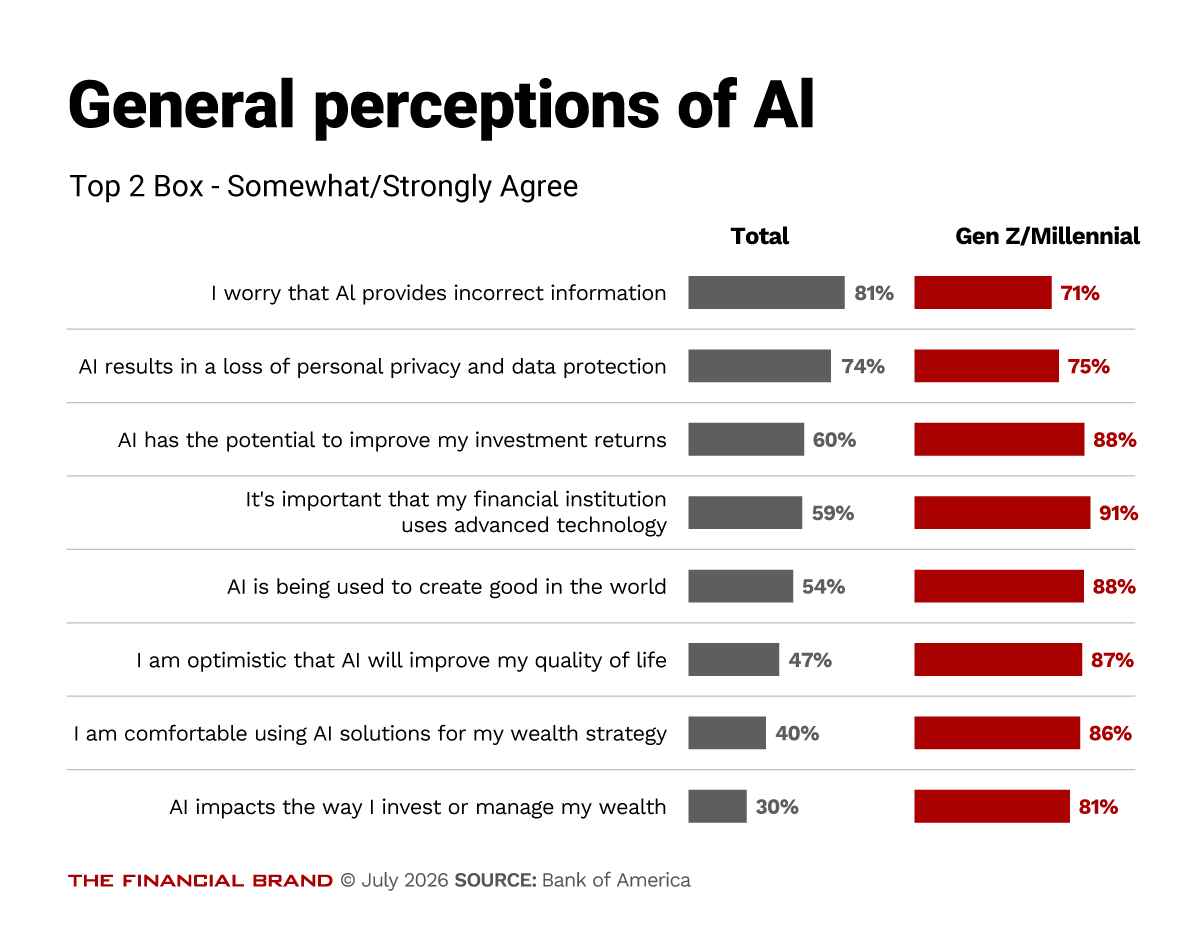
In addition, younger investors increasingly expect their advisors to embrace the technology as well. Eighty-seven percent are comfortable with advisors using AI to manage portfolios, while 85% are comfortable with AI supporting relationship management and client service.
That doesn’t suggest affluent clients want algorithms replacing human advice. Throughout the report, advisors remain central to the wealth management relationship. Instead, younger investors appear to view AI as another tool that should make advisors faster, better informed, and more responsive. Affluent investors are looking for advisors who make intelligent use of new technology.
What this means: Firms that combine trusted human advice with intelligent technology may be better positioned to meet those expectations than institutions that treat AI as either a novelty or a back-office efficiency project.
The Wealthiest Investors Operate Differently
Perhaps the report’s clearest distinction emerges among ultra-high-net-worth investors with at least $25 million in investable assets.
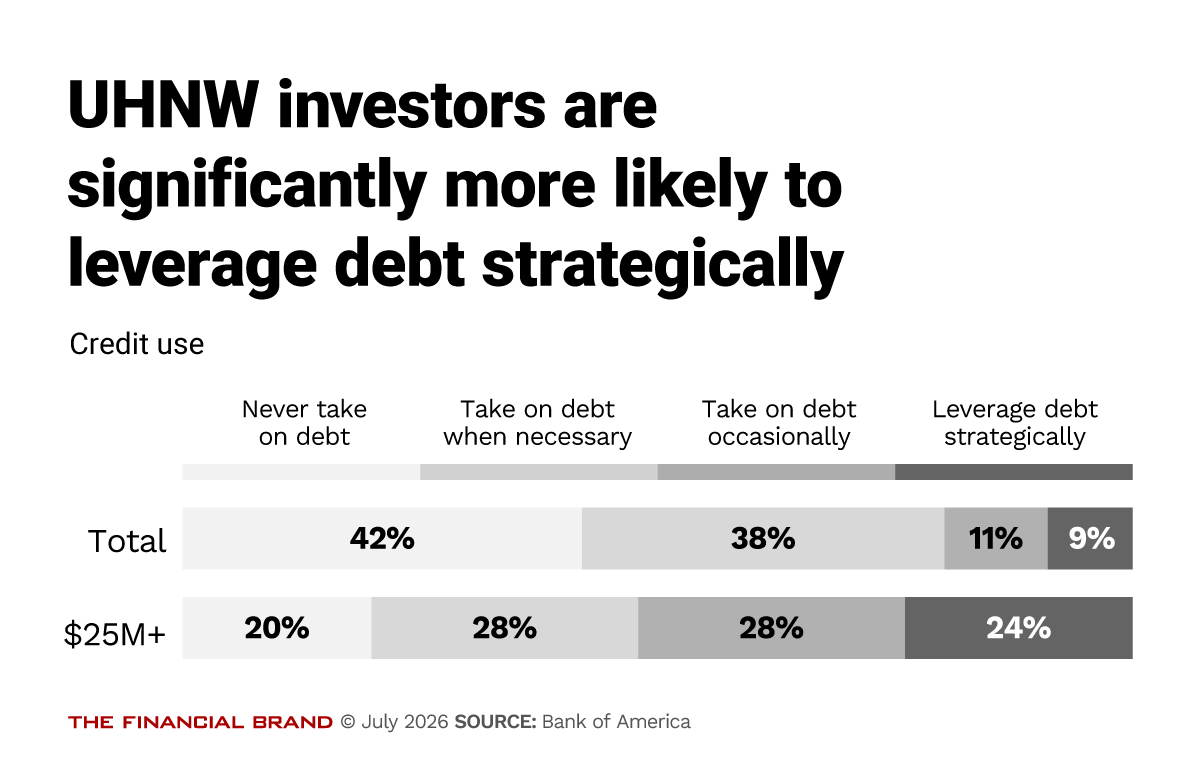
Rather than simply owning larger portfolios, these households often behave more like institutional investors. They allocate more capital to private markets, work with multiple advisors, maintain relationships with private banks and family offices, and strategically employ lending to preserve liquidity and pursue investment opportunities.
Most affluent investors continue avoiding debt whenever possible. Ultra-high-net-worth investors take the opposite approach, frequently turning to loans and credit to finance acquisitions, support businesses, bridge liquidity events, or capitalize on market opportunities.
They also devote considerably more attention to preparing future generations. Estate planning, family education, governance, and succession become increasingly important as wealth accumulates.
For retail banks, only a small percentage of clients will reach this wealth tier. Even so, the behaviors emerging at the top often foreshadow broader market expectations. Coordinated advisory teams, sophisticated lending strategies, integrated planning, and highly personalized service are becoming hallmarks of premium wealth relationships.
As younger generations accumulate assets and today’s affluent households become more complex, those expectations are likely to spread well beyond the ultra-wealthy.
Customer expectations tend to migrate downmarket over time. Personalized advice, coordinated financial planning, AI-enabled service, and access to specialized expertise often begin as premium offerings before becoming expected by a much broader customer base.
These findings offer an early look at how wealth management is evolving and where institutions may need to invest if they hope to remain relevant to the next generation of high-value clients.


