
Identify Financial Stress Early by Tracking Debt Complexity Across Accounts
By Jessica Kendall, Contributor at The Financial Brand
Simple Subscribe
Subscribe Now!
Consumer debt continues to reach record levels, with household debt hitting $18.8 trillion at the end of 2025. But new analysis from Spinwheel suggests banks may be focused on the wrong leading indicator. Rather than total balances alone, the number of debt types a consumer manages simultaneously may provide a stronger signal of financial strain.
Key insight: Analyzing $2.9 billion in debt across more than 20,000 borrowers, Spinwheel found debt burdens accelerate dramatically when consumers add a second debt category. Borrowers carrying multiple debt types exhibit significantly higher obligations, even when mortgages are excluded from the analysis.
This data suggests traditional metrics such as credit scores and individual account balances may no longer provide a complete picture of financial health. As consumers manage increasingly fragmented financial lives, institutions may need to shift from evaluating isolated products toward understanding the full architecture of a customer’s obligations.
Need to Know:
- Debt complexity may be a stronger predictor of financial stress than total balances alone. Consumers moving from one debt type to two saw median debt balances increase by 10x.
- 90% of consumers carried a credit card balance, yet credit cards represented only 7.2% of total debt dollars.
- High credit card counts do not necessarily indicate financial distress and may instead reflect credit optimization strategies.
- Auto loans represent the largest non-mortgage debt category, creating substantial monthly payment obligations tied to depreciating assets.
- AEven excluding mortgages, balances were 7.3 times higher once a second debt type was added.
Banks Need a New Way to Measure Financial Health
For decades, banks have relied on familiar indicators to assess consumer risk: credit scores, utilization rates, debt-to-income ratios, and payment history. Those measurements remain valuable, but they were built for a simpler borrowing environment.
Consumers are managing mortgages, auto loans, multiple credit cards, personal loans, Buy Now, Pay Later plans, and other installment products simultaneously. Today, a key sign of financial strain may not be how much consumers owe within a single liability. Instead, it’s complexity.
When borrowers moved from one debt category to two, median balances increased more than tenfold, rising from $2,755 to $28,250.50. Even when mortgages were removed from the equation, total balances remained 7.3 times higher after a second debt category entered the picture.
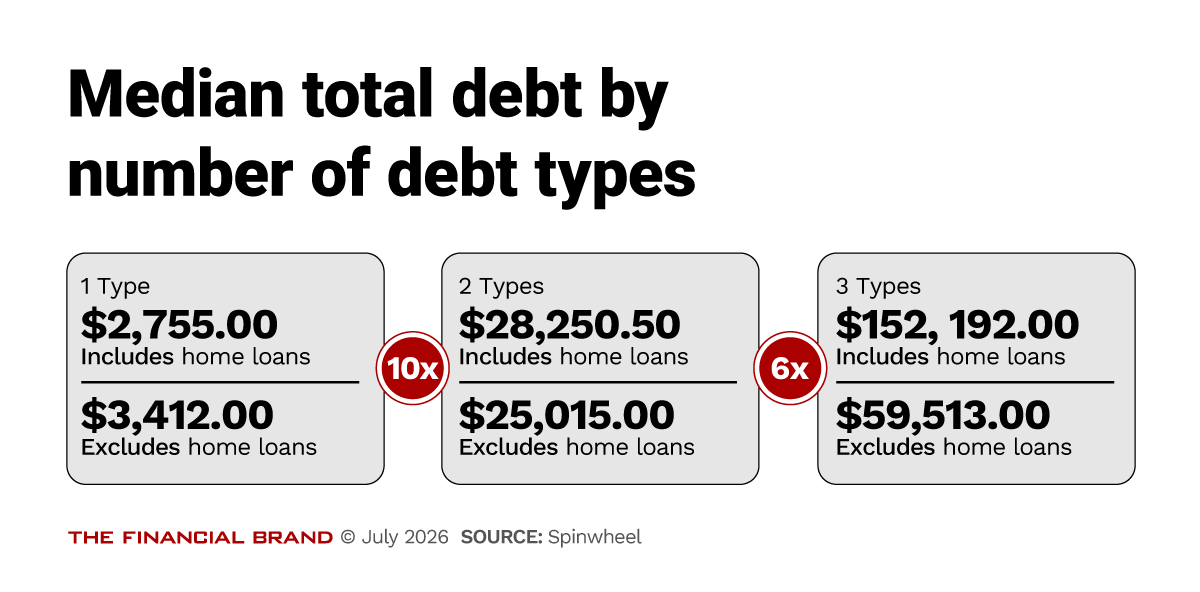
Key insight: Managing multiple obligations introduces significantly more operational friction for consumers. Different due dates, repayment structures, interest rates, and servicing experiences create a larger cognitive burden than a single balance ever could.
This raises an important question: Are current risk models capturing the number of financial systems customers are managing or only measuring individual accounts in isolation?
Institutions already have sophisticated tools for evaluating repayment behavior. The challenge may now be identifying mounting complexity before it appears as financial stress or delinquency.
Consumer Debt Is More Nuanced Than We Assume
The report also challenges several longstanding assumptions about debt behavior. For instance, credit cards remain the most common form of debt, with 9 out of 10 consumers carrying a balance. Yet credit cards account for only 7.2% of total debt dollars.
That finding highlights an important distinction between prevalence and severity. Just because a debt product is widespread does not necessarily mean it represents the largest financial burden.
Large credit card portfolios also do not immediately mean financial distress. Instead, Spinwheel’s data showed consumers with more than 25 cards used only 20.9% of their available credit, compared with 36.3% among consumers carrying just 1 or 2 cards.
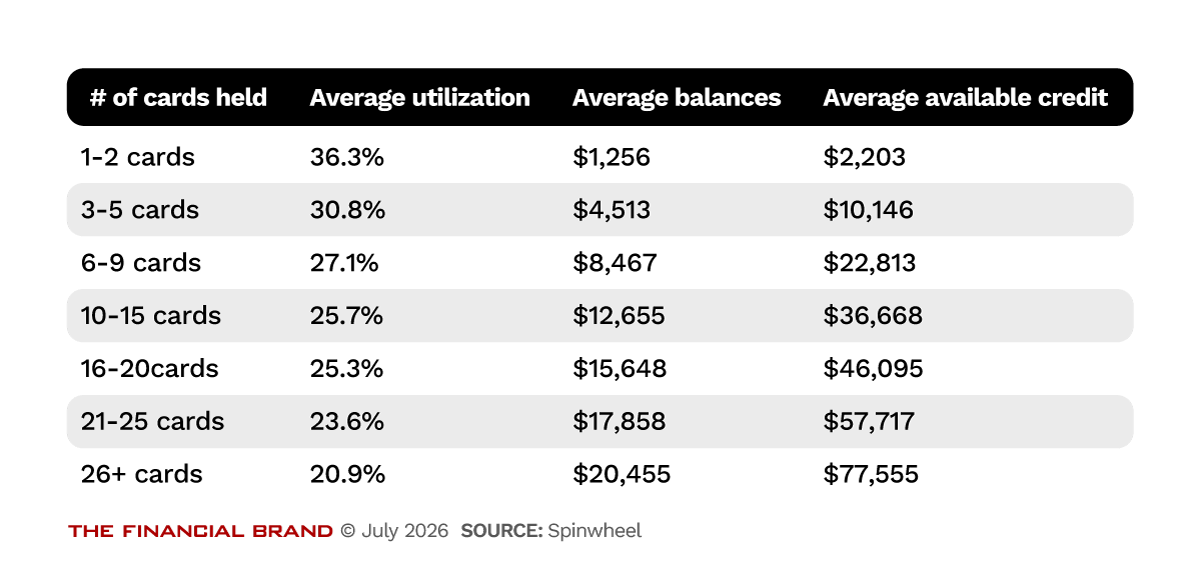
The explanation likely lies in how financially sophisticated consumers interact with the credit system. Many strategically open new cards to capture rewards, secure promotional interest rates, and strengthen credit profiles.
This does not mean more credit cards are universally positive. Outliers still exist. But card quantity alone appears to be a weak proxy for financial health.
Key insight: For marketers and product leaders, this presents an opportunity to rethink segmentation strategies. Institutions often target customers with multiple accounts as potential risk cases. However, customers with larger portfolios may represent highly engaged users who actively manage their financial lives.
Behavioral context increasingly matters as much as account counts.
The Auto Loan Burden Deserves More Attention
Finally, the biggest debt burden (not including mortgages) for many consumers isn’t what you’d expect, according to this data set. Spinwheel found auto loans surpassed student loans in total balances, reaching $264 million versus $236 million.
Nearly half of consumers carried an auto loan. What’s more, unlike a mortgage, auto loans finance a depreciating asset. This may be an emerging blind spot and opportunity for banks to make a difference.
Key insight: Institutions increasingly invest in financial wellness experiences that focus heavily on budgeting tools and credit card management. Those efforts may need to expand to address transportation affordability as a core component of household financial health.
Bottom Line: Customer Intelligence Must Become More Holistic
Banks already possess enormous amounts of customer data, but that information often remains fragmented across products and channels.
Future underwriting, personalization, and financial wellness programs may depend less on identifying isolated balances and more on understanding how obligations overlap and interact.
That shift could help institutions identify emerging strain earlier, personalize interventions more effectively, and better support customers before repayment issues surface.


