
Your Credit Union’s Digital Experience Is Leaving Growth on the Table
By Jessica Kendall, Contributor at The Financial Brand
Simple Subscribe
Subscribe Now!
Credit unions have spent years adding tools to understand digital behavior. Yet most still show every prospective member essentially the same homepage, regardless of what that person has come to research.
That is the central finding of Finalytics.ai’s 2027 Credit Union Personalization Report. In an audit of the public websites of the 100 largest U.S. credit unions, researchers found that 33 had a personalization engine or first-party rule system in place. Just 10 changed their homepage in response to a visitor’s auto loan research.
The gap points to a problem that another technology purchase may not solve. Effective personalization requires a decision about what a visitor needs to see, content that addresses that need, and rules that connect the two. Credit unions have more work to do on those fundamentals than on adding another platform.
Bottom line: The competitive advantage is not owning personalization technology. It is putting that technology to work.
Need to Know:
- Audit before buying. Many credit unions already have personalization features in their content management systems or subscriptions that remain unused.
- Connect intent to content. A visit to an auto loan page should inform the message a prospective borrower sees on returning to the homepage.
- Start with simple rules. A few targeted homepage variations can establish a working personalization program without requiring sophisticated predictive models.
- Design for anonymous visitors. Prospects often research products before logging in, so the public website must respond to the signals available during that visit.
- Measure business outcomes. Compare application starts and funded accounts from personalized sessions against a control group.
Technology Ownership Has Outpaced Execution
Finalytics researchers tested each website from the perspective of an anonymous visitor: a first visit to the homepage, a return visit, a plain reload, one visit to the auto loan page, and a return to the homepage.
The distinction was deliberate. A rotating carousel or randomly changing promotion does not demonstrate personalization. A homepage that replaces a general message with an auto loan offer after a visitor researches auto loans does.
Only 10 credit unions made that connection. The other 90 showed no comparable response to the test, even though 33 had a recognized personalization engine or first-party rule system deployed.
Key insight: Across all 100 institutions, the average personalization score was 16 out of 100, and the median was just 8. In other words, most public websites showed little ability to adapt to a visitor’s demonstrated interest.
Size offered no guarantee of better results. The 25 largest credit unions averaged 18 points, while the 25 smallest averaged 11. The second smallest asset quartile, however, averaged 25 points. Global Credit Union led the ranking with 82 points, followed by GECU at 79 and Citadel Credit Union at 77.
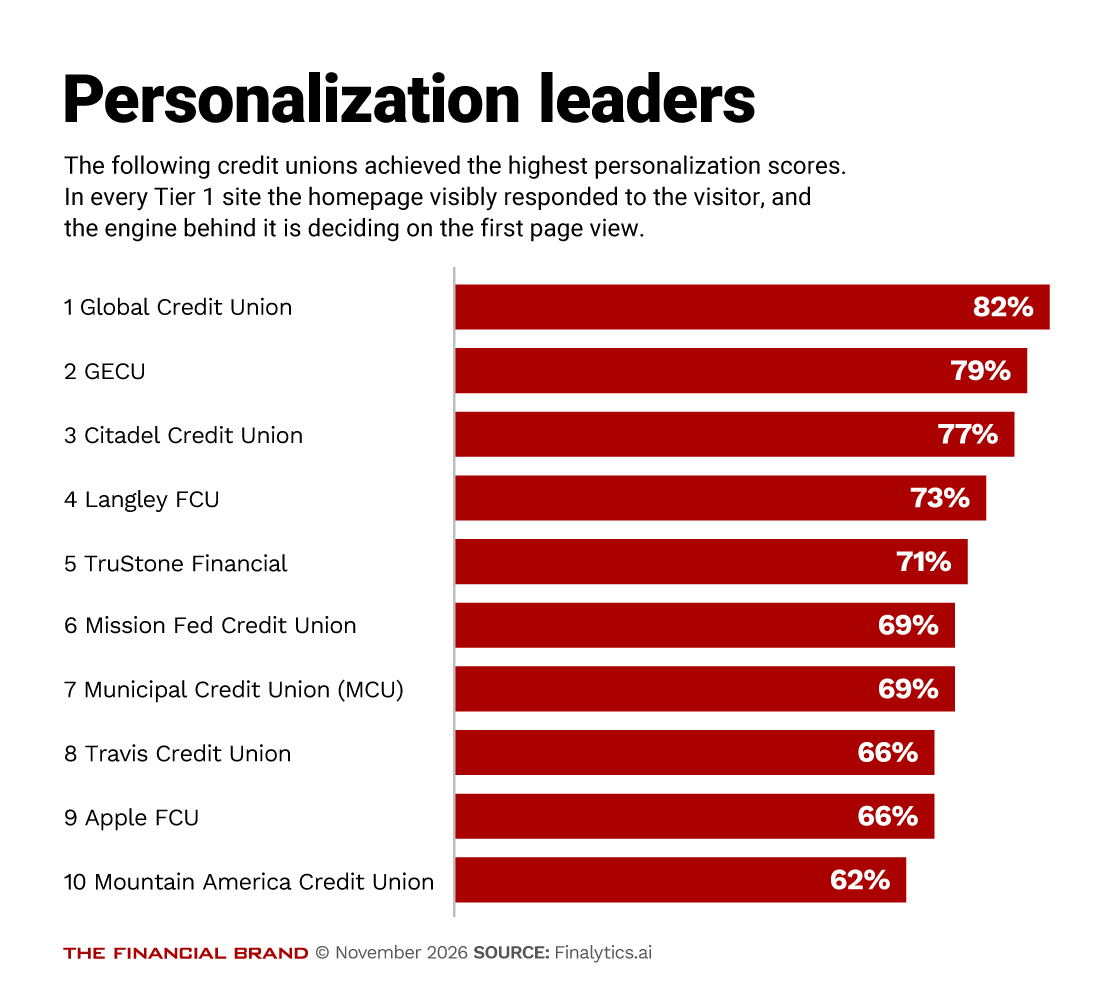
The results make a useful point for executives evaluating their own digital investments: personalization is not simply a matter of scale. A large institution may have more data, a bigger marketing team, and a more extensive technology stack. None of that guarantees that a visitor will see a more relevant experience.
The Content Decision Comes Before the Platform
The 10 credit unions that personalized successfully had one thing in common: They changed the primary homepage message to reflect the visitor’s auto loan research. None required the visitor to log in, complete a form, or accept a cookie banner to trigger the observed experience.
Global Credit Union shifted from general financial messaging to vehicle loans. Citadel Credit Union replaced a checking account promotion with a car loan message. Langley Federal Credit Union moved from a certificate promotion to an auto loan offer.
These institutions used different technologies, including dedicated personalization platforms and general-purpose tools configured to respond to visitor behavior. The common factor was a decision about which message the visitor should see, supported by content that could deliver it.
That is also where many of the other institutions fell short. Twenty-three credit unions had a personalization engine on their homepage but demonstrated no behavior-driven change. The report also identified 28 sites with CMS-native personalization capabilities enabled and 17 using experimentation platforms.
Those tools offer potential starting points, particularly when the organization is already paying for them. But a platform cannot decide which customer need deserves a different message, or create the content to deliver it.
What this means: An A/B test might identify which generic homepage headline performs better overall. Personalization asks a different question: Which message is more useful to this visitor, given what they have already shown interest in?
The Data Is There. The Connection Is Missing.
Most credit unions are not starting from zero. All 100 websites carried Google Tag Manager or Google Analytics, and 63 also used behavior analytics tools. Thirty-one had a customer data platform on the public website.
Yet measurement and response are different capabilities. Analytics can show where visitors go and what they do. Personalization requires the website to use that information while the visitor is still there.
The same disconnect appears in other digital tools. Seventy-three sites used conversational engagement tools, but most assistants waited for visitors to initiate a conversation. Calculators and product widgets also captured useful signals that rarely carried through to the homepage. A visitor who spends time calculating an auto loan payment has expressed an interest the website could use to make the next interaction more relevant.
Consent configuration also deserves attention. Forty-eight sites used consent management platforms, and five blocked the entire tag stack until visitors accepted the banner. That can leave downstream tools without visibility into visitors who decline or ignore the prompt. Credit unions should review these configurations with privacy and compliance teams to understand how permitted first-party data and personalization can operate appropriately.
What this means: The opportunity is to connect existing signals to an in-session content decision. A credit union may already know that someone visited an auto loan page, used a payment calculator, or explored checking options. The question is whether the website can act on that information before the visitor leaves.
Prove the Experience Can Move the Business
The number of tools installed, rules configured, or homepage variations launched are just implementation milestones. The business case depends on whether a more relevant experience helps more people take the next step.
Credit unions can establish that case without attempting to personalize every page or journey at once. Start with one or two high-value product intents, create a relevant alternate message, and use existing tools to deliver it. Then compare application starts and funded accounts from personalized sessions with a control group that sees the standard experience.
That measurement also gives teams a basis for deciding what to expand. If an auto loan message increases application starts but not funded loans, the next question may concern the application experience or the offer itself. If the change produces no lift, the institution can revisit the audience, content, or timing before investing in a broader program.
Bottom line: Personalization becomes a growth capability when a credit union translates customer intent into a useful next step. Leaders can begin with tools already in place, a handful of relevant messages, and a test that shows whether the experience performs better.


