
Stop Chasing Fintechs and Start Owning Customer Money Flow
By Jessica Kendall, Contributor at The Financial Brand
Simple Subscribe
Subscribe Now!
The 2026 Strategy Benchmark from Jack Henry captures a banking industry trying to modernize faster while defending core relationships against growing pressure from fintechs, digital wallets, and embedded finance platforms.
While margins improved in 2025 and 88% of financial institutions plan to increase technology spending over the next two years, executives remain under pressure to grow deposits, improve operational efficiency, and compete for younger accountholders who are increasingly loyal to fintech platforms rather than traditional banks.
Key insight: Across payments, lending, fraud, and digital banking, the report points to the same underlying shift: competitive advantage increasingly belongs to the institution that controls customer engagement, payment activity, and financial data.
In response, banks and credit unions are prioritizing AI, payments modernization, orchestration, and embedded financial experiences that reduce friction and strengthen long-term loyalty.
What this means: The findings suggest future growth will depend less on launching isolated digital features and more on connecting systems, improving personalization, and remaining embedded in customers’ daily financial activity.
Need to Know:
- Deposit growth remains the top strategic priority for banks, while credit unions are concentrating on acquiring younger accountholders and driving long-term demographic growth.
- 88% of banks and credit unions plan to increase technology spending over the next two years, up from 76% in the prior survey. AI has become the leading technology investment category for both banks and credit unions, surpassing digital banking and automation.
- Payments strategy is increasingly tied to customer acquisition, especially among younger consumers and small-business owners who expect instant, mobile-first experiences. 94% of institutions plan to add new payment services, but only 36% currently have a formal payments strategy in place.
- Fintechs and neobanks are viewed as a bigger competitive threat than other community financial institutions.
- Banks and credit unions are moving beyond standalone digital features and investing more heavily in orchestration, data integration, and embedded fintech capabilities.
1. Banking Competition Moves Beyond Banks
One of the most important findings in this year’s benchmark may be who banks and credit unions believe they are competing against.
For the first time in three years, banking executives ranked fintech companies ahead of other community financial institutions as the industry’s biggest competitive threat. Credit unions, meanwhile, expressed their greatest concern over challenger banks and neobanks.

That change reflects a broader reality: banking increasingly happens inside digital ecosystems controlled by someone else.
Key insight: Consumers move fluidly between digital wallets, fintech apps, embedded payment tools, and traditional banking platforms. Younger consumers, in particular, often treat banking as a feature rather than a destination. The report repeatedly highlights how Gen Z customers rely on debit cards, mobile wallets, real-time transfers, and third-party payment apps as part of everyday financial management.
That behavior has direct implications for deposits. Only $1 out of every $8 collected through third-party payment apps ultimately flows back to the financial institution.
At the same time, most banks and credit unions possess only 20% to 25% of their accountholders’ total financial data, with the rest fragmented across fintech platforms and external apps. In fact, a typical Gen Z or Millennial couple may use 30 to 40 separate financial providers.
Those statistics help explain why payment ownership and data orchestration appear throughout nearly every section of the report. Institutions now recognize that whoever controls payment activity also controls much of the behavioral data needed for personalization, AI modeling, fraud detection, and long-term relationship growth.
2. AI Spending Shifts from Experimentation to Execution
For the first time in the benchmark’s history, AI ranks as the top planned technology investment for both banks and credit unions.

The spending increase is substantial. According to the report, 83% of financial institutions plan to increase GenAI budgets this year, while 67% expect to implement GenAI strategies specifically for retail lending.
Important takeaway: What stands out is how quickly AI priorities have shifted from experimentation into operational deployment. For instance, among lending initiatives, 47% of banks and 45% of credit unions ranked automated workflows among their top priorities. AI-assisted underwriting followed closely, selected by 37% of banks and 30% of credit unions. Another 32% of banks identified predictive analysis and decision-making as a strategic focus area.
At the same time, most financial institutions still struggle with the underlying infrastructure needed to support meaningful AI deployment. Median technology budgets increased 10% year over year, yet only 15% of those budgets are allocated toward growth initiatives. The majority continues to be consumed by maintenance, compliance, and “keeping the lights on.”
That imbalance has created a growing “execution gap.” Many institutions continue launching front-end digital features while underlying systems remain fragmented and technical debt continues to accumulate.
What this means: Orchestration must be a core competency moving forward. Banks and credit unions need to unify data sources, connect workflows across systems, and build consistent personalization logic across digital channels, payment networks, and embedded partners.
The opportunity is significant because customer expectations remain largely unmet. Only 22% of consumers believe their primary financial institution can proactively anticipate their needs.
3. Deposits, Payments, and Demographics Converge
Deposit growth remains the dominant strategic priority for banks. Nearly two-thirds of bank CEOs identified growing deposits as their primary focus over the next two years. Meanwhile, credit unions are placing greater emphasis on acquiring younger accountholders, particularly Gen Z and Gen Alpha consumers.
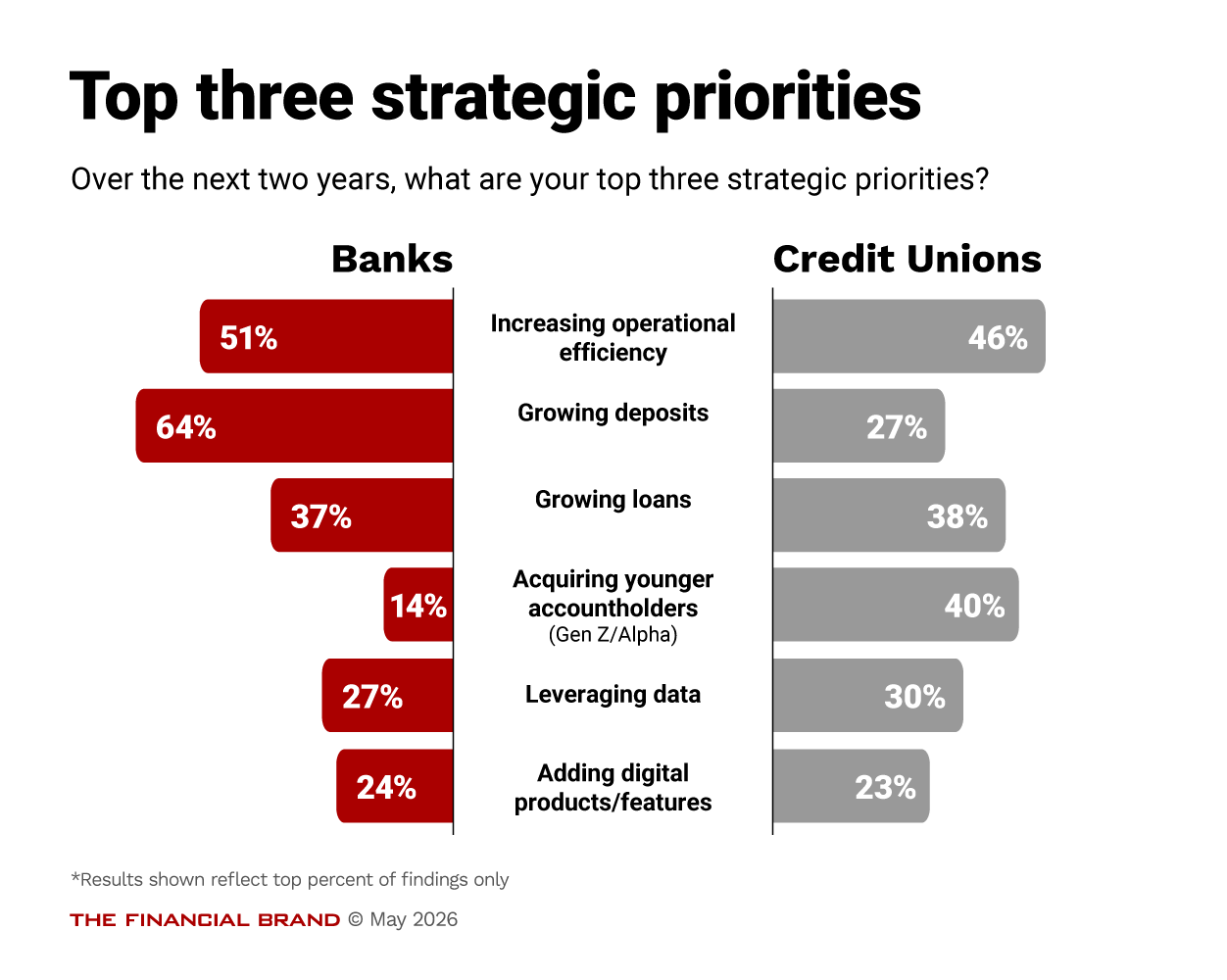
Growing deposits and acquiring younger accountholders are not mutually exclusive. In many cases, they are becoming the same challenge.
Younger consumers are forming financial habits differently than previous generations. Many begin with payment apps, digital wallets, or embedded financial services long before they establish a primary banking relationship.
That creates a different competitive environment for community institutions, where the battle is less about branch proximity and more about convenience, speed, and integration into everyday financial activity.
Payments may now be at the center of that competition. Among institutions with formal strategies for acquiring younger accountholders, the top priorities include tap-to-pay capabilities, mobile-only account opening, and debit-card-based real-time transfers.
Key insight: Nearly every surveyed institution plans to add new payment services over the next two years. Top priorities include digital card issuance, FedNow instant payments, contactless cards, same-day ACH, RTP connectivity, and real-time debit-based transfers. Among banks, 52% plan to implement digital card issuance capabilities, while 45% of credit unions identified FedNow as a top payment priority.
This focus on payments has important small-business implications as well. Three-quarters of surveyed institutions plan to expand small-business services, with payment acceptance and digital self-service tools leading the investment list.
That investment likely reflects a broader strategic reality: payments now function as both an acquisition engine and a retention mechanism for banking relationships.
4. Lending And Fraud Strategies Begin to Merge
Lending and fraud priorities are also becoming more interconnected as financial stress, AI adoption, and digital account activity accelerate simultaneously.
Today, 67% of consumers live paycheck to paycheck, increasing demand for flexible financing products, short-term loans, earned wage access, and BNPL services.
In response, 95% of financial institutions plan to enhance lending capabilities over the next two years. Small-business lending ranked as the top lending priority overall, selected by 77% of banks and 49% of credit unions. Home equity lines of credit ranked second overall, while commercial real estate lending also gained traction among banks.
At the same time, fraud and cybersecurity concerns continue escalating rapidly.
As cyber-enabled financial crime losses and consumer fraud losses increase, executives view fraud as an identity problem rather than simply a transaction problem. Among fraud priorities, 61% of banks identified real-time transaction monitoring as a top capability investment, while 45% of credit unions prioritized staff training as scams become more behavioral and socially engineered. AI and machine learning fraud models ranked highly across both groups.
Cybersecurity priorities reflect a similar shift toward resilience and response. Enhancing detection and response capabilities ranked first overall, followed by strengthening data protection, privacy controls, and operational resilience.
The Next Competitive Advantage Is Coordination
Overall, this data paints a picture of an industry entering a far more interconnected operational environment and fragmented competitive landscape
Payments strategy influences deposit growth. AI effectiveness depends on data orchestration. Fraud prevention overlaps with digital identity management. Small-business growth depends heavily on embedded financial experiences and real-time money movement.
That interconnectedness is forcing banks and credit unions to rethink how they organize technology, operations, and customer engagement.
Bottom line: The institutions that perform best over the next several years may not be those launching the most visible digital features. More likely, they will be the ones that reduce friction fastest, unify customer intelligence most effectively, and remain consistently connected to how consumers and businesses move money every day.


