
How to Make Trust Your Competitive Edge in the Era of Digital Banking
By Jessica Kendall, Contributor at The Financial Brand
Simple Subscribe
Subscribe Now!
Digital convenience has become an expectation in retail banking, but consumers are asking for something more. La Macchia Group’s 2026 State of the Financial Consumer finds growing demand for trusted financial guidance delivered through personalized experiences, accessible education, and knowledgeable people.
Consumers continue to value branches for financial advice and important conversations. They also expect communications tailored to their needs and increasingly look to their financial institution for help navigating complex financial decisions.
Key takeaway: As generative AI and social media become more common sources of financial information, banks and credit unions have an opportunity to reinforce their role as trusted advisors. Technology can play a key role in enhancing relationships rather than replacing them, allowing institutions to deliver more personalized, confidence-building experiences across every channel.
Need to Know:
- Consumers continue to value physical branches and personal interactions, even as digital banking becomes routine. Branches remain an important venue for advice, problem solving, and relationship building.
- 84% of consumers believe banks and credit unions should provide financial education. However, nearly 1 in 4 respondents said they weren’t sure guidance would be helpful.
- Personalization has shifted from a competitive advantage to a customer expectation. 52% say personalized financial recommendations are very or extremely important, while 78% expect personalized communications at least some of the time.
- Technology is most effective when it complements — not replaces — human expertise. Consumers favor digital tools that improve convenience while preserving access to knowledgeable staff.
- 52% report only moderate or low confidence in their understanding of personal finances.
Banking Is Still Built on Relationships
Banking relationships are still defined by trust. While digital channels have become an essential part of everyday banking, consumers continue to place significant value on human expertise and personal connections.
That trust also shapes how consumers choose where to bank. Rather than viewing financial institutions as interchangeable, many believe meaningful differences exist in the expertise, service, and guidance they provide. More than half of respondents disagreed with the idea that any institution could adequately serve their needs.
This feeling creates an opportunity for banks and credit unions to compete on experience instead of price or product alone. Financial institutions that demonstrate expertise, build confidence, and provide guidance can differentiate themselves in ways that are difficult for competitors to replicate.
The report also challenges a common assumption about in-person banking. Despite years of investment in digital channels, respondents across every generation expressed a preference for in-person banking experiences over online banking experiences, and most rejected the notion that they no longer need physical locations.
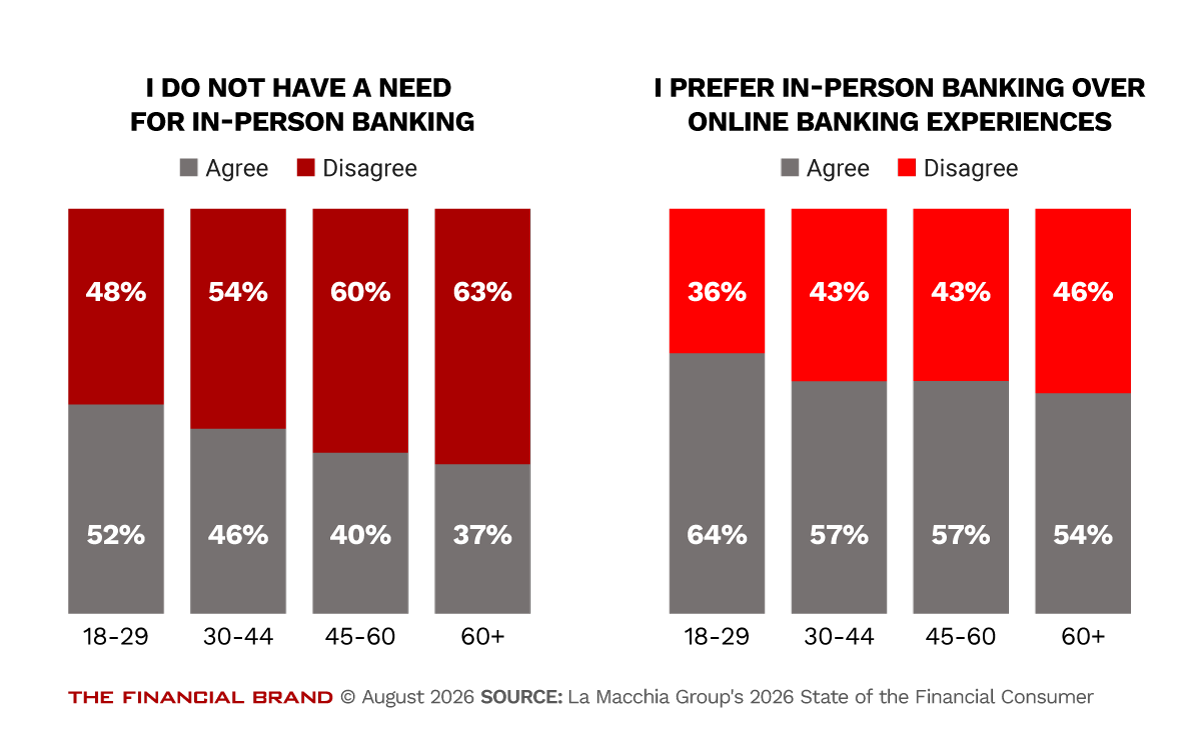
Branches continue to serve important purposes beyond processing transactions. Consumers visit them to resolve problems, discuss financial decisions, and seek reassurance from knowledgeable employees. Nearly three-quarters (73%) prefer speaking with a person rather than relying on automated technology when they visit.
Key takeaway: Retail bankers must rethink how branches support advisory conversations while using technology to improve efficiency and convenience.
The Branch Is Evolving, Not Disappearing
It’s clear that rather than choosing between physical and digital experiences, consumers want both working together. When asked how important it was to them that their financial institution branch utilizes technology or digital solutions, 79% said technology is at least somewhat important.
Yet the types of technology they value are practical rather than flashy. Self-service kiosks, interactive product information, and educational resources ranked among the most appealing capabilities. What’s more, 42% said seeing their branch use technology or digital solutions would make them more likely to visit a branch.
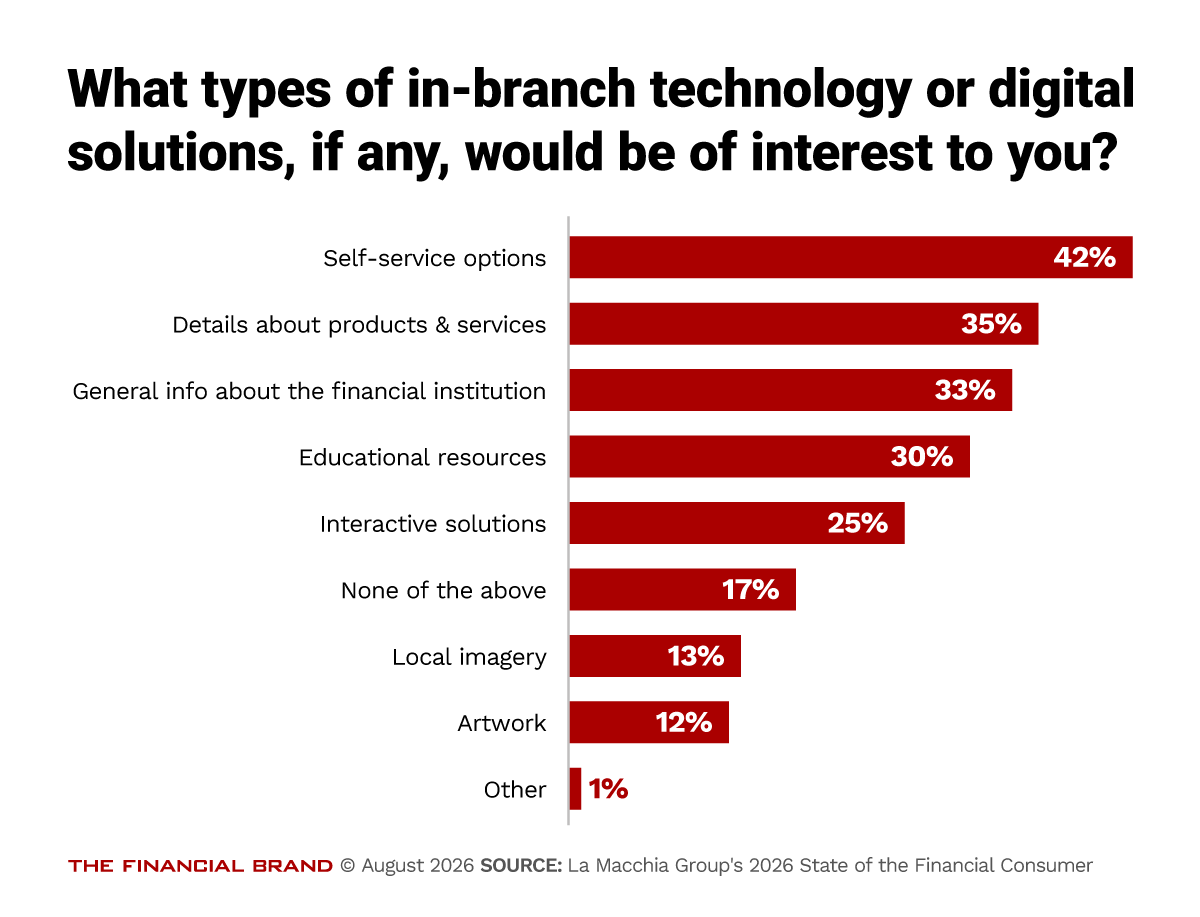
What else would make them visit a branch? Consumers want welcoming, comfortable environments that encourage conversations rather than simply processing transactions. Respondents favored branch designs inspired by libraries, coffee shops, and residential spaces — settings that support consultation and relationship building instead of standing in line.
Key takeaway: This hybrid model reflects a broader evolution in branch strategy. Technology should remove friction from routine interactions and allow employees to spend more time helping customers navigate complex financial decisions. Digital tools can become enablers of stronger relationships within the branch rather than replacements for them.
Consumers Want Financial Guidance but Hesitate to Ask Their Bank
Financial guidance is also becoming a bigger part of the value consumers expect from their banking relationship. More than 8 in 10 respondents believe financial institutions should provide educational resources. This reinforces the idea that consumers increasingly view banks and credit unions as trusted advisors rather than transaction processors.
Yet, 24% of consumers aren’t sure whether seeking guidance from their financial institution will help. Others cite discomfort, inconvenience, or concern about being judged as top barriers that keep them from going to their financial institution for financial guidance.
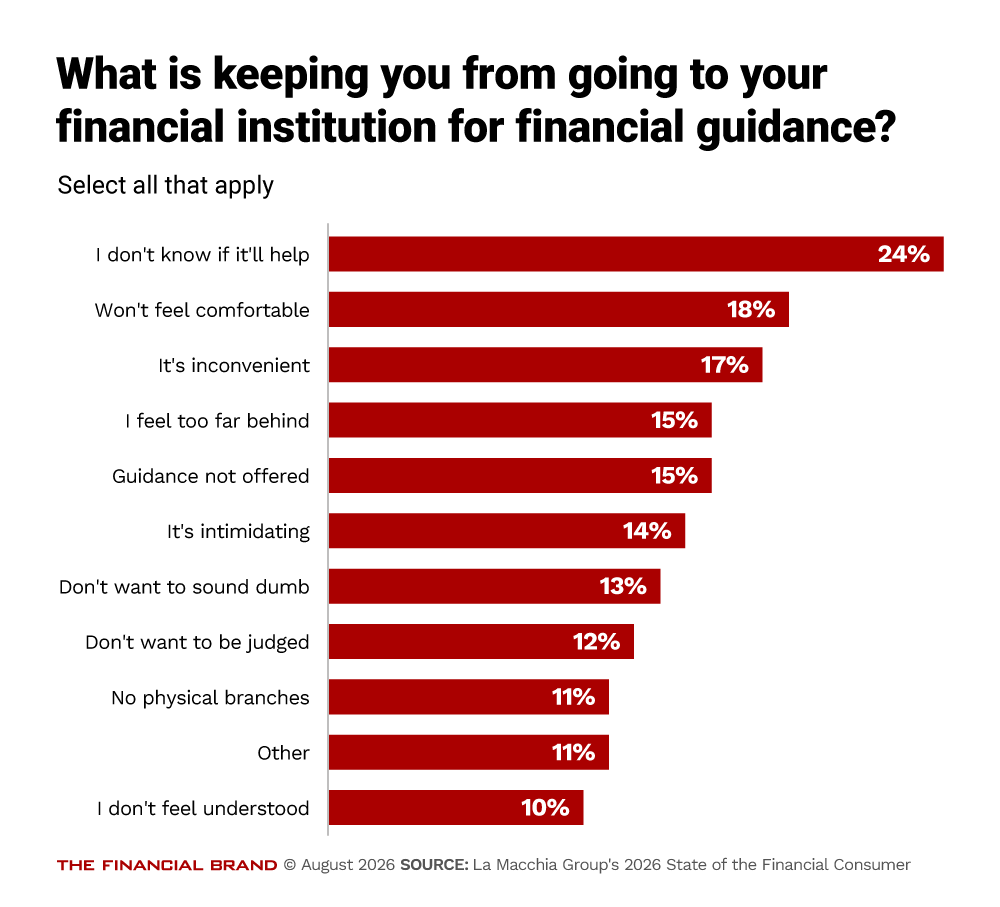
Producing more educational content doesn’t address these barriers. Consumers already seek financial information from a variety of places. Online searches rank first, while financial institutions and family members are tied as the second most common source of guidance. Consumers are also turning to generative AI for financial questions, creating additional competition for consumer attention. To become a trusted source of education for consumers, institutions need to make advice feel approachable, practical, and easy to access through multiple channels.
And the need is evident. While almost half of consumers express strong confidence in their financial knowledge, a slight majority (53%) report they are only somewhat confident or not confident at all.
The topics they most want help with — including savings, investing, financial planning, credit scores, and debt management — represent opportunities for banks and credit unions to strengthen relationships through ongoing education rather than one-time campaigns.
Key takeaway: Financial institutions have an opportunity to position themselves as the source that combines expertise with personalized advice. Online searches and AI may provide fast answers, but consumers often need recommendations grounded in their individual financial circumstances.
Personalization Is Table Stakes
Consumers expect their financial institution to understand their individual circumstances and provide guidance that reflects their financial goals. According to the survey, 52% of respondents say personalized financial recommendations are very or extremely important, while 78% expect to receive personalized offers and communications at least some of the time.
The opportunity extends well beyond product recommendations. Consumers want advice that reflects where they are in their financial journey. More than half of respondents expressed interest in receiving personalized financial planning advice, with younger generations showing particularly strong demand for customized investment guidance.
Communications that acknowledge a customer’s financial goals, life stage, or recent activity can build stronger engagement than campaigns driven solely by product eligibility. Personalization can also reinforce trust. Consumers are increasingly comfortable receiving recommendations from their financial institution because they view it as a credible source of expertise. That trust gives banks and credit unions an advantage over many digital channels competing for consumers’ attention.
Bottom line: consumers continue to value trusted relationships with their financial institutions, even as they embrace new technologies and digital channels. They want banks and credit unions who deliver both digital convenience and personalized service.
Institutions that successfully combine education, personalization, and human expertise into a cohesive experience will be well positioned to strengthen customer relationships and differentiate themselves in an increasingly competitive market.


