
Why Digital Adoption Does Not Equate to Customer Engagement (or Growth)
By Jessica Kendall, Contributor at The Financial Brand
Simple Subscribe
Subscribe Now!
Digital banking has entered a more demanding phase. The question for banks and credit unions is no longer whether customers use digital channels — they do. The challenge is whether institutions are creating experiences strong enough to deepen relationships, drive growth, and earn sustained engagement.
The 2026 Digital Banking Performance Metrics report sponsored by Alkami and conducted by Cornerstone Advisors shows meaningful progress in several areas. Mobile banking activation climbed sharply, digital lending crossed an important threshold, and digital users are generating more cross-sold products.
At the same time, several long-standing friction points remain unresolved. Digital account opening abandonment continues to limit growth, person-to-person payments are drifting toward third-party apps, and some widely deployed features show weak customer adoption.
Key takeaway: Digital performance increasingly depends on execution rather than availability. Institutions offering the same tools are producing very different outcomes, suggesting competitive advantage increasingly comes from removing friction, measuring engagement, and acting on behavioral data.
Need to Know:
- Digital engagement continues to strengthen, but usage quality matters more than enrollment. High-performing institutions are driving frequent interaction, not simply digital registration.
- Account opening friction remains one of retail banking’s largest growth constraints. Financial institutions lost an average of 3.36 digital account openings for every one completed, revealing persistent onboarding friction.
- Mobile has become the center of the banking relationship. 82% of mobile banking users were active in 2025, up from 73% in 2024, one of the report’s sharpest year-over-year gains.
- 51% of retail loan applications originated digitally in 2025, surpassing the halfway mark for the first time.
- Business banking represents the industry’s next major digital gap. Enrollment is solid, but capabilities around treasury, lending, and cashflow management remain uneven.
- P2P payment adoption dropped from 24% to 15% in one year, reflecting increasing consumer reliance on third-party payment platforms.
Yes, Digital Engagement Is Growing. But That’s Not Enough
Retail banking executives have spent years trying to shift customers into digital channels. That phase is largely complete. According to the latest benchmark, active digital banking users reached 87% of checking accounts in 2025, continuing a steady upward trend.
Mobile banking also posted one of the report’s strongest gains, with active mobile users climbing to 82% after several years of flat performance.
But enrollment tells only part of the story.
What’s working: The institutions separating themselves from peers are driving stronger engagement behaviors. Active users logged in an average of 17 times per month, roughly every other day, while top-performing institutions saw engagement closer to six times per week. That gap matters because frequent interaction tends to correlate with stronger product adoption, higher retention, and greater wallet share.
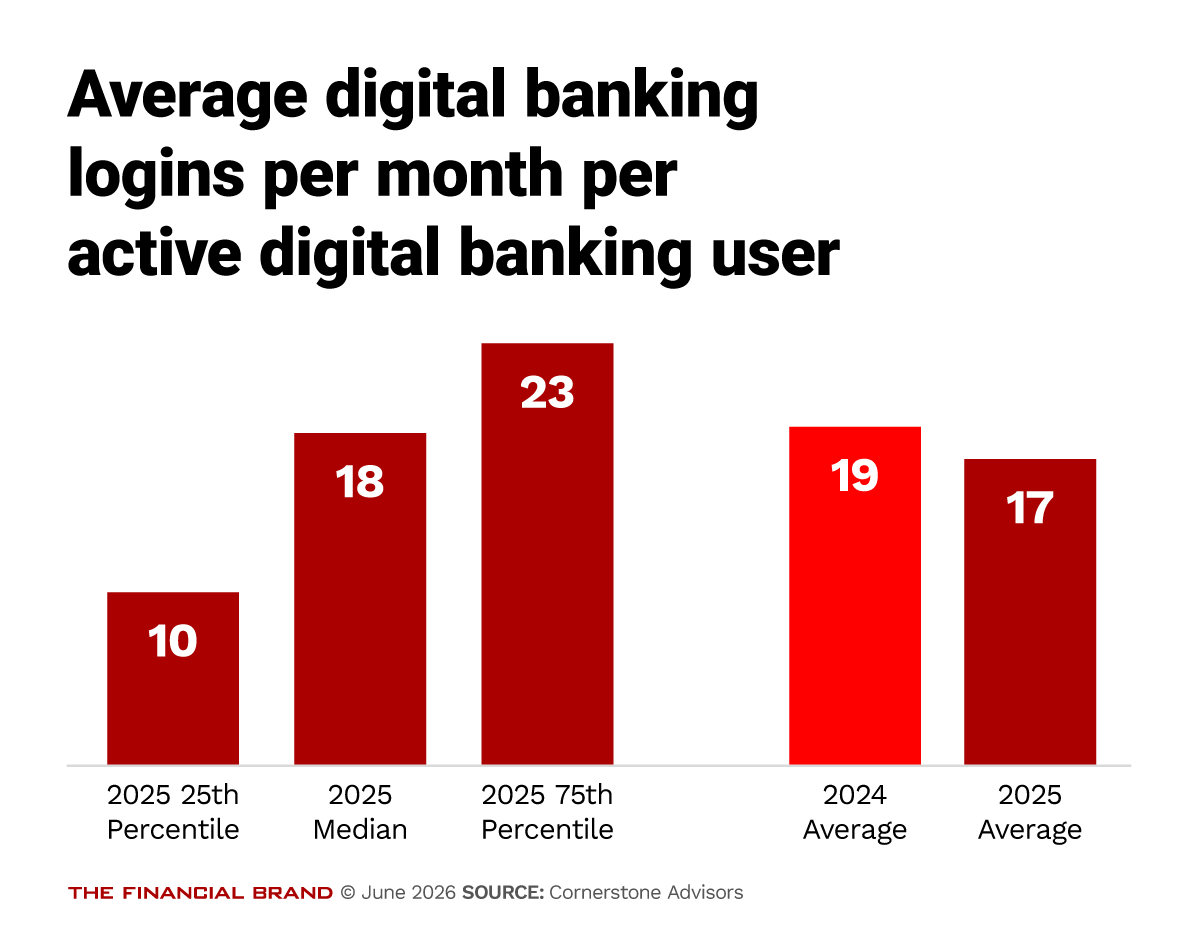
Key takeaway: For marketing and growth leaders, this shifts the digital conversation away from simple adoption campaigns. Measuring whether customers sign up for digital banking is increasingly insufficient. The more meaningful question is whether customers return often enough for digital channels to shape financial behavior.
Mobile payments illustrate how quickly habits can shift when institutions make digital functionality easier to use. Adoption nearly doubled in 2025, rising from 19% to 38%, while monthly transactions climbed from roughly six to more than nine per user.
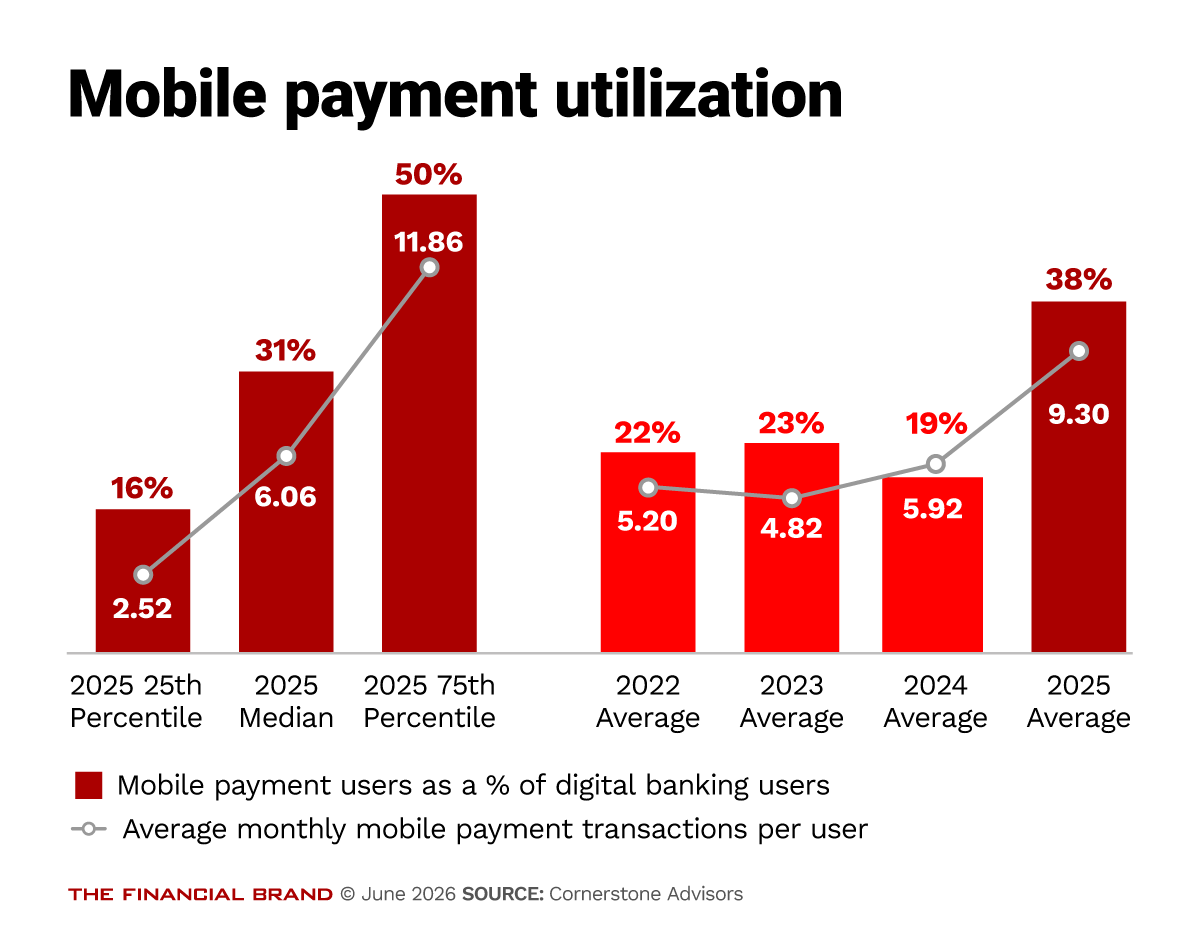
The acceleration suggests institutions are making progress integrating cards into digital wallets and embedding themselves more directly into customers’ payment routines.
At the same time, person-to-person payments tell a less encouraging story. P2P usage through a bank or credit union declined sharply, reinforcing what many institutions already suspect: consumers increasingly associate payments with platforms like Venmo and Cash App rather than their bank or credit union. In many cases, the institution facilitates the transaction without owning the relationship.
Growth Often Breaks During Onboarding
If there is one metric executives should pay close attention to, it may be digital account opening abandonment.
Digital checking account openings increased to 27% of total checking accounts in 2025, a welcome sign that consumers are increasingly comfortable opening accounts online. Yet growth is being constrained by onboarding friction.
Institutions lost an average of 3.36 digital applications for every successful account opened a figure that changed little from the prior year. Some institutions are losing more potential customers than they convert.
Customer acquisition investments become harder to justify when conversion processes stall midway through the experience. This makes digital onboarding an enterprise issue rather than a marketing problem. Improving completion rates depends on tighter coordination across fraud, compliance, digital experience, operations, and technology teams.
Digital lending offers a useful contrast. Retail loan applications surpassed 50% digital adoption for the first time, reaching 51% in 2025. That progress suggests consumers are willing to complete complex financial activities digitally when experiences feel intuitive and expectations are clear.
Key insight: The institutions gaining ground are reducing friction where customers already expect speed.
Features Matter Less Than Utilization
One of the report’s more revealing findings is how unevenly customers use digital capabilities.
Card management has become nearly universal, offered by more than 90% of institutions. Credit score monitoring and savings goal tools are also widely available. Yet utilization patterns reveal a disconnect between what institutions deploy and what consumers value. Credit score monitoring, for example, generated the strongest engagement despite being less universally available than card management. Personal financial management tools moved in the opposite direction, with utilization falling despite broader rollout.
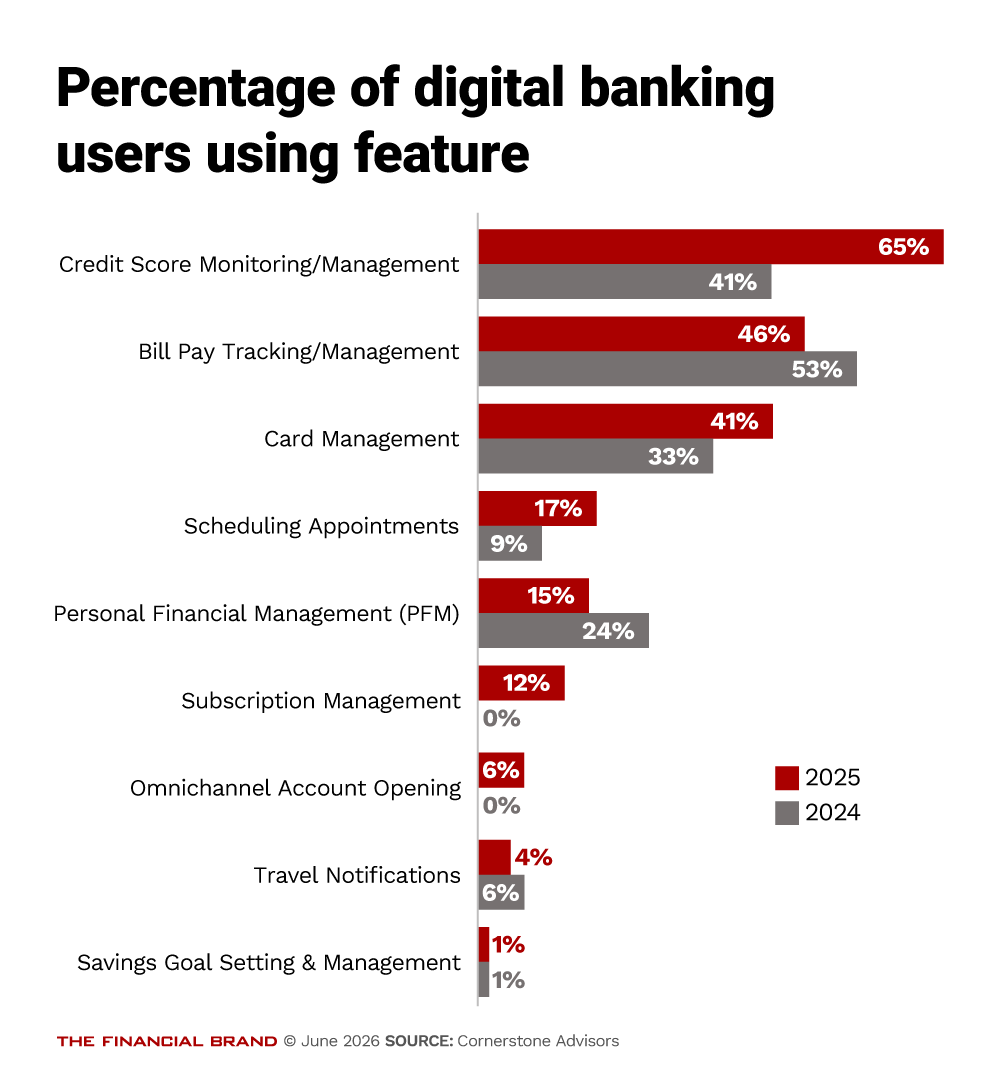
Key takeaway: This data should prompt a different conversation inside many institutions. Digital feature roadmaps often prioritize parity — matching what competitors offer. But parity does not necessarily drive engagement. Retail banking teams may see stronger results by identifying which features customers actually use and designing campaigns that reinforce those behaviors rather than continually expanding functionality.
Cross-sell results reinforce this point. Institutions added an average of 1.56 new products per digital user in 2025, up meaningfully from 1.22 the year before. More engaged digital customers are becoming more valuable customers.
Business Banking’s Digital Catch-Up
For the first time, the report also benchmarks business digital banking — an area where many institutions still trail customer expectations.
Business enrollment is respectable, with 65% of business customers enrolled in digital banking and 78% actively using it. Yet capability gaps remain significant. Only 17% of institutions reported offering online business account opening, and digital business lending remains uncommon. Features around cashflow forecasting, integrated receivables, and real-time payments remain far from standard.
The bigger challenge may be visibility. Institutions reported frustration around limited usage data and an inability to see the platform through business customers’ eyes. That creates blind spots in experience design and product optimization.
Bottom line: Institutions increasingly compete on how effectively they measure digital behavior and improve experiences around what customers actually do.


