
Schwab Is Now No.1 in Both Checking and Savings Satisfaction. Here’s How They Did It
In JD Power's latest ranking, Charles Schwab Bank surged past the competition to claim top spot for consumer satisfaction. How? Not by flogging sky-high rates. Instead, they lean into support services for customers facing challenging economic times.
By Steve Cocheo, Senior Executive Editor at The Financial Brand
Simple Subscribe
Subscribe Now!
Direct banks continue to drive higher customer satisfaction ratings compared to other banks, according to new research from J.D. Power. A key reason? The perception that these institutions are doing a better job taking care of their customers through challenging times.
The firm’s 2025 U.S. Direct Banking Satisfaction Study ranks satisfaction among direct banks that provide checking accounts and savings accounts. The company began evaluating retail financial institutions and other providers in terms of helpfulness in challenging times in the wake of Covid, according to Paul McAdam, senior director of banking and payments intelligence.
This yardstick includes consumer ratings on factors including:
- My problems are resolved, and phone reps resolve the problem on the call.
- Gives me the ability to gain financial knowledge and helps me improve my financial wellness.
- Enables me to access credit when I need it.
- Helps me improve my creditworthiness.
- Enables me to grow my money.
- Gives me the ability to gain financial knowledge and helps me improve my financial wellness.
This is relevant to strategy and product design in a period when other research indicates that fintechs are grabbing a bigger share of “churning” accounts than do banks and credit unions.
Direct banking providers don’t all serve the same clientele. For example, Charles Schwab Bank, the institution that topped both rankings of providers of checking and savings for the first time, doesn’t actually serve the general retail banking market. Account holders must have a brokerage account to use the bank. Other providers, such as Ally, serve a broader audience, while Varo specifically aims to be a more inclusive bank, targeting consumers who have felt ignored by traditional providers. The opening message on Varo’s website is, “Say hello to a 100% free bank account.”
“About half of Charles Schwab Bank’s customers have deposits of $10,000 or more there, whereas for a brand like Varo, it’s 3% who do,” says McAdam. He notes that Schwab bank — which we’ll have more to say about later — has topped the checking category for seven years in a row.
How Customer Satisfaction Plays Out Across Provider Categories
Satisfaction with a direct bank can be influenced by some factors beyond its control. McAdam points out that the more positive a consumer’s overall financial outlook, the more likely they are to feel their direct bank is supporting them.
McAdam says direct banks’ customers come from across the demographic spectrum, with the one common factor being a preference for banking remotely. By contrast, in other J.D. Power retail banking research, customers of traditional banks lean heavily on branches: 42% consider them essential to do their banking and 49% like the reassurance that they are there, even though they don’t use them much.
As the chart below shows, comparing overall satisfaction ratings among multiple providers over 2022-2025, feelings about direct banks as well as other providers, have fluctuated. (In our coverage of last year’s direct bank study, we noted that customer service issues were hurting some direct banks’ ratings.) But the direct banks have always outshone the others through the period cited.
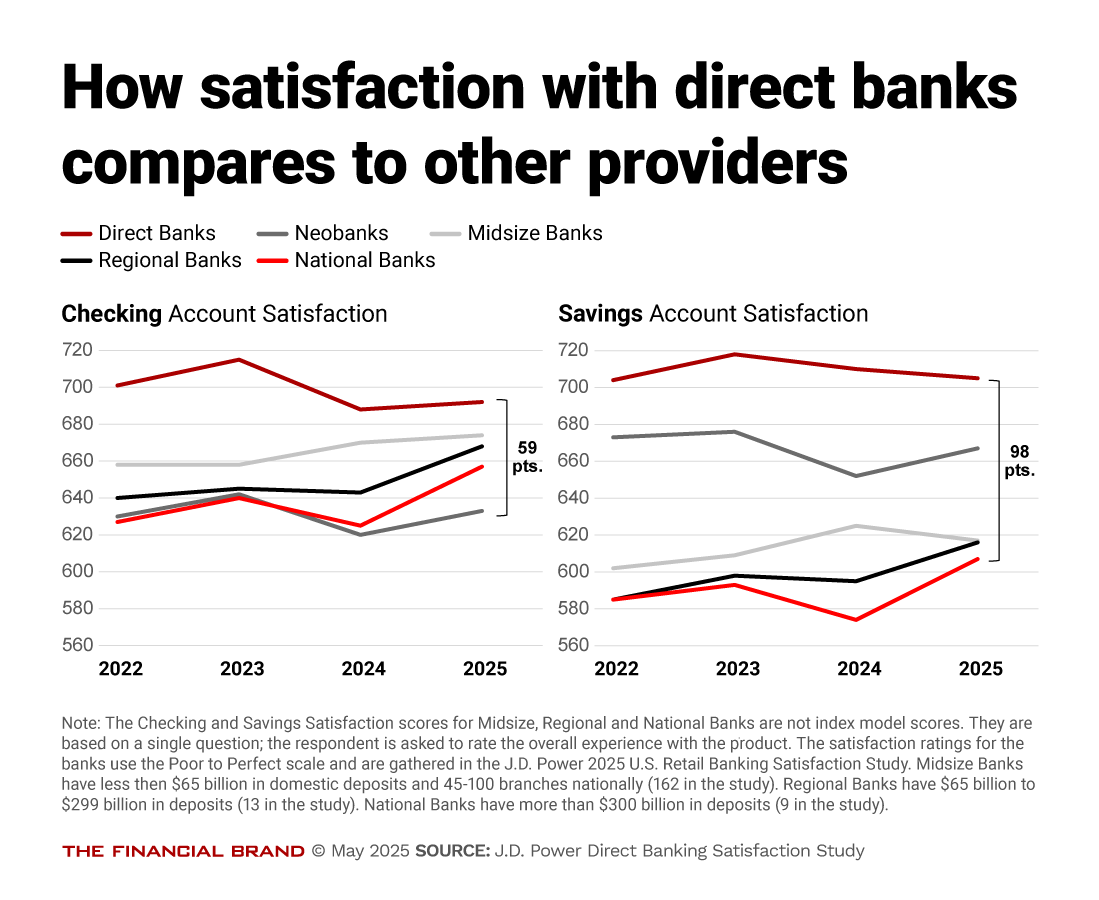
Granted, the direct bank edge may not last. As the both the checking and savings charts above show, larger banks — both national and regional institutions — saw a significant uptick in satisfaction ratings from 2024 to 2025.
“The bigger banks are offering advice moreso than in the past, and they’re also doing a lot better around fee communication, helping customers understand fees, and helping customers understand steps they can take to avoid fees,” McAdam says.
Neobanks rank at the bottom in terms of consumer satisfaction on the checking account side. As a group, they tend to be narrower in scope, which affects some aspects of the “helps me through challenging times” rating points. Some of these fintechs have been broadening their offerings, and Chime, in its IPO filing, sketched not only its present expansion of services but the major expansion of offerings and clientele it envisions.
The neobanks rank second, as a provider group, on the savings side. McAdam says this is chiefly driven by the rates paid.
Other than promotions to bring in new accounts, most national, regional and mid-size traditional banks are paying very little on savings, he notes. Neobanks have used interest rates as a lure for years.
“Neobank customers are younger, with somewhat weaker financial profiles in terms of financial health and pressures on their budgets,” says McAdam. “So, they place a little extra value on any way they can get a good deal. The neobanks, be it Chime or Credit Karma or otherwise, offering a better savings rate strongly resonates with that customer base.”
Read more: They Said It Couldn’t Be Done: Fintechs Gaining in the Race for Primacy
Looking at Charles Schwab Bank’s Double Firsts
Visit the Charles Schwab Bank website and an opening video makes it clear this is not a brand that serves the average American consumer. A few indicative quotes:
- “The money you have in your account is yours, and it isn’t going to be whittled away on gotcha fees.”
- “It’s a bank specially designed for investors.”
- “We’re a brokerage firm first, that has a bank. Not a bank that has a brokerage firm.”
- “White glove service.”
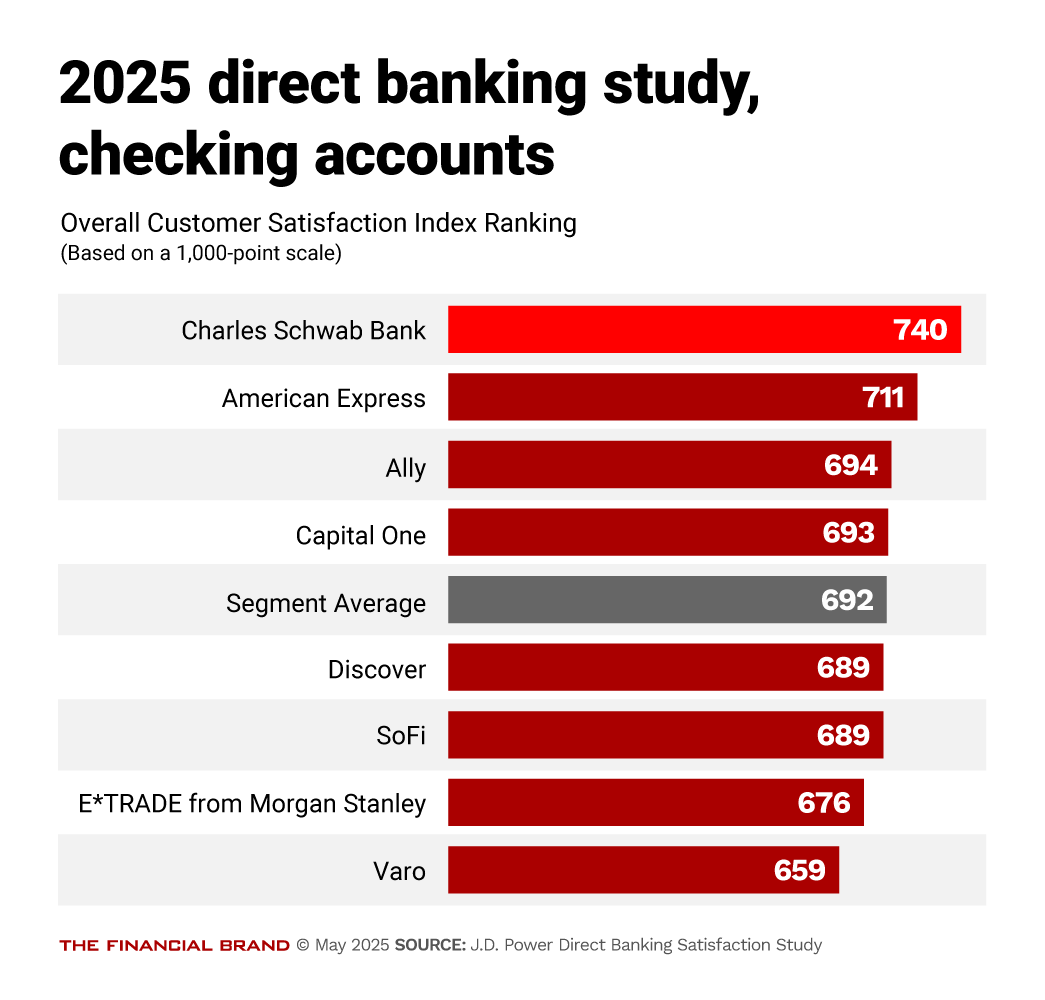
Schwab has ranked highest in overall satisfaction in the checking category for the seventh year straight, at 740 on a 1,000-point scale. The most meaningful factors in the overall ratings categories are managing a checking account through the mobile app and managing my checking account through the website. (These were also the top factors for direct bank savings accounts.)
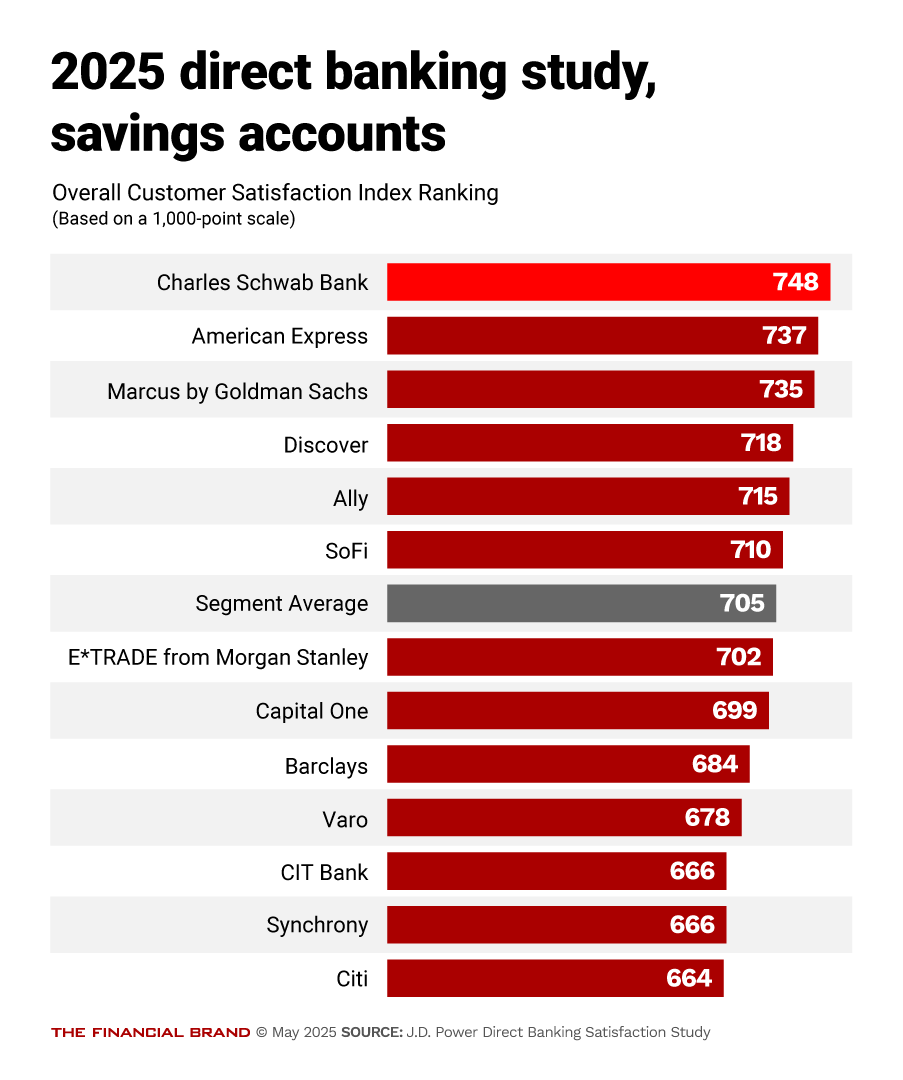
Notably, on the savings side, Schwab Bank’s savings account pays 0.15% APY, “not the 3.5%-4% savings interest rate that many brands are paying these days,” says McAdam.
He puts this down to the broader relationship that Schwab customers have with the company.
“Their customers view Schwab as helping them to grow their money holistically,” says McAdam. Satisfaction stems as much from brokerage performance, in terms of being pleased with the growth of money there, as anything else.
The bank offers a range of services beyond basic banking accounts and the parent’s brokerage. Schwab offers various types of consumer credit, for example. The range of services is reflected in the Schwab mobile app, one that pulls every part of the relationship into one place. McAdam notes that satisfaction with a provider’s app is part of J.D. Power’s evaluation of overall direct bank satisfaction.
McAdam also points out that higher-balance deposit customers, and those that have a money market account or investment account with their direct bank, are much more likely to feel that their institution supports them in challenging times.
“I’m sure these customers don’t need to call very often, but when they do, they’re getting top-quality phone service, so that certainly helps their overall picture as well,” says McAdam.
Read more: Should Banks Fear the Surge in Partnerships Between Credit Unions and Fintechs?
Where Direct Banks (and Everybody Else) Can Improve
Based on the study, McAdam says there are some areas direct banks, as well as other providers, can explore to improve customer satisfaction.
First is online chat. Whether the bank explores online chat with live representatives, a chatbot or a full-fledged virtual assistant, “that’s an area where all boats can still rise,” says McAdam. “We’re still in somewhat the early days.” He says this is a weak point in multiple direct bank brands.
Second is making debit-card service smoother. One of the frequent negatives that surfaced in the research is times when a depositor’s debit card fails. There are multiple causes, he says, including false positives generated by anti-fraud software, which may trigger a freeze that the consumer isn’t aware of until they are attempting a transaction.
Finally, in the ranking of digital channel and communication key performance indicators that going into the “supports me in challenging times” measurement, the top five are:
- It’s very convenient to reach customer service.
- The mobile app provides all information needed.
- The website provides all information needed.
- The features of the mobile app are completely understandable.
- The app is easy to navigate.
One more, from the study: Effective problem resolution, along with empathy displayed by phone reps, goes a long way to improving satisfaction.


