
The Trust Paradox: Why the Next Era of Retail Banking Hinges on AI Orchestration
By Jessica Kendall, Contributor at The Financial Brand
Simple Subscribe
Subscribe Now!
Imagine two retail banking customers facing urgent financial moments on a Friday afternoon.
The first customer notices an unfamiliar $450 pending charge on their mobile app. Anxious, they tap the in-app chat button, hoping for immediate assistance. Instead, they meet an automated bot that presents a standard menu of FAQ topics. When the customer types ‘speak to a representative,’ the bot prompts them to re-enter their account details. After being routed to a phone queue, the live representative asks them to verify their identity a third time and explain their issue from scratch. What began as a routine inquiry turns into a frustrating exercise in repetition.
Now, consider the second customer. Their bank detects unusual debit card activity in another state. Before the customer even notices, an automated AI agent initiates a proactive text message: “Did you just spend $450 in Chicago?” The customer replies ‘No.’ Within seconds, the AI agent temporarily pauses the card, issues a replacement, and transfers the interaction to a fraud specialist. The specialist opens the call already knowing the customer’s name, verification status, and exact transaction details. The entire issue is settled in under three minutes.
Reality check: These two experiences illustrate the central paradox facing retail banking today. In the first scenario, technology operates as a deflection wall — a barrier designed to keep customers away from human staff to reduce handling costs. In the second, technology acts as a protective shield — an intelligent layer that anticipates needs, preserves context, and builds long-term confidence.
Key insight: The future of retail banking CX won’t be defined by who automates the most calls, but by who orchestrates interactions to strengthen customer trust.
What 2026 Consumer Data Tells Us About Banking CX
To understand where customer friction occurs, industry leaders look to quarterly benchmarks. Metrigy’s Q3 2026 Consumer Experience Study offers valuable intelligence on consumer sentiment across financial services. Rather than rejecting digital service outright, consumers are indicating clear preferences about where automation adds value and where human connection remains essential.
The research highlights a primary source of customer frustration: identity re-verification and repeating information after transfers. Cited by 26.0% of consumers as their top operational grievance, this ‘context tax’ occurs when siloed channels fail to pass session data along the customer journey.
At the same time, consumer data establishes distinct boundaries regarding when human escalation is expected. When high-stakes or emotionally charged scenarios arise, customers want the reassurance of a human specialist:
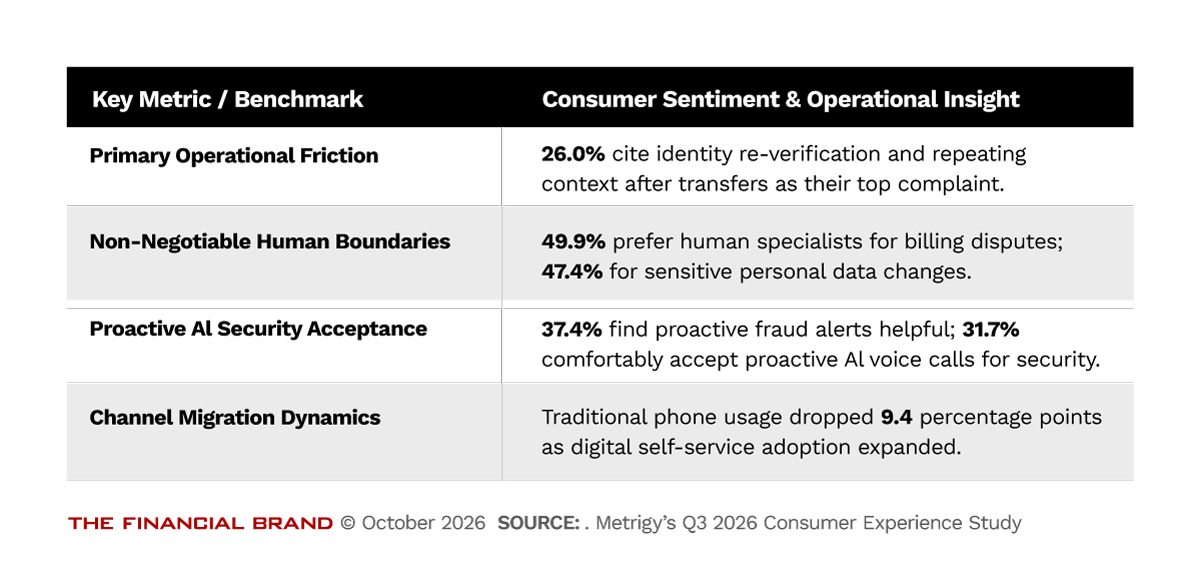
Key insight: Consumers do not dislike automated tools. In fact, 37.4% actively appreciate proactive fraud alerts, and 31.7% are comfortable receiving automated security voice calls. What consumers object to is being trapped behind rigid self-service tools when handling sensitive issues like billing disputes (49.9%) or lost funds (46.4%).
Retail Banking Breakthroughs: Modernizing Core Journeys
Leading financial institutions are moving toward integrated AI orchestration. By unifying digital self-service, agent assist tools, and core banking data, banks are elevating high-volume servicing and high-stress journeys.
A clear example is the transformation of debt collection and vulnerability management. Traditional collections relied on high-volume dialing systems that repeatedly contacted past-due accounts — an approach that often increased stress without improving recovery rates. Today, orchestrated AI agents analyze transaction patterns and early risk signals to detect financial hardship before accounts fall deep into default.
Key insight: Rather than placing abrasive automated calls, intelligent systems initiate supportive, low-friction digital outreach. The AI agent can offer personalized payment arrangements or adjust due dates within pre-approved credit guidelines. When complex situations require human empathy, the system routes the customer to a specialized representative with full interaction history attached. This approach protects customer dignity while significantly improving repayment outcomes.
Similarly, everyday account servicing — such as travel notifications, fee inquiries, and card reissuance — can be handled smoothly through conversational AI, freeing human branch and contact center staff to focus on complex advisory needs.
Proof Point: MoneyGram Eliminates Digital Onboarding Friction
When global money transfer provider MoneyGram overhauled its online platform, customer drop-off spiked during required government ID document uploads, driving up contact center call volumes. Instead of forcing customers to navigate standalone help pages or wait for live support, MoneyGram provided contextual, real-time prompts at exact points of hesitation.
By delivering timely guidance directly within the digital transaction flow, they reduced onboarding friction and achieved an 87% increase in loyalty program enrollment during rollout, alongside a 10 percentage point rise in overall digital engagement. Crucially, business teams were able to manage and update these contextual rules independently without relying on IT roadmaps.
Proof Point: Boosting Loan Bookings with Proactive AI Engagement at Fairstone
Fairstone, a prominent consumer finance lender, sought to improve completion rates for personal loan applications without placing additional burdens on call center teams. By deploying a proactive conversational AI agent, Fairstone engaged applicants at crucial decision points in the loan lifecycle. Rather than waiting passively for customers to call with questions or abandon application forms, the proactive AI reached out with contextually relevant, conversational guidance. This proactive model drove digital application completion, resulting in a 10% increase in total loan bookings while delivering a seamless, highly responsive customer experience.
The Strategic Blueprint: 4 Pillars of AI Orchestration
Transitioning from isolated chatbots to enterprise orchestration requires a clear architectural foundation. Forward-thinking retail banks focus on four core pillars:
- Unified knowledge and memory: To eliminate the ‘context tax,’ customer data, transaction history, and prior conversation records must flow seamlessly across mobile apps, web chat, IVR, and branch systems. When an interaction shifts channels, the context shifts with it.
- Composite AI architecture and governance: As detailed in industry frameworks, retail banks must combine generative AI natural language capabilities with deterministic, rules-based guardrails. This Composite AI model ensures conversational responses remain compliant with strict banking regulations, PCI-DSS standards, and privacy requirements.
- Proactive engagement over reactive support: Rather than waiting for customers to report problems, orchestrated systems monitor account indicators to deliver timely alerts — such as upcoming balance shortfalls or suspicious login attempts — before friction escalates.
- Invisible human to AI handoffs: When an automated conversation approaches human boundaries — such as a billing dispute or fraud report — the system transfers the interaction to a live specialist alongside real-time intent summaries and verified customer status.
Beyond Automation: Building the AI-Orchestrated Bank
Retail banking relationships are built on trust. When institutions deploy technology solely to reduce contact volume, they risk alienating the very customers they seek to serve.
Bottom line: By replacing rigid deflection barriers with intelligent AI orchestration, retail banks solve everyday customer problems smoothly and predictably. In doing so, they eliminate unnecessary effort, respect human boundaries, and earn the trust required to guide their customers’ long-term financial journeys.


