
Why Cardholders Switch, and What It Takes to Keep Them
By Nicole Volpe
Simple Subscribe
Subscribe Now!
Credit card issuers know how important it is to achieve top-of-wallet status. Being a consumer’s most-used card can have a significant impact on revenue and profitability, increasing net interest margins, customer lifetime value (LTV), and the interchange and other fees it earns. Consider the following:
- Primary cards generate significantly more interest and fees because gross interchange scales based on total volume and most-used cards tend to hold higher monthly balances.
- Once a primary card is set as default across merchant ecosystems (e.g., Amazon, Apple Pay, Uber, Netflix), cardholder inertia creates a deep moat — because updating defaults is a high-friction activity.
- Issuing institutions tend to enjoy much higher net promoter scores with primary cardholders, which increases conversion rates for high-margin cross-sell products such as personal loans, high-yield savings accounts, and auto financing.
The good news for issuers is that most primary cardholders are loyal. In a survey of 2,460 consumers conducted by Elan and PYMNTS Intelligence, 64% of respondents said they had kept their primary card over the past two years, and 75% of those loyalists said they had never seriously considered switching.
Key insight: Top-of-wallet status can also be brittle and once it reaches a breaking point, hard to maintain. Data shows that a consumer considering a change moves quickly: 71% said they made their choice within a month of deciding to switch and 17% said it took them less than a week. Switchers also said they rarely comparison-shop — 38% considered only the card they chose and 40% weighed just one alternative.
Moreover, the risk is not small: 36% of respondents say they’ve switched in the past two years, which extrapolates to about 78 million people. While 28% (corresponding to 60 million people) characterize themselves as at least somewhat likely to switch in the next 12 months.
Where Issuers Go Wrong
For issuers, losing top-of-wallet status is fundamentally a stealth problem. It can creep up on a cardholder relationship the way going broke happens in a Hemingway novel: “gradually and then suddenly.” By the time the issuer gets the message — typically by noticing that an individual’s usage has plummeted — the relationship is gone. For nearly half of switchers (46%), there is no contact at all between cardholder and issuer prior to the status change.
Meanwhile, the experiences of the other switchers strongly suggest that issuers haven’t cracked the code on recovery and win-back. Respondents who said they’d switched fall into three categories: Switchers who contacted their issuer but decided the issuer’s offer fell short (20%). Switchers who contacted their issuer and received no resolution offer at all (17%). And switchers who received a proactive call from their issuer who then failed to make a meaningful stay offer (17%).
To understand why issuers struggle to prevent switching, it’s helpful to compare the retention offers issuers are likely to make with the ones cardholders say they would need in order to stay. In this respect, the findings expose a disconnect:
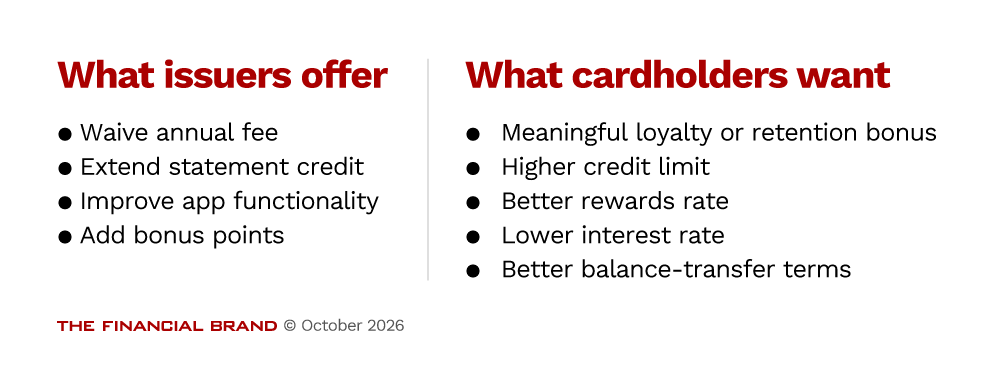
Key insight: The survey reveals that issuers mostly think in terms of one-time incentives, while cardholders seek a meaningful and/or sustainable monetary benefit. Critically, only 13% reported that their relationship was beyond recovery, regardless of offer.
The Dynamics of Switching
Issuers’ struggle to defend top-of-wallet status is compounded by the fact that the drivers and behaviors of switching can be subtle.
The following are key takeaways on switching dynamics, along with related advice for issuers.
1. You’re not losing your primary cardholders, they’re being wooed away.
It’s easy to assume that cardholders switch because something drove them away, but the data suggests the opposite. Nearly half of switchers (46%) said they weren’t dissatisfied with their old card at all but that they discovered a better offer. And the reasons cardholders give for choosing a new card consistently outweigh their complaints about the old one: a better rewards rate (cited by 38%), a higher credit limit (36%), and a sign-up bonus (30%) all ranked above the leading grievances, such as a rewards program losing value (28%) or a fee increase (23%).
The implication is that avoiding potential switch triggers — for example, by holding fees and rates steady — won’t necessarily reduce departures. Instead, program managers should start by developing and maintaining competitive awareness, regularly reviewing card portfolios in the context of the best offers in their served community or market. They can then take active steps to ensure their cardholders are aware of their card’s advantages.
“That’s why it’s so critical to update products as consumer preferences shift,” said Mitch Pangretic, SVP, Director of Strategic Partnerships at Elan Credit Card. “That means having a product team that is continually researching consumer preferences, studying market trends, creating ROI forecasts, and investing in products that deliver meaningful value across the credit spectrum and generations.”
Such insights can also help define retention tactics that go beyond small-value responses like one-time fee waivers. Similarly, issuers should develop a programmatic approach to flagging cardholders at risk — including shifts in spending patterns and balance transfers — and a rapid-response approach to keeping them onside.
2. ‘Card switching’ is really ‘spend shifting’
When a cardholder changes their primary card, they’re not necessarily going out and getting a new one. According to the survey, 58% of the time, switchers elevated a card that was already in their wallet rather than bringing a brand-new card into the mix.
The key learning here is that the real battle is over share of the accountholder’s spend and that a rival issuer can make a significant inroad at any moment — by, for example, promoting a new double-rewards feature or raising a credit limit.
3. Past switchers are likely to switch again.
Among cardholders who changed their primary card in the past 24 months, 29% say they are likely to switch again in the next 12 months. Among those who have not switched, just 5% say they are likely to switch. This carries an uncomfortable implication for acquisitions: When institutions win new cardholders by luring them from rivals, they are acquiring consumers who already have a high switching propensity.
This is especially true if your acquisition campaign is built around a teaser rate — in which case the relationship is not unlike that of a “hot money” consumer who chases a CD rate. For issuers, that argues for implementing an ongoing engagement program early in the cardholder’s lifecycle, taking steps to progressively strengthen the value proposition beyond rates and fees.
4. Value proposition and age demographics are strong predictors of switching.
A cardholder’s likelihood of switching can be traced back to the reason they got the card in the first place. Those drawn by defensive or utilitarian value propositions — fraud or dispute protection (24%) or credit-building (21%), for example — are more than twice as likely to switch as those drawn by rewards (10%).
Switching likelihood also varies by generation, with risk rising among younger generations: Gen Z (26%) and Millennials (20%) respondents say they’re likely to switch far more often than Gen X (9%) and Baby Boomers (3%). Drilling down, Gen Z respondents who have switched say they were drawn to new cards by specific terms: a better rewards rate, higher credit limit, or a sign-up bonus. At the same time, 66% of Gen Z say the issuer’s mobile app matters to their loyalty, compared with 37% of Baby Boomers.
Bottom line: Card rewards programs are among the stickiest offerings in financial services, but they can also be expensive to operate. “Rewards programs are fundamental to a competitive credit card program but will consume capital by funding the redemptions. It can be challenging when the rewards value consumes the majority of interchange income earned, especially when the issuers portfolio has a high number of transactors — where they are not earning finance charges,” Pangretic said. He cited cash-back products as an example, which consistently rank among the most attractive rewards options for consumers, but are also among the most expensive programs to support.
Card program strategists might also consider building acquisition and retention strategies around younger cardholders and those living paycheck to paycheck. As part of this, they should strengthen digital experiences and offer targeted credit line increases or personalized incentives.
The survey’s findings about Gen Z may be most compelling for institutions seeking long-term sustainable growth. Gen Z represents the future of every financial institution’s cardholder base. Their high propensity to switch sets the stakes even higher, especially when combined with the pivotal role credit cards play in building primacy and LTV. Viewed in this light, taming card switching — the monitoring, the competitive intelligence, the rapid response — takes on greater importance.
The institutions that take a comprehensive approach to cardholder switching, treating it as an always-on program, are the ones that will keep their place at the top of the wallet for generations to come.


