
The K-Shaped Consumer Is Giving Way to Something More Complicated
By Jessica Kendall, Contributor at The Financial Brand
Simple Subscribe
Subscribe Now!
For much of the post-pandemic recovery, the U.S. consumer economy has been defined by a widening gap between higher- and lower-income households. That K-shaped pattern is now beginning to converge.
Bank of America Institute’s latest data shows spending and wage growth moving closer together across income groups, with lower-income households gaining momentum. That convergence is happening alongside signs of broadly healthy household finances, including stronger credit card repayment and relatively stable savings and deposit balances. The wealthiest households remain an important exception, with rising equity values helping sustain their spending even as wage growth moderates.
Why this matters: For retail banks, the shift has implications well beyond the economic outlook. As consumer financial trajectories become less predictable based on income alone, banks may need to rethink how they identify emerging opportunities, segment customers and tailor products and engagement to a broader range of households.
Need to Know:
- Spending and wage growth have converged substantially across lower-, middle-, and higher-income households since May, with the top 5% remaining the notable exception.
- Lower-income households are gaining financial momentum. Their spending grew 5.4% year over year in July, while after-tax wage growth reached 5.2%, effectively closing the gap between income growth and spending growth.
- More households across income groups are paying their credit card balances in full each month, while savings and checking balances remain elevated relative to inflation-adjusted 2019 levels.
- Total card spending per household grew 5.0% year over year in July, down from 6.3% in June but still one of the strongest readings of the past three years.
- The S&P 500 was up more than 20% year over year in July, helping support spending among the top 5% of households through the wealth effect.
The K-shaped Economy Begins to Converge
Since May, spending and wage growth have narrowed substantially across income groups. By July, spending growth had largely converged among lower-, middle-, and higher-income households, excluding the top 5%. Lower-income households posted 5.4% year-over-year card spending growth in July, compared with 4.9% among middle-income households.
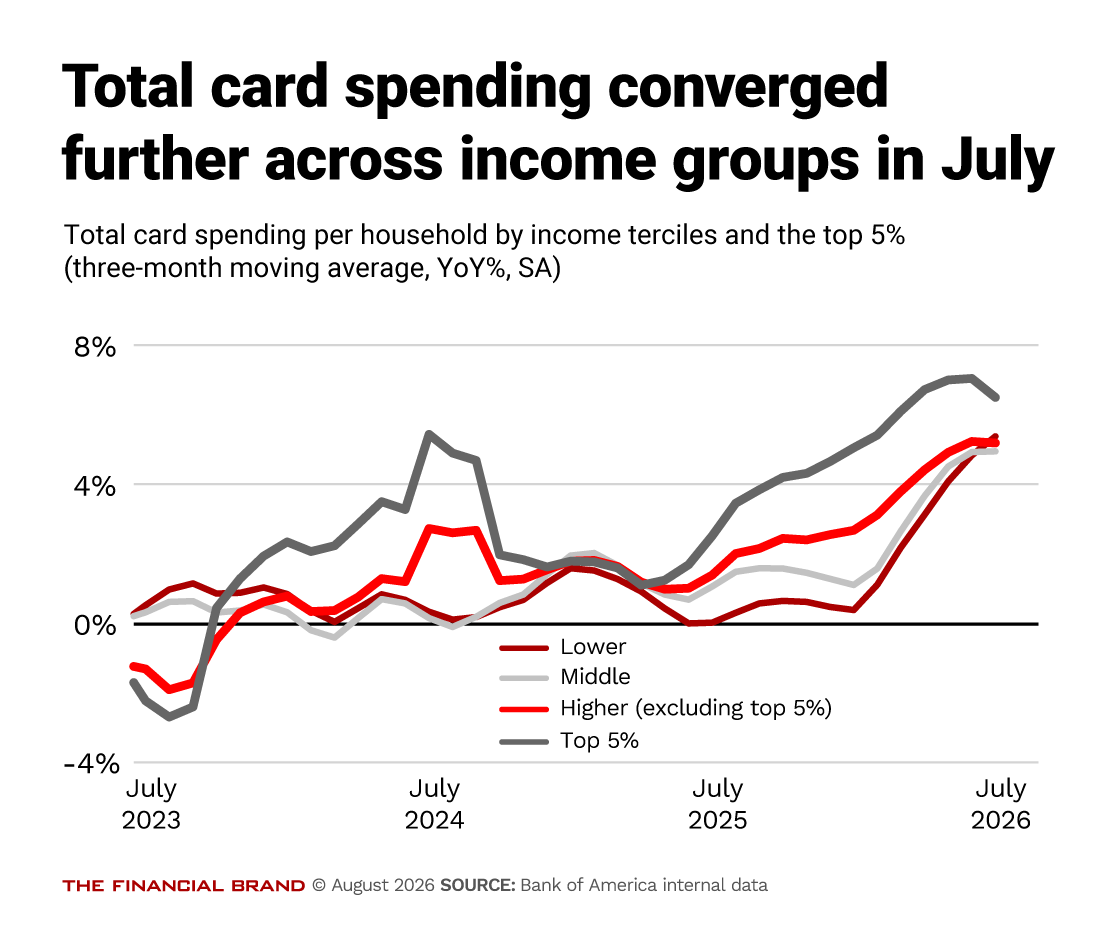
Wage data helps explain the shift. After-tax wage growth reached 5.2% among lower-income households and 4.2% among middle-income households in July. For lower-income households, the gap between spending growth and wage growth has effectively disappeared, leaving their finances more balanced than they have been during much of the recent recovery.
Key insight: The change is important because the K-shaped economy was defined by more than different spending levels. It reflected different financial trajectories. Higher-income households generally had greater capacity to spend, while lower-income households faced greater pressure from rising costs and slower income growth.
The result is a consumer economy in which the sharp income-based divergence of the past several years is becoming less pronounced, particularly below the very top of the income distribution.
A Broader Consumer Market Is Emerging
The convergence becomes even more interesting when looking at individual spending categories.
Higher-income households still significantly outpace lower-income households in airlines and clothing, while maintaining an edge in areas such as general merchandise, lodging, and durables.
But the gaps have narrowed meaningfully over the past six months, particularly in lodging, airlines, and clothing. Lower-income households have also surpassed higher-income households in restaurant spending growth.
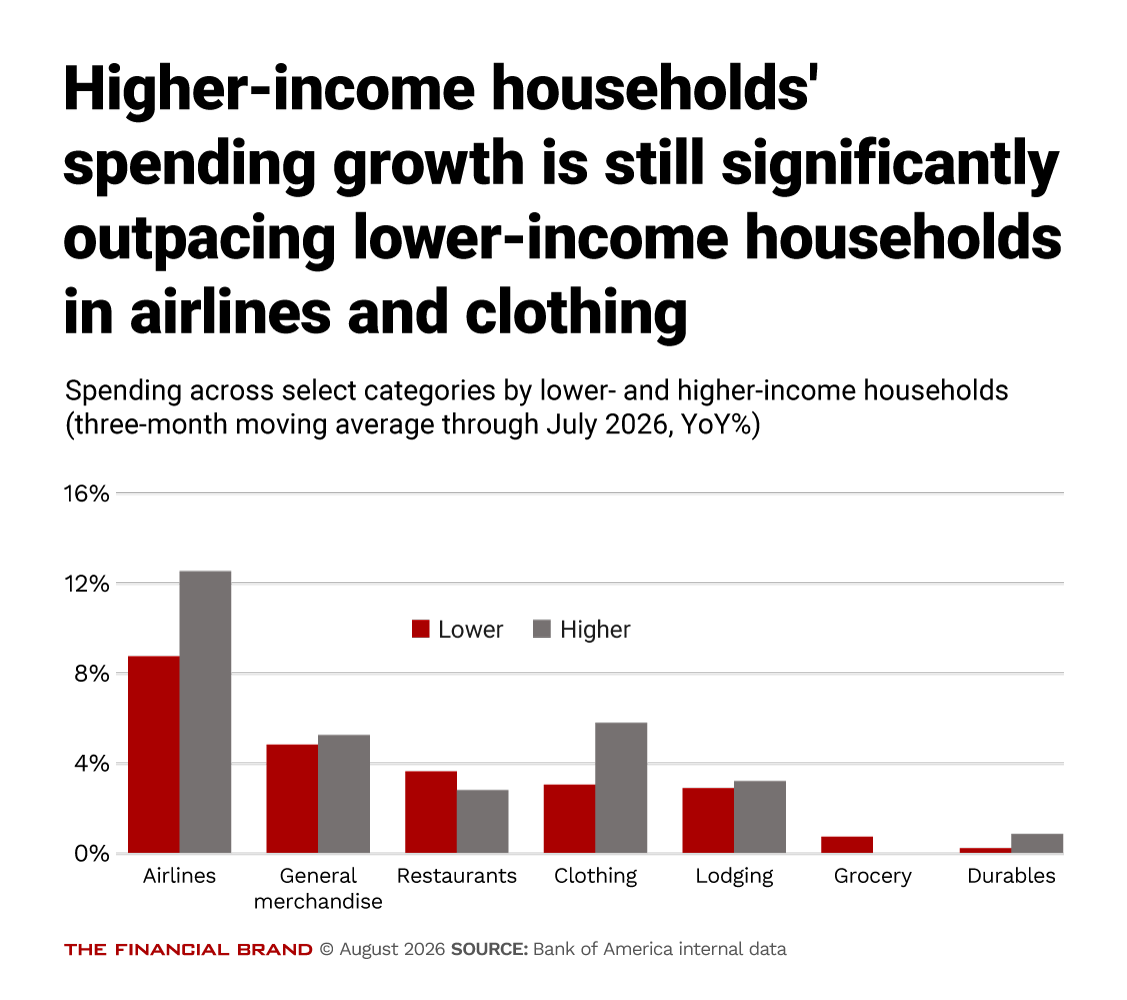
That broader participation in discretionary spending gives banks a reason to look beyond income when evaluating customer behavior. A household’s income provides useful context, but changes in wages, spending, and other financial indicators can offer a more current view of its financial trajectory.
Key insight: For marketers and business leaders, that distinction can shape how customers are segmented and prioritized. A consumer whose income category has remained unchanged may nevertheless have moved into a meaningfully different financial position. Banks that incorporate those changes into their customer strategies can develop a more nuanced picture of who is gaining financial momentum and where needs may emerge.
Financial Health Gives Banks Room to Engage
The convergence in spending is occurring alongside signs that consumers’ broader financial positions remain relatively healthy.
Across all income cohorts, a greater share of households are paying their credit card balances in full each month. The share making only minimum payments has also increased in 2026, but at a slower pace than the increase in full-balance payments.
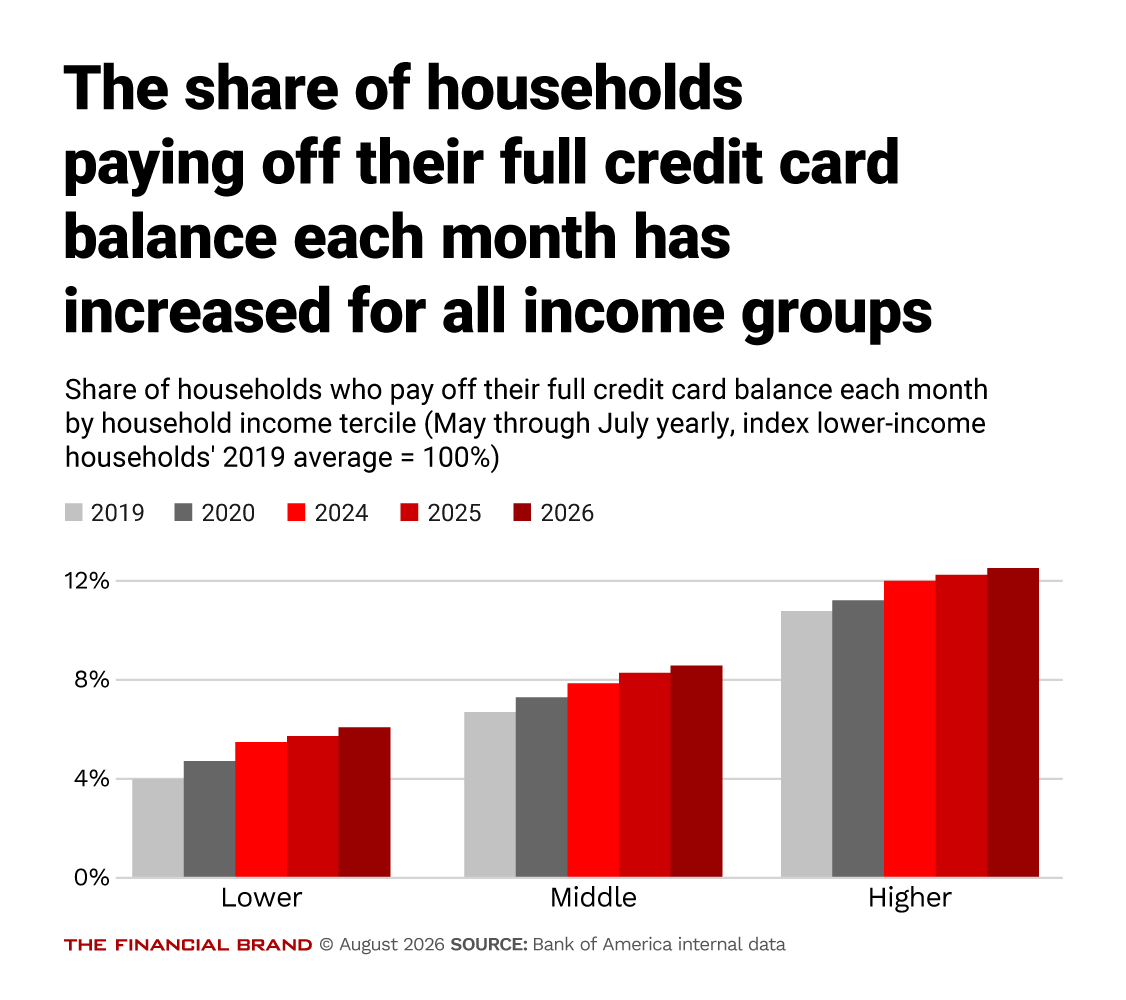
Savings and checking balances provide another encouraging signal. Following larger tax refunds in 2026, household savings and deposits remain elevated across income cohorts, with no significant acceleration in withdrawals.
Together, these indicators point to a consumer environment with more financial resilience than the K-shaped narrative suggests. Consumers are spending, wage growth is becoming more broadly distributed, and many households retain financial reserves. That gives banks more room to think about growth across a wider portion of the customer base rather than concentrating attention on consumers who already have the strongest financial profiles.
The top 5% still deserves separate consideration. Their spending continues to outpace wage growth, and Bank of America attributes much of that strength to the wealth effect created by higher equity prices. The S&P 500 was up more than 20% year over year in July, while the highest-income households are disproportionately exposed to directly held equities.
Why this matters: The K-shaped economy has not disappeared entirely. Instead, the two sides are moving closer together while the wealthiest households continue to operate on a somewhat different economic track.
For bank marketers and business leaders, the exception reinforces the larger lesson: income alone does not explain financial capacity. The strongest growth opportunities may not sit neatly inside traditional income segments. Banks should watch for changes in wages, spending, deposits, credit repayment, and other indicators of financial momentum, then use those signals to inform how they prioritize customers and tailor engagement.
Bottom line: As the gap between income groups narrows, banks have an opportunity to build growth strategies around a more nuanced view of financial health—one that recognizes changes in a customer’s circumstances rather than relying on income as a proxy for where that customer is headed.


