
Sure That Your Digital Banking for Small Business Is Competitive? Think Again
By Steve Cocheo, Senior Executive Editor at The Financial Brand
Simple Subscribe
Subscribe Now!
If your bank or credit union is offering small business owners digital services that are merely online and mobile consumer banking with a different coat of paint, offerings from both fintechs and (increasingly) major banks are poised to erode your share.
In recent years, small companies have shown strong interest in fintechs that provide accounting, payment, invoicing, investment and more services combined with a banking engine, either provided by the small business’ own bank or a bank partnering with the fintech. Other offerings include accounting packages like Autobooks and Quickbooks that operate seamlessly with small businesses’ bank accounts, and which have been adding on other services, such as payments, as well.
The largest banks have been fighting back. In Keynova Group’s latest Small Business Digital Banker Scorecard, many of the 11 major banks studied are busy filling the gap between too-simple service and full-fledged business service with treasury management and other sophisticated products.
Why this is a wake-up call: “They’re finally paying attention and not just saying, ‘Here’s a consumer banking platform that we’ve slapped a small business label on’,” says Susan Foulds, managing director. “They’re designing things now with small business customers specifically in mind, that are almost like ‘cash management light’.”
Need to Know:
- Major banks’ small business digital options are improving, especially with increasing options for both inbound and outbound payments.
- Digital services increasingly include payment options like the ability to conduct company transactions via credit cards, automated clearinghouse transfers, and instant payments.
- Built-in features like customized invoicing and cash flow give small business clients an alternative to third-party fintech platforms.
Countering the Fintech Factor
Fintech players such as Mercury, Rho, Relay, Bluevine and Brex give small companies digital options once unavailable to their part of the food chain. (Capital One bought Brex earlier this year, but the fintech continues relationships with its banking as a service partners.) Pricing ranges from limited free versions to monthly fees of hundreds of dollars for a multitude of functions and multiple usage “seats.”
Competitive insight: On a webpage seeking bank partners, accounting provider Autobooks leads its appeal with this message: “Your small business customers are already looking for these tools. The question is where they find them.”
Autobooks argues that the more that banks and credit unions sit back and watch small business customers adopt fintech services that put depository institutions in the background, the less visibility they will have into the small firm’s operations.
Foulds says the new digital capabilities added by major banks now need to be adopted by midsize and smaller institutions to enable greater industry competition. Making more services available through the banking provider also saves steps for swamped business owners, Foulds adds.
Design insight: Until a small business gains significant momentum, tools offered by their banking provider have to be workable for owners who double as their own finance staff, says Foulds. She adds that while increasing mobile capabilities are important to develop, desktop computing often plays a bigger role even now in small business digital banking than it does among many consumers.
Read more: Banks Seek Uses for Tokenized Deposits as Pressure from Stablecoins Rises
Major Banks that Offer Small Firms a Payments Hub
Keynova’s study found that more banks are giving small firms a broader array of business-oriented payment choices in more of a retail banking presentation. Foulds believes that businesses at different stages and sizes have differing payment needs, so offering a variety of channels is helpful.
Foulds says that Chase has offered a small business payments hub for some time. A newer example is U.S. Bank’s overhaul of its small business payments services. Foulds likes the payments center’s user experience as well as the range of choices. She expects more of the big banks to either build their own such centers or further revamp their existing payment functions.
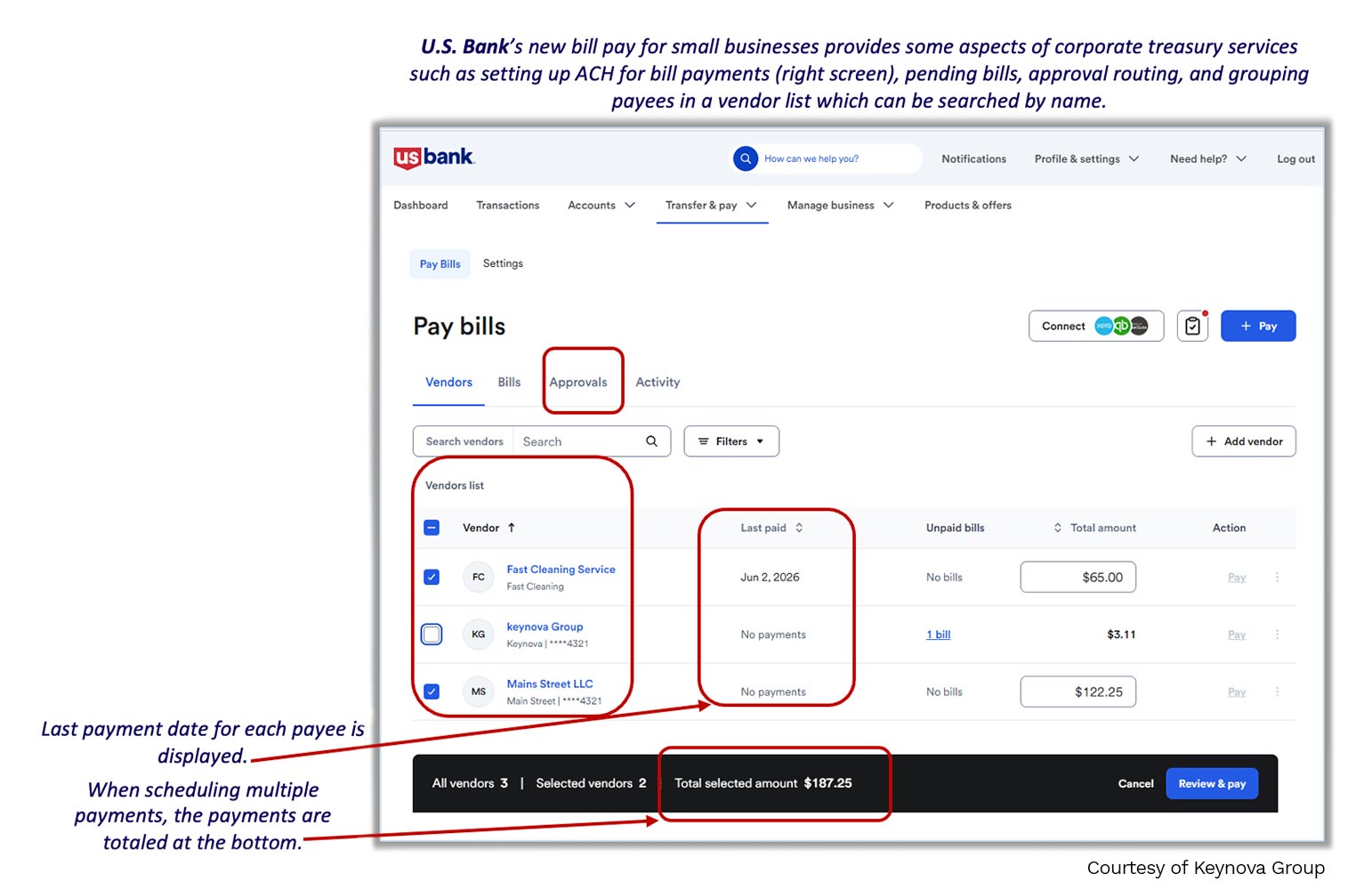
“You can enter a credit card to pay a bill and you can enter ACH routing information in order to pay a vendor directly from your account,” says Foulds of the U.S. Bank hub. Payments via ACH, entered one at a time, are handy — and cheaper — for businesses that only need to send a handful monthly, rather than many recurring ones.
Why this matters: The ability to make a payment via a credit card through the hub can save steps for the owner.
“Small businesses often have many miscellaneous items they want to charge to a business account, so they don’t have to reimburse someone who makes a personal charge, which then means the hassle of expensing it and reimbursing them,” says Foulds. The bank’s hub integrates management of pending bills, approval routing, and searchable vendor payment lists.
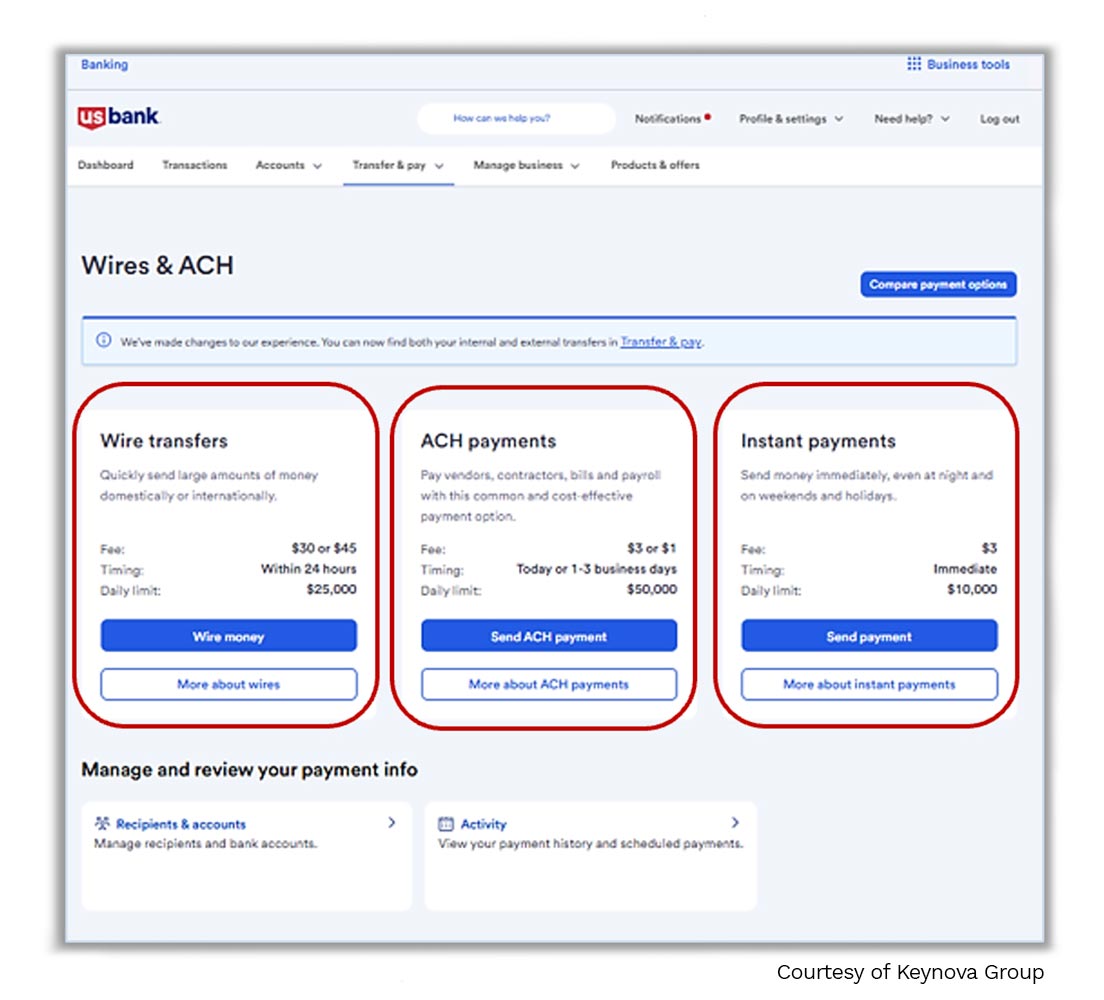
Of the institutions that Keynova studied, 73% offer some means of paying via ACH, while U.S. Bank’s credit card payments represent a leading-edge practice among the banks.
“The credit card option comes in handy if your vendor or biller accepts credit cards, and many do,” says Foulds.
Key insight: The fintech Melio, which specializes in payments, actually permits small business owners to make payments via a personal credit card, in order to conserve cash.
Thus far only three of the banks studied — Chase, Citi and U.S. Bank — offer firms the ability to make instant payments through their small business digital services.
Read more: Stop Managing B2B Payments Like It’s 2010
Inbound Payments: Helping Small Firms Invoice for Their Receivables
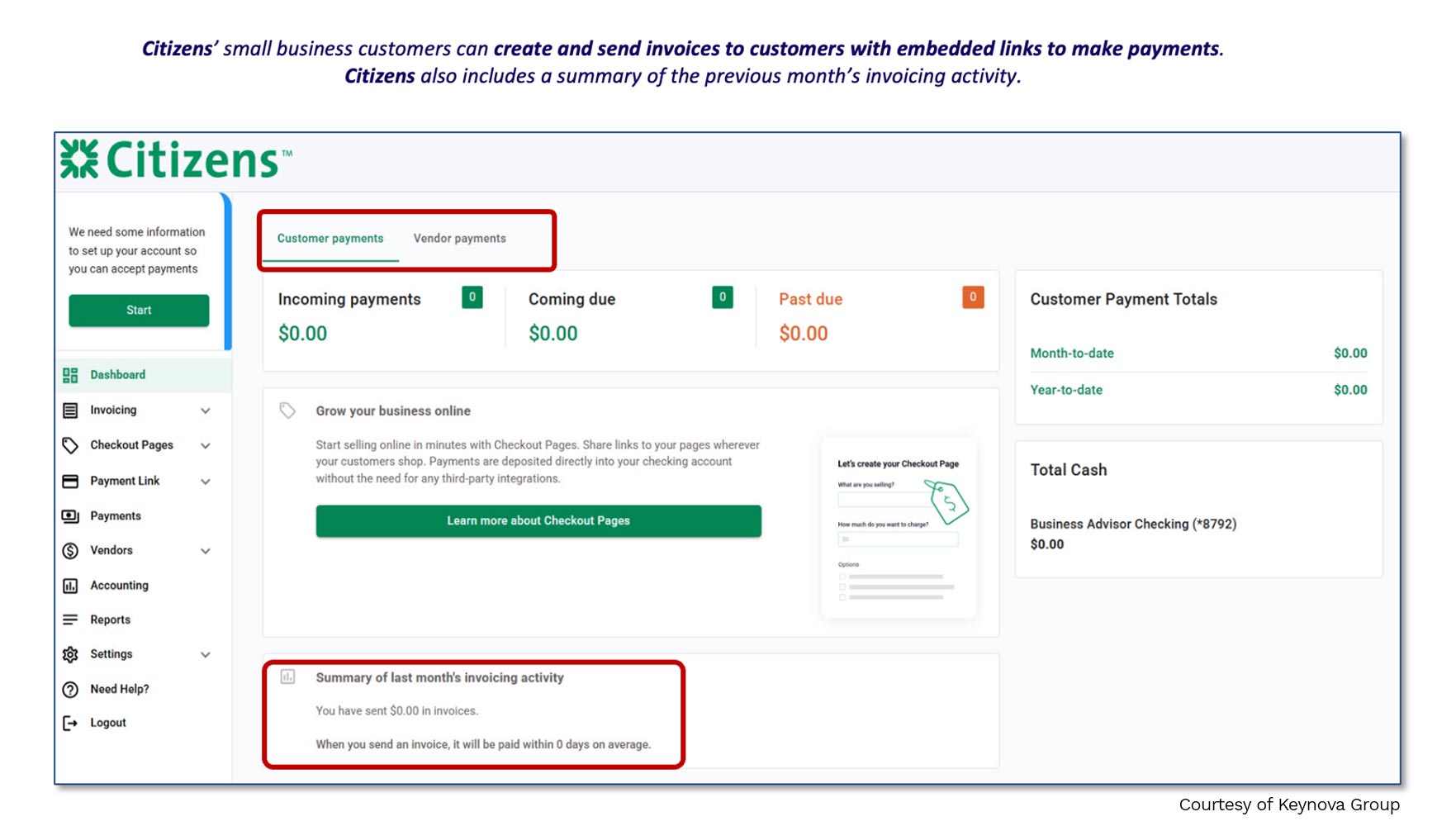
A popular third-party product is invoicing, enabling small firms to streamline the generation and processing of billing and inbound payments. Keynova found that banks are either partnering with third-party invoicing apps or developing their own capabilities to build invoicing and payment collections into their small business digital services.
Two banks that have impressed Foulds in this regard are Chase and Citizens.
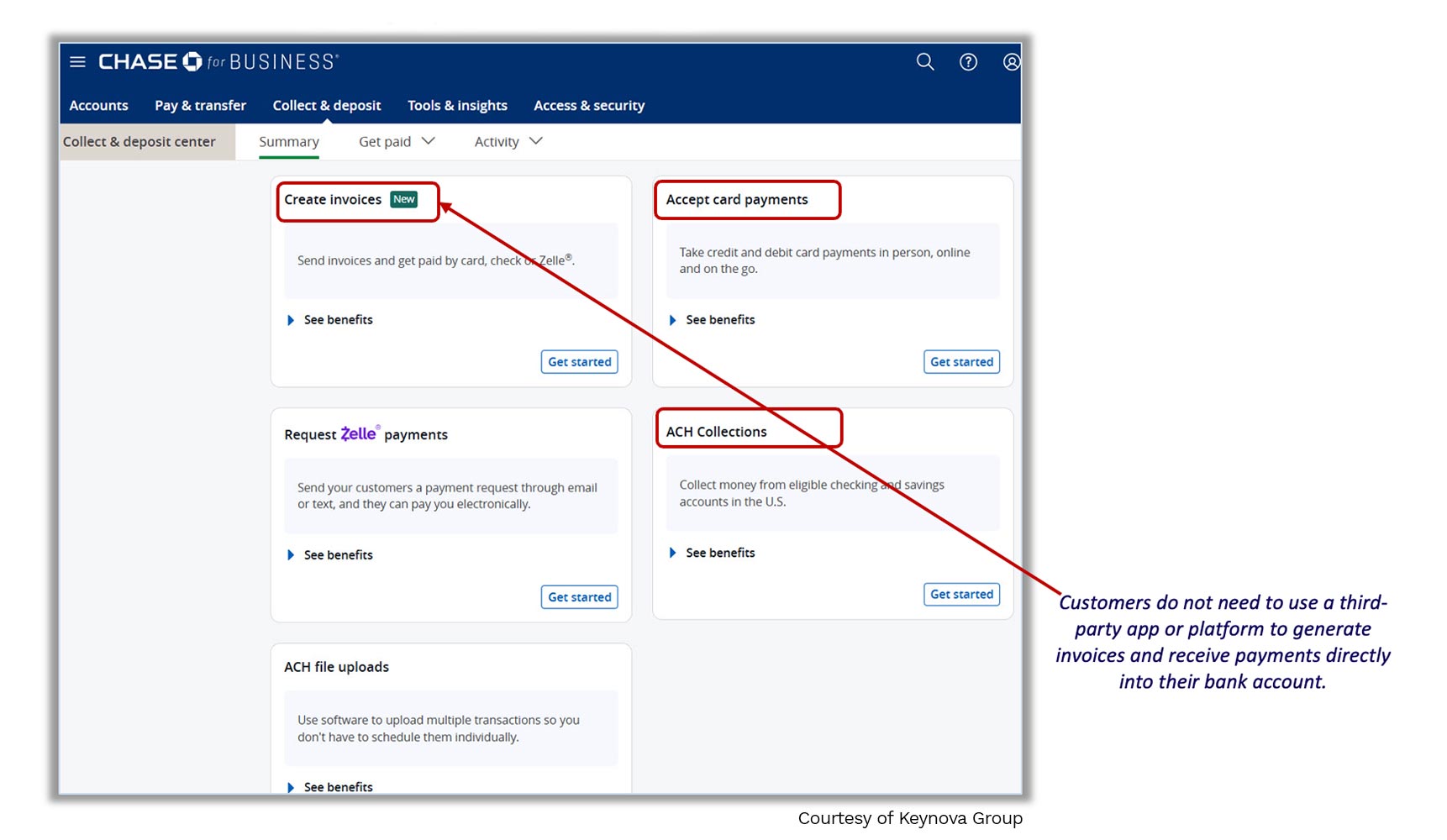
In both banks’ cases, the client doesn’t need to use a third-party app to generate and send invoices. Overall, 73% of banks offer the ability to send digital invoices with links that enable customers to receive payment directly into their bank account.
Keynova also found that some of the banks studied have been adding services that streamline receipt of payments into small firms’ accounts. Nearly 40% of the banks now enable firms to accept incoming card payments, for example.
This is accomplished by tying the banks’ merchant services function — typically a separate entity in the bank — into the institution’s small business digital interface.
“The banks have come a long way here, and they’re doing it in a way that is simple, versus cash management platforms that are intended for people in larger businesses with accountants and other finance staff,” says Foulds.
The firm found that a third-party add-on some banks have tapped is integrated invoicing and reporting service. The tool keeps tabs on paid and unpaid receivables and can send reminders to tardy customers. Over a third of the banks offer templates for custom invoices that can be linked to the reporting stream.
The study also found that while most banks can set up a small business to accept credit cards, only one in three integrate inbound card payments into their small business digital setup — a potential plus for banks that adopt that now.
Read more: How to Beat the Fintechs Who are Stealing Your Bank’s SMB Clients
The Missing Link: A Human Contact
Something Keynova watches in many of its studies that isn’t strictly digital is how easily a customer can find out how to reach a banker when they need assistance that they can’t get via the bank’s website or app.
Bank of America is the only bank among those studied that makes it easy to contact someone, says Foulds, including offering the ability to make an appointment through the digital interface.
Foulds says more of the big banks need to personalize their services more and that adding contact information on the digital front will help with that.
As smaller banks and credit unions build up their small business digital services, they should strive not to lose the personal connection between customer and banker that they currently enjoy.
Read next: Why the Future of Commercial Payments Is Different Than What Banks Expected


