
Brett King: Why Branches Will Never Be the Center of Banking Again
Simple Subscribe
Subscribe Now!
Executive Summary
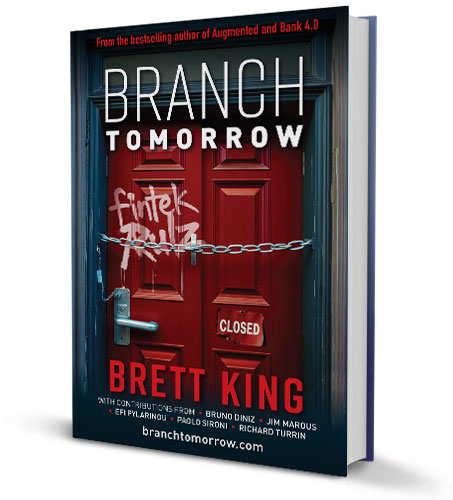
- In his latest book, Branch Tomorrow, Brett King says the branch is done, other than as a support to digital banking.
- Bricks and mortar become increasingly irrelevant in an age of increasing use of artificial intelligence.
- The longer banks hang onto branching as a strategy, the more resources won’t go into their digital battles.
Over 15 years ago, Brett King issued a wakeup call to the banking business in his book Bank 2.0: How Customer Behavior and Technology Will Change the Future of Financial Services. The key argument of the book — a bible for disrupters — was that branches had to evolve away from their transactional role, a stance King took before it became popular.
Since then, in Bank 3.0, Bank 4.0, Branch Today, Gone Tomorrow, and other writings, King has ramped up his view that branches are worse than dinosaurs and ought to be extinct as we’ve known them. In his latest book, Branch Tomorrow, he tries to put a stake in the heart of the traditional concept of branches for good.
In chapters of his own, as well as contributed regional reports by other experts (including The Financial Brand‘s Jim Marous), King makes this case:
“On a global basis we see a clear, multi-decade trend moving away from engagement via bank branches. This represents a cultural revolution for banking that has relied on branches as the primary distribution, sales and service mechanism for the last 500 years.”
 King also says that the only point to branches now requires a cultural shift, such that digital finance becomes the center of the business:
“This means redesigning branches to work for the digital space, not against or in parallel to it as the status quo is today. The only feasible role for branches today is in support of the digital bank, because the digital bank is the only arena where growth is guaranteed.”
Yet this comes at a time when major U.S. banks have been using branches as a prime marketing tool.
King thinks such continued investment in branches has actually slowed the banking industry’s innovation, diverting funds and effort away from better strategies. He devotes an entire chapter to ways fintechs and others have passed banks while they were focused on branches.
The Financial Brand presents this excerpt, with the permission of King and his publisher, Marshall Cavendish Business. The book is available in Kindle on Amazon, with the print edition pending.
Those with thin skins are warned, King pulls no punches. The excerpt begins with why he thinks banks took the wrong lesson from the popularity of Apple Stores. — Steve Cocheo, senior executive editor
The Promise and Failure of the “Apple Store” Branch
During the early days of app-based banking, the branch world fought back hard. In parallel to the smartphone boom, we had a plethora of vendors and retail banks imagining branches of the future, with notable examples from Citibank, Deutsche Bank, Frank (OCBC), Jyske Bank, Capital One, DBS, and others. The intent was clear: In the face of consumer trends moving away from branch interaction, something had to be done to get people “back to the branch.”
The most effective argument for this internally at banks appeared also to come out of the smartphone era, namely the phenomenal success that Apple had seen with its next-generation retail outlets. The answer appeared to be simple — banks needed to create their own Apple Store equivalent.
Chase has been working to figure out what the bank branch of the future should look like, as customers flock to brick-and-mortar locations less while picking up smartphones more… The new branch’s look and feel is more akin to that of the Apple Store across the street than to the layout of a traditional bank branch, where customers walk in, stand in line, and wait their turn.—”Building the Bank of the Future” by Andy Meek, June 6, 2015, Memphis Daily News
People loved going to Apple Stores. In fact, they were seen queuing for days just for the privilege of buying one of Apple’s iPhones, so why wouldn’t they also love going to futuristic bank branches?
There is one giant problem with this premise, however.
The reason Apple Stores were so phenomenally successful was not primarily a result of their innovative design, but the fact that they carried the latest iPhones which saw insane demand during this same period. People went to the store with the intent to buy an iPhone, but the entire experience made people feel like they were on the bleeding edge of an amazing technological revolution.
We suddenly had these gorgeous super-computers that we could carry around in our pockets, and there was only one place we could get them. This created a mythos around the Apple Store’s design, when actually it was the revolution around smartphones which gave Apple Stores their most potent commercial leverage.
Bank branches, however, are another story entirely. Compared with the likes of Amazon and Alibaba, where you could order something online and have it delivered in hours, the convenience argument for branches embedded in the community was an issue. The experience in branches, unlike Apple Stores, was generally not a demonstration of the amazing technological advances in banking — they were a technological veneer over very traditional products and processes.
What Sets Branches Apart from Apple Stores:
The experience in branches, unlike Apple Stores, was generally not a demonstration of the amazing technological advances in banking — they were a technological veneer over very traditional products and processes.
Why do you need to go to a branch to sign a piece of paper just to get access to banking products or services? The products themselves were largely abstractions of bank utility that didn’t strictly need a branch for delivery — if they did, the successful challenger banks we see around the world today would never have succeeded.
The origin of those products in the branch? In essence, the products available in a branch have not materially changed since the 14th century or at best the 19th century. There has been no iPhone-style product injected into branch banking to revolutionize a customer’s need to return to the physical branch. In fact, exactly the opposite is true: Pretty much everything offered by a branch to support your day-to-day banking needs is now being delivered via websites, apps and mobile wallets.
In fact, besides the emergence of the ATM machine in the 1970–80s, there was no real innovation in banking during the entire 20th century. This was the argument that former Chairman of the Federal Reserve, Paul Volcker, made in the aftermath of the 2008 financial crisis when asked about the innovation made in financial instruments over the preceding decades.
This self-service revolution, however, led not only to reductions in service overhead, but also started to impact the way people banked. In 2008, the Internet surpassed bank branches for daily, core transactional banking activity. By 2015, smartphones and mobile app-based banking had surpassed both the Internet and branch collectively for day-to-day banking. Today, digital interactions outnumber face-to-face or human interactions with a bank by some 300 to 1. As of the pandemic, more people open a bank account globally digitally than in a branch. Most customers in the most advanced economies don’t even visit a bank branch once in an entire calendar year.
A Digital Versus Branch Fundamental:
As of the pandemic, more people open a bank account globally digitally than in a branch. Most customers in the most advanced economies don't even visit a bank branch once in an entire calendar year.
Bank of America announced in its Q2 2023 earnings call that it had achieved an 83% digital adoption rate and that revenue from digital sales represented over half of its total sales. This shouldn’t be surprising given that online and mobile account openings surpassed the branch as early as Q3 2019.
Add to this the more recent emergence of a competing artifact for the very heart of banking — the ubiquitous mobile wallet.
How Mobile Wallets Are Changing Financial Reality
At the most basic level, the primary product a bank supplies its customers with is a bank account. The bank account lay uncontested over centuries as the primary artifact for banking, evolving very slowly from a passbook to a cheque book and then a plastic card in just the last half of the last century. But the evolution of the smartphone and the concept of a mobile wallet have rapidly undermined that core bank account concept in a period of just over a decade.
Today, mobile wallets are used for day-to-day payments more than passbooks, cheque books, debit and credit cards, or cash. This unexpected twist has happened mainly through the rapid financial inclusion created in developing economies via access to basic mobile money features on the phone. In fact, the World Bank observed that during 2011–2017, more than 1.2 billion people gained access to financial services for the first time, largely because of mobile phones.
Customers don’t seem to mind this at all.
While a global phenomenon, the true explosion in mobile payments arose in China and Sub-Saharan Africa. In 2023, the total transaction value of mobile payments in China increased to 500 trillion yuan (approximately US$70 trillion), up around 5% from the previous year. That same year, there were more than 158 billion mobile payment transactions made across China. Meanwhile, the global payments volume on plastic hit US$42 trillion in 2023, showing that mobile payments in China alone were approximately double the volume of plastic card transactions globally for the same year.
And that’s before we include the myriad of other wallet schemes available globally such as PayTM in India, Pix in Brazil, GCash and PayMaya in the Philippines, the mobile money plays from Africa like M-Pesa and MTN MoMo, Kakao in South Korea, FonePay in Nepal, PromptPay in Thailand, etc.
The explosion of mobile wallets globally is unprecedented in banking — far faster than the rapid take-up of mobile banking, Internet banking before it, or even the decades-long growth in credit card use. The growth in mobile wallet adoption makes any other innovation in banking look glacially slow in comparison. In fact, by 2025, 4.9 billion humans (well over half the global population) will use a mobile wallet — and this is in a sector where half of the world’s population were unbanked until around 2015 after hundreds of years. This is truly extraordinary progress, and clearly defines the way the world of the future will think about and frame banking.
It is clear that the role of the branch has become an outdated banking model.
The Central Issue: Behavior, Not Design
It turns out that it was not the design of bank branches that was inhibiting customers’ use of them, it was simply a shift in the basic balance between convenience and utility.
In truth, the only way we would see a reversal of the emerging trend in declining branch interactions would be to take smartphones away from customers and ban the use of the Internet. There just wasn’t any longer enough compelling core value in the branch interaction to retain the economic viability of the physical, futuristic designs, borrowed from Apple or not. At least not for the majority of banking use cases.
Branches Have Had Their Day:
There's never going to be a more compelling use case for branches than pre-Internet.
The problem with branches wasn’t a design issue — it was simply a behavioral one brought to life by the modern mobile phone. As mobile banking became more and more accessible, and as next-gen banks and wallets reimagined banking in this real-time environment, people simply didn’t need to go to the bank to do their banking like they used to. To reverse this would require removing that capability, and that is not going to happen. Ergo, there’s never going to be a more compelling use case for branches than pre-Internet. We are now simply limited to edge cases that we can justify economically.
“But the Regulations!”
Banking is a heavily regulated industry, however. Unlike Microsoft, Apple, Amazon, Alibaba and Alphabet, the regulators that governed the safe operation of banks had historically been formed based entirely on branch-based operational thinking, and the bevy of laws in respect to banking reflect this.
Thus, the least risky course of action for regulators in that environment was to deny online access to financial services and still rely on artifacts like the first-century wet signature, bank debit cards, and cheques. After all, how could you identify a customer if they couldn’t turn up at a branch to show their driver’s license or physical ID document? As most senior regulators were made up of retired bankers, challenging this status quo was extremely difficult in those early years of digital adoption.
The same was simultaneously true of access to digital health and education.
Today, research still shows a herculean effort to link optimal customer service with bank branches, arguing that for certain types of interactions, customers are still reliant on bank branches. (Even as a group of authors working on this topic [King and chapter contributors], the debate on “where did branches still fundamentally offer value versus digital?” raged on amongst us.)
The research conducted by mainly industry-based press on the role of branches in banking continues to generate the message that for some customers doing certain types of activity, branches remain one — if not the most critical — driver of which bank a new customer might choose.
Recent data shows that the bank branch remains a vital component of the customer experience even as transactions move to other channels. Further, one in three customers prioritize branch proximity when choosing their new primary bank… 62% of customers say they will use in-branch banking in the coming year. — Insider Intelligence, “Mobile to Beat Branches in Usage This Year,” December 2022
Again, the key problem with these surveys and assertions are that branch foot traffic tells a distinctly different story. While customers say the branch is critical to their choice of bank, and that remains somewhat true, and while customers respond to a survey saying that they intend to visit a branch in the near future — data demonstrates that is no longer the reality.
Today, the most recent research on daily banking users shows that the intent to visit a branch has rapidly eroded and thus is aligned with behavioral data emerging over the last decade.
Despite What Customers Say… :
The most recent research on daily banking users shows that the intent to visit a branch has rapidly eroded and thus is aligned with behavioral data emerging over the last decade.
In the mid-1990s, the average American, Aussie and Brit retail banking customer visited a branch on average every two weeks or so. SME banking customers visited their bank every week — rain, hail or shine — particularly if they relied on cash in their business.
Today, however, most customers won’t step foot in a branch in an entire calendar year, unless they fall into a very specific demographic set. Today, the majority of customers in the economies mentioned above say that they’re not planning on visiting a branch over the next 12 months, and a large chunk of customers say they will never again likely use a branch for their banking needs.
However, as we will discover in the remaining pages of this book, there are clear social considerations that might be argued that transcend the economic principles. Indeed, rural areas tend to lag behind in term of digital adoption, although those same locations are now seeing accelerated closures because the economics are much tougher than in urban areas. This then leaves the government having to take policy positions on the social infrastructure that banks provide.
Underneath this all though, we now understand that the decline in branch banking has a design element, but not one related to the branch, and instead related to customer experience generally.
The Core Utility of Banking Has Evolved and Is Evolving
There’s an interesting statistic floating around in respect to the largest digital bank in the world, WeBank based in Shenzhen, China (400 million customers). Recently, its CIO Henry Ma explained that using artificial intelligence, WeBank has eliminated 98% of the calls that required human interaction in the call center.
A Key Challenger Bank Philosophy:
In the U.K., founders of the challenger banks like Starling, Monzo and Revolut have repeatedly said that if a customer needs to seek a human to fix a problem, that is largely a design failure.
In the U.K., founders of the challenger banks like Starling, Monzo and Revolut have repeatedly said that if a customer needs to seek a human to fix a problem, that is largely a design failure.
The reason these challenger banks have much lower traffic when it comes to live customer support is that they have worked hard to solve those potential issues through advances in the tech-stack, offering simpler products and vastly improved experiences and interfaces.
Again, the current generation of bankers believed that if you need to speak to a human, that’s a design failure — not a point of pride, and certainly not a differentiation.
This is a fundamentally different view of the utility of banking that we see emerging. Seeing a human can, for the most part, represent unnecessary friction in many bank interactions today. And while some customers still claim to prefer to see a human, the economics of that are pushing banks to think about redesigning away human interactions unless they are of the highest value moments. This dramatically changes the economics of the branch, the demographic targets and the skill sets required for in-branch staff. It also changes budget allocations, and the way we think about onboarding and acquiring customers.
The excerpt from Branch Tomorrow is copyright 2025 by Brett King. The book can be purchased on Amazon in Kindle format. A print edition is pending.
Read more about branches:
- Why NYC is Still the Key Proving Ground for Branch Innovation
- BofA Pivots Branches to Deliver Customer Consultations Over Transactions
- Inside Fifth Third’s Southeast Expansion Strategy
Read a counterpoint from Financial Brand Forum 2026 speaker E.J. Kritz: Reports of the Death of the Branch are Greatly Exaggerated


