
Build the Banking Technology Strategy That Will Deliver Long-Term Competitive Advantage
By Jessica Kendall, Contributor at The Financial Brand
Simple Subscribe
Subscribe Now!
Technology spending remains strong across the banking industry, but priorities have become more focused. According to KPMG’s 2026 Banking Technology Survey of 200 banking executives, institutions are directing investments toward a relatively small set of initiatives that strengthen operations today while preparing for future competition.
Key takeaways: Cybersecurity, digital customer experience, AI enablement, data modernization, and payments infrastructure dominate investment plans, reflecting a shift away from broad digital experimentation toward practical execution.
The survey also highlights how technology is influencing broader business strategy. AI capabilities are becoming acquisition targets, data quality is emerging as the primary obstacle to enterprise AI adoption, and payments modernization increasingly includes instant payments and digital asset readiness.
Key Insight: Competitive differentiation will depend less on adopting every new technology and more on executing foundational technology investments that improve customer experience, operational resilience, and organizational agility.
Need to Know:
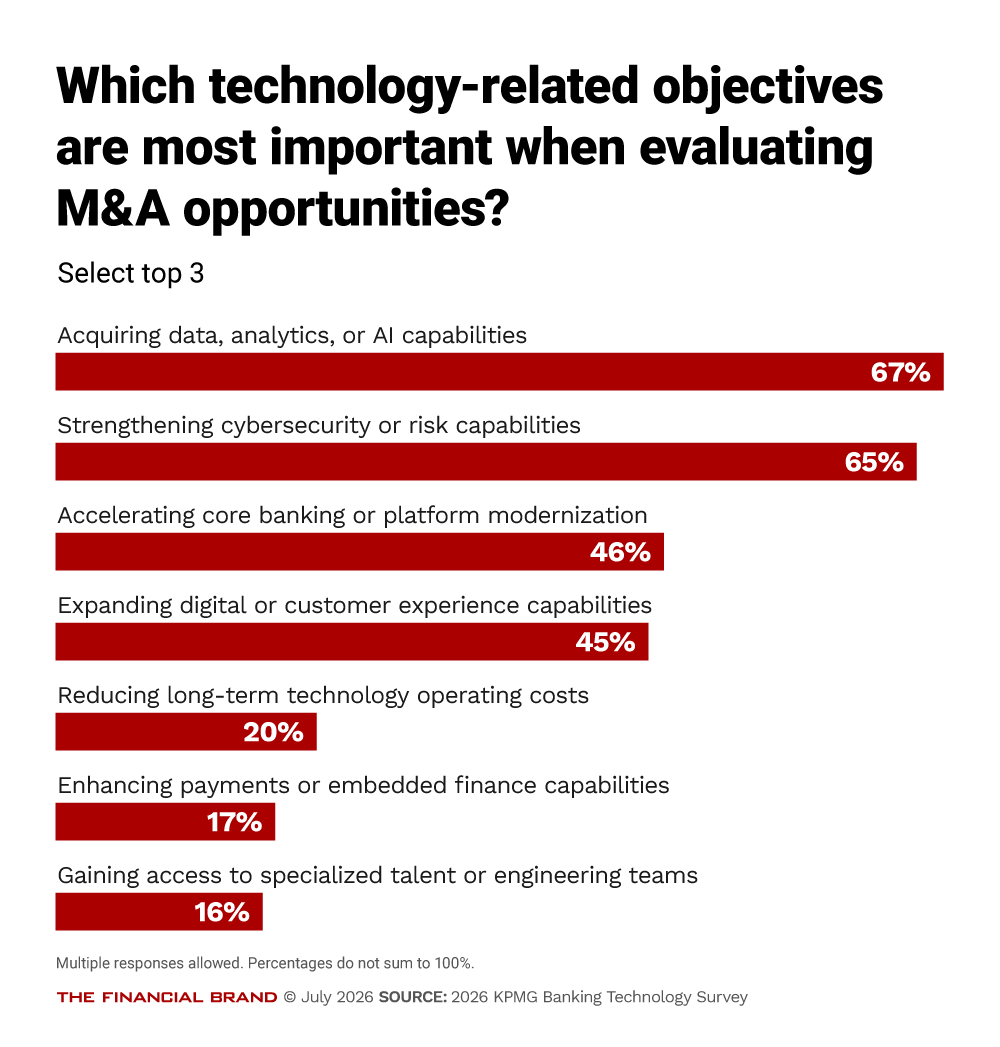
- 67% said acquiring AI, analytics, or data capabilities is a top technology objective when evaluating acquisition opportunities.
- Data quality has become the biggest barrier to successful AI deployment, making modernization efforts increasingly dependent on strong governance and trusted enterprise data. In fact, 100% of respondents identified data quality as a challenge in their data modernization efforts.
- Technology is influencing merger and acquisition strategies, with banks seeking AI expertise, cybersecurity capabilities, and modernization skills through acquisitions.
- Digital customer experience remains a priority, but banks are emphasizing improvements to existing channels rather than launching entirely new customer interfaces.
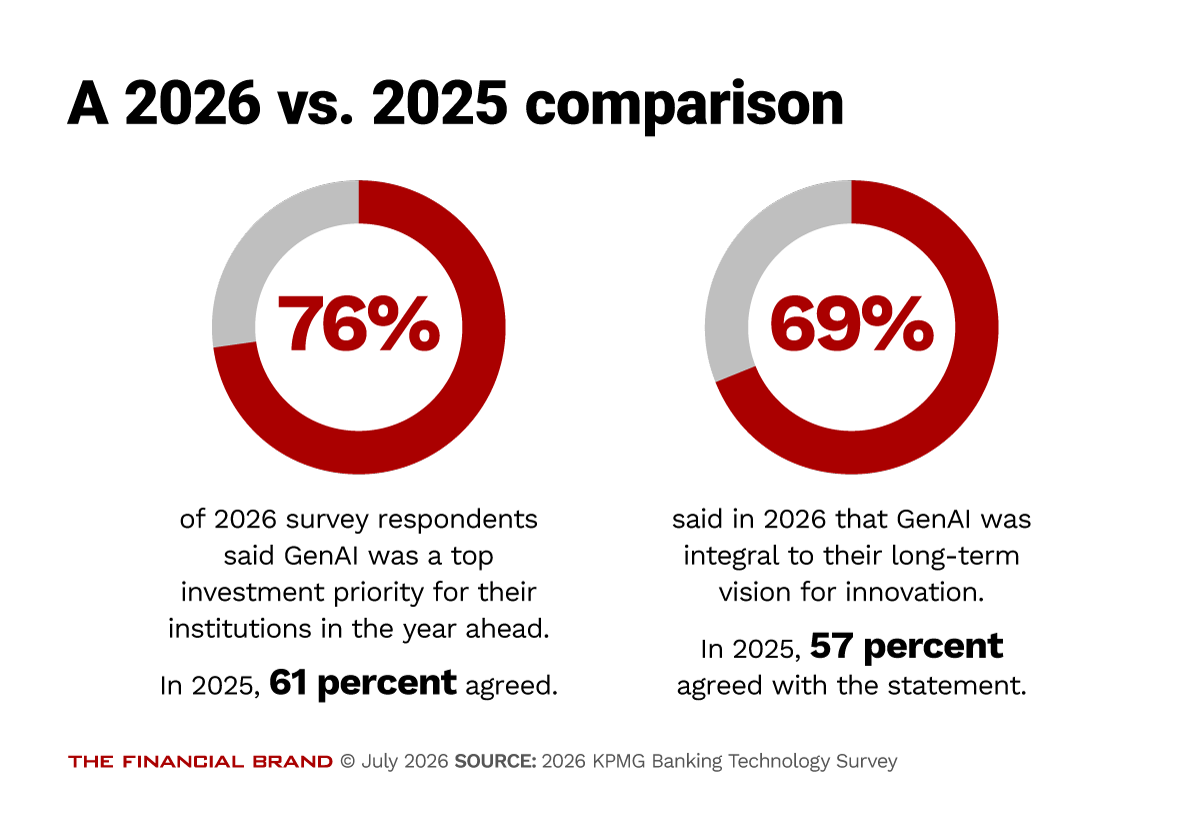
- 76% of banks are already using or piloting generative AI for data-driven insights and personalization.
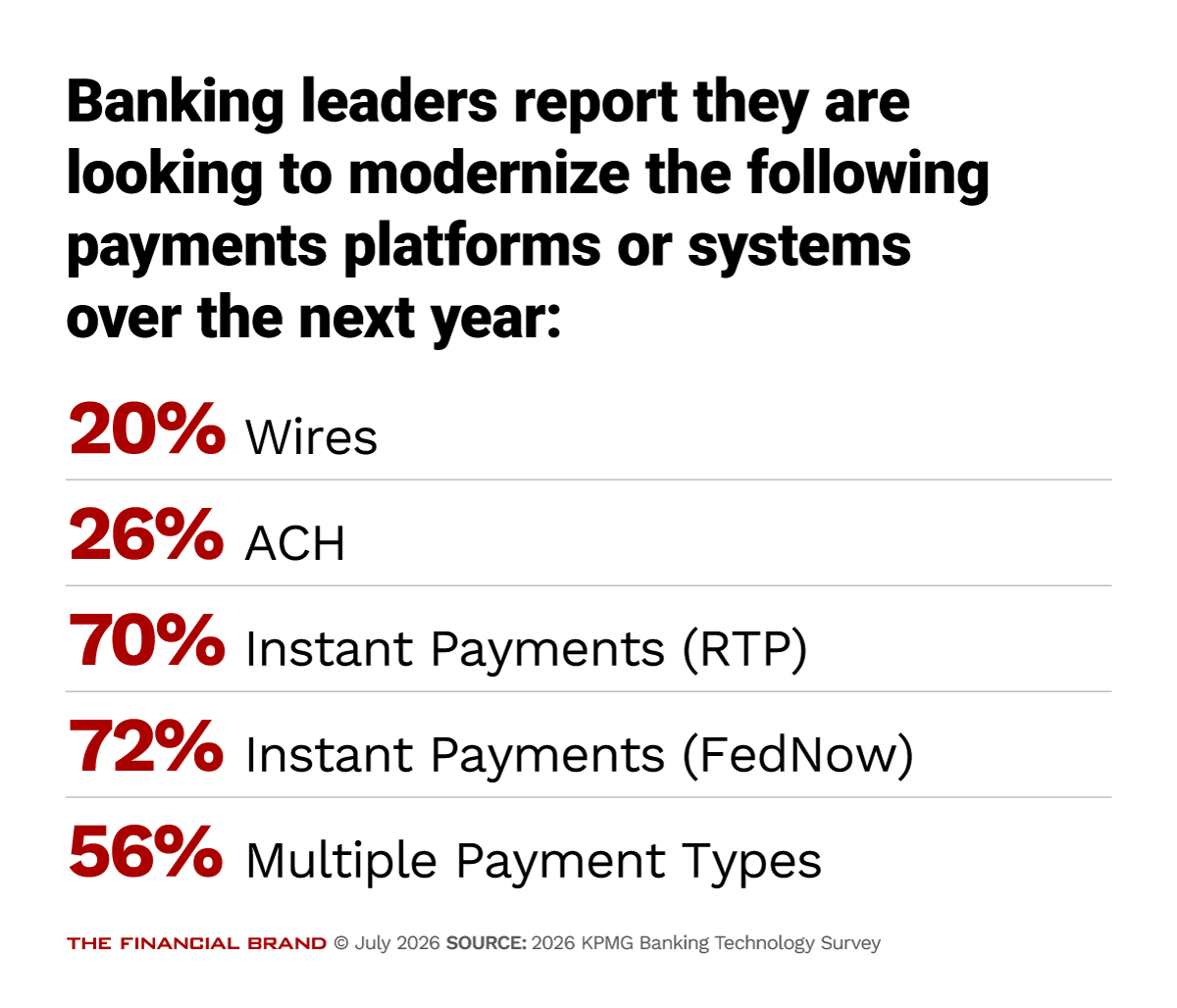
- 72% are modernizing platforms to support FedNow instant payments, while 70% are investing in RTP infrastructure.
Technology Spending Becomes More Focused
Banks have spent years pursuing digital transformation across nearly every part of the business. Now, they are concentrating technology spending around cybersecurity, AI, customer experience, data modernization, and payments instead of investing broadly across emerging technologies.
Today, the focus is on a handful of initiatives that directly improve resilience, efficiency, and customer experience. Operational efficiency and automation rank as the leading investment priority over the next year, followed closely by security and fraud prevention.
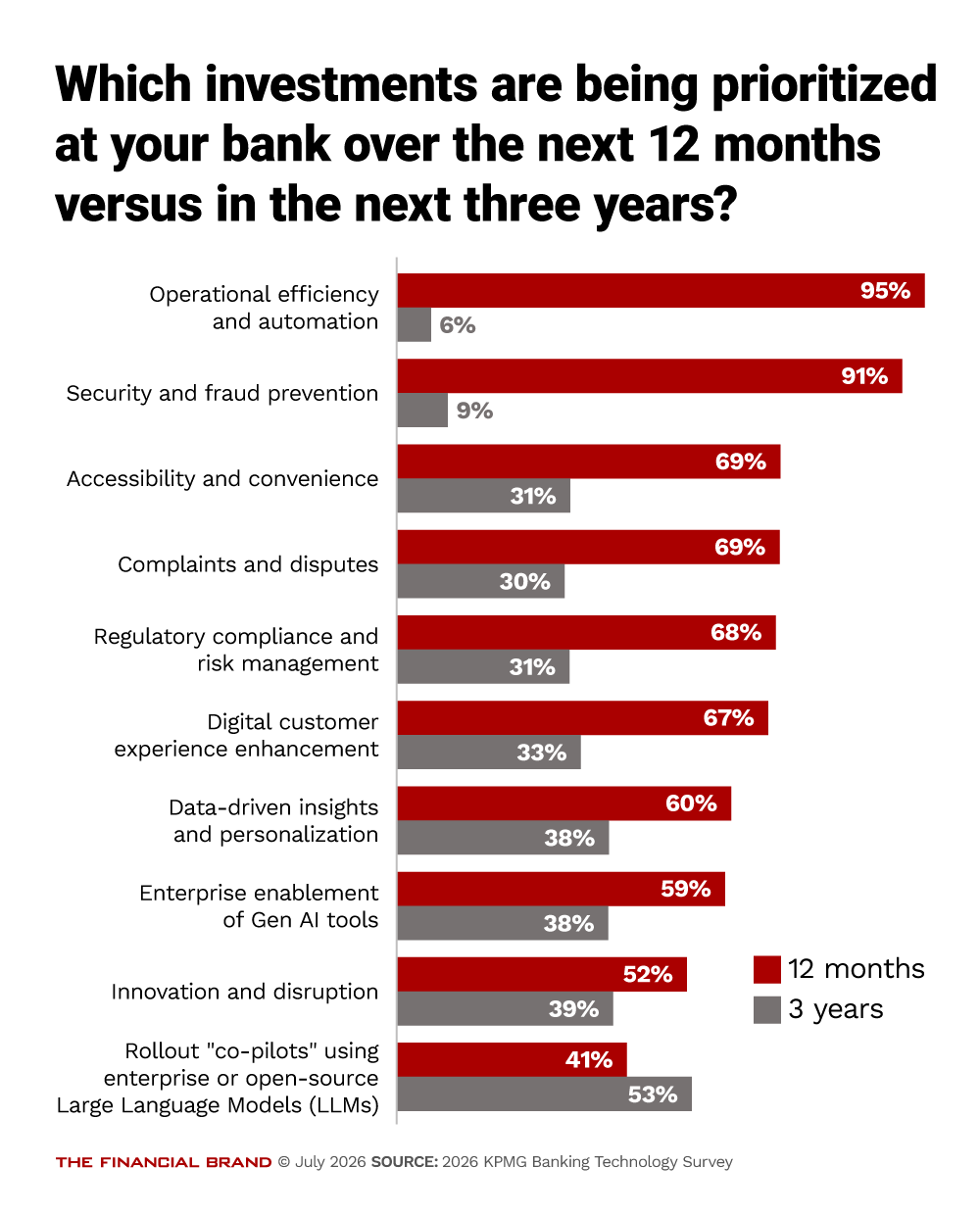
Customer-facing investments also continue to receive significant attention. Every respondent identified online and mobile banking as investment priorities, while chatbots, virtual assistants, and generative AI tools have become mainstream additions to digital banking strategies.
Key insight: Many of the technologies that generated excitement several years ago have fallen down the priority list. Banks appear more interested in improving existing customer experiences than introducing entirely new channels.
Technology is also shaping corporate strategy beyond internal investment. More than three-quarters of respondents said technology either drives or significantly influences acquisition decisions. The most attractive targets are organizations with AI expertise, advanced analytics capabilities, and cybersecurity strengths, suggesting that banks increasingly view acquisitions as a way to accelerate technology modernization rather than simply increase scale.
AI Depends on Better Data
Artificial intelligence continues to move from experimentation into everyday banking operations.
Compared with last year’s survey, more institutions now view generative AI as both a near-term investment priority and a long-term strategic capability. Much of the initial focus remains on improving internal operations, increasing productivity, and enhancing customer service rather than creating entirely new revenue streams.
However, enthusiasm for AI is tempered by practical implementation challenges. The survey identifies insufficient governance frameworks, poor data quality, legacy technology, and difficulty measuring return on investment as the most significant barriers to enterprise AI deployment.
Among those obstacles, data quality stands above the rest. Fifty-four percent of respondents point to poor data quality or data readiness as a top challenge for deploying AI across the enterprise.
More broadly, data is seen as a core foundational challenge to many modernization efforts. Every single respondent identified data quality as one of the main challenges they face in data modernization efforts, while nearly three-quarters cited legacy systems and integration complexity.
Key takeaway: These findings reinforce a growing reality across financial services: innovation and AI effectiveness depend on underlying data that is accurate, accessible, and governed consistently.
The survey also suggests banks are beginning to shift their data strategies beyond regulatory compliance toward growth-oriented objectives such as personalization, customer intelligence, and operational decision-making.
Security, Payments, and Future Readiness
Cybersecurity remains one of the industry’s highest technology priorities. With the increasing sophistication of cyber threats and expanding use of AI by attackers, banks are responding with AI-powered security capabilities of their own. In fact, 90 percent are already piloting or deploying generative AI for security and fraud detection.
At the same time, technology concentration risk is also receiving greater attention. Nearly seven in ten respondents identified cloud providers as their largest technology concentration concern, followed by vendor dependencies and technology stack concentration.
Payments modernization represents another major area of investment. Banks continue upgrading traditional wire and ACH platforms, but instant payments have become the primary focus. FedNow and RTP implementations now outpace investments in legacy payment rails, driven by changing customer expectations and the need to develop new payment products.
The survey also points toward longer-term changes in payments infrastructure. While many institutions are still evaluating digital assets, larger banks are already designing systems capable of supporting tokenized deposits and stablecoins. These initiatives remain concentrated among the industry’s largest institutions, but they illustrate how payment modernization is increasingly preparing banks for future transaction models rather than simply replacing legacy systems.
Bottom line: Taken together, the findings suggest banks are entering a more execution-oriented phase of technology transformation. Rather than pursuing every emerging innovation, institutions are prioritizing the foundational capabilities that enable stronger customer experiences, more effective AI, resilient operations, and modern payment infrastructure.
For retail banking leaders, success will likely depend less on how many technologies they adopt and more on how effectively they connect these investments into a coherent operating strategy.


