
The Identity Dilemma: How AI Blurs the Line Between Reality and Fraud
By Sepideh Rowland, partner at Klaros Group
Simple Subscribe
Subscribe Now!
Every holiday season, children eagerly await the arrival of their own personal elf, perched on a shelf to observe their behavior and report back to Santa. The excitement of discovering the elf’s new location each morning is a cherished tradition. Yet, as children grow, they begin to question the elf’s authenticity, suspecting it might be a clever story designed to encourage good behavior.
In recent years, artificial intelligence has added a new twist to this tradition: Parents can now create videos showing the elf moving around the house at night, making the magic seem real. AI enables us to create and document events that never actually occurred, but which are indistinguishable from reality.
This phenomenon is not limited to holiday traditions. On social media, countless profile photos appear authentic but are, in fact, generated by AI.
In fact, the boundary between what is real and what is fabricated is dissolving at an unprecedented pace. This has serious implications for bank onboarding, security and fraud prevention.
Need to Know:
- Where once the mantra was “trust but verify,” today’s world demands a more cautious approach: “verify.”
- Not long ago, creating a fictitious identity required access to the dark web and illicit transactions.
- Now, anyone with access to generative AI tools can produce hyper-realistic identification cards, complete with photos, documents, even biometric data, from the comfort of their own home.
- AI is not inherently good or bad — it is a mirror reflecting human intent. In the hands of banks, it can streamline compliance and protect customers. In the hands of criminals, it can dismantle safeguards and erode trust.
AI’s Growing Role in Financial Services
Artificial intelligence has become a cornerstone of modern financial services. Banks and fintech companies deploy AI to streamline customer onboarding, reduce manual review, and harness predictive analytics for fraud detection and credit scoring. These efficiency gains are not just operational, they are strategic, enabling institutions to differentiate themselves in fiercely competitive markets.
Examples of efficiency gains:
• Faster onboarding: Automated identity checks powered by AI significantly reduce the time required to onboard new customers. What once took days or weeks can now be accomplished in minutes, enhancing customer satisfaction and reducing abandonment rates.
• Reduced manual review: AI brings enhanced automation to processes that previously required extensive human intervention. By handling routine checks, AI frees human analysts to focus on complex or suspicious cases, improving both efficiency and accuracy.
• Improved predictive analytics: AI-led processes can analyze vast amounts of data to establish customer patterns and behaviors, enabling institutions to anticipate customer needs, detect anomalies, and respond proactively to potential risks.
Financial institutions are racing to adopt AI not only for cost savings but also to deliver seamless digital experiences. In a market where customer loyalty is fragile, speed and convenience are powerful differentiators.
The ability to offer instant account opening, real-time fraud alerts, and personalized financial advice is rapidly becoming the norm rather than the exception.
However…
As machines take on more of the verification process, the human role in discerning authenticity diminishes. The danger lies not in AI itself, but in overreliance on it without human oversight.
But there’s another danger as well. While “human in the loop” is a common refrain, the real challenge is ensuring that human reviewers understand — and can detect — the new risks AI poses to traditional banking processes.
Without continuous training and awareness, even the best-intentioned oversight can become ineffective.
Read more: Is That Your Boss or a Deepfake on the Other Side of That Video Call?
The Dark Side: Is AI Too Good to Trust?
Yet, the same technology that empowers banks also empowers criminals. GenAI can produce convincing fake documents, synthetic identities, and deepfakes that bypass traditional verification systems.
This dual-use dilemma underscores a paradox: AI enhances compliance but can also be weaponized against it.
AI-generated images, videos and audio are being rapidly adopted by criminal organizations, not only to enhance the sophistication of scams but also to enable these organizations to increase the volume of their activities.
Here’s a warning from the FBI’s Internet Crime Complaint Center. AI is enabling criminal organizations to “create realistic images for fictitious social media profiles in social engineering, spear phishing, romance schemes, confidence fraud, and investment fraud” and to “generate fraudulent identification documents, such as fake driver’s licenses or credentials (law enforcement, government, or banking) for identity fraud and impersonation schemes.”
Read more: How to Stop Three AI Threats Changing the Face of Identity Fraud — Literally
Criminal Organizations Exploiting AI to Pass CIP
A striking example of AI’s dual-use nature is its exploitation by criminal organizations to circumvent Customer Identification Programs (CIP), which are designed to prevent fraud and money laundering.
AI gives criminals new tools to slip through the cracks, undermining the very safeguards meant to protect the financial system, such as:
• Document generation: AI can fabricate passports, driver’s licenses and utility bills that are virtually indistinguishable from genuine ones.
Just as the elf is brought to life through animation, the person in these generated documents can be animated to pass video authentication requirements, holding the AI-created ID and demonstrating full movement.
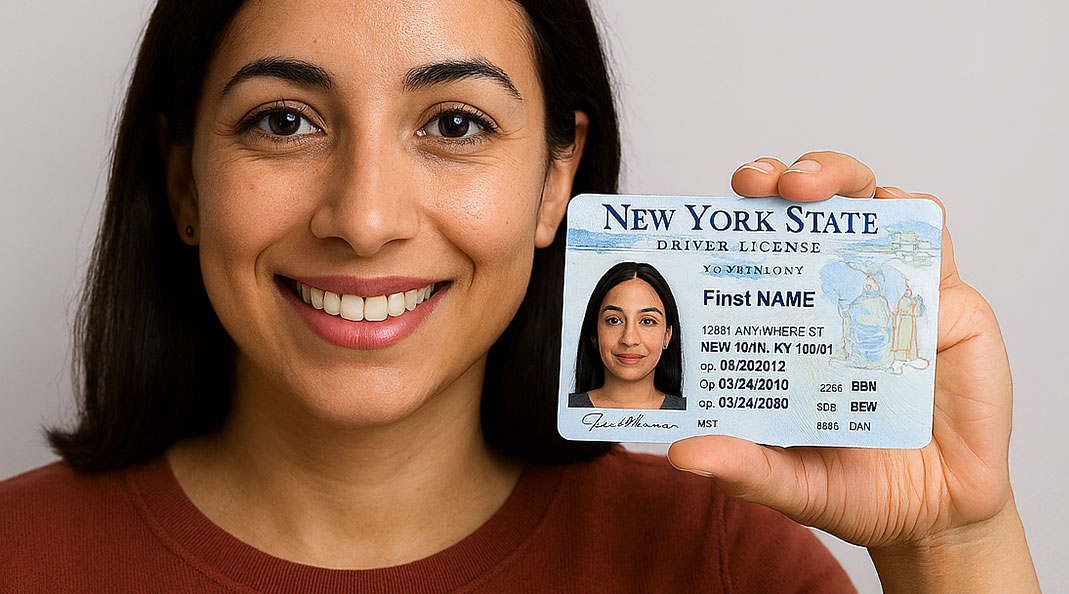
The image of this person and her identification are both fictitious. They were generated using artificial intelligence through Microsoft’s Copilot, to demonstrate what banks are up against.
• Synthetic identities: Entire personas — complete with AI-generated photos, videos and biometric data —can be created to fool verification systems.
These synthetic identities can open bank accounts, apply for loans, or even launder money without ever being traced to a real individual.
• Social engineering: AI-powered chatbots can mimic customer service representatives, using personal information gleaned from social media to trick victims into revealing sensitive data. The sophistication of these attacks makes them difficult to detect and prevent.
Frauds curated for banking. Criminals are not just creating fake identities — they are tailoring them to meet specific bank standards.
In fact, AI can quickly digest compliance and security obligations posted on bank websites, assess regulatory filings, and analyze enforcement actions to identify vulnerabilities.
These abilities enable fraudsters to design identities that pass scrutiny, exploiting gaps in the system with unprecedented precision.
Read more: Your Teams’ Phones Are Now Your Biggest Security Hole. How to Plug It
The Future of Identity Verification Is Cloudy
The road ahead is uncertain. Should we approach AI in identity verification with cautious optimism or continued skepticism?
The answer lies in balance. While AI offers powerful tools for enhancing security and efficiency, it also introduces new risks that must be carefully managed.
As AI systems become more sophisticated, the role of human judgment becomes even more critical.
Financial institutions must invest in ongoing training for staff, ensuring they are equipped to recognize and respond to new forms of fraud. This includes understanding how AI-generated documents and synthetic identities differ from genuine ones, as well as staying informed about the latest tactics used by criminals.
The identity dilemma is not about whether AI should be used, but how it should be governed. Verification, layered defenses and human accountability must remain at the core of financial services in the age of AI.
Five Ways to Fight AI Identity Fraud
The integration of AI into identity verification is both inevitable and transformative. As technology continues to evolve, so too must banking’s approaches to security, governance and ethical responsibility. Financial institutions, regulators and technology providers must work together to develop standards and best practices that balance innovation with risk management.
The solution for financial institutions is awareness and evolution of controls to address AI-related risks. This can be done by:
1. Strengthening document authentication controls by layering multiple verification checks to make AI-generated documents harder to pass, i.e., detection of pixel inconsistencies, edge abnormalities, or compression patterns typical of generative models.
2. Cross checking document data against issuing authorities, public records or third-party verification databases.
3. Conducting active liveness tests to determine whether a real human is present, i.e., asking users to perform gestures, turn their head completely around, or repeat random sequences to counter the threat described where criminals animate synthetic faces to pass video authentication.
4. Deploying deepfake detection AI models to integrate machine learning models trained to spot inconsistencies such as temporal inconsistencies (e.g., flickering, unnatural blinking), or audio-visual mismatches (e.g., lips not perfectly synced with speech).
5. Continuing to conduct behavioral monitoring, to detect deviations in velocity, device fingerprinting, and geolocation anomalies (impossible travel, mismatched locations).
Ultimately, the goal is not to eliminate risk entirely — an impossible task — but to create systems that are resilient, adaptable and capable of responding to new threats as they emerge. By embracing a philosophy of continuous verification, layered defenses, and human oversight, we can harness the power of AI to build a more secure and trustworthy financial ecosystem.
Read next: Auto Buying Fraud is Exploding. Capital One Is Using AI to Fight Back


