
Your Customers Are Getting Wealth Advice Somewhere Other Than Your Bank
By Jessica Kendall, Contributor at The Financial Brand
Simple Subscribe
Subscribe Now!
Americans are pursuing wealth through a wider range of investments, information sources, and financial strategies, but greater choice hasn’t made building wealth feel simpler.
U.S. Bank’s 2026 Wealth Report finds that 72% of Americans believe investing has become more complicated, while 75% want more guidance on where to invest.
The challenge is to turn that demand for guidance into stronger customer relationships and deeper engagement across the financial lifecycle. That requires more than publishing financial education. Banks must connect relevant advice to the decisions customers are making, help them evaluate their options, and make the next step clear.
Key insight: With younger consumers increasingly turning to social media and AI for financial guidance, banks have an opportunity to differentiate through accessible, personalized support that builds trust and keeps customers connected to the institution as their financial needs evolve.
Need to Know:
- Reframe wealth around customer goals. Homeownership remains important, but younger consumers increasingly see investing as a more realistic route to financial growth.
- Make financial guidance easier to access. Three-quarters of Americans want more help deciding where to invest, creating demand for clear explanations and relevant support.
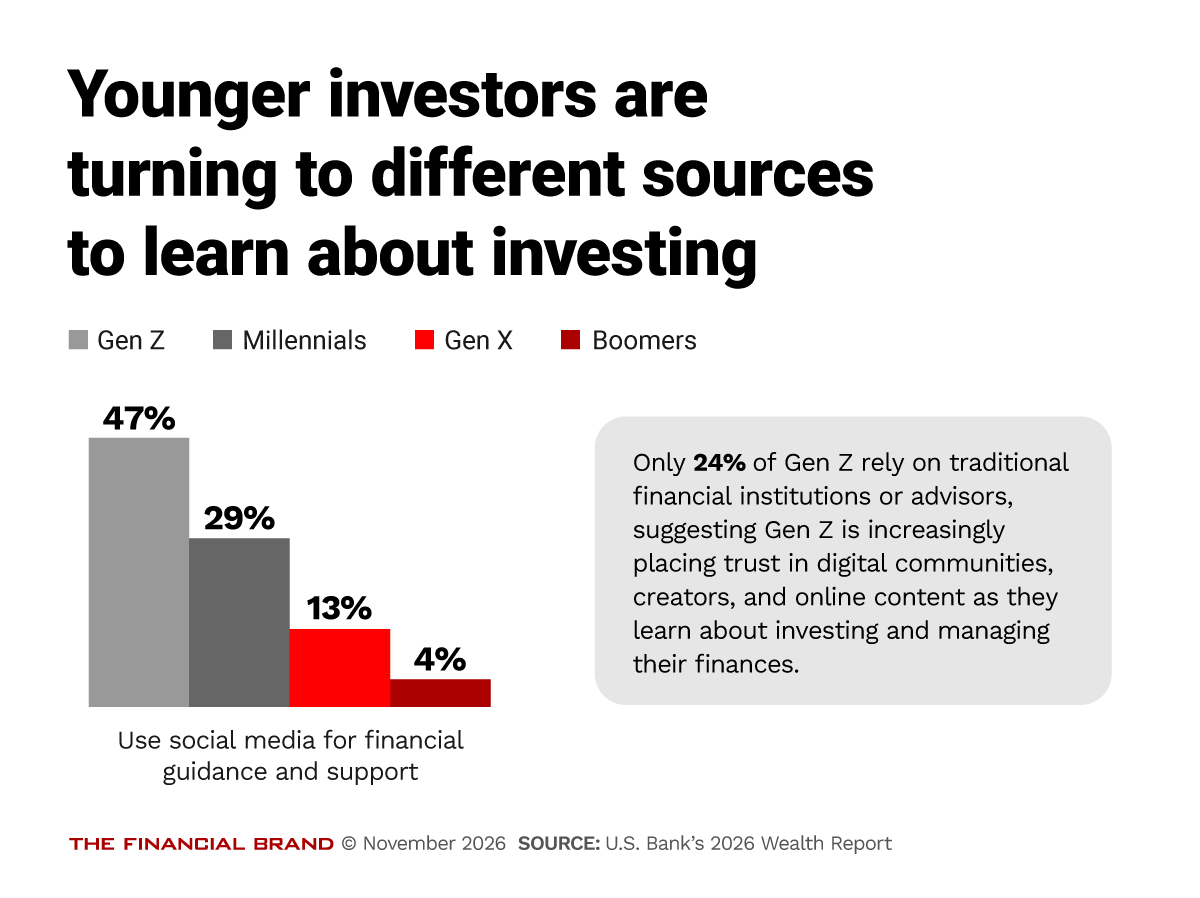
- Reach customers where they seek information. 47% of Gen Z use social media for financial guidance, while 22% use generative AI — creating a need for banks to engage beyond traditional channels.
- Address differences in financial confidence. 44% of surveyed Americans are first-generation wealth builders, without family financial role models or an expected meaningful inheritance. Distinct barriers like this can affect participation and progress.
- Connect education with action. Consumers need help translating financial information into plans that reflect their circumstances and priorities.
Younger Customers Are Redefining Financial Success
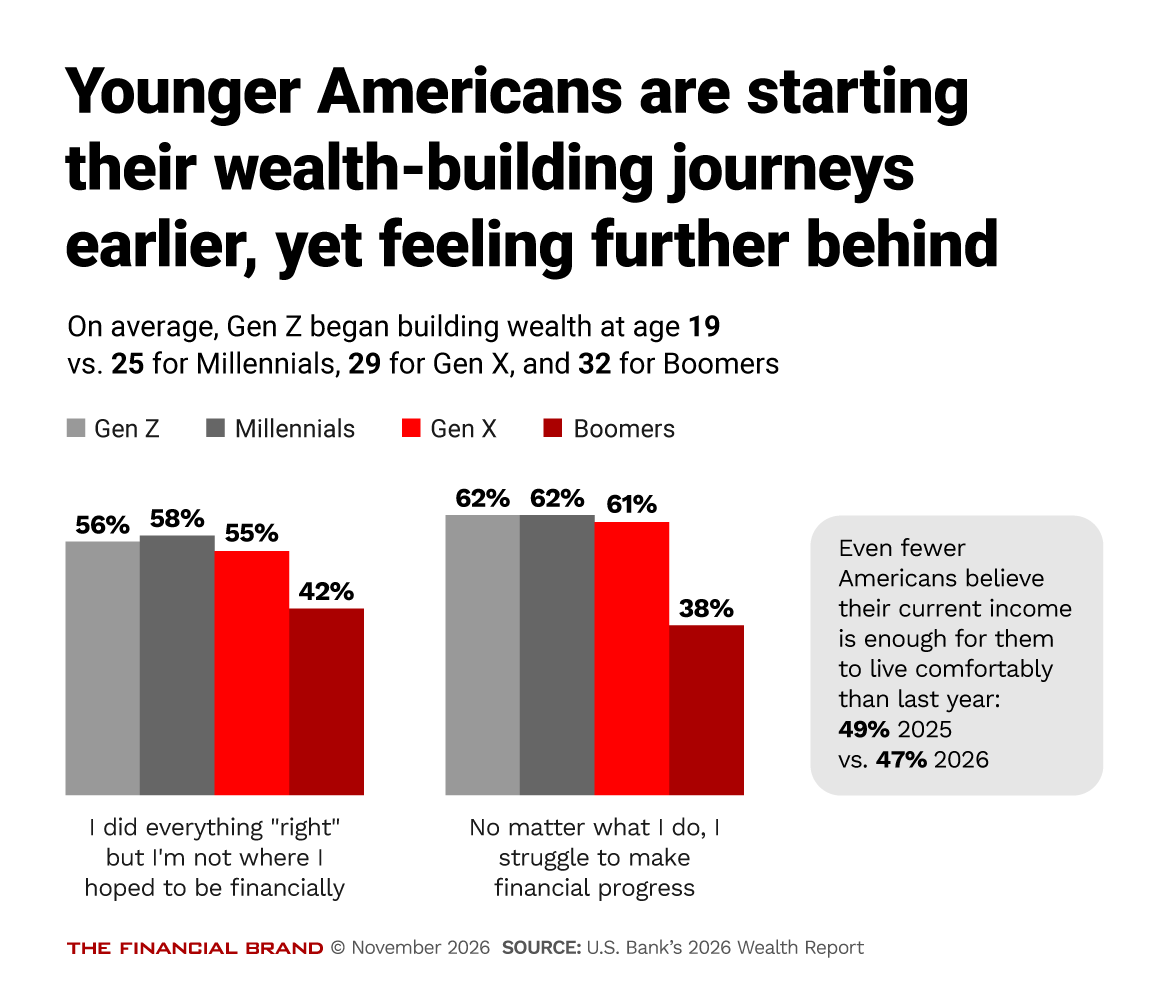
For younger Americans, the traditional formula for building wealth feels increasingly difficult to follow. According to the U.S. Bank survey, younger generations are starting their wealth-building journeys earlier than previous generations while feeling further from traditional milestones such as homeownership and comfortable retirement.
Gen Z respondents reported starting at an average age of 19, compared with 25 for Millennials, 29 for Gen X, and 32 for Boomers. Starting early, however, does not necessarily mean feeling financially secure. More than half of Gen Z respondents said they had done everything financially right but were not where they had hoped to be. Meanwhile, 62% said they struggled to make financial progress.
Homeownership remains a widely shared aspiration: 86% of Americans consider owning a home a marker of financial success. Yet younger generations are adjusting their strategies to reflect their financial realities.
For example, a majority of Gen Z (62%) and Millennials (61%) believe the stock market offers a more realistic path to wealth than homeownership, compared with 45% of Boomers. At the same time, nearly half of Gen Z and Millennials see newer investment options like cryptocurrency as more appealing than traditional investments.
What to consider: Banks should broaden how they discuss financial progress. Customers may be saving for a first home, building an emergency fund, paying down debt, or investing toward a longer-term goal. Communications that treat homeownership or retirement as the only meaningful measures of success can miss the priorities shaping customers’ decisions today.
Banks can make financial guidance more relevant by helping customers connect everyday financial choices with their own definitions of progress. Goal-based tools, educational content, and conversations that acknowledge competing priorities can help customers see a practical path forward.
Demand for Financial Guidance Is Higher Than Ever
The investment landscape is becoming harder for consumers to navigate. Seventy-two percent of Americans say investing feels more complicated than it used to, while 66% feel pressure to keep up with investment trends. Another 28% say they do not know enough about investing, and 13% find investment platforms too complicated.
That said, the demand for help is clear. Seventy-five percent want more guidance on where to invest. Yet consumers do not all look to the same sources for answers.
Among Gen Z respondents, 47% use social media for financial guidance, 22% use generative AI, and only 24% rely on traditional financial institutions or advisors. More broadly, financial advisors were rated the most useful resource overall among the tools assessed in the survey, while generative AI was rated the least useful by people who had used it.
What to consider: Customers are already encountering advice and investment ideas across a fragmented information landscape. So, the answer isn’t publishing more guidance. Instead, banks need to make their own guidance easy to find, understandable, and useful at the moment a customer is making a decision.
That means explaining financial concepts in plain language, addressing questions customers actually ask, and connecting education to relevant next steps. It also means considering how customers discover information online, including through social platforms and AI-powered tools. A bank’s expertise has limited value if customers cannot find it or cannot apply it to their circumstances.
Financial Confidence Starts from Different Places
Customers do not enter the wealth-building journey with equal levels of knowledge, confidence, or financial support. In particular, the report highlights persistent differences for women and people building wealth without family financial role models.
Only 26% of women said they felt prepared to make informed financial decisions when they began building wealth, compared with 41% of men. Women are also more likely to want investment guidance: 80% said they wanted more help deciding where to invest. Yet just 22% use a financial advisor, compared with 35% of men.
Circumstances help explain some of the barriers. Women were more likely than men to cite insufficient investment knowledge and a lack of confidence in making investment decisions. They were also more likely to report that debt, income disruptions, and major life changes had affected their long-term financial plans.
Another group likely to feel unprepared to make financial decisions are First Generation Wealth Builders. These 44% of Americans began intentionally building wealth at an average age of 28, compared with 25 years old among Family Guided Self Builders. Only 21% felt prepared when they started, versus 49% of those who had family financial role models.
What to consider:A one-size-fits-all approach to financial education does not work. Some customers need foundational support with budgeting, emergency savings, and debt. Others are ready for more advanced investment conversations. Still others may need help navigating a financial transition or understanding unfamiliar investment options.
Banks can use customer research, behavioral signals, and voluntary preference data to make education more relevant without making assumptions about an individual’s knowledge or financial situation. The goal is to give customers a useful next step, not overwhelm them with information they are not ready to use.
Turn Financial Education into Relationships
The report also offers a useful perspective on how being financially informed can balance risk. Financially Informed Risk-Takers, a group representing 23% of respondents, were more likely to have a financial plan (67% versus 58%) and work with an advisor (50% versus 35%). They were also 3 times more likely to say they felt very prepared when starting to build wealth.
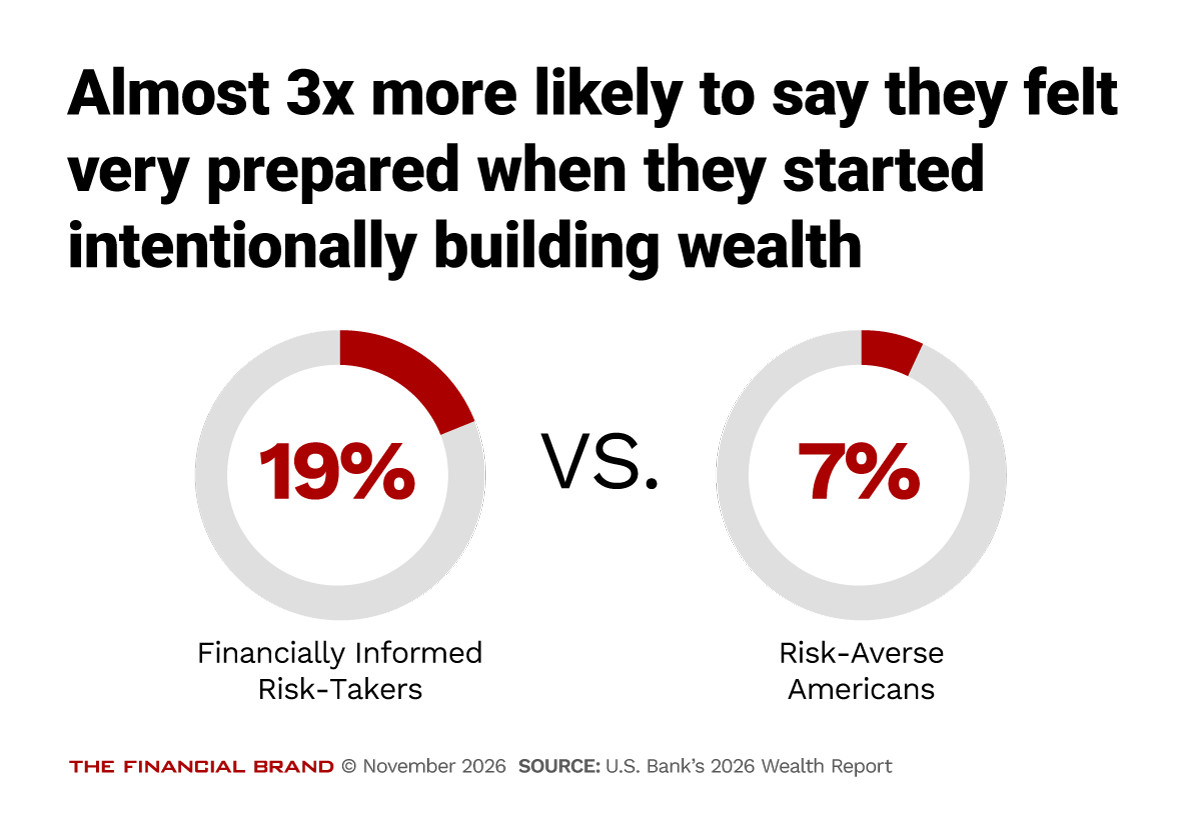
This shows confidence and engagement can coexist with active planning and a willingness to learn. Customers exploring new investments still need context to evaluate those options against their goals and tolerance for risk.
Banks can strengthen their role by connecting financial education with practical tools and appropriate professional support. A savings goal could lead to guidance on emergency reserves; a question about investing could prompt an explanation of risk and diversification; a major life change could trigger a review of financial priorities. These experiences should help customers take informed action while making it easy to seek human guidance when needed.
This can also drive relationship depth. Customers who find useful support at different stages of their financial lives have more reasons to return to their bank for their next decision. But, education alone doesn’t increase retention or revenue, so banks should measure results rather than assume them. Useful measures include engagement with guidance, completion of relevant financial actions, adoption of appropriate services, and changes in customer confidence.
Bottom line: Americans are still pursuing financial security, but their starting points, preferred sources of advice, and definitions of progress differ. Banks that recognize those differences can make financial guidance more accessible and more useful. The goal is to help customers move from uncertainty toward informed decisions, building relationships around the financial lives customers lead.


