
The Banks Building Customer Habits Will Outgrow Those Buying Accounts
By Jessica Kendall, Contributor at The Financial Brand
Simple Subscribe
Subscribe Now!
Banks and fintechs may be serving the same customers, but they are increasingly competing with very different offer strategies.
According to Zafin’s 2026 State of Offers Report, which analyzed more than 3,000 live offers from 837 financial institutions across 67 countries, the industry remains heavily concentrated around traditional incentives such as rate promotions, fee waivers, and welcome bonuses. In fact, approximately 3 in 10 offers compete primarily on rates and fees, creating an increasingly crowded marketplace where differentiation is difficult.
Reality check: financial providers that are winning aren’t doing so on rates alone. While banks continue to rely heavily on milestone-based rewards and partner-driven programs, fintechs are designing offers that encourage ongoing customer interaction and reinforce financial behaviors.
The findings suggest that a future competitive advantage may depend less on pricing and more on creating offers that deepen engagement, strengthen relationships, and become part of customers’ everyday financial routines.
Need to Know:
- Rate- and fee-based promotions remain the dominant offer strategy across the industry, accounting for roughly 30% of all offers analyzed.
- Fintechs are twice as likely as large banks to deploy habit-forming offers that encourage ongoing customer engagement and behavioral change.
- Traditional banks maintain an advantage in partnership-based offers, leveraging co-branded programs, subscription bundles, and large partner ecosystems.
- Financial wellness remains an underdeveloped category for most banks, despite growing consumer interest and widespread industry discussion.
- Nearly 40% of all offers require little more than account signup, limiting their ability to build long-term customer relationships.
The Commodity Offer Problem
For decades, banking offers have followed a familiar formula: higher rates, lower fees, cash bonuses, and introductory incentives.
The challenge is that virtually everyone is doing the same thing.
Zafin’s analysis found that rate and fee incentives remain the single largest category of offers across every institution type. Community financial institutions are especially concentrated in this category, with nearly half of all offers built around pricing adjustments, fee waivers, or rate promotions.
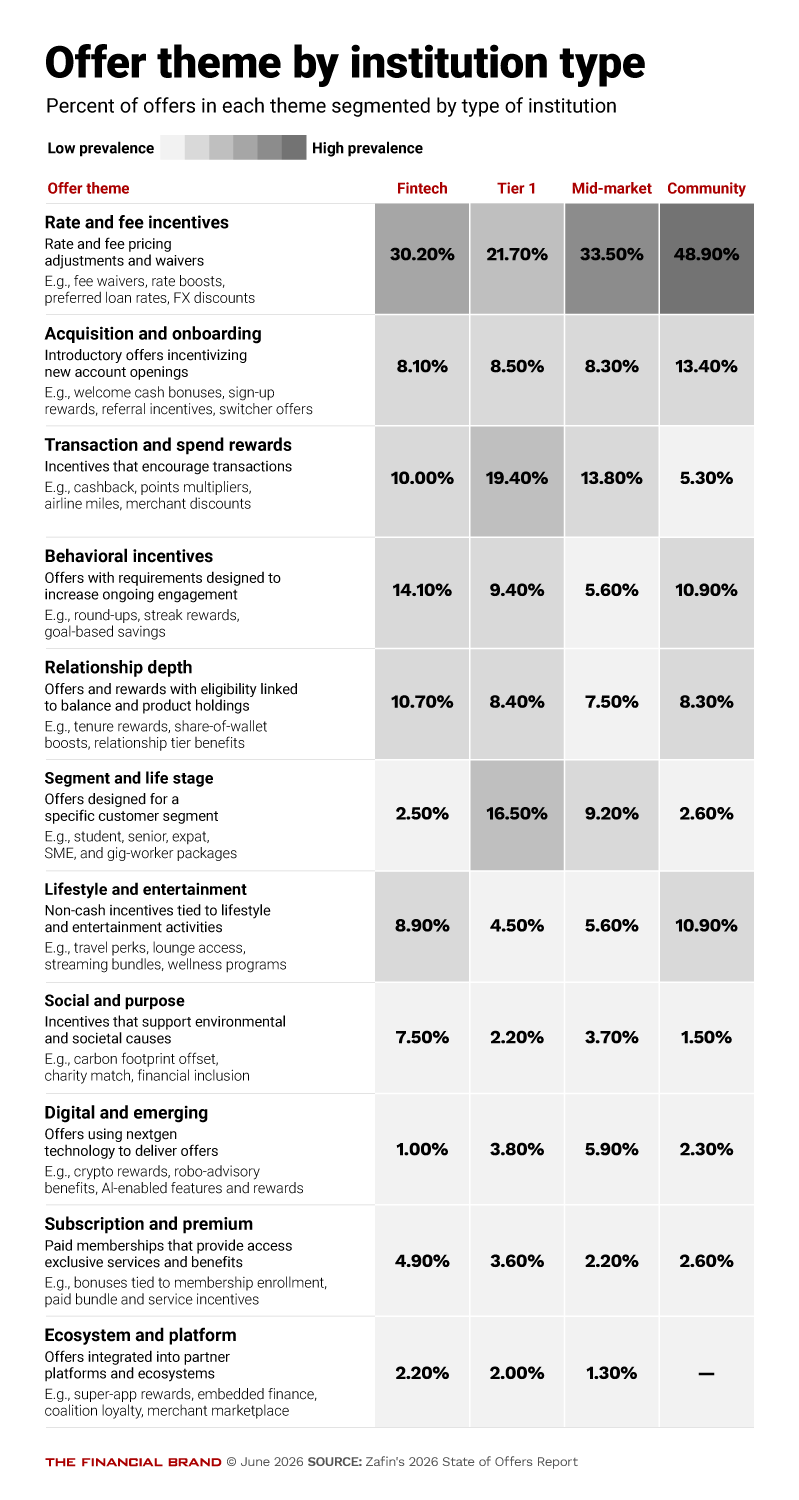
This creates a difficult dynamic. Rate-based offers are relatively easy for competitors to replicate, often compress margins, and rarely create lasting differentiation. While they can drive acquisition, they seldom deepen customer relationships once the promotional period ends.
The report argues that both fintechs and banks have largely converged on what it calls the “commodity floor.” Competing on rates has become table stakes rather than a sustainable source of advantage. The institutions creating separation are finding ways to layer additional value on top of those basic offers.
Key insight: Some of the least utilized categories across the industry represent areas where differentiation may be easiest to achieve. Subscription-based programs, ecosystem partnerships, digital-first rewards, and relationship-based incentives all remain relatively uncommon despite growing consumer demand for personalized experiences.
Fintechs Are Redefining Offer Design
Fintechs are building offers differently than banks. Rather than relying primarily on fixed rewards, fintechs increasingly use behavioral incentives, goal-based savings programs, round-up features, configurable rewards, and AI-enabled experiences.
Zafin classifies these as advanced or next-generation offer mechanics because they actively shape customer behavior rather than simply rewarding a transaction. Examples include:
- Savings streak rewards.
- Goal-based savings incentives.
- Automated saving triggers.
- Personalized rewards.
- Contextual offers triggered by customer behavior.
- Gamified financial challenges.
More than one-third of fintech offers leverage advanced or next-generation mechanics, compared with significantly lower adoption among traditional institutions. This gap reflects a broader philosophical difference.
Banks often design offers around products. Fintechs increasingly design offers around customer behaviors. That distinction matters because behavioral engagement creates more opportunities for customer interaction, generates richer data, and reinforces habits that strengthen long-term relationships.
The report also highlights a growing lead for fintechs in financial wellness initiatives. Ten percent of fintech offers are designed to improve a customer’s financial position through tools such as credit-building features, savings programs, or AI-guided financial coaching. Traditional financial institutions lag considerably behind.
Key takeaway: Many banks have spent years discussing financial wellness as a strategic objective. Fintechs are increasingly embedding it directly into the product experience.
The Engagement Gap May Be Bigger Than the Innovation Gap
Customer engagement may be one of the industry’s biggest missed opportunities, according to the report. The industry has considerable room for improvement when it comes to driving customer relationships beyond the moment of acquisition. Nearly 40% of all offers require nothing beyond initial signup. Another large percentage deliver value passively without requiring customers to return or engage regularly.
From a customer acquisition perspective, these offers are effective but they create limited opportunities for ongoing interaction that can build relationships. By contrast, financial institutions have an opportunity to leverage more habit-forming and platform-embedded offers to drive engagement.
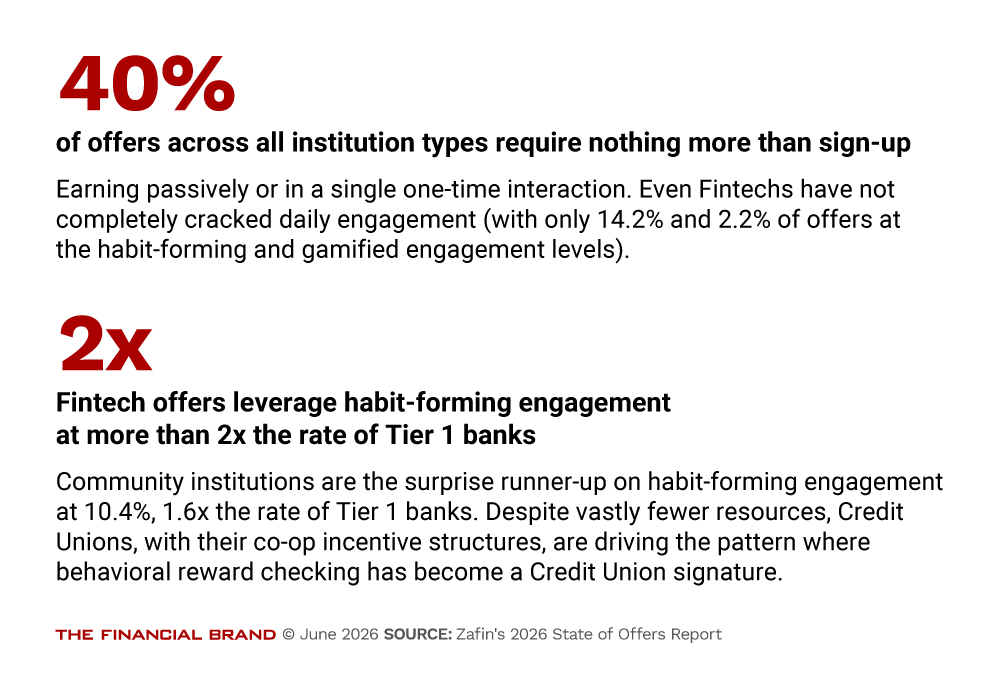
Habit-forming offers can encourage customers to establish repeat financial behaviors through mechanisms such as automated savings, recurring goals, behavioral milestones, and routine-based rewards. Fintechs lead this category by a wide margin, deploying habit-forming offers at more than twice the rate of large banks.
Surprisingly, community institutions outperform many larger banks in this area as well. Credit unions and community organizations often use behavioral incentives that encourage ongoing participation and reinforce member relationships.
Key insight: As customer acquisition costs continue to rise across the industry, institutions that can increase retention, deepen relationships, and generate more frequent engagement may realize greater returns than those focused solely on attracting new accounts.
Building Beyond Traditional Offers
The data suggests that innovation is less about institution size and more about how broadly leaders define what an offer can be. Examples of advanced offers appear across institutions of all sizes. The differentiator is a willingness to move beyond familiar offer structures and leaning in to what makes them stand apart.
Large banks possess partnership ecosystems that fintechs often cannot match. Community institutions benefit from trusted local relationships. Fintechs bring speed, experimentation, and modern technology.
Each institution type has distinct strengths. But, are those strengths being translated into offers that create meaningful customer engagement?
Bottom line: In a market where nearly every institution can match a rate promotion, the next generation of competitive advantage is building offers that influence behavior, encourage ongoing interaction, and deliver value beyond pricing.


