
How Bank of Oklahoma’s ‘Brand Journalism’ Nurtures Customer Needs Instead of Selling Things
Bankers are often reporters' go-to sources for economic and personal finance coverage. BOK Financial's CMO Sue Hermann thought the bank could get some direct benefit from that.
By Steve Cocheo, Senior Executive Editor at The Financial Brand
Simple Subscribe
Subscribe Now!
Way too much bank website content reads like a digested brochure about checking accounts or, worse, a commercial masquerading as valuable advice. Major commercial banks are stuffed with expertise on key subjects that consumers and business people alike crave, especially in confusing times. In fact, when major financial news hits — a key current example is perspectives on tariffs — one of the first sources local media seek out is an expert at an area bank for quotes or sound bites or a guest appearance.
Yet frequently that expertise doesn’t get tapped for content published by the financial institution itself — some of the best stuff goes to someone else’s audience.
The possibilities that can be realized when a bank decides to deploy its experts to produce “brand journalism” excited Sue Hermann, CMO at BOK Financial, parent of Bank of Oklahoma, when she heard about the concept at a public relations seminar. Not only can brand journalism deliver meaningful content to customers and potential customers, rather than the usual pabulum, she says, but it can begin to improve the flagging degree of trust that studies still show the industry suffers from.
Today, BOK Financial produces “The Statement,” a content site offering timely articles and videos. The site features four sub-channels — “Your Money,” “Your Business,” “Perspectives” and “Community.” Since 2019 the bank’s team of internal experts and writers, as well as freelance writers, produce approximately 150 articles or videos annually.
Hermann says the critical difference is “creating a need, rather than selling a thing. Not talking about checking accounts, but helping people understand the importance of long-term planning for their financial needs.”
Generating quality content isn’t cheap. Nor is it as easily tracked for effectiveness as a digital ad might be, says Hermann. It can be hard to sell to superiors, she says, when they counter that “I can run a digital ad, get a click, open a checking account, done.”
Then Covid happened, with all of the urgency to get the word out about alternatives to in-person banking, forbearance programs, government assistance offered through financial institutions, and more. The bank built what became The Statement on that beginning.
Recent titles include “Are pop culture trends recession indicators?,” discussing indicators from “recession pop” music to “recession hair”; “Retiring in a down stock market,” offering 10 tips for seniors; “Are you ready for your ‘Golden Girls’ era?,” covering ways women can take charge of their own financial future; “The true cost of pet ownership,” which included tips on how employers can help; “Are you paying too much with Medicare?,” advocating annual healthcare cost reviews; and “5 myths about inflation—busted.”
Brand journalism “is a long-term play and it takes a long time for some people to get on board,” says Megan Ryan, the bank’s director of content strategy. This not only includes superiors who want proof that the technique produces results, but even experts within the bank. She and Hermann say that often the best people on a given subject area start out feeling that they’re just bankers, and not media material.
But the bank has tracked reader and viewer behavior in multiple ways and Hermann says the content team is garnering results.
“Tens of thousands of people come to the site each month,” says Hermann. “They’re spending more than a minute on the site and they are sharing those articles with others. And we get that traffic without promotion dollars.”
The bank tracks return users and Hermann says people come back for more articles and videos. (The bank filters bots and employees out of its figures.) In addition, The Statement contributes to higher levels of “earned media” — exposure gained through social media sharing and other channels.
Building exposure for the bank in this way, rather than pouring on email after email and then sending those who click through to a page about checking (yes, this is a bugaboo for Hermann), she says.
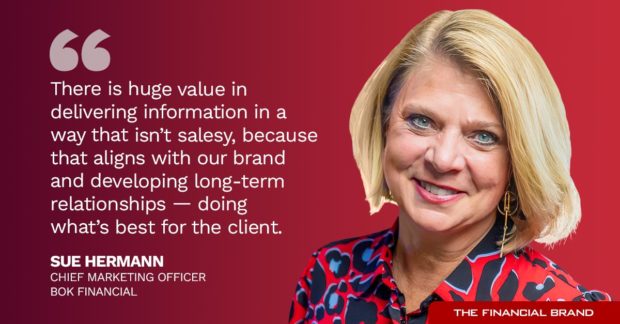
“There is huge value in delivering information in a way that isn’t salesy, because that aligns with our brand and developing long-term relationships — doing what’s best for the client,” says Hermann.
Read more: Flagstar Deputy CMO on 5 Ways to Be a Better Bank Marketer
Getting The Statement Off the Ground
Development of the site began in 2019, but Covid became an accelerant, according to Hermann, as the bank began to crank up its information stream.
“A consultant we worked with told us that we needed to have a hundred pieces of content before the site could be launched,” says Ryan. Between startup posts and the need for Covid information, the initial inventory didn’t turn out to be a problem. Things really got moving in 2020.
Hermann says the bank learned early on that making a success out of this technique takes dedication and regularity.
“You can’t ‘date’ brand journalism,” says Hermann. “You have to marry it. You have to embrace this approach.”
Another helpful element is cross-pollination. Something setting BOK Financial apart from some other large banks is that both marketing and corporate communications report to Hermann as CMO. In the early days, the two functions tended not to leave their swim lanes, as Hermann calls the divide, but now more sharing of ideas and information regarding The Statement occurs.
Ryan says she runs the site as if it were a news organization.
“We have a Tuesday news meeting where everyone brings ideas,” she says. “It may be something that you saw in other media channels. Or a conversation with someone in one of the bank’s lines of business. Or public relations may say that there’s been an interesting inquiry from the media.”
Meetings with line-of-business staff sometimes prompt marketing staff to ask what questions the bankers are hearing from their customers. This may pinpoint an issue and then the right approach to address it has to be settled.
The idea is not just to chime along with other media, but to add a viewpoint of bank experts or a round-up informed by that expertise.
Sometimes, says Hermann, the message may be, “this is what people are saying, but here’s the reality. Or it may be, here’s how to understand this topic. Or, here’s a different take on it.” Sometimes fresh articles can be generated by taking unused but useful parts of interviews done with outside media and using them as starters for the bank’s own content.
Hermann and Ryan says its helpful to have professional journalists on the staff or as regular freelancers, because they are not only comfortable with the need to crank out articles on a timely basis, but also the ability to drop what they are doing, and to pivot to a hotter need. Handling the tariffs subject is one example. This is an example of what Ryan calls a “news jack” — not a news article per se, but one inspired by a news development.
A real fire drill can be delivering a timely video, versus an article, because that means corralling experts, tech resources and more to get the job down. It’s not quite like hawking CDs with a calmly planned campaign on a locked in media schedule.
One thing Hermann is adamant about: She doesn’t want GenAI to be used to generate content.
“Maybe someday, but for my foreseeable future, I believe that the human spark can’t be replicated for real content creation,” says Hermann. “I don’t think the technology is there.”
Read more: Why Personalization, Mobile and Trust Are Driving Consumer Banking’s Ad Strategies in 2025
Walking the Line on What the Purpose of Content Is
A hazy area for Hermann is exactly where the line is between content and marketing materials.
Sometimes a marketing campaign for a particular product or service is the spark that starts a story on The Statement. But Hermann resists the idea of putting marketing messages near or in the content itself.
“I’m not a fan of that,” says Hermann, who went to journalism school. “I don’t believe we should be sharing information and then trying to sell you something, because then the information is suspect.”
It’s natural for a marketing team to see “real estate” and to clamor to use it, acknowledges Hermann. But so far, while the bank has given thought to doing that, it’s only gone that far.
There are some matters that have bright lines around them, as well. All articles and content are subject to review by both the bank’s compliance and legal functions.
Things run fairly smoothly now, but Ryan says there were transitions to make in the beginning. Compliance tended to be siloed along with the functions of the bank, and had a carefully curated collection of disclosures devised for every line of business.
“When we started with brand journalism, it was one of the first things we had ever done as an entity,” says Ryan. “Before that, it was always, this line of business, this brand. But we want this effort to represent the entire organization.”
Hermann adds that there’s been little after-publication heat internally about any article.
“There have been a few times someone has asked, ‘Oh, why did we comment on that?’,” says Hermann. “But it’s usually someone with some distance from the issue. I don’t think we’ve ever had a quoted subject matter expert come back and say, ‘Oh, I take it back’.”


