
Bank Marketing’s AI Visibility Problem Is Bigger Than Website Traffic
By Jessica Kendall, Contributor at The Financial Brand
Simple Subscribe
Subscribe Now!
Artificial intelligence changes where brands need to compete for consideration. It is reshaping how consumers discover financial products, compressing research that once involved search engines, comparison sites, bank websites, and reviews into a single conversation.
Fintel Connect’s 2026 AI Search Guide for Financial Marketers report shows that consumer intent influences whether AI retrieves current web sources, while a bank’s own content and third-party coverage influence which brands appear and receive recommendations. Affiliate publishers also play a particularly important role in product comparisons.
Key takeaways: Banks should prioritize decision-stage and eligibility content, make product details easy for AI systems to retrieve, and evaluate affiliate partnerships for their influence on discovery as well as direct referrals. AI visibility requires a coordinated strategy across channels.
Need to Know:
- Prioritize high-intent searches. Decision-stage prompts triggered source retrieval in 90.3% of answers, creating a more immediate path for current content to influence recommendations.
- Make owned content useful to AI. Banks whose websites were retrieved were recommended first more often (24.5%) than banks whose pages were absent (15.3%).
- Treat affiliate partnerships as discovery channels. Comparison and ranked-list pages influence AI recommendations before consumers click through to a financial institution.
- Adapt to each AI platform. ChatGPT, Claude, and Gemini draw on different source mixes, making a uniform optimization strategy less effective. For instance, 70.2% of ChatGPT citations are from financial institution-owned pages, compared with 64.9% affiliate citations for Claude and a more balanced mix on Gemini.
- Measure visibility alongside traffic. Track where the bank appears in AI answers, which sources support those answers, and whether the bank is recommended first.
Why AI Search Changes Banking Discovery
Fintel Connect’s latest examination of 800 non-branded consumer prompts across three AI platforms, producing 2,400 answers and 7,809 citations, illustrates why traditional traffic measures may miss part of the customer journey.
Consumers traditionally researched financial products across multiple destinations, including searching online, comparing rates and features, visiting bank websites, and reading reviews, before narrowing their options. Now, AI platforms can synthesize information from multiple sources into a single answer, potentially reducing the number of brands a consumer considers.
AI visibility also means a model can read a page without naming the brand in its response. Or, a brand can be mentioned without being recommended. And, a recommendation can carry different weight — and explanation — depending on its position. The research shows that the first-listed brand received an average of 90.4 words of description, compared with 75.3 for the second-listed brand and 68.2 for the third.
Why this matters: Bank marketers need to improve both inclusion and position, particularly when consumers are actively evaluating products, to ensure they remain part of the conversation. This includes being present at every stage of the consumer’s journey from awareness to consideration to decision.
Invest Where AI Retrieves Evidence
The wording of a consumer’s question strongly influences whether an AI platform consults current web sources. In the study, awareness-stage prompts generated citations only 8.8% of the time. That rate climbed to 58.3% for consideration prompts and 90.3% for decision-stage prompts.
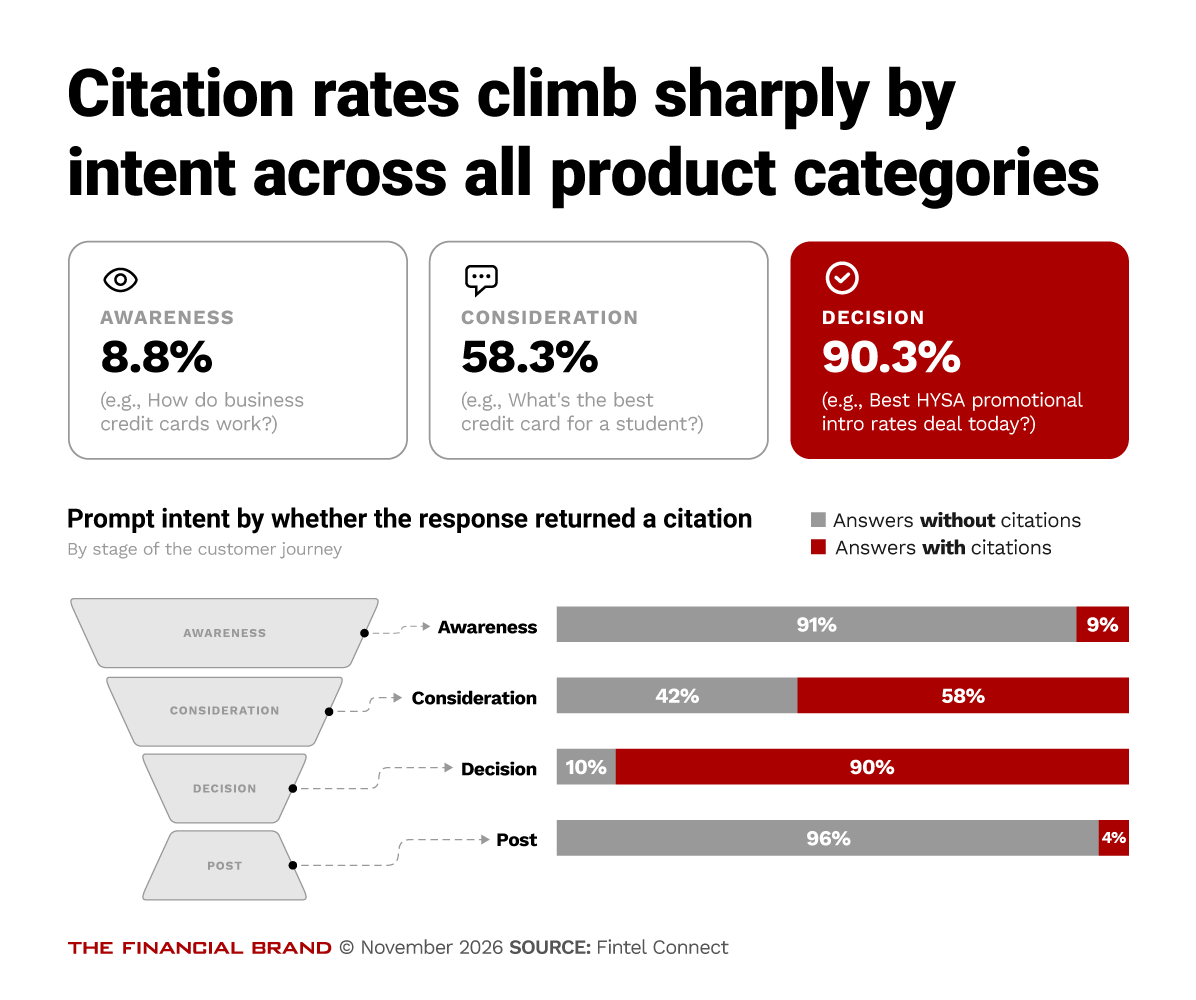
Unsurprisingly, questions asking for the “best” product, current offers, or options available “today” were more likely to trigger retrieval than general explanatory questions.
This distinction has practical consequences for content investment. New material has a more direct route into answers when a model retrieves current evidence than when it relies on information learned during model training. Banks should begin by building a tracked set of prompts around product comparisons, eligibility, rates, fees, and application decisions. Then audit whether existing pages answer those questions clearly.
Product and eligibility pages also deserve particular attention. In fact, the report found that product pages accounted for 57.9% of brand-owned citations overall. In high-yield savings, product and rates pages represented 66.7% of brand-owned citations.
What to do: Provide rates and fees in readable text, identify qualifying criteria, explain who a product suits, and date the information so its recency is clear. Avoid burying essential details in PDFs, images, or interactive elements that may be difficult for retrieval systems to interpret.
Make Affiliate Partnerships Part of Strategy
A bank’s website is only one source of evidence available to AI systems. Affiliate publishers and comparison sites also shape which products enter the answer.
Across the study, 72% of answers recommending a brand were supported by at least one affiliate-page citation. What’s more, affiliate or publisher content accounts for at least 1 in 5 cited answers across LLM models — including nearly 65% of answers from Claude.
The influence is concentrated. NerdWallet, Bankrate, Forbes Advisor, WalletHub, and Experian’s editorial site accounted for 51.9% of all affiliate citations. However, the leading publishers varied by product category, so a partner roster built for credit cards may not serve a savings or personal-loan strategy equally well.
Banks should evaluate affiliate partners on their ability to influence consideration, not solely on the referrals and conversions they deliver. Identify which comparison pages AI retrieves for priority products, where the bank is absent, and which content gaps partners could address.
Key insight: Owned content and affiliate coverage can reinforce one another. Brands whose own pages were retrieved were recommended first 24.5% of the time, versus 15.3% when their pages were not retrieved. The study also found a higher first-recommendation rate when affiliate content appeared in an answer.
That supports a coordinated approach: publish strong product evidence on the bank’s website while building relevant coverage on the third-party pages AI systems already use.
Build a Platform-Specific Measurement Plan
The study found meaningful differences among AI platforms. Financial institution-owned pages represented 70.2% of ChatGPT citations, while affiliate pages accounted for 64.9% of Claude citations. Gemini had a more balanced mix of owned and affiliate sources, alongside community and video content.
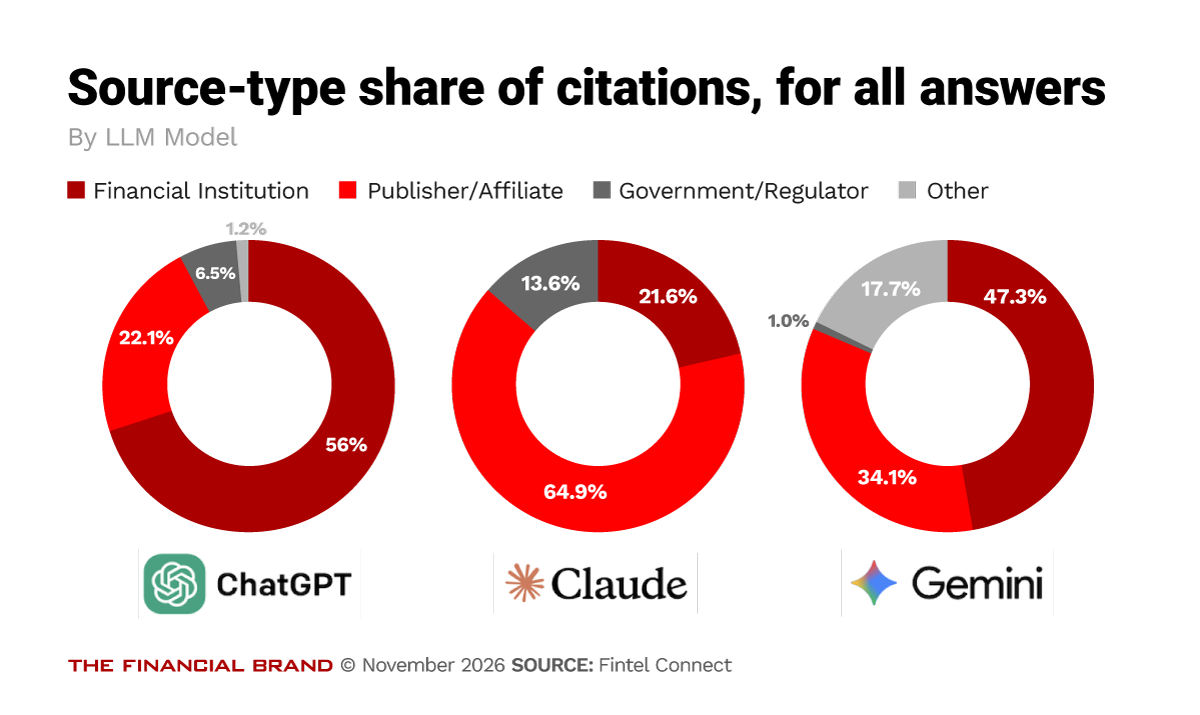
Those differences make it important to track visibility by platform and product line rather than relying on one overall AI-search score. Banks should monitor which prompts produce brand mentions, whether the bank is recommended first, which sources are cited, and how competitors appear.
Community discussions and video, particularly on Gemini, also play an important role. For prompts containing “best,” Gemini cited Reddit in 29.7% of answers and video sources in 54.5%. Banks exploring these channels should focus on credible, useful participation rather than treating communities as another place to distribute sales messages.
Bottom line: AI search is still evolving. This study represents a defined set of prompts, models, and product categories rather than the entire market. A practical starting point includes making product information retrievable, strengthening the sources that inform AI recommendations, and measuring whether the bank earns a place in the answers consumers use to make financial decisions.


