
How to Pivot AI Momentum to Measurable Banking Results
By Jessica Kendall, Contributor at The Financial Brand
Simple Subscribe
Subscribe Now!
Artificial intelligence has moved beyond experimentation in financial services. NVIDIA’s 2026 State of AI in Financial Services report shows an industry shifting from pilots to operational deployment, with AI increasingly delivering measurable business outcomes. Nearly two-thirds of financial institutions are actively using AI, while agentic AI is emerging as the next major area of investment and adoption.
Key insight: 89% of surveyed institutions report revenue gains or cost reductions from their AI investments. The industry’s focus is clearly shifting from experimentation to execution.
As AI adoption spreads across financial services, competitive advantage is becoming less about access to technology and more about the ability to embed AI into customer experiences, employee workflows, and operational processes.
Need to Know:
- AI adoption has reached a new stage of maturity, with 65% of financial services organizations actively using AI and many expanding deployments across core business functions.
- Agentic AI is gaining traction quickly, with 42% of institutions already using or evaluating AI agents for operational workflows.
- Operational efficiency is a clear source of ROI, but improvements in employee productivity and customer experience are becoming increasingly important outcomes.
- Data-related challenges have overtaken model training concerns as the industry’s primary obstacle, highlighting the importance of governance, quality, and accessibility.
AI Moves into the Banking Mainstream
AI adoption has crossed an important threshold. Financial institutions are no longer spending most of their time evaluating possibilities. Instead, they are deploying AI across business operations and expanding successful initiatives.
Sixty-five percent of surveyed organizations report actively using AI, a significant increase from the prior year. Another 24% are assessing AI initiatives. Taken together, nearly nine in ten institutions are either deploying AI or actively evaluating new applications.
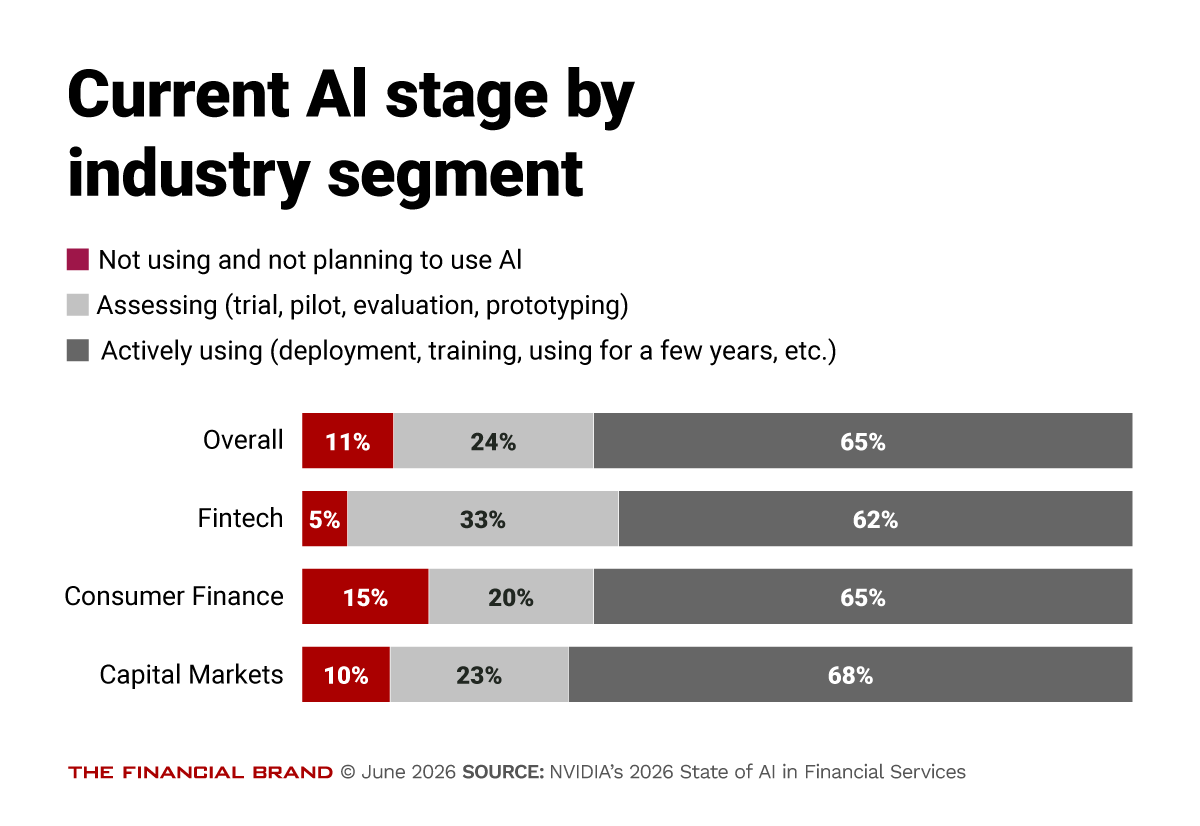
This shift changes the competitive landscape. Just a few years ago, AI discussions often centered on potential. Today, institutions are asking where AI can deliver measurable business outcomes and how quickly those outcomes can be scaled.
Key insight: Institutions are applying AI across analytics, customer engagement, fraud prevention, document processing, and decision support. Data analytics remains the leading use case, cited by 68% of respondents. Generative AI follows closely at 61%, reflecting the rapid adoption of large language models and conversational experiences.
These investments are increasingly tied to specific business outcomes rather than experimentation alone.
What this means for you: Focus AI investments on customer journeys and employee workflows where measurable outcomes already exist. The institutions seeing the greatest returns are integrating AI into core business processes rather than treating it as a standalone capability.
The ROI Story Is Becoming Clearer
Eighty-nine percent of respondents report revenue gains or cost reductions from their AI investments. While outcomes vary across organizations, nearly two-thirds (64%) say AI has helped increase revenue by more than 5 percent. And, operational efficiency emerged as the most commonly cited impact on business operations. More than half (52%) cite that AI created operational efficiencies for their business.
Many of the most impactful outcomes and top use cases focus on removing friction from existing processes. Examples include automating document processing and supporting customer experience and engagement. These applications often produce measurable gains without requiring major changes to business models or customer behavior.

What this means for you: Prioritize AI initiatives that help reduce friction and improve existing performance metrics. Improvements in servicing speed, fraud losses, onboarding efficiency, or employee productivity are easier to measure and easier to scale than broader transformation efforts.
Agentic AI Expands the Possibilities
The survey found that 42% of financial institutions are already using or assessing agentic AI. Among those organizations, nearly half have already deployed agents in production environments.
Unlike traditional AI tools that respond to prompts or perform isolated tasks, AI agents can plan, reason, and execute multi-step activities toward defined goals.
The most common applications provide a useful roadmap for banking executives. Knowledge management and information retrieval ranked first, followed by internal process optimization and customer support automation. These use cases share a common characteristic: they help employees access information faster and complete routine work more efficiently.

While agentic AI remains an emerging capability, early deployments suggest opportunities well beyond customer-facing chatbots. AI agents can assist call center employees, accelerate research, support compliance reviews, guide onboarding processes, and improve operational consistency.
That said, performance concerns, reliability issues, talent shortages, and implementation challenges remain common barriers.
What this means for you: Begin with well-defined workflows and measurable objectives to generate stronger results than those pursuing broad, enterprise-wide agentic AI deployments from the start.
Data Will Determine Who Scales
As AI adoption matures, the report shows that technology itself is becoming less of a constraint than the organizational foundations required to support it.
Data-related challenges have become the industry’s most frequently cited obstacle, identified by 40% of respondents. Privacy concerns, data sovereignty requirements, and information spread across multiple systems continue to complicate implementation efforts.
Interestingly, concerns about insufficient training data have declined sharply compared with previous years. This suggests that many institutions have improved their ability to collect and prepare data for AI models. Today’s challenge is more often about making trusted data accessible across the enterprise while maintaining appropriate controls.
The report also highlights growing support for open-source AI. Eighty-four percent of respondents consider open-source software important to their AI strategy. Financial institutions increasingly view open models as a way to reduce costs, maintain control over sensitive data, and customize solutions for industry-specific requirements.
What this means for you: Consider strong data governance, clear ownership structures, and scalable implementation processes prerequisites for long-term AI success. Banks that invest in these foundations today will be better equipped to expand AI initiatives as new capabilities emerge.


