
Is AI Learning the Job Faster Than Banks Can Redefine It?
By Steve Cocheo, Senior Executive Editor at The Financial Brand
Simple Subscribe
Subscribe Now!
Executive Summary
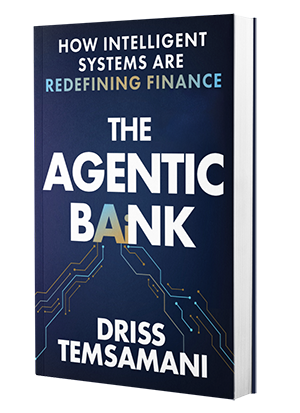
- A new book, The Agentic Bank, digs beneath the surface of agentic AI to expose more of how this technology works, how it’s to be controlled and how it will change how banks operate.
- Author Driss Temsamani envisions agentic AI as a collaborative tool, removing the burden of much routine work to allow bankers to focus on problem solving.
- In time, the customer experience will also change, as agents begin reaching out to suggest solutions to their problems.
Is your head spinning yet?
The conversation surrounding artificial intelligence moves so fast that it’s hard at times to digest what it means. Adoption of AI tools in some sectors of the banking business occurs at a similarly breathtaking pace. The Bank of New York, for example, has trained 99% of its workforce, from the top down, in using its Eliza agentic AI platform, and has around 100 “digital employees,” for example.
 Most of us don’t understand very clearly, if at all, what happens inside the black boxes collectively referred to as “AI.” And some nervous cynics wonder who does, especially when it touches our money.
Banking technologist Driss Temsamani does understand. In his book The Agentic Bank: How Intelligent Systems Are Redefining Finance, he pries open the black box and provides a good understanding of how agentic AI is working — and increasingly will work — in bank management and operations. The book is not for the casual reader, but is a serious plain English primer for the banking executive who wants a clear, yet detailed, understanding of the guts of agentic AI.
“Agentic banking is not a question of if, but when,” writes Temsamani, who is head of digital for the Americas at Citibank.
In a conversation with The Financial Brand, he explains that agentic AI is the culmination of development of AI techniques on an increasingly compressed timeline. In 2010 the ability for AI to observe patterns developed, giving it vision. A few years later, advancements in cloud computing and increased sophistication of central processing units allowed the development of neural networks, conceived in the way scientists understand the human brain to work.
In 2022, with the advent of ChatGPT, Temsamani continues, AI learned to communicate through large language models. And then, in 2024, AI began to be able to function such that it could carry out actions. That is what agentic AI represents, the ability of artificial intelligence to handle operations on its own.
Today, he says, we live in an era of “weak AI,” artificial intelligence trained on data generated by humans. Increasingly, as agentic AI observes and digests data on its own, Temsamani sees it becoming “strong AI.” He sees the potential there as boundless.
But we’re getting ahead of the story. Right now, the best place to begin is with “Lisa,” a persona Temsamani writes about. Lisa is the global head of liquidity for a multinational financial institution.
Want more insights like this? Check out Candescent’s content portal: Illuminating Insights in Digital-First Banking
How Lisa’s Job Evolves with Agentic AI
Along the book’s course Temsamani uses hypothetical bankers in specific positions to illustrate how industry jobs will change as more agents do the heavy lifting of those jobs. The case of “Lisa” is introduced early on, along with a trio of AI agents who handle not only the rote work, but also much of the analysis and decision making of her job — subject either to Lisa’s approval or, over time, in keeping with her established policies and preferences. Some of the latter occurs through the AI’s observation and reflection on what Lisa tells it, over time.
“Her job once meant navigating spreadsheets stacked like barricades, surviving late-night crisis calls, and manually triaging cash positions with incomplete data,” Temsamani writes. “Today, it is defined by orchestration. Lisa no longer asks, ‘What’s going wrong?’ She asks, ‘What are my agents doing about it?'”
Lisa’s role is literally global, and this sets the stage for a task that needs eyes everywhere, not only for what’s happening, what may happen, and what happens after that happens, but how the bank will zig when the circumstances zag.
Her agents’ role is to turn Lisa into a maestro, a conductor. “The cadence of decision-making has shifted from episodic to continuous, from reactive to anticipatory,” the book explains. “… She is shaping the behavior of an intelligent institution that perceives, reasons, and acts with her.”
Early on Temsamani narrates a day in the life of Lisa with her agents. A key change is that everything is dynamic. Bankers accustomed to spreadsheets and even printouts see a day where Lisa talks to her “staff” and is constantly given options to approve or disapprove. Likewise, the functions that Lisa works with, such as the treasury, risk and legal areas, are kept in the loop through their own agents, which are communicating constantly with Lisa’s. Still more agents, such as governance agents, are monitoring the other agents in the background to make sure everything recommended and ready for action syncs with policies, rules and tolerances.
A key change: “Stress testing ceases to be a quarterly ritual; it becomes a live reflex, continuously running in the background and surfacing only what action matters,” Temsamani writes.
Feeding the agents requires a huge amount of data, pulled from numerous sources. A particularly interesting example illustrating this concerns a typhoon alert, and the ripple effects for the bank and for clients arising from the weather. The agents evaluate the potential impacts on both and suggest actions to take, with attention to many moving parts.
Later in the book, he discusses how Lisa and her agents dovetail with other advanced technologies like digital currencies and tokenized assets. This provides a glimpse beyond the surface of usual discussions of these topics, for people who like to know how things work.
Read more: Five Real-World AI Applications That Will Boost Your Bank’s Operations
Agentic AI Augments Banking’s Lisas
“Lisa is being augmented” by agentic AI, Temsamani explains in the interview. Likewise, humans currently working for Lisa can in turn be augmented by their own agents.
“Their day is going to get cut in half. They’ll have more hours and they may use them for solving bigger problems that they never had time to solve before,” he says. “I think our planet is in bad need of quality time to focus on high-value activities, but we just don’t have that time because we’re bogged down by low-value activities.”
Some of these burdens are self-imposed, he says, but others are forced on bankers by company systems. He sees agentic AI freeing them from such burdens.
How well augmentation works will depend on the AI used, and the training it receives.
“A well-designed agent acts like a trusted deputy. A poorly defined one behaves like an intern with a master key,” Temsamani writes.
Read more: The AI Advantage: How to Build a Future-Ready Workforce with Smarter Training
Does Lisa Have Job Security?
This brings up a key reason that Temsamani doesn’t see the Lisas of the business losing their jobs. Automation, through computers and then through the internet, has been taking over many banking tasks. What’s different about agentic AI, he maintains, is that it injects intelligence into the process.
Agents can take on specific slices of human tasks, he argues, “and do them a thousand times better.”
However, he says, the three agents won’t replace Lisa: “While they get trained on a particular task and can do it a thousand times better, they still cannot on the fly make decisions with the intelligence that a human can through life experiences.”
In a sense, at least right now, each agent works and learns within its own specialty. But when a challenge spans multiple specialties, he says, that needs a human. At present agentic AI cannot self-learn the way a person does, not without a human stepping in and saying, “No, that should go in this direction or that direction,” says Temsamani.
“The risk level of taking the human out of the loop is way too high for us to think that we’re going to have autonomous AI,” says Temsamani. At present, it is impossible. However, each agent will adapt over time, much as a human employee eventually learns what the boss trusts them to do on their own, and where the boss insists on the final word.
“This is not automation for its own sake; it is intelligence designed for collaboration, a co-pilot that knows when to lead and when to yield,” Temsamani writes.
Read more: Why AI Won’t Replace Bankers but Will Expose the Bad Ones
Controlling What Goes on in the Black Boxes
Temsamani focuses a good deal on the guardrails and governance that monitor and evaluate how the agents are doing their job.
“In finance, trust depends on clarity,” he writes. “If stakeholders cannot understand what an agent did and why, every decision risks becoming a black box, and black boxes are unacceptable.”
One tool that institutions must adopt is called an “explainability console.” Think of this as a window installed so the insides of the black box can continuously be observed. The goals, according to the book:
- View outcomes alongside confidence levels and applied policies.
- Trace step-by-step reasoning claims.
- Inspect supporting evidence at the source.
- Override or escalate decisions with full audit logging.
From those bullets Temsamani goes into considerable detail about how this kind of tool works.
As he portrays it, governance of agentic AI is an ongoing affair. Boundaries are set in the beginning, performance is continually monitored, and everything is tracked. There are entire regimes of software that handle much of this that the layman never reads about in the general business media. The reader gets to know a bit about tools with names like Splunk, Elastic and Fiddler.ai, which encourages further independent reading.
“This ensures that when agents fail, and they will, they fail gracefully, within known limits, and with a complete audit trail that preserves accountability,” the author writes. “Transparency is not bolted on afterward; it is designed into every decision.”
Read more: Banks Flirt With AI Deposits but Fear Dynamic Pricing Backlash
When Agents Meet Bank Customers
Temsamani believes deeply in the power of agentic AI and sees bank culture coming to be a blend of human and agent, internally. But in time this will also involve clients.
A glimpse of this comes in when “Elena,” a small business owner, is facing a cash bind. Late that night, she checks out financing options on her bank’s app, hoping to find something to tide over her small design firm. Everything seems overwhelming and involves paperwork, and she shuts off her computer to resume in the morning with fresh eyes.
But when she logs back in, an agent-generated message acknowledges that, based on last night’s queries, she has a need — and the agent has a solution.
“Based on your account history and cash flow patterns, you’re pre-approved for a $25,000 working capital line. No paperwork needed. Funds available immediately.”
Agents follow up later in the week, including one that offers her advice on collecting from late-paying customers. Content marketing with a very different twist, you might say.
“Elena felt like she had a financial partner, not just a bank account,” writes Temsamani.
Read more: Building an AI Team Means Hiring Where the Talent Is, Not Where Your Bank Is
Getting Beyond the Cost-Cutting Mindset
In both the book and the conversation, Temsamani makes it clear that he sees agentic AI as the means to better ways to do business inside and outside the bank’s walls.
“Many CEOs and leaders around the world are adopting AI now to cut costs, and it’s becoming another tool to drive down expenses,” says Temsamani. He objects to the focus. He thinks this is a time to reimagine how banks operate, in the context of agentic AI.
“We can’t just say this is another technology to drive efficiency,” he says. He adds, “the whole world of fintechs and big techs was born from the fact that the traditional companies could not reimagine themselves.”
Read this next: How the Agentic AI Revolution is Transforming Operations at 70% of Banks


