
Will the GENIUS Act Revolutionize Banking and Payments? Absolutely. Here’s How
By Steve Cocheo, Senior Executive Editor at The Financial Brand
Simple Subscribe
Subscribe Now!
Executive Summary
- The signing of the GENIUS Act in July establishes a regulatory framework governing stablecoins issued by traditional financial institutions, fintechs and even nonbank companies like retailers.
- The act favors the U.S. dollar’s dominance of the stablecoin market, versus stablecoin laws and regulations enacted or under development in other countries.
- Observers say banks and credit unions of all sizes should be jumping on this issue now, so they aren’t blindsided. Others think it’s wise to let the current hype dissipate.
All summer, while the GENIUS Act was being deliberated in Congress, the hype cycle for stablecoins, the focus of the act, had already begun. A form of digital asset that had taken its share of reputational dents was getting body work and a polishing. President Trump signed the act in mid-July, and the hype has only accelerated.
For many reasons, this is a big moment for traditional financial services players, fintechs and many other players.
“Do we understand all of the downstream impacts? Probably not,” says Richard Rosenthal, principal at Deloitte. But he says this behooves institutions of all sizes to examine potential risks, necessary controls, and the possibility of unintended consequences as stablecoins move forward under the GENIUS Act’s authority.
“GENIUS” stands for “Guiding and Establishing National Innovation for U.S. Stablecoins.” Related legislation, the CLARITY Act, passed the House the same day as the GENIUS legislation, and now the CLARITY Act is pending in the Senate. The full name of the latter is the Digital Asset Market Clarity Act. It focuses on the regulatory roles of the Securities and Exchange Commission and the Commodity Futures Trade Commission.
All the hype is roiling the waters of banking, with suggestions (for example) that it could make it hard for smaller banks and credit unions to fund loans. There have been suggestions that nonbank financial companies and even nonfinancial companies like Amazon or Walmart could issue their own stablecoins, creating competition with or even supplanting traditional intermediaries like banks and credit unions.
Major banks have already been moving towards their own “tokenized deposits,” similar to stablecoins, or exploring consortium-style approaches to stablecoins. Smaller players will more likely engage with vendors, both newcomers and longstanding bank tech providers, rather than trying to build their own wheels, experts believe.
While much of the activity already underway and contemplated for stablecoins is business related (especially for cross-border payments), some see ordinary consumers using them as well.
A recent major report and policy document by the President’s Working Group on Digital Asset Markets says that the GENIUS Act “open[s] the door to stablecoins being used for consumer payments in the United States and across the world.” [Emphasis added.]
An important provision of the act is that stablecoin issuers are not permitted to pay holders of stablecoin any yield or interest — something that may be litigated as some current issuers offer rewards linked to stablecoin accounts.
How Excited or Worried Should You Be About Stablecoins?
Deloitte’s Roy Ben-Hur, managing director at Deloitte, says many institutions will not have the luxury of waiting to see what develops. “They will be seeing at least some of their peers moving into the space,” says Ben-Hur. Some fintech players are already moving forward.
“They need to be ready with an answer to a client who comes in and says, ‘I want to integrate stablecoin into my business-to-business payments, what options do you have to offer me?’,” says Ben-Hur. “If they’re not ready for that, the client can easily move those funds to another institution that may provide them with those capabilities.”
Ben-Hur believes even small and medium sized institutions will have to prepare.
On the other hand, an analysis by the Curinos consulting firm is more conservative.
“We’re wary of crystal balls, and rationality doesn’t always carry the day,” the firm says. “But in piecing together the true benefits of stablecoin adoption and our observations of behaviors — particularly among small and mid-sized businesses — we would anticipate a gradual adoption of stablecoin with a near-term plateau to be at the lower end of current estimates.”
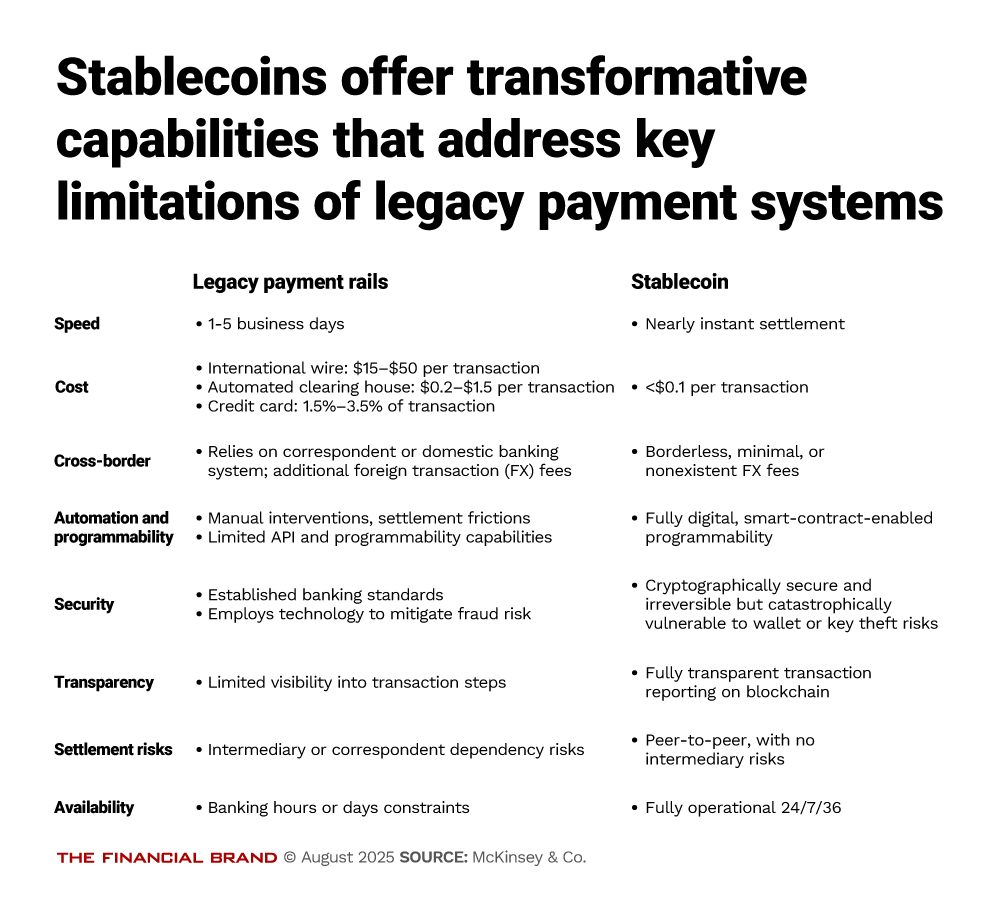
The analysis points out that for small and mid-sized firms stablecoin payments could save on charges for existing payment rails. However, “transformation would be a big lift on small finance teams.” The firm sees more activity coming from large corporations. On the consumer side, Curinos doesn’t see any real benefits for either mass consumers nor affluent consumers.
The Financial Brand also put this question to a veteran business banker, Frank Sorrentino, chairman and CEO of ConnectOne Bank, a $13.9 billion-assets bank in the New York City tri-state area. (ConnectOne was part of the USDF Consortium, which was developing a multi-bank digital coin called “U.S. Dollar Forward.” Initially described as a stablecoin, as the definition of that narrowed, the group adopted “tokenized deposit” nomenclature. Sorrentino notes that the USDF group was wound down.)
Sorrentino gives a nuanced answer to the question. First, he sees a good deal of interest in stablecoins, especially given that they can be set up to execute smart payments — transactions that automatically go through when certain events take place. He explains that blockchain technology lends itself to real estate transactions, cross-border payments and more, and has the potential for being more cost-effective for banks and customers. There are attractions to a new rail that can provide real-time payments.
Some business customers will value stablecoins, he believes. A company buying a container full of goods overseas would appreciate a mechanism that can simultaneously handle payment and verify chain of title in the goods would be an example. He sees use in home finance as well. He says the bank is watching for opportunities — “It’s not going to be for everybody.”
Thus far, he says, ConnectOne hasn’t been getting queries from customers, but it is still early days.
“It’s a big departure from the way things have been done before,” says Sorrentino, “but it’s like every other technology. Generally, the hype is more than what the actual applications wind up being, but over time, generally, we underestimate the power of the change that is coming.”
Aside from real estate transactions, Sorrentino is a bit skeptical about consumer payment applications.
“You’re not going to be buying a slice of pizza on the blockchain, in my opinion,” he says.
Banks that decide to press ahead will likely need to upgrade their capabilities. Smart payments will only work if a bank can accommodate the 24/7 flow that self-executing transactions entail, according to Carlos Kazuo Missao, executive director and global head of innovation solutions at GFT Technologies, an international payments consulting firm.
“They will need to modernize a big chunk of their infrastructure,” says Missao. He says even some of the largest banks need to fill such gaps between legacy abilities and stablecoin delivery.
A few data points to consider: In a survey of nearly 300 domestic and international banks, crypto service providers, challenger banks and nonbank payment service providers by Fireblocks, 90% said they are taking action on stablecoins. Of that, 49% use stablecoin payments, 23% are piloting such payments, and 18% are planning to get into stablecoin payments. Among traditional banks, cross-border payments are the top priority use case.
Understanding the Basics of the GENIUS Act
Something that sets stablecoins apart from other financial developments coming out of Congress is that they’ve already been out there, in various forms, for just over a decade.
A recent report from McKinsey & Co. notes that stablecoins in circulation have doubled over the last year and a half, accounting for about $30 billion of daily transactions, globally. The report points out that that sum represents less than 1% of worldwide financial flows. On the other hand, a report by EY points out that total transfer volume via stablecoin in 2024 hit $27.6 trillion — greater than the volume of Mastercard and Visa combined.
Much of the use to date has been for settling cryptocurrency transactions, though backers of the GENIUS Act hope to see adoption for many forms of commerce.
So, if stablecoin use has already been growing, what exactly did the new law do?
“The GENIUS Act, from our perspective, is more like a formalization of the way the market is already working with stablecoins in the U.S. — it doesn’t bring any super new announcement,” says GFT’S Missao.
That is no slight on the new law. Missao and others point out that the GENIUS Act is important because it legitimizes stablecoins in the U.S. and has set in motion a rulemaking and regulatory development process, notably for the use of stablecoins in payments.
“After years of legal ambiguity, this law is a watershed moment for the crypto industry. It replaces a patchwork of state and federal guidance with enforceable standards for reserve assets, redemption rights, disclosures and custody while clarifying that compliance stablecoins are neither securities nor commodities,” says an analysis of the act from the Paul Hastings LLP law firm.
A key element of the law is that it pulls the internal workings of stablecoins under federal law.
A stablecoin differs from other forms of digital assets in that it has a link to “real world” currency and other forms of value. Unlike, say, bitcoin, which is the product of algorithms to earn the creation of the coins, the makeup of a dollar stablecoin — now established by the act — consists of an instrument backed dollar-for-dollar by actual U.S. currency or other related assets. Among those qualifying are funds held at FDIC-insured depository institutions, U.S. Treasury securities, and repurchase agreements and reverse repurchase agreements tied to those securities.
When a stablecoin is referred to as “pegged” to the dollar going forward, it will be meant literally — this is not indexing. A key element of the legislation is that stablecoin issuers will be subject to monthly reporting regarding the state of the reserves they are maintaining behind their stablecoins. The law also amended the U.S. Bankruptcy Code to make it clear that, in the event of an issuer’s bankruptcy, the assets backing a stablecoin must be used to protect stablecoin holders, and not given to general creditors of the failed issuer.
The new law has a parallel to the structure of the U.S. banking system. In this country we have “dual banking” — chartering by both the national government as well as each of the state governments. The GENIUS Act sets up federal laws governing stablecoins, but also sets standards for state stablecoin approaches to co-exist with the federal scheme. Stablecoin issuers must issue $10 billion or less in stablecoin to quality for the state regimen. (At the same time, federally qualified payment issuers and insured banks and credit unions approved to issue stablecoins are exempted from state stablecoin rules in their host state.)
The law also provides for compliance requirements, including anti-money-laundering mandates.
Read more: Stablecoin and AI Agents Will Reinvent Banking, According to a Crypto Pioneer
How the GENIUS Act Fits into World Finance
The GENIUS Act will also have a role on the world financial stage.
Many other national governments have been vying to get their own stablecoin legislation in place. Right now, most stablecoins are backed by the U.S. dollar. In some quarters there is both a wish to ensure that other countries’ own currencies play a role in stablecoin creation and also the fear that if those governments don’t move, the U.S. dollar will play an even stronger role in the world economy.
However, all the national legislative and regulatory efforts follow their own blueprints, notes a July EY report, “Global Approaches to Stablecoin Regulation.” The result, as portrayed in the report, is a patchwork:
“These nuanced differences will likely create regulatory and supervisory fragmentation, which will be exposed to arbitrage, as well as impact business models and drive different levels of stablecoin adoption across the world.”
In an analysis of the situation, David Beckworth, senior research fellow at the Mercatus Center, says that the European Union’s Markets in Crypto-Assets Regulation (MiCA) takes a hard line on stablecoin compliance and has “discouraged innovation in euro-based tokens.”
Stablecoins in Payments Applications for Consumers and Vendors
Cindy Turner, chief product officer at global payments processor Worldpay, sees strong potential for stablecoin payments on the business side where it can solve friction and pain points.
Turner gives an example. Say a Vietnamese clothing company sells chiefly in the U.S., obtaining dollars. One of its major expenses is advertising on Meta channels, which is billed in dollars. Yet its domestic currency is the dong.
Using dollar-denominated stablecoins to settle the payment for advertising by using funds received from sales keeps everything in dollars and avoids two foreign exchange charges — converting from dollars to dongs and back from dongs to dollars. She says that each FX transaction could eat up 2%-3% of the conversion, via fees. She says Worldpay has already started facilitating stablecoin transactions for certain categories of customers.
Turner, whose past includes stints at PayPal, JPMorgan Chase and Visa, doesn’t see the appeal for consumers of using stablecoins, in spite of the enthusiasm others have for it, especially because many consumers like the rewards programs offered by credit cards and some debit cards.
“But consumers can be a little irrational, so it doesn’t mean that usage isn’t going to start to appear in some places on the margin,” says Turner.
Turner doesn’t see stablecoin payments completely taking away the volume of other business payment channels, either.
“What I think we are moving towards is a trusted parallel to the traditional banking infrastructure,” says Turner. Some people will be willing to trust their stablecoins to nonbanks and others will prefer to trust banks that they already have confidence in.
InvestiFI currently offers banks and credit unions the tech capability to open checking accounts that also permit consumers to make investments from those accounts. One option is cryptocurrency investments. InvestiFI is also developing an option to purchase stablecoins to keep in the account for spending.
CEO Kian Sarreshteh says that he’s noticed that some companies offering stablecoin accounts are promoting them as having a return. As mentioned earlier, the GENIUS Act bars paying a yield or rate. He says companies get around this by offering rewards, and thinks lawsuits are coming.
Will Stablecoins Turn Retailers into ‘Stablecoin Banks’ — and Create Bank Card Rivals?
Will non-financial companies like retailers issue their own stablecoins for use by their customers — a throwback to times when companies issued their own scrip?
Deloitte’s Richard Rosenthal equates the appeal with prepaid cards that can only be used at a given retailer or website — stores have racks with dozens of them and many online platforms sell them digitally.
“Companies like to create affinity for their products,” says Rosenthal. As a handful of companies begin to adopt this option, he says, others will perceive the need to launch their own efforts. Deloitte’s Roy Ben-Hur thinks retailer stablecoins will be pushed with promises of discounts. Retailers will be able to avoid interchange and other fees and will have some money to work with.
Ben-Hur thinks retailers will also lean into stablecoins when dealing with their vendors. A potential deal clincher will be offering vendors faster payment terms if they deal in the vendor’s own stablecoin.
“There’s going to be a lot of game theory, a lot of chess playing,” predicts Rosenthal.


