
Bundling Debit with BNPL Is the Next Big Thing in Cards
By Steve Cocheo, Senior Executive Editor at The Financial Brand
Simple Subscribe
Subscribe Now!
Executive Summary
- Klarna has joined Affirm in adopting the Visa Flexible Credential framework. That will make it possible to build deeper relationships with consumers via debit cards that incorporate pay later options.
- In time, these relationships could involve more payment types, bundling even more potential from the same consumers.
- While banks in other countries have gotten involved with Visa Flex, in the U.S. they have been quiet even as fintechs jump in.
Klarna and Affirm are working from similar battle plans as they push further into the payments business beyond their buy now, pay later roots. Both are powering their initiatives with the Visa Flexible Credential structure, something that U.S. banks haven’t picked up thus far.
Affirm got on board early with Visa Flex. Indeed, the company became the debut user of Visa’s “one card to rule them all” framework, leading with a debit card that can be switched to other payment types via an app. Klarna announced details of its deal with Visa in early June, becoming the first announced user of Flex in Europe.
During Visa’s product drop event in late May, Jack Forestell, Visa global head of product, teased the Klarna deal and spoke enthusiastically about worldwide interest in Visa Flex. “Our clients are seeing Flex as a platform for innovation,” Forestell said.
At the time, he said that over 200 client companies were in the Visa Flex pipeline globally, developing use cases ranging from small business payments to multicurrency accounts, secured credit and agentic commerce. He reeled off the names of multiple payment processors integrating Flex into what they provide, but didn’t mention any U.S. banks. Among the early adopters on the international scene are Liv, a digital bank in the United Arab Emirates, and SMBC Bank in Japan.
When Flex was unveiled, Forestell recalled, it was described it as a combination of debit, credit, pay-in-four with buy now, pay later, and even paying using rewards points, by way of example. In a May investor Q&A Visa CFO Christopher Suh referred to the customer’s ability to “toggle between funding sources.”
This basic blueprint underlies what Klarna and Affirm are doing. A customer can pay with a single credential and choose the account it will be funded from. It’s been compared to a rail yard where train cars can be shifted from one track to another — but all within the issuer’s own system, and, not coincidentally, under Visa’s umbrella. (Mastercard has its own variation on the idea, Mastercard One Credential, introduced in mid-February.)
Both Klarna and Affirm appear to be striving for beachheads in “all-in-one” products.
“This is a market validation that the most progressive and aggressive issuers are going to be issuing all-in-one accounts going forward,” says Richard Crone of the Crone Consulting LLC payments advisory firm.
The potential appeal for sophisticated users is strong, according payments consultant Peter Tapling, managing director of PTap Advisory. “To have one card, and dynamically, depending on the transaction, have it hit a different account on the back end, is pretty cool,” says Tapling. “That’s a very convenient feature.
In some ways, this has already been going on among leading card issuers. The American Express “Plan It” service has allowed cardholders to use their app to switch charge card and credit card purchases into installment plans after the fact. Some major bank issuers — and a growing number of smaller banks and credit unions — provide a similar option from debit cards into payment plans. A difference is that with Flex Credential the choice is made up front.
But Klarna and Affirm could pose a more powerful threat to traditional card players than one-on-one product competition.
Read more: Digital Wallets Increasingly Dominate Payments, But Cash Maintains A Stubborn Toehold
Klarna Launches European Pilot for Debit Cards (Plus)
In Europe Klarna is introducing the Klarna Card, a debit card issued by WebBank on its behalf. The balance account is provided by the bank as well, which makes FDIC insurance possible — for the European audience.
Customers will be able to pay immediately via debit, or, alternatively, via the app, they will be able to switch the charge to a pay later option. Presently the latter includes Klarna’s classic “pay in four” plans and longer-term pay later options. The debit card and attached alternatives will be available for both point of sale and online purchases.
Klarna’s U.S. debit card efforts are in a “trial phase” at present. The company has said that over 5 million U.S. consumers are on its waiting list.
Affirm is further down the track with its debit card, having already onboarded approximately 2 million card holders. Users can opt for a pay later plan through the Affirm app, and then use their card. (Debit purchases on the card over a minimum can be switched to a pay later option within 24 hours of buying.) The service also relies on Visa Flexible Credential.
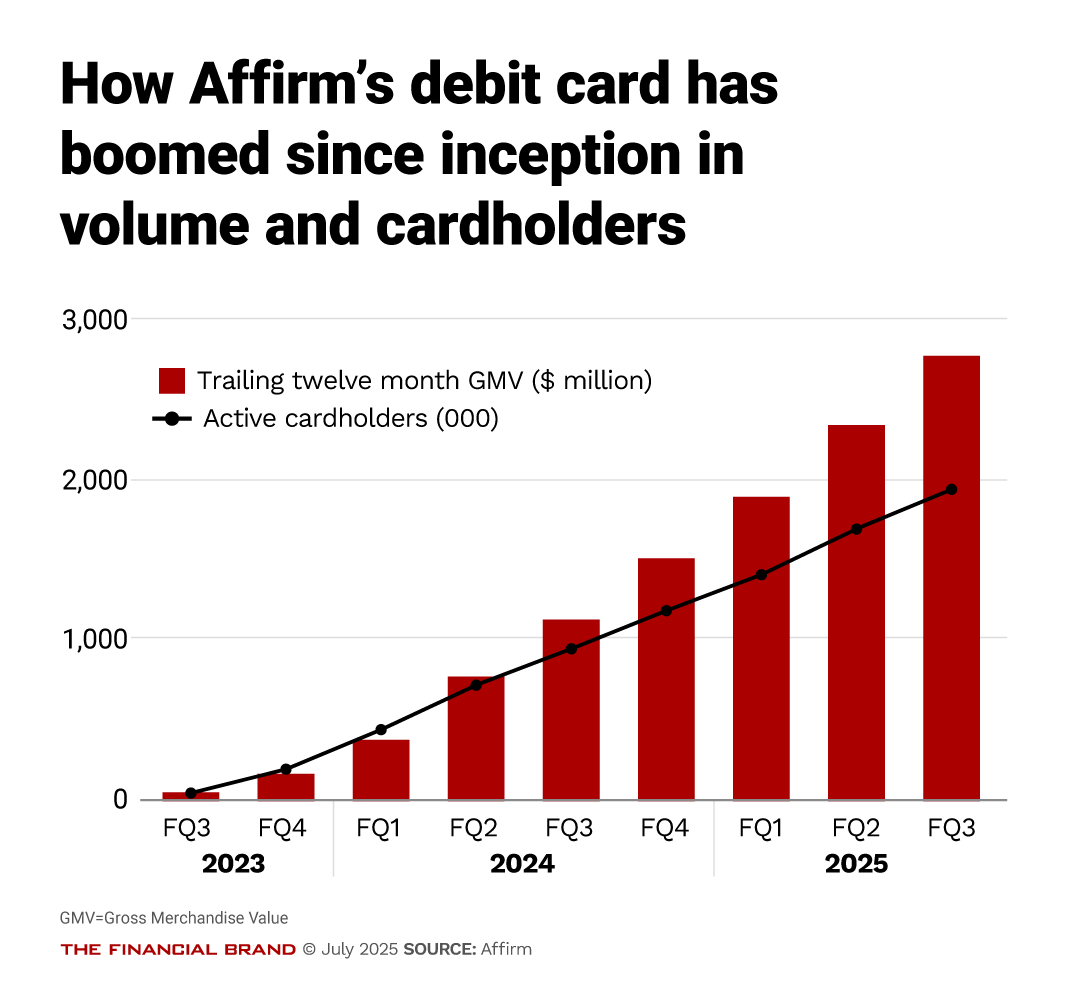
In his most recent quarterly shareholder letter, Affirm founder and CEO Max Levchin called the card “the power tool for Affirm consumers.” As the debit card base has grown, its transaction volume has burgeoned, hitting $807 million of gross merchandise value in the company’s fiscal third quarter for 2025, an increase of 115% year over year.
Affirm clearly stole a march on Klarna in this regard.
“First and foremost, Klarna is doing nothing more than copying Affirm’s playbook,” says Richard Crone. “They are emulating the success, or, rather, trying to emulate the success, of Affirm fastly and furiously — though they are late to the party.”
Crone points out that PayPal, a digital wallet, already includes elements of the all-in-one concept and that Levchin was one of the creators of the original PayPal.
“Max is simply doing what he did to build PayPal, by having an all-in-one account with multiple tender types,” says Crone.
In the meantime, PayPal recently announced a partnership with Mastercard One Credential, to jointly develop new payment features.
“Everybody wants their card to be the card that you use all the time,” says Tapling. But he notes that many consumers carry multiple cards, as plastic or in digital wallets, and they play them for maximum reward value, among other purposes. Currently, the two credential programs rely on the user’s willingness and interest in confining their activity to the options offered by one issuer. In the card area, as well as other aspects of financial services, people increasingly like to mix and match.
Agentic payments is a lurking factor. Crone thinks that the advantages of “all-in-one” offering may be limited. As agentic commerce, and agentic payments arrive, the role of the agent will become more and more consequential.
Crone believes agents that have a first loyalty to the consumer will straddle all available financial and reward relationships to find the optimal choice. And it may be a fluid choice. Crone thinks that, in time, agents will negotiate one-off deals when agents for merchants and issuers make counter-offers.
Read more: Are American Consumers Ready to Let AI Agents Shop and Pay on Their Behalf?
Inside the Strategy at Affirm and Klarna
Building out their original offerings to include debit cards gives both Affirm and Klarna a bigger range of products to sell that bank issuers generally don’t have, according to Crone. Both enjoy a relationship with participating merchants at checkout, generally as a button purchasers can click in order to make a BNPL purchase.
Crone says more than a purchase is going on at the time that the buyer makes that pay later purchase.
“Every time somebody presses on a Klarna or Affirm button, they’re opening a new account,” says Crone. “And the easiest way to grow a consumer relationship is to add another account to it.”
Adding the Flex Credential functionality will enable both companies to cross-sell additional financial products. It begins with providing automated clearing house access to facilitate BNPL repayment, which Crone sees also making pay-by-bank functionality possible down the road. Cashback rewards could be paid into a general purpose reloadable card. Down the road, credit cards could be added to the mix. The idea is that all of these options could become elements in the all-in-one offering orchestrated through Visa Flex.
Tapling has less enthusiasm for this idea than does Crone. Tapling suggests that for some consumers having all of these payment options will be a needless complication. He thinks many people would prefer more straightforward methodologies.
But one wrinkle that both he and Crone see having some potential — the timing depends on many factors — is the addition of stablecoins to the mix. A day doesn’t go by that players from this corner or that corner of the financial services business doesn’t announce at least intentions of launching some product in that evolving space.
Tapling sees stablecoin transactions becoming part of an all-in-one offering, anywhere from two to five years away. A big question is not the transacting of stablecoins between people, but what they will do when they want to convert stablecoin holdings into local currency. To the degree that use of stablecoins remains inside their own environment, he says, transactions could be easier.
Crone says the broader that Klarna and Affirm make the options available, the more potential they will see as agents take over payments.
Read more: Jumping Aboard the BNPL Bandwagon Becomes a ‘Must Do’ Even for Smaller Banks
Where Do Bank Issuers Fit In?
As noted, U.S. banks have not publicly announced specific plans for Visa Flex capabilities. Tapling suggests some of them may feel that offering options like converting credit card or debit charges to pay later plans suffice. Crone is less charitable, saying they’ve been asleep at the helm.
The entrée that Klarna and Affirm have via the pay button is an advantage that banks lack at present. The Paze ecommerce-only digital wallet doesn’t offer any variation on the flex principle and still doesn’t have ubiquity, Crone points out, even though the consortium is working to expand acceptance via deals with Worldpay and others.
Similarly, at the level of individual institutions, traditional issuers lack that entrée.
“They’re not integrated into the checkout and shopping cart functions of ecommerce merchants,” says Crone, “let alone at physical merchants.”
Read more: How Three Banking Organizations are Leaning into Payments to Power Growth


