
Digital Wallets Move to the Center of Payments, But the Long-Awaited ‘Superapps’ Are Looming
By Steve Cocheo, Senior Executive Editor at The Financial Brand
Simple Subscribe
Subscribe Now!
Digital wallets have become “payments chameleons,” according to Worldpay’s Global Payments Report 2026, providing a common carrier for a payments mix that varies widely from one country’s economy to another.
Wallets today are the conduit for payments made via credit cards and debit cards; buy now, pay later accounts; account-to-account transactions; pre-paid cards; QR codes; cryptocurrency; and more.
Key insight: “Digital wallets are winning” entails “multiple stories unfolding in parallel,” the report says. Globally, digital wallets play different roles in different locales, and the trend to wallets is strong in in some countries, lagging in others, the U.S. being a prime example.
Key perspectives:
• “In markets led by a single payment method,” it explains, “wallets make it easy to pay that way.”
• “In more competitive markets, diversity of payment methods is reflected in the wallets themselves, offering choice and flexibility.”
And in some markets, digital wallets have evolved to serve purposes beyond payments — the so-called “superapps.”
What to watch: In the U.S., after false starts, Elon Musk’s X has announced plans to move ahead with turning the social media platform into a superapp, including payments, beginning this month.
Need to Know:
- While digital wallets lead the consumer payment sector globally, in the U.S. the wallet story is still very much a credit and debit card story, and direct use of plastic over digital wallets remains quite strong.
- Signs of the contrast: Americans use cards directly for 49% of online purchases, globally consumers use cards online 31% of the time, and in the Asia Pacific region, only 15%. The same general pattern holds for in-store spending.
- U.S. buy now, pay later transactions hit 6% of online volume in 2025 and Worldpay projects they will rise by a 13% compound annual growth rate by 2030.
- One out of 10 dollars spent by U.S. consumers is still transacted in cash.
Worldpay’s study is based on transaction data from external sources, the company’s own payments volume, as well as analysis of survey responses from over 63,000 consumers in 42 global markets.
Wallets Lead Both E-Commerce and Point of Sale Globally
Digital wallets accounted for the leading share of payment volume in 2025 both online (56%) and at merchants (33%) and are projected to grow even further in both categories by 2030, according to the study report. The chart below breaks down volume by payment type.
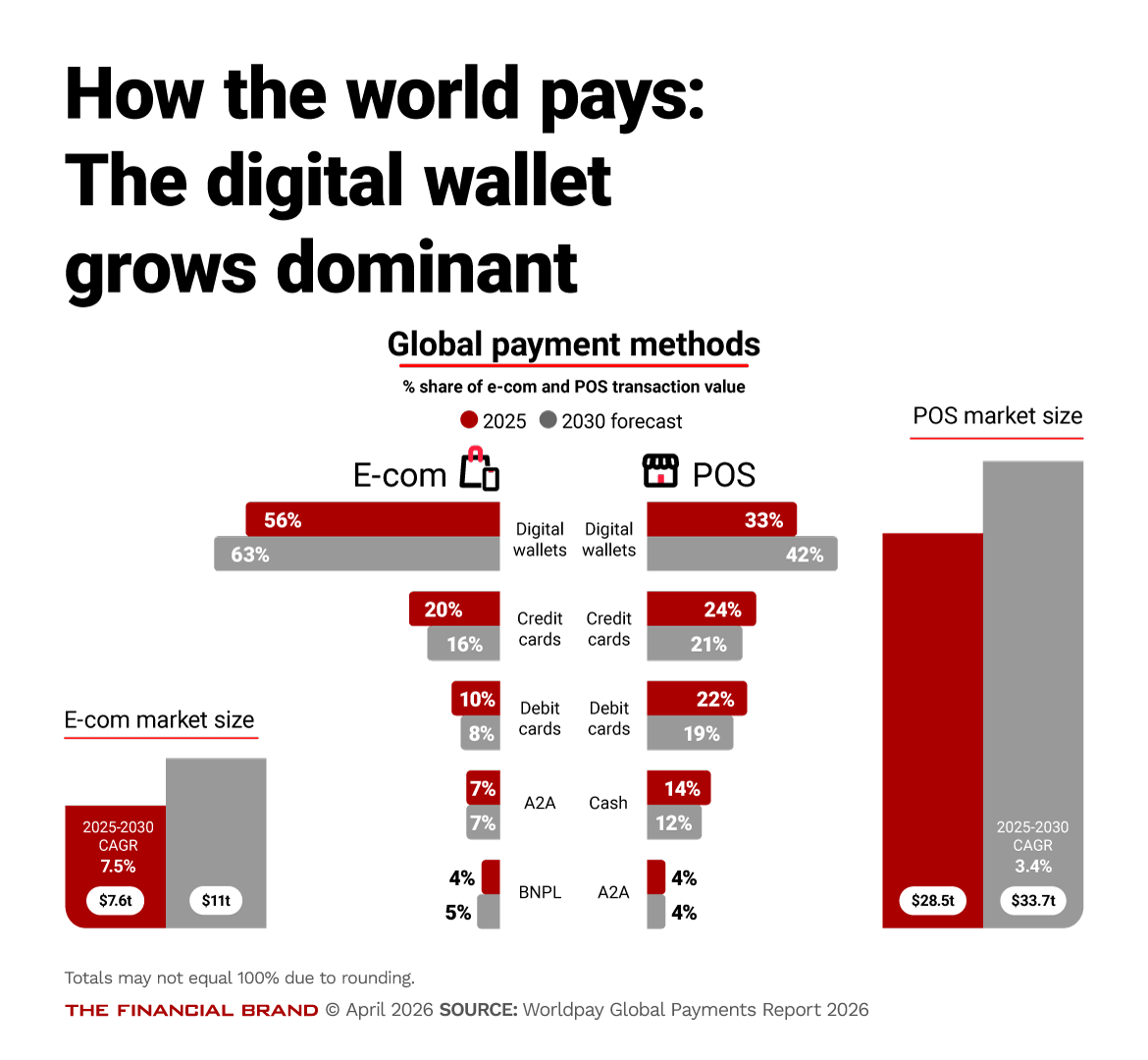
The second highest payment type, worldwide, is credit cards and the third is debit cards, both in e-commerce and at point of sale, as shown.
Taken together, credit and debit card volume — not including their use in digital wallets — accounts for 31% of online volume and 48% of point-of-sale volume. (These totals reflect rounding, versus the numbers in the chart.)
“Cards’ share is forecast to decline slightly through 2030,” according to the study, “reflecting the [growing] consumer preference to use cards within digital wallets.” The report notes that total card volume continues to increase worldwide when usage both inside and outside digital wallets is considered.
The types of wallets favored in specific countries varies from region to region, a product of consumer preference, encouragement by governments of digital methods, and the availability of superapps, such as Alipay and WeChat Pay, which have spread beyond their original base in China.

“Superapps are gaining momentum,” the report says.
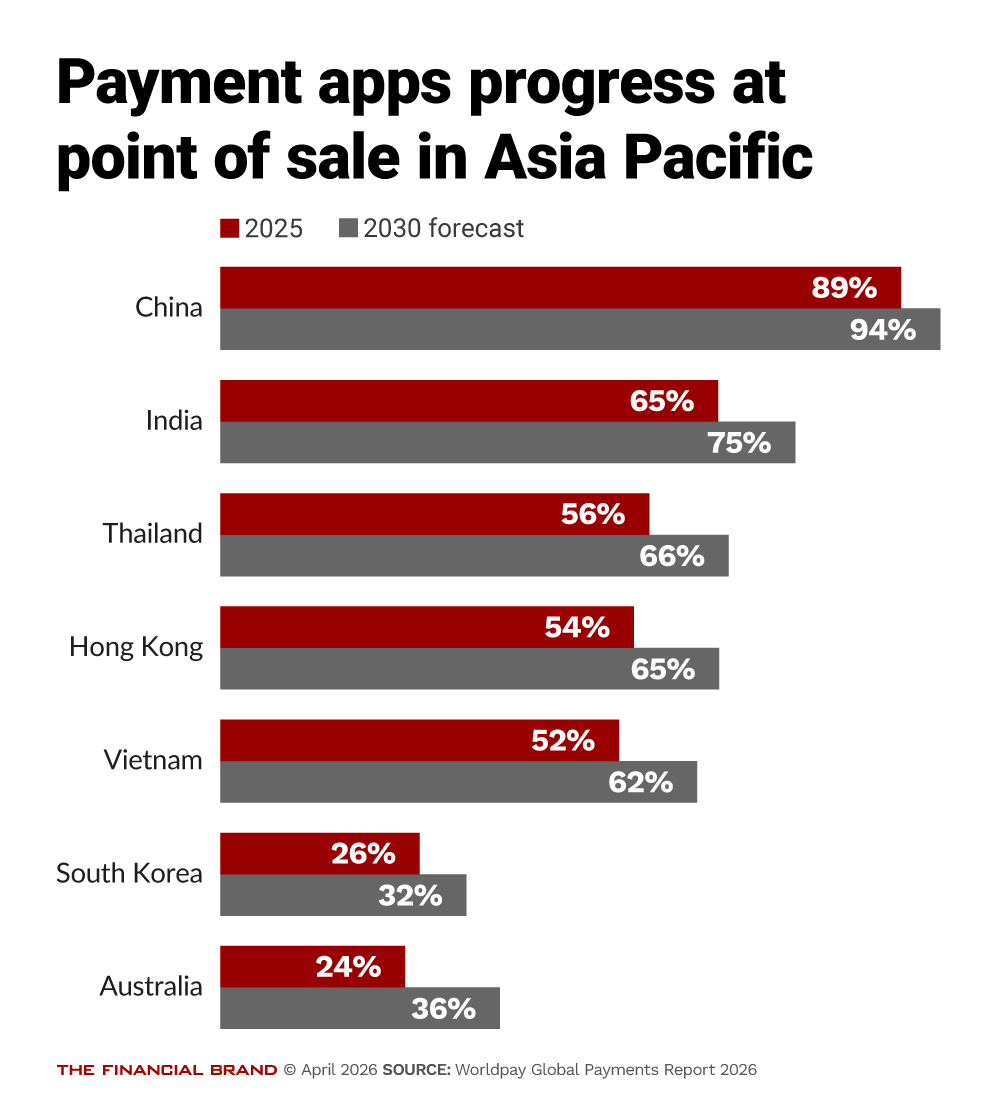
The trend towards payment apps has been strongest in the Asia Pacific region, as tracked country by country in the graphic below. In China, for example, penetration is projected to be nearly universal by 2030, and it’s already nearing that presence now.
Read more: How Many of These Mobile App Best Practices Is Your Bank Following?
Buy Now, Pay Later Now Permeates the Payments System
The report notes that the use of buy now, pay later service has risen to $300 billion both online and at point of sale. That’s a 130-fold increase since the debut of the study in 2014.
“BNPL adoption has increased across age groups and sectors, making installment payments a mainstream way to pay,” the report says. “The context of installment lending is rapidly evolving, with BNPL completely woven into the fabric of digital wallets and shopping platforms.”
BNPL providers offer their own apps and a growing number offer debit cards that enable switching between immediate payment and installments. BNPL can also be embedded in multi-purpose wallets, either from outside the wallet provider’s offerings or as part of them — such as the BNPL option offered in Apple Pay by Apple with partners or PayPal’s own option.
The unexpected BNPL effects on cards: When BNPL first came on the scene, some scoffed that it was just a variation on rolling over credit cards. The report acknowledges that not only did consumers embrace it as something else, but that it has had a feedback effect on the credit card segment.
“The success of BNPL is a rising tide that lifts multiple payment categories, including the one BNPL was supposed to threaten — cards,” the report says.
Increasingly card issuers around the world offer pay-over-time options that originate out of credit card programs, and which Worldpay counts as credit card volume because it originates on those rails.
Issuers have adopted the variation as a way of fighting the competition from companies like Affirm and Klarna that entered the payment business via BNPL.
“Growth in installments within cards and wallets has muted growth in the [BNPL] category proper,” the report says.
In the U.S., a growing practice is offering consumers BNPL options, including allowing after-the-purchase switching of debit card transactions to installments.
Read more:
Americans Still Love Plastic
The report observes that, in stable markets where cards already have a strong foothold, digital wallets tend to be dominated by card-linked funding. This includes Australia, the U.K. and the U.S.
Indeed, in the U.S., as shown by the chart below, digital wallet transactions, including those based out of cards, remain in third place in the U.S. for point-of-sale purchases. Even then, as the heat map below the main chart illustrates, most of the U.S. volume processed through digital wallets are, essentially, card transactions.
Bottom line: “Card transaction values continue to rise, with some share shifting to their use within digital wallets.”
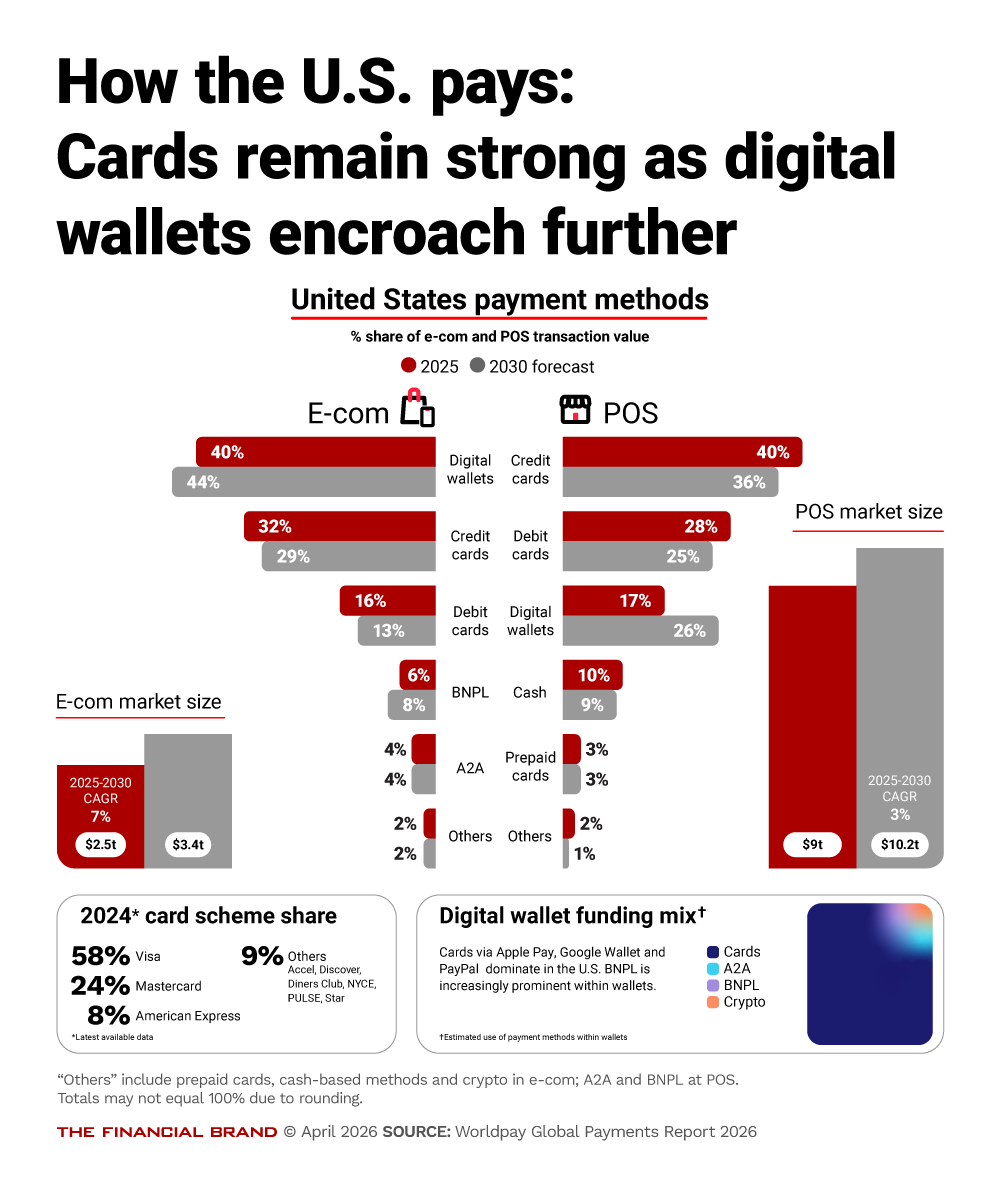
The study projects that digital wallet use will grow at an 11% CAGR by 2030 as more people become comfortable moving plastic transactions into bytes.
Generational shift will play a key part in that growth.
The study found that digital wallets are the leading payment option among 18-24-year-olds (39%) and 41% of 25-34-year-olds.
Read next: Your Customers Will Blame You When Their Shopping Bots Go Rogue


