
How to Navigate a Credit Card Market Polarized Between the Affluent and the Stressed
By Steve Cocheo, Senior Executive Editor at The Financial Brand
Simple Subscribe
Subscribe Now!
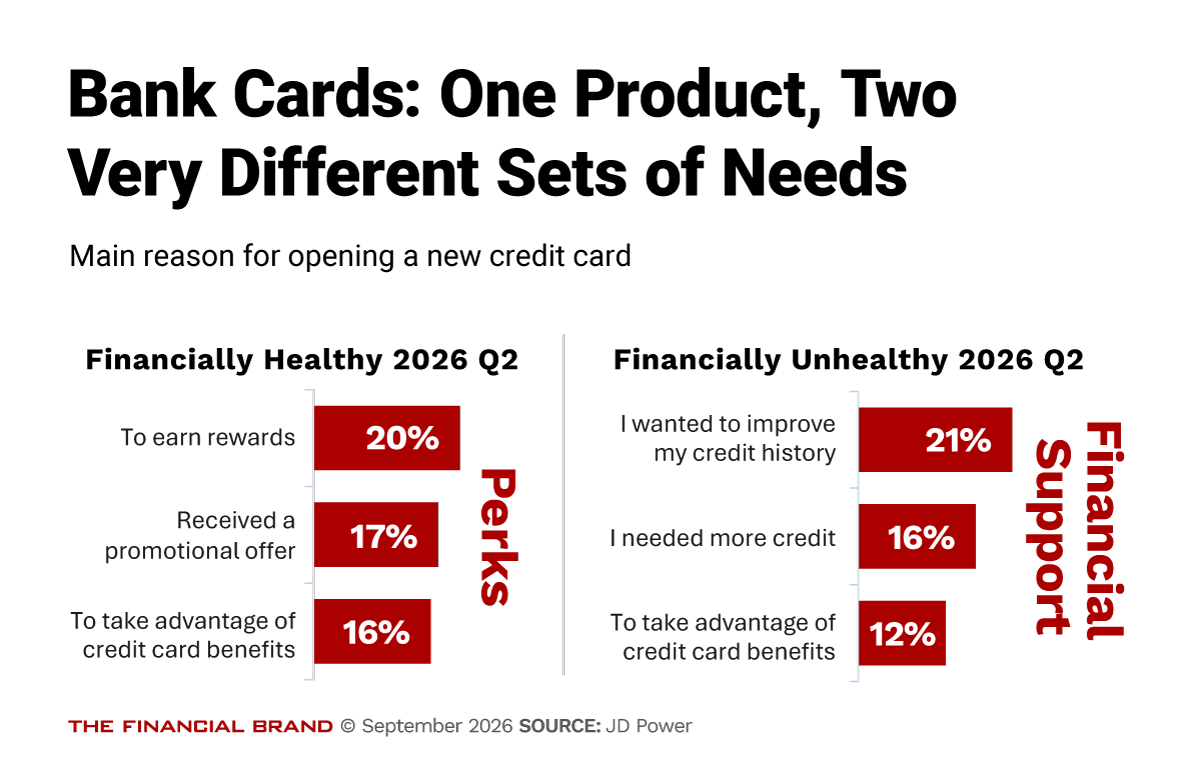
The bank card business is growing increasingly bifurcated, as consumers with better credit seek out superior rewards and benefits options while people with lower credit ratings look for more credit to augment card lines they’ve already drawn down.
This two-pronged market presents challenges for card product designers, marketers and card managers. Innovation is called for at both ends of the barbell, according to John Cabell, managing director of payments intelligence at JD Power.
“The gulf is getting wider,” says Cabell, particularly as the economy is creating headwinds for consumers who are on a budget.
The design challenge: “It’s a matter of making sure that the cards that are fundamental for credit building and for debt consolidation have features and pricing that are competitive in a way that serves that cardholder segment just as well as what’s been happening in the premium segment for holders of those products,” says Cabell.
Need to Know:
- JD Power’s 2026 U.S. Credit Card Satisfaction Study found that financial health among cardholders is eroding. The share of cardholders who consider themselves financially unhealthy rose to 60% versus 56% in the year-earlier survey report.
- Monthly spending across all cardholders in the study increased $109 year over year to $1,167. Ironically, JD Power says this increase reflects both financial strength for some consumers and increasing financial burdens on others.
- “Financially healthy cardholders are getting more value from rewards and lifestyle benefits,” the company indicates, “while financially vulnerable customers are feeling greater pressure from debt and rising fees.”
- The study found that 52% of respondents are revolvers, down slightly from 53% a year ago, “pointing to sustained reliance on credit.”
- Among revolvers, 30% are carrying $2,500 or more in debt.
Originations of new bank card accounts have been rising among both subprime (up 14.1% year over year) and super prime consumers (up 15% year over year), according to TransUnion, based on first quarter figures. Assessing the overall market, TransUnion officials indicated that lenders were increasing nonprime consumers’ credit lines, though at a lower rate than they have been increasing lines granted to stronger credit tiers.
However, some lenders have had to grant more aggressive credit line increases to lower tiers to maintain or build market share, according to Sheldon Stewart, a director at Auriemma Roundtables. These are lenders who have typically offered minimum lines.
“They are finding that they have to go higher,” says Stewart, “because people don’t want to accept the cards otherwise.”
Consumer insight: “If I’m spending $500 a month on groceries, why would I take a credit card that can only give me $500?” says Stewart. “I need a line that’s going to at least give me two months worth of groceries.”
“If we continue to see debt increasing, if we continue to see financial health get wobbly, I think things will only get worse for those who are struggling,” says Cabell.
Meeting the Needs of the Financially Stressed
Cards addressing the needs of the financially unhealthy vary in approach, according to Cabell. Some are designed specifically for consumers who need to build, or rebuild, their credit. One type of credit builder product is the secured card, once an innovation but now ubiquitous.
Other cards, joined with balance-transfer offers, enable consumers carrying significant balances to consolidate debt, typically for a lower interest rate, for some period. (Such transfers sometimes carry a fee.) This product competes to a degree with unsecured personal loans consumers also obtain to consolidate debt at a lower rate. For example, Happen Bank, formerly Lending Club Bank, promotes its personal loans for having lower rates than cards — and at a fixed rate — plus the discipline of paying them back in installments.
A selection of new cards introduced for this customer segment in 2026, including a couple that have added in some rewards:
• OnePay’s Builder Card. OnePay is a fintech owned by joint venture of Walmart and Ribbit Capital, tapping banking-as-a-service of Coastal Community Bank. The card, introduced in April, is a variation on the secured card.
However, instead of being secured by an upfront savings deposit or a CD, the credit line is dictated by the current balance in the customers OnePay checking account. In addition, the card requires no credit check and carries no interest nor late fees.
When a charge is made to the card, funds are automatically moved from the checking account to the consumer’s Builder Card Lockbox subaccount.
• Fifth Third’s Truly Simple Credit Card. This card, introduced in September, permits balance transfers at 0% for 18 months. There is no annual fee and some perks are included, such as $120 in annual value via Mastercard’s Instacart program.
“The card is designed to meet growing consumer demand for longer introductory financing periods while providing tools and benefits that help customers save money and reduce financial stress,” says the bank’s press release.
• Navy Federal’s cashRewards Secured Credit Card features a low initial deposit, unlimited 1% cash back on all purchases, and the ability to start the account with a deposit of as little as $200.
• USAA Bank announced a new family of credit cards in July. An emphasis of the new program is rewards. The bank cited research indicating that a growing portion of cardholders are tapping points immediately to pay for everyday expenses like gas and groceries, rather than saving them up. The Eagle Ascend Card, offered with American Express, is designed as a credit builder account and includes a limited-time offer for a Walmart+ membership.
Read more: Why the ‘K-Curve’ Demands Proactive Strategies from Banks Right Now
Next: AI Could Stoke Innovation for the Financially Challenged
The buzz Stewart has been hearing in his company’s card-related roundtables is how increasing application of AI to the cardholder relationship could change key dynamics.
This concept is still percolating among many players, he says. But what’s coming are AI-based tools that will use bank cards as a hub relationship. AI will analyze each cardholder’s lifestyle and spending patterns and recommend the best option under the card relationship for a particular charge.
How this could change the market: In a sense, AI will become an on-the-fly debt counselor, as the debt is being incurred. Stewart says someone making charges for an overseas vacation might be given the option to putting all of the bills for that period into a unified installment payment plan — sort of a supercharged buy now, pay later.
In this way an issuer could pick up more payment volume while giving consumers better credit options, says Stewart, and at the same time helping to maintain profitability.
What Could Help Customers with Stronger Credit
“If you think back over time, the way cards used to be, they were more of an extension of your purchasing power and cash flow,” says Cabell, speaking of cards for consumers with stronger credit. “Now, in many cases, they’ve become membership experiences, delivering perks to your lifestyle that you wouldn’t otherwise have.”
At the high end, JD Power found that satisfaction increased among holders of ultra premium cards like American Express Platinum and Chase Sapphire Reserve. The study found that in spite of major fee increases imposed last year, along with a bevy of new features, cardholders still consider the premium benefits to be worth the fees. Cabell says he expects further innovation among such programs as they gain more traction.
Rewards still make a difference in card satisfaction. The study found that the overall rate of satisfaction, on a 1,000-point scale, was 613, but cardholders whose cards offer no rewards had a satisfaction level of only 573 points. The high-end cards from Amex, Chase and Capital One had ratings in the 700s.
Reality check: All that said, card rewards programs have a problem. The study found that many consumers are finding rewards less compelling and that they are finding them harder to fathom.
Almost a third of cardholders say they don’t completely understand how to redeem their rewards. “Just 29% of customers say their card use maximizes rewards earning, suggesting that issuers may be leaving value on the table,” says JD Power.
Cabell also notes an element of issuer fatigue in the face of increasing cardholder thirst for benefits.
“It’s a challenge to continue to meet those expectations,” he says.
Read next: Tracking Customers’ Spending Patterns Can Drive Better Personalization


