
How Traditional Institutions Can Beat Neobanks at Customer Acquisition
By David Evans, Chief Content Officer at The Financial Brand
Simple Subscribe
Subscribe Now!
American banking customers are sending a clear message about what drives satisfaction and loyalty in 2025, with digital-first neobanks commanding significantly higher satisfaction scores than their traditional counterparts.
True, YouGov’s annual bank rankings show that Navy Federal Credit Union leads overall customer satisfaction with a net score of 70.4, while Bank of America dominates consideration among new account openers at 35.4%.
However, the most striking finding is the widening satisfaction gap between digital and traditional institutions: The top five neobanks all exceed Chase’s 47.4 score, the highest among legacy banks.
Digital-only banks dominate satisfaction rankings, with five neobanks — Revolut, Cash App, Chime, Ally, and SoFi — all outperforming Chase, the highest-rated traditional bank, and demonstrating a systematic satisfaction advantage for digital-first business models.
Need to Know:
- Revolut leads neobanks with a 59.4 satisfaction score while posting a 1.5-point year-over-year consideration gain among new account openers, the second-largest increase after Bank of America’s 1.9-point improvement.
- Neobank customers demonstrate daily online banking use, almost 40% more than the general population.
- New neobank account openers are intensely interested in cryptocurrency, with 50% believing crypto represents the future of online financial transactions compared to just 26% of the general population.
- Low or no maintenance fees are the decisive factor in banking choice for neobank customers, followed by digital banking capabilities and excellent customer service.
The Digital Satisfaction Advantage
The changing of the guard: YouGov’s 2025 bank rankings reveal a fundamental reordering of customer satisfaction rankings. Stalwarts like Navy Federal Credit Union and USAA still occupy the top positions, but their membership restrictions limit the broader market implications for other institutions.
The more consequential finding emerges in positions three through seven, where five digital-first institutions — Revolut, Cash App, Chime, Ally, and SoFi — all surpass every traditional bank in customer satisfaction.
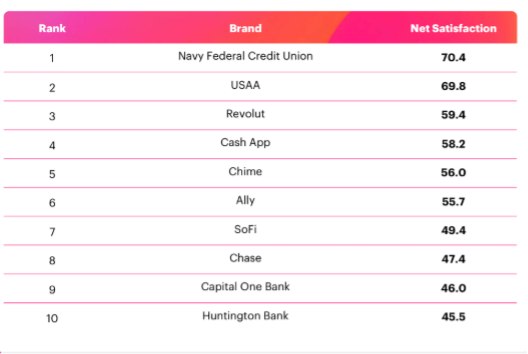
It’s not even close. The highest-ranked traditional bank, Chase, achieves a respectable 47.4 satisfaction score, placing eighth overall. But Chase trails Revolut by 12 points, Cash App by 10.8 points, and even seventh-place SoFi by 2 points.
Key takeaway: The satisfaction gap between digital and traditional banking has evolved from anecdotal preference into systematic structural advantage.
Why this matters: When Revolut customers report 59.4-point satisfaction rating and Chase customers see 47.4, the differential creates vulnerability in Chase’s customer base and establishes elevated expectations for anyone considering accounts.
Traditional banks now face the challenge of competing against satisfaction benchmarks they haven’t historically needed to achieve.
Is the battle over? No, domestic traditional banking institutions still hold some cards:
- Traditional banks still win on the institution-type preference despite digital’s satisfaction advantages. Among new account openers, 48% prefer traditional banks with in-person service options, while only 27% favor digital-only providers. Millennials show the strongest digital preference at 35%, but even this cohort doesn’t reach majority preference for digital-only banking.
The gap between satisfaction with digital banks and willingness to choose them exclusively suggests that customer needs remain more complex than these satisfaction scores alone capture.
Dig deeper:
- How Consumers’ Rising Expectations Are Elevating Fintechs Over Banks
- Consumers Say It’s Not You, It’s Chime
- Citi’s Fintech Chief: Why ‘Self-Driving Money’ Is the Next Revolution
Who Are the Neobank Customers?
If traditional institutions are to compete effectively and regain ground lost to neobanks, they need to go to school on the customers who are selecting these new rivals.
The stereotypes are wrong: Neobank customers now comprise 31% of Americans, representing mainstream adoption rather than niche early-adopter status.
They also skew slightly older than stereotypes suggest: 31% are aged 30-44 and 36% are aged 45-64, compared to 26% and 33% respectively for the general population. This age distribution shows that digital banking appeals across life stages, not exclusively to digital natives.
Neobank customers, however, demonstrate distinct lifestyle patterns:
- 47% rent their primary residences versus 38% of the general population.
- 65% stream video content more than one hour daily, vs 38% of the general population.
- 48% buy or browse services online, including food delivery and transportation.
How to Win Back Neobank Customers
Neobank customers demand a challenging combination: low prices, high service quality, sophisticated technology, strong security, and clear communication, simultaneously. Neobanks have built their business models around these priorities, creating customer expectations that traditional banks with physical branch networks and legacy technology infrastructure find difficult to match profitably.
The good news: The competitive landscape remains fluid. Traditional banks still command brand recognition, offer in-person service for complex transactions, maintain extensive ATM networks, and benefit from inertia among existing customers. Digital banks counter with superior user experiences, lower fees, and technology-forward features but lack physical presence for customers who value in-person interaction.
Neither model dominates completely, leaving market share gains available to institutions that successfully combine traditional strengths with digital capabilities — or that segment customers effectively and serve chosen groups exceptionally well.
Quick Moves
Focus on fees. Low or no maintenance fees matter to almost half of neobank customers.
Reach neobank customers where they live. Focus marketing and advertising on social media and streaming services. Among social platforms, YouTube reaches 76% of neobank customers, Facebook 74%, Instagram 55%, TikTok 40%, and X/Twitter 30%. Among streaming services, Netflix reaches 63%, Amazon Prime Video 57%, Hulu 49%, Disney+ 35%, and Paramount+ 34%.


