
How Consumers’ Rising Expectations Are Elevating Fintechs Over Banks
By David Evans, Chief Content Officer at The Financial Brand
Simple Subscribe
Subscribe Now!
Executive Summary
- Digital financial tools have moved from novelty to necessity, with 78% of Americans now using fintech applications, up 20 percentage points since 2020.
- According to The Fintech Effect, a new study from Plaid and the Harris Poll, three dynamics define the current landscape: a search for relief from economic pressure, with three quarters of survey respondents reporting improved financial confidence as a result of the use of digital tools; a non-negotiable demand for connectivity, with 77% insisting their bank integrate with their preferred apps; and the mainstreaming of alternative payment methods — particularly pay-by-bank, buy-now-pay-later, and cryptocurrency.
- Traditional banking executives must recognize that convenience is now table stakes. Competitive advantage lies in transforming passive platforms into active financial co-pilots that deliver personalized guidance, proactive fraud protection, and AI-powered insights with full transparency and control.
Economic anxiety permeates American households. Sixty-eight percent worry broadly about the economy, 76% feel their paycheck no longer stretches as far as it did a year ago, and job security concerns have climbed 11 percentage points over two years to reach 68%.
This isn’t just abstract worry; it’s driving concrete behavioral change. According to the new survey conducted by Plaid and the Harris Poll, a remarkable 85% of consumers have taken conscious action to manage finances because of economic conditions, with common tactics including cutting discretionary spending (43%), reducing essential expenses (38%), prioritizing savings (36%), and seeking additional income streams (33%). Gen Z stands out particularly, with 47% taking on side hustles to supplement primary income.
Against this backdrop of financial stress, the survey finds that fintech has become a critical coping mechanism, with a clear correlation between digital tool usage and financial confidence.
Even as perceptions of the broader economy remain uncertain, personal financial confidence is climbing, with 75% of consumers rating their money relationship positively — up six points since 2023. Sixty-nine percent credit technology for creating this sense of control, and 61% say fintech apps specifically are helping them weather economic challenges. This represents a fundamental shift in fintech’s role from convenience layer to financial partner. Consumers aren’t just tracking balances — they’re using digital tools to close the gap between paychecks and expenses, find high-yield savings accounts, and develop smarter financial habits that translate short-term wins into long-term gains.
Banking executives should recognize two strategic imperatives emerging from this dynamic: First, design for now by offering tools that directly alleviate pain points like income volatility and inflation fatigue. Second, build for the future by helping consumers translate immediate financial relief into lasting improvements in credit standing, investment growth, and retirement readiness.
Financial institutions that position themselves as genuine partners, not just product providers, during periods of economic stress will earn trust, loyalty, and a lasting place in customers’ financial lives.
Want more insights like this? Check out Candescent’s content portal: Illuminating Insights in Digital-First Banking
From Passive Tools to Active Financial Co-Pilots
Consumer expectations for fintech are evolving rapidly from simple transaction facilitation to comprehensive financial guidance. Overall fintech app penetration hit 78% — up 20 points since 2020 — and crucially, the share of consumers expecting to utilize six or more apps within six months rose to 19% from 14% in 2020.
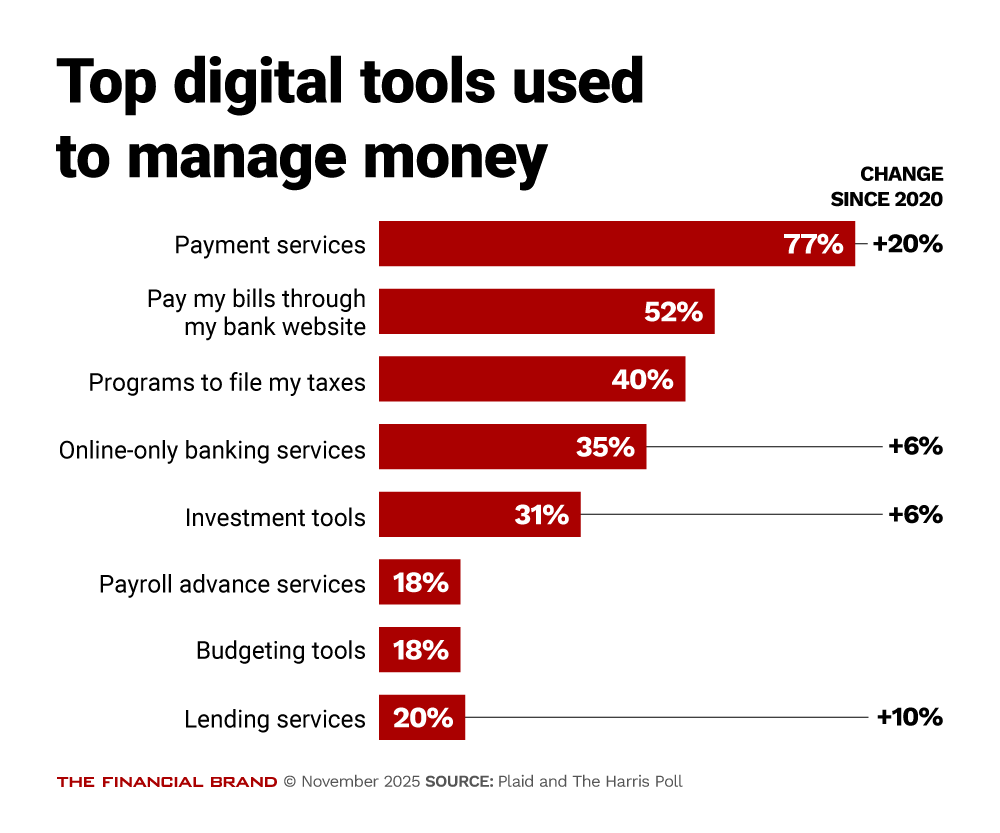
Within these applications, payments remain the dominant use case at 77%, but wealth management, credit tools, and payroll-advance services have all posted significant growth since 2020. The motivation behind this adoption surge is clear: users cite efforts to save time (55%), feel more knowledgeable (46%), and save money (43%). When it comes to concrete results, 33% attribute a bigger nest egg to fintech — a six-point lift over two years that carries particular significance given nearly half of Americans live paycheck to paycheck.
Yet a striking gap persists between consumer demand for financial education and actual delivery. Sixty-one percent of consumers have never been more interested in learning about money, and 81% are actively seeking financial education. However, only 19% currently get that education from their apps. When asked where they turn for financial knowledge, consumers cite friends and family (38%), financial professionals (32%), social media influencers (28%), podcasts (27%), and financial news websites (27%) before mentioning apps. This represents a massive strategic opportunity. Consumers hungry for in-app advice specifically request inflation-era education and strategies (71%) and accountability nudges (61%).
The path forward is clear: transform passive dashboards into active financial allies. Banking and fintech leaders should embed personalized guidance directly into user experiences — think pay-yourself-first automations, dynamic budgeting that flexes with inflation, gamified savings goals, or benchmark analyses helping users understand their standing relative to peers. Those who successfully make this transition won’t just retain users; they’ll earn deeper trust, stronger loyalty, and long-term relevance in an increasingly competitive marketplace where convenience has become table stakes and guidance is the true differentiator.
Trust Requires Both Speed and Safety
Consumer comfort with opening fintech accounts has reached 84%, up five points from 2023 and only marginally behind comfort levels for opening accounts with big banks (86%) or community banks (87%). This near-parity represents a watershed moment: fintech has achieved functional equivalence with traditional banking in consumer perception. Driving this comfort is growing willingness to share financial data, with 70% of consumers feeling comfortable sharing information with digital tools they use (rising to 77% among Millennials). Equally important, 62% of consumers welcome apps remembering their identity if it accelerates sign-in, and Plaid’s own data shows approximately 75% of consumers opting into remembered experiences over the past year. Seventy-two percent feel safer using digital financial products that require identity verification such as driver’s license scanning.
Trust isn’t automatically granted, however. It’s earned through consistent signals of security and transparency. The factors most strengthening consumer trust include strong data encryption and security certifications (37%), immediate fraud protection and reimbursement policies (34%), and FDIC or regulatory backing (34%). Transparency expectations are near-universal: over 80% of consumers want instant breach notifications, clear explanations of personal data usage, and aggressive steps to combat fraud. Perhaps most telling, 81% will not download an app if they’ve read multiple online complaints about it, demonstrating how quickly negative experiences can spread and damage reputation.
Banking executives face a delicate balance: consumers expect both meaningful friction during onboarding to ensure security and seamless experiences throughout ongoing usage. Every touchpoint matters. Real-time fraud detection, clear data permissions, and user-centric design have become non-negotiables. The institutions that succeed will recognize that trust accumulates (or erodes) one experience at a time, and they’ll invest accordingly in proactive communication, real-world protections, and user control mechanisms that demonstrate respect for consumer data and financial wellbeing.
Lending Processes Are a Huge Pain Point
Traditional lending processes frustrate consumers at multiple stages. Nearly half (47%) say loan applications are too confusing, 39% find simply applying for a loan challenging, and 43% struggle to meet qualification requirements. This confusion creates both a problem and an opportunity. Currently, only 20% of consumers use fintech lending apps — but that represents a doubling since 2020, and adoption is accelerating as digital lenders offer smarter application flows, clearer qualification criteria, and real-time data integrations that make experiences less opaque and more empowering.
The fundamental issue with traditional credit-scoring lies in its reliance on static, historical data that often fails to capture true financial health — particularly for gig workers with irregular income, younger borrowers without long credit histories, or groups historically underserved by conventional lending systems. Consumers increasingly recognize this limitation and question one-size-fits-all credit models. Among recent loan applicants surveyed, 84% were comfortable sharing financial information with lenders when the value proposition was clear, signaling readiness for a new approach based on transparency and control.
By shifting toward lending models that incorporate real-time transaction data, fintech lenders can offer more holistic, accurate assessments of creditworthiness. This approach expands access to credit more broadly while simultaneously improving efficiency through automated decision processes and sharpening risk mitigation. The result is increased revenue and reduced losses — a genuine win for both borrower and lender. Banking executives should recognize that lending is getting smarter and fairer by enabling consumers to share their data directly, and institutions that embrace this transformation will capture market share from competitors still tethered to outdated underwriting models that leave both parties frustrated and underserved.
Alternative Payments Invade the Mainstream
What was recently considered “alternative” has rapidly become standard. Pay-by-bank awareness now stands at 80%, with 54% of consumers reporting increased usage over the past year instead of cards. Among Gen Z, usage climbs to 62%, driven primarily by convenience (34%) and security (25%), with fee avoidance also playing a significant role at 22%. This represents a fundamental shift in payment preferences, particularly among younger demographics who will drive long-term trends. The speed at checkout has become increasingly important, up five percentage points since 2023 to reach 20% of consumers citing it as a key driver.
Buy-now-pay-later has achieved even more dramatic penetration, reaching 58% overall usage over the past 12 months and an eye-popping 79% among Gen Z. The motivations extend beyond simply wanting to buy today: nearly one-third (30%) used BNPL to bridge income gaps between paychecks, and 25% specifically to avoid credit card interest charges. This evolution signals BNPL’s transformation from a convenience feature on big-ticket items to an essential financial tool younger consumers deploy for everyday purchases to manage cash flow more effectively. The implications for traditional credit products are significant and banking executives must decide whether to compete, partner, or risk losing relevance with emerging high-value customer segments.
Cryptocurrency ownership climbed to 34% overall and to 43% and 45% among Millennials and Gen Z respectively. Thirty-seven percent of consumers plan to engage with crypto apps — up seven percentage points since 2023. While skepticism endures with 59% still doubting crypto as a sound investment, the directional shift matters. Banks, fintechs, and merchants that strategically embed alternative payment capabilities, native BNPL solutions, and crypto investment options into their offerings will effectively capture the loyalty — and spending power — of increasingly influential demographic cohorts. “Alternative” no longer means niche; it means next.
Connectivity Becomes Non-Negotiable Infrastructure
Seventy-two percent of Americans consider the ability to connect to apps and services a top priority when choosing a bank, with 66% saying they’d consider switching their primary institution altogether if it couldn’t connect to their financial accounts. This emphasis on connectivity transcends mere convenience — it has become a fundamental factor in trust, with 71% of Americans saying they only trust banks that can easily and safely connect to fintech apps. More than half of Americans (58%) have already abandoned a financial app because it couldn’t sync with their bank, demonstrating that connectivity failures drive churn on both sides of the relationship.
The benefits of seamless data flow are measurable and significant. When connectivity works properly, 76% of consumers feel more in control of their finances and 69% report making smarter financial decisions. Seventy-two percent explicitly state they don’t want to jump between multiple apps to manage money, reinforcing the value proposition of integrated experiences. Consumers are increasingly willing to switch providers based on digital experience quality, with chief motivators including lower fees (43%), enhanced security and fraud protection (36%), better customer service (32%), and more services or features offered in a single app (31%).
For banking leaders, the strategic implications are clear. Open banking infrastructure isn’t optional — it’s essential for customer retention and competitive positioning. Financial institutions that embrace open APIs and invest in embedded finance capabilities can transform connectivity from defensive requirement to offensive differentiator, curating holistic money experiences integrating payments, savings, credit, and financial wellness in single platforms.
Failure to deliver high-fidelity data connectivity risks driving customers away not just from apps but from primary banking relationships. With consumers demonstrating increasing willingness to churn in search of better value, trust, and digital experiences, the pressure to modernize connectivity infrastructure has never been more urgent.
AI Expectations Accelerate from Curiosity to Requirement
More than half of Americans (54%) are now excited about AI-powered finance tools — up seven percentage points from 2023 — and 57% expect their fintech apps to use artificial intelligence. This represents a dramatic acceleration in both awareness and comfort. One-third of Americans (33%) have experimented with generative AI in the past year, up from just 20% in 2023, and 21% already use AI specifically to help organize personal finances. Fifty-nine percent of Americans — and 70% of Millennials — say their comfort with AI has grown over the past 12 months, reflecting rapid normalization of what was recently considered cutting-edge technology.
Consumer comfort extends across a wide range of financial applications. Sixty-three percent are comfortable using AI for finding and managing subscriptions, 63% for getting help lowering bills, and 59% for solving customer service issues — all up significantly from 2023. Additional use cases garnering majority support include getting financial education advice (58%), addressing security concerns (58%), and receiving budgeting and spending advice (54%). Notably, 61% of Americans trust an app more if it uses AI for fraud detection, demonstrating that consumers associate artificial intelligence with enhanced security when properly implemented.
Yet trust remains conditional. Transparency on AI use (42%) and the presence of human approval for major financial actions (42%) are the top trust boosters, followed closely by stronger fraud protection (40%) and explicit data guarantees (40%). Seventy-three percent want government regulation of AI, suggesting consumers understand its powerful potential and desire appropriate guardrails. The next frontier involves apps integrating AI into core user experiences in ways that feel personal, contextual, and safe — think real-time financial coaching, automated savings decisions, or dynamic budgeting insights, all explained in plain language and backed by visible security guarantees. Banking executives should recognize that AI implementation will only be as powerful as the data behind it: high-quality, real-time, and responsibly sourced.


