
Use These Tests to Flush Out Tech Vendors That Will Test Your Patience
By Nicole Volpe, Contributor at The Financial Brand
Simple Subscribe
Subscribe Now!
Executive Summary
- Nearly 60% of software buyers regret recent purchases, with poor service cited as the primary reason by over 30% of respondents. Seven out of 10 SaaS provider switches stem from service deficiencies, not product shortcomings.
- When vendors under-deliver on support, your customers experience slower upgrades, more downtime, and poor support, contributing to the 26% of bank customers who cite poor service as their reason for switching institutions.
- Evaluate how vendors deliver service day-to-day, what tools they use to support operations, whether they have consistent processes across product lines, how they incorporate feedback and what metrics they track and share with clients.
For banks and credit unions evaluating a new enterprise technology or SaaS platform, here’s a modest proposal: you’re probably focusing too much on features and functionality, and not enough on quality of support and service.
For many technology teams, that may be hard to accept — but sometimes the truth stings. Institutions pour significant time and money into creating RFPs, vetting vendor responses, and stress-testing their claims. But as much as all of that matters, they may still end up missing what may be the decision’s most consequential component: the ability to deliver service that’s not just responsive, but anticipatory — hallmarks of an emerging shift toward Intelligent Banking — where data, design, and empathy converge.
Research increasingly bears this out: a broad-based study of nearly 3,500 businesses by Capterra, part of Gartner Digital Markets, revealed that roughly 60% of software buyers regret a purchase made in the past 12 to 18 months. And more than 30% of respondents to the study cite poor service as their primary reason for regret, second only to cost. Another recent study, by ScaleFusion, found that seven out of ten decisions to change SaaS providers stemmed from service deficiencies, not product shortcomings.
And if you think your institution, having checked the boxes on functionality, can simply tough it out on service, consider your customers. A SaaS provider’s platform faces the market under the banner of your brand and directly impacts the experience of your customers — who care about service quality, too. According to J.D. Power’s 2024 U.S. Retail Banking Satisfaction Study, 26% of customers likely to switch banks in the next year cite a poor service experience as the reason.
When your vendor under-delivers on support or service, your customers feel it — through slower upgrades, more frequent downtime and latency, and their own inability to get prompt, effective support.
We sat down with John Garvey, Chief Operating Officer of digital banking technology provider Candescent, to discuss ways of heading off this problem. Garvey provided a list of five critical questions every institution should be asking of their prospective tech partners and building into their overall evaluation processes. This article unpacks the implications of Garvey’s questions and discusses what institutions should look for in their vendors’ responses.
Want more insights like this? Check out Candescent’s content portal: Illuminating Insights in Digital-First Banking
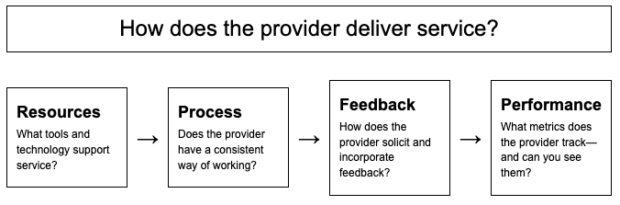
1. How does the provider deliver service?
This one seems simple but it gets right to the heart of what’s at stake: what a vendor delivers obviously matters, but how they deliver it may matter just as much. The question to ask is this: how will this new partner actually serve us day to day?
Responses to listen for include whether you’ll have named, accountable vendor-side contacts who understand your business; a clear escalation path when issues arise; and a service workflow that lets implementation and support work together rather than holding them in silos (Don’t you have enough to worry about with your own silos without buying a piece of someone else’s?). Lacking such continuity and consistency, even strong platforms can deliver subpar outcomes at critical moments like upgrades, integrations, and incident response.
The Capterra / Gartner survey reinforces the importance of communication and responsiveness. The survey’s most-cited drivers of buyer regret are problematic handoffs between sales and implementation (43%) and mismanaged expectations (42%), both of which are rooted in poor communication and unclear accountability. Once a relationship is underway, response speed becomes the defining driver: nearly half of all buyers who regretted a purchase said the vendor could have made things right by immediately responding to customer requests (49%) or by providing enhanced implementation assistance (46%).
2. What tools and technology does the provider use to support its service operation?
A provider’s own technology stack is critical to its service quality. Why not ask about it directly? In addition to capturing platform names and details, prospective buyers should pay special attention to how the vendor uses its CRM, how it deploys AI, and whether supporting knowledge resources are available.
A consistent CRM integration is especially critical because it ensures all of your interactions and resolutions are logged in one place and allows support teams to see context instantly and coordinate across functions. Garvey suggests asking: “Do they capture all of the client issues and resolutions in one place so that they can mine that information when there’s a support call and make the triage faster?” A unified CRM also enables trend analysis and proactive issue management; this is critical for institutions managing complex, multiyear platform relationships.
AI-driven support, meanwhile, can streamline repetitive tasks such as ticket classification, status updates, and even root-cause analysis, improving both speed and consistency. Properly implemented, agentic AI tools can shorten response times while freeing human specialists to focus on higher-value client needs. These capabilities reflect a broader evolution in financial services where human understanding meets data intelligence to create more predictive, personalized, and meaningful experiences. Such tools may also speed your own team-members’ access to answers, avoiding the need for support in the first place. Knowledge-management tools can also reduce time to resolution — especially when continuously updated and connected to the CRM. These include shared access to FAQs and guides to best practices and step-by-step responses, among other things.
3. Does the provider have a consistent way of working?
This especially matters in a marketplace defined by vendor consolidation, where so many technology providers are the result of multiple mergers and acquisitions aimed at building out their suite of features and capabilities. Institutions should ask whether a vendor applies a unified delivery methodology across all teams and product lines, or whether practices vary depending on which business unit or acquired company you happen to be dealing with.
“Many providers are oftentimes a result of dozens of transactions that have never been integrated,” Garvey said. “This means there’s often a direct relationship between the level of merger activity and the likelihood of fragmented and inconsistent service.”
Buyers should understand the underlying drivers of consistency. Are teams trained in a common project management framework? Do they follow uniform implementation and escalation procedures? Will you end up managing through different reporting formats, measurement standards for on-time and on-budget performance, and uneven accountability when problems surface? A vendor able to demonstrate disciplined integration and a single, coherent approach to delivery offers a more reliable foundation for a long-term partnership.
4. How does the provider solicit and incorporate feedback?
When evaluating a potential partner, institutions should look closely at how feedback is gathered and then applied. “Do they do consistent check-ins when you finish a particular project or you’ve had a support ticket?” Garvey said. “Do they solicit feedback and incorporate that feedback to do constant improvement?”
Most providers can point to client advisory groups or Net Promoter Score (NPS) surveys, but those mechanisms don’t always achieve what they should. Advisory sessions often remain focused on product features and roadmaps and less so on service quality or responsiveness.
Garvey notes that stronger organizations close the loop through more systematic and immediate measures, such as customer satisfaction (CSAT) surveys after project milestones or support tickets, and regular check-ins that feed back into operations. The differentiator to watch for is whether they use that data to drive consistent improvement. Do they identify and correct issues before they become systemic?
5. What metrics does the provider track — and can you see them?
“With all of these practices and processes in place,” Garvey asks, “how do I actually know any of it is working?” How does the vendor measure service performance and how is that data aggregated and shared? Are uptime, on-time delivery, and mean time-to-resolution tracked consistently? Can clients see their own results alongside benchmarks for the broader client base? Vendors that track service KPIs, and make them transparent, are signaling confidence in their delivery model. Clear visibility into such metrics allow clients to hold partners accountable over time.
The Shape of Things to Come
Whether a vendor offers a “premium” service level option is telling in itself. Those that do are signaling both a willingness to commit to meeting the highest delivery standards and the confidence that they can make good on that commitment. Setting aside which service level you might choose, wouldn’t you rather work with a partner that has control over — the ability to manage and measure — critical variables like uptime, on-time and on-budget delivery, and mean time-to-resolution?
For banks and credit unions, switching services is a major undertaking with lasting consequences. The process of making that choice should of course ensure your institution can bring the right functionality to market. But don’t forget that it will also set the terms of the support and service environment that you, and your customers, will live with for years to come. It will determine whether your institution spends those years competing and winning in the marketplace with Intelligent Banking or putting out fires, both its own and those of its vendors.


