
Build a Growth-Ready Banking Ecosystem Beyond the Website
By Allyson Couture, Manager of Marketing at Silvertech
Simple Subscribe
Subscribe Now!
For years, banks treated the website as the center of their digital strategy. If the homepage looked modern, the CMS was upgraded, and some level of personalization was enabled, digital transformation was considered “done.” Significant investment went into redesigns, migrations, and feature upgrades to improve what customers saw when they landed on the primary site.
But customer behavior has moved on — and it has moved fast.
Today, a bank’s real differentiator is not how its website looks, but how seamlessly it connects transactions, mobile engagement, digital marketing, branch experience, and customer service into a single, coherent journey. Most meaningful interactions now happen outside the primary website — inside mobile apps, online banking portals, email,SMS communications, call centers, advisor conversations, and physical branches.
In fact, a 2025 American Bankers Association survey found that 54% of U.S. bank customers use mobile apps most often to manage their accounts, compared with just 22% who primarily use online banking on a desktop or laptop. While these channels appear connected from the customer’s perspective, the data behind them often is not.
A single banking journey might begin with a Google search, continue through a mobile app, trigger a fraud alert, require a phone call, and end with an in-branch visit (all in the same day). Customers don’t think in terms of channels; they think in terms of outcomes. But when each interaction is powered by a different system with its own data and context, banks lose the full picture of intent and behavior.
Without a unified view of customer data across touchpoints, continuity breaks down. Personalization becomes shallow, decisions become reactive, and opportunities to guide the customer forward are missed. Customers expect relevance, clarity, and recognition no matter where the interaction occurs. Meeting that expectation depends less on the channel itself and more on whether the underlying data is connected.
Yet many digital strategies are still anchored to a primary website experience and a platform model that was never designed to support this reality. Websites remain important, but they are no longer the center of gravity. When digital strategies continue to treat them as such, fragmentation creeps in and momentum stalls.
This disconnect has exposed a hard truth for financial institutions:
No single platform can own the entire customer experience.
Need to Know:
- Websites are no longer the center of the banking experience. Most meaningful customer interactions now happen across mobile apps, portals, contact centers, and branches — requiring orchestration beyond any single platform.
- Monolithic DXPs limit growth. While they promise unified experiences, DXPs often silo data and personalization at the website, slowing innovation and constraining enterprise-wide insight.
- Composable ecosystems unlock momentum. By connecting CMS, data warehouses, CDPs, and AI, banks can activate real-time insight across journeys — turning transformation into measurable, sustained growth.
For years, digital teams debated whether to build or buy a Digital Experience Platform (DXP). But the most forward-looking banks have moved beyond that debate. They’ve recognized that the real challenge isn’t choosing the “right” platform, but rather it’s designing an ecosystem that works as a connected system across channels, data sources, and teams.
The strategic question has evolved from “Which DXP should we invest in?” to something far more consequential:
How do we compose the right mix of marketing, data, and technology — and make it work together to drive growth?
Why Monolithic DXPs Fall Short of Growth
DXPs promise end-to-end personalization, unified journeys, and centralized control. In practice, however, most DXPs function as content management platforms with added layers. While they may integrate with analytics tools or marketing automation platforms, they rarely connect deeply with core banking systems, mobile platforms, operational data sources, or the myriad of other touchpoints you have with your customers or members.
The outcome is predictable across the industry:
- Personalization stops at the website
- Customer data remains fragmented across systems
- AI initiatives stall due to closed or rigid architectures
- Marketing teams depend heavily on IT to move quickly
- Measuring outcomes and ROI is next to impossible.
As customer expectations rise, these limitations don’t just slow progress — they actively constrain growth. Transformation initiatives become expensive, complex, and difficult to evolve. Teams end up working around platforms rather than being enabled by them. When banks take the time to study and map the end-to-end customer journey across digital, operational, and human touchpoints, the disconnects become clear. What looks like a modern digital experience on the surface often breaks down across channels, handoffs, and moments of decision. A journey map can reveal where customers hesitate, where context is lost, and where internal systems fail to work together.
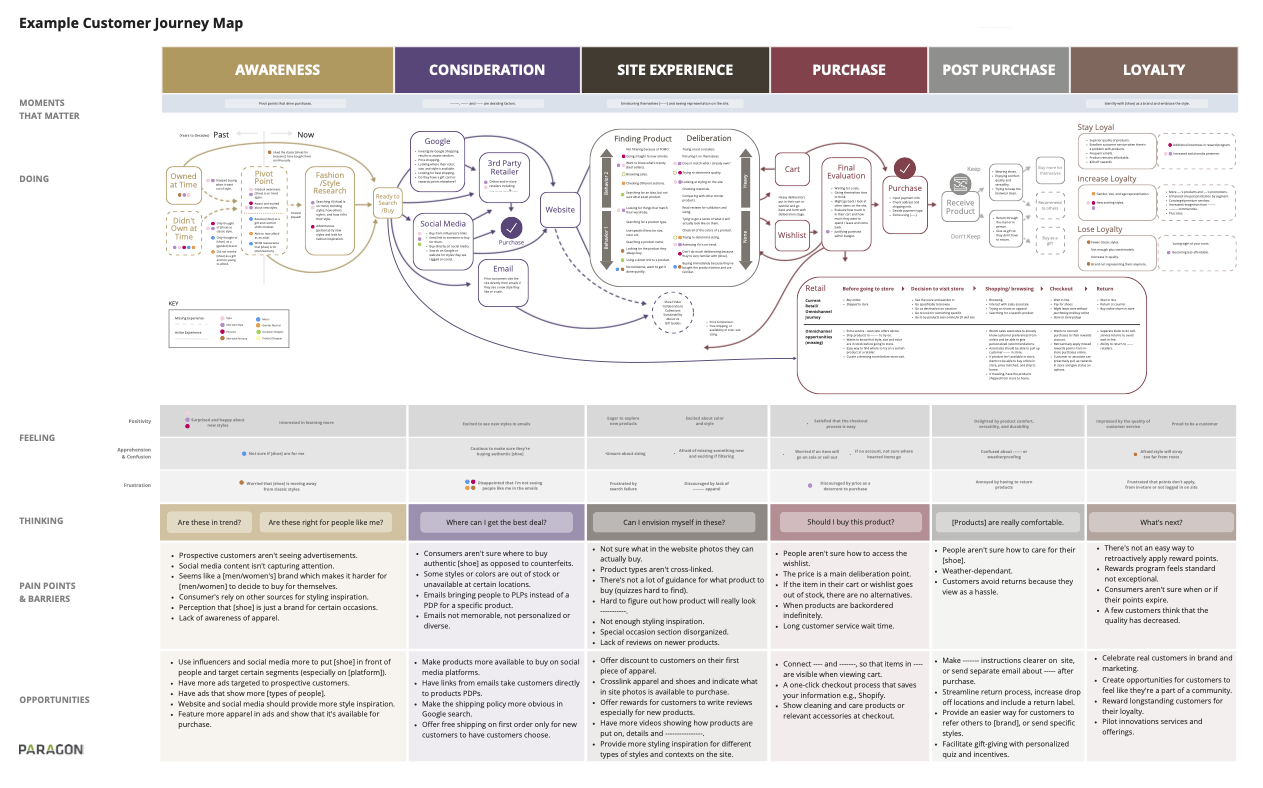
These challenges become especially visible in high-value journeys like account opening, lending, and servicing. A prospective customer might explore a product online, receive a follow-up email, begin an application in a portal, abandon it, and later call a contact center for help. In many monolithic DXP models, each interaction lives in a different system, owned by different teams, measured in isolation.
Marketing may see strong campaign engagement but lack visibility into funded accounts. Digital teams may optimize experiences without insight into call center volume or abandonment triggers. Operations teams may feel downstream impacts without understanding the digital signals that caused them. Growth stalls not due to lack of effort, but because insight is trapped inside silos.
Monolithic DXPs can struggle because they are built to centralize control. Growth today depends on orchestration — the ability for systems to share data, respond to behavior in real time, and evolve independently without creating bottlenecks. This is why banks that chase “the next platform” often find themselves resetting progress every few years. Each new solution promises transformation, but replaces flexibility with a different form of lock-in.
Banks that outperform take a different approach. Instead of replacing one monolithic platform with another, they focus on composability — building digital ecosystems from best-of-breed tools that are flexible, interoperable, and designed to evolve as customer behavior and business needs change.
At the core of these ecosystems are three foundational capabilities:
- A modern CMS to manage and distribute content across channels, not just the website
- A centralized data warehouse to unify transactional, behavioral, and operational intelligence
- A Customer Data Platform (CDP) to activate insight in real time
Data flows seamlessly between these systems to create an architecture that actually results in multi-channel readiness and enterprise-level personalization.
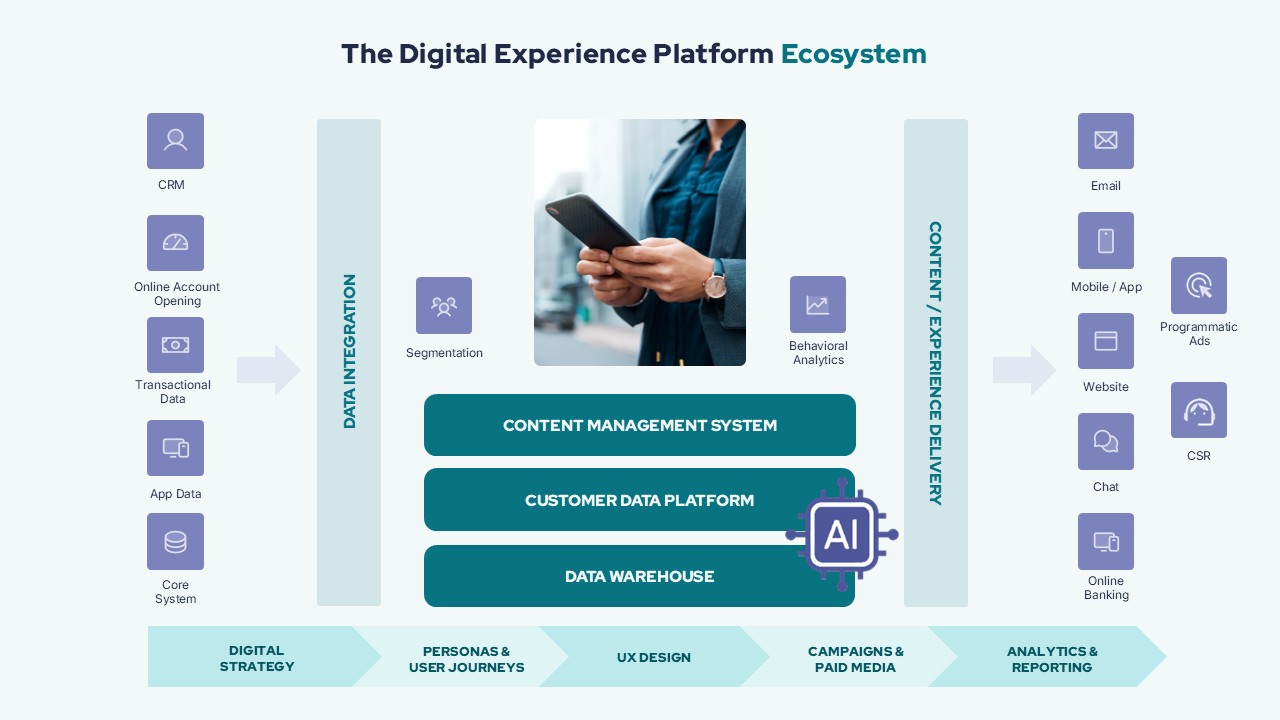
When connected properly, these systems enable something DXPs alone cannot: true multi-channel readiness and scalable personalization. Content becomes portable. Data becomes actionable. Experiences become consistent — even as customers move fluidly between touchpoints.
Composable architectures don’t eliminate complexity, but they make it manageable. Instead of forcing one platform to do everything, banks gain the flexibility to optimize each component independently while strengthening the ecosystem as a whole.
AI as the Accelerant of a Composable System
AI is not the strategy — it’s the force multiplier.
True AI-driven marketing, personalization, and experience optimization depend on systems that are open, modular, and API-first. AI requires access to connected data across touchpoints to understand intent, predict behavior, and orchestrate experiences in real time.
This goes far beyond chatbots or auto-generated content.
In a composable ecosystem, AI can:
- Identify patterns across behavioral, transactional, and engagement data
- Predict customer intent, churn risk, and lifecycle stage
- Surface new audience segments dynamically
- Recommend next-best actions across channels
- Continuously optimize journeys based on performance signals
This level of orchestration is difficult (if not impossible) inside closed, monolithic DXPs. AI thrives on connected data and modular architectures, which is why composability has become the foundation for meaningful AI adoption in financial services.
Composable systems also allow banks to personalize experiences across generations without relying on assumptions. Rather than segmenting customers by age or static personas, AI-powered CDPs adapt journeys based on real behavior, context, and life stage.
A Gen Z customer researching student loans, a millennial exploring homeownership, and a retiree managing distributions may all interact with the same ecosystem — but receive experiences shaped by intent and timing, not demographic guesses. This approach increases relevance while reducing the operational burden of maintaining dozens of static segments.
AI also plays a growing role in trust and security. Unified behavioral data improves fraud detection by identifying anomalies across channels while reducing false positives that frustrate legitimate customers. The result is stronger protection with less friction — a balance banks increasingly struggle to achieve.
In this way, AI doesn’t replace human strategy. It amplifies it, turning insight into action at a scale no team could manage manually.
From Transformation Projects to Growth Systems
Composable transformation does not require a massive rebuild. In fact, the most successful banks intentionally avoid “big bang” initiatives that attempt to modernize everything at once.
Instead, they follow a phased, practical path that balances speed with stability:
- Crawl: Start with a modern CMS and basic behavioral analytics
- Walk: Integrate CRM and marketing platforms into a unified data model
- Run: Centralize intelligence through a data warehouse and CDP
- Fly: Introduce AI orchestration across channels
Each phase delivers value independently while building toward a connected growth system.
This is where transformation becomes measurable. Conversion optimization shifts from periodic campaigns to continuous improvement. Marketing teams test and learn faster. Fraud detection improves through unified behavioral signals. Trust grows as experiences become more consistent, contextual, and timely.
Just as importantly, composability changes how organizations operate internally. Teams stop thinking in terms of channels and start thinking in terms of journeys. Strategy flows directly into execution. Insight feeds optimization, which feeds learning, which feeds growth.
For banks, the future of digital engagement no longer lives in a single platform.
The real platform is the system itself — the intelligent orchestration of content, data, AI, and experience working together to drive sustained growth. Digital transformation only matters when it creates momentum. Banks that treat transformation as a connected growth system will move faster, adapt better, and outperform those still chasing isolated upgrades.


