
3 Critical Skills that Give Community Banks the Edge with Business Customers
By Suman Bhattacharyya
Simple Subscribe
Subscribe Now!
Community bankers love to tout their local connections. They take pride in knowing their business customers and understanding how they operate. That knowledge has long been their moat.
Digital banking, however, is eroding that advantage. As online offerings get cheaper and easier to use, physical proximity isn’t as much of an edge. Community banks are coming under pressure as business customers take up products from multiple providers. Caught between larger financial institutions going after smaller business customers and fintechs encroaching on their market share, they now have to work harder to hold on to business customers.
Key insight: In BNY’s 2025 Voice of Community Banks Survey, more than 70% of small businesses said they “prefer or would prefer” to bank with a community bank, yet only 31% currently do. Meanwhile, the share of small-business financing applicants who sought financing from online fintech lenders rose from 17% in 2020 to 29% in 2025, according to the Federal Reserve’s Small Business Credit Survey.
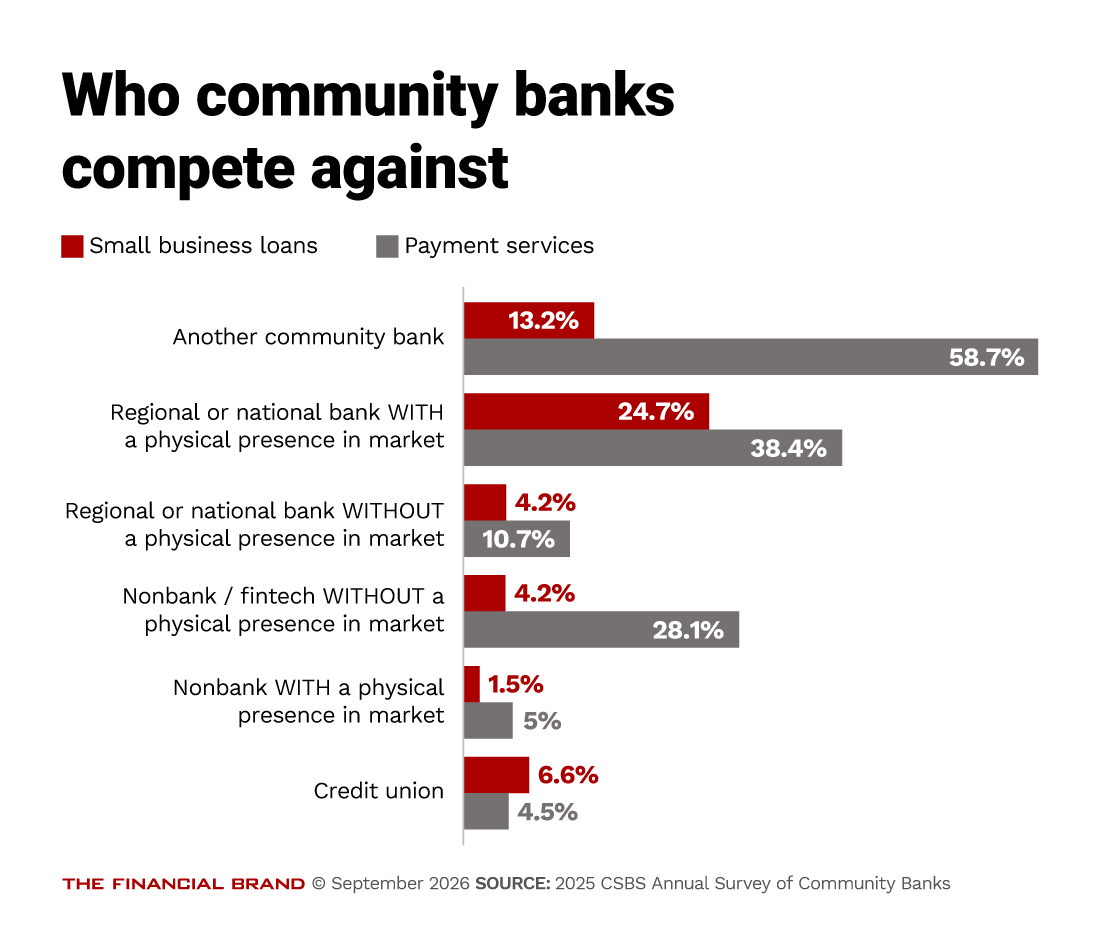
So how can community banks retain and attract more business customers? The answer involves more than just digitizing existing processes, experts say. Banks need to make customer data more useful to their employees and customers. They need to be able to connect their services with software businesses already use, and be strategic about which industries and markets they pursue. In the process, they may also need to redefine what “community” means: catering to a niche of customers instead of being tied to a physical location.
“I still believe in relationship financial services, and the question is: Do I need to have the relationship physically?” said Carey Ransom, managing director at BankTech Ventures. “If you’re the best provider of a service to me and you have depth in my business, I kind of don’t care where you are.”
Industry executives and bankers point to three ways community banks can compete.
1. Get the data right
Community bankers say one of their weakest links is technology. In the 2025 Conference of State Bank Supervisors Annual Survey of Community Banks, 81% of respondents rated technology implementation and costs as an extremely or very important internal risk, second only to cybersecurity.
Before considering new tools, banks first need to make the data they already hold accessible and usable, executives say.
Grasshopper Bank, a digital business bank that operates without traditional branches, has spent the past year and a half moving data out of its core and other systems of record into Google BigQuery. Using an internal AI agent called Hopper built with Gemini Enterprise, employees can retrieve client and account information before meetings.
“Our internal AI is only as powerful as the data it has access to,” said Pete Chapman, Grasshopper’s chief technology officer.
Data also offers important insights to help FIs retain business customers and deepen those relationships, a concept Courtney Rowan, senior vice president and chief digital and transformation officer at Citadel Credit Union, calls “relationship intelligence.”
Key insight: “Most community banks know who their customers are, but fewer understand which are growing, which are ready for things like treasury management services, which business owners need lending, [and] who’s likely to churn,” she said. “You have to use your data to move from product-centric to relationship-centric. It changes the conversation from selling products to solving business needs.”
Citadel is developing a customer data platform to help its analytics team understand how business customers’ needs are changing and when a relationship may be at risk.
2. Give customers the banking ‘pipes’
Community banks can’t build every financial tool their business customers use — and they shouldn’t have to. Increasingly, banks are embedding their services inside software and workflows companies already use.
“Banks can explore ways to bring banking services directly into business processes,” said Matt Cox, EY’s global corporate, commercial and SME banking consulting leader. “The goal is not to embed banking everywhere, but to focus on the tools and experiences that can improve customer outcomes.”
Grasshopper Bank offers business customers several “pipes” for accessing their financial data. Chapman described digital banking as the ‘traditional’ first pipe and Plaid as the second. [Grasshopper later clarified that this second pipe encompasses connections to third-party software more broadly, including both direct integrations and connections enabled through Plaid.] Businesses with their own software can also use a read-only API to pull their financial data. A fourth pipe uses model context protocol to let authorized AI tools retrieve data from the bank.
FIs that can’t provide that access risk losing business customers.
“We don’t want a client saying, ‘I don’t want to use Grasshopper anymore because Grasshopper doesn’t connect [to] our accounting platform,’” Chapman said. “We should be able to meet them where they are and securely deliver that data.”
Key insight: Flexible data access could also help community banks compete with larger institutions that impose more restrictions, he adds.
“We can win by tearing down those walls and enabling our clients,” Chapman said.
Giving customers access to their financial data can help banks retain deposits; a faster account-opening process can help bring in new deposits.
22nd State Banking Company, which operates Alabama-based 22nd State Bank, partnered with fintech Linker Finance to create Always.bank, its online small-business banking platform. The service allows customers to open and fund a business account in about 12 minutes. At launch, the bank had more than 300 lending-only customers it hoped to convert into deposit customers.
Steve Smith, president and CEO of both 22nd State Banking Company and Always.bank, said the bank wanted to match the speed of larger digital providers without giving up the personal service of a community bank.
3. Pick the markets you can win
Digital banking lets community banks move beyond their geographic home base, but they still need to be picky about where they expand and which industries they target.
Univest Bank and Trust focuses on markets it knows, primarily in Pennsylvania and neighboring states. “We’re not trying to go in and bank a bunch of companies in California that we have no real knowledge about,” said Michael Keim, the bank’s president. Univest also assigns teams that understand particular industries, such as agriculture and private equity.
That’s one way banks can identify where to expand, according to Brandon Oliver, principal at BankTech Ventures. By looking at the types of businesses they already serve, community banks may find sectors where they’ve developed expertise. Oliver used marinas to illustrate how the approach could work: A bank that has served a marina for years might understand the financing needs of similar businesses.
“There’s a whole economy that’s based in this marina ecosystem that we could go after,” he said.
Key insight: Smaller FIs can take a similar approach to geographic expansion. Citadel Credit Union used data on where it already had members to choose the first markets in which to seek new business customers, including Delaware, New Jersey and counties bordering Philadelphia, Rowan said. The credit union initially tested a high-rate business deposit account but shifted to business checking when the offer drew less interest than expected.
And while digital platforms can help banks expand to new markets, physical locations still matter: they show a local commitment even to customers who bank digitally. West Warwick, Rhode Island-based Centreville Bank offers its digital small-business lending platform in Rhode Island, Connecticut and Massachusetts. It also opened two fully staffed branches in Providence, including one in the downtown financial district.
“It’s important for customers, young and old, to see that we’re actually in their community, even if they never walk into the branch,” said Ken Burnett, senior vice president and commercial lending team lead at Centreville Bank.
While physical presence still matters, banks no longer get to set the terms of the relationship.
“We’re in the era where the customer decides,” Ransom said. With “theoretically infinite choice,” business owners can choose the provider that understands them best.
“Banks that are starting to lean more into being in the business of their customer success are going to be the successful ones,” he said.


