
The Era of Ever-Growing Bank Deposits Is Over. Now What?
By Neil Stanley, Founder, Owner and CEO The CorePoint
Simple Subscribe
Subscribe Now!
Executive Summary
- The transformation of savers into investors has ended the era of always more deposits for banks.
- Depositors are choosing higher-rate investments, but not only because of yield. Bank deposits are often inferior to non-bank products in every way, and fintech is magnifying the difference.
- While pricing strategy is bread and butter when it comes to deposits, banking executives must now innovate product design or accept the consequences of offering products that have less utility and lower yield.
On the surface, the recent rate cut from the Federal Reserve appears to move the deposit market back towards “normal.” From a pricing standpoint, there’s some truth to that. Except that very little about deposits or bank balance sheets remains the same today as it was even four years ago.
In 2021, the banking industry quietly entered a new era, and few noticed: Banks are no longer experiencing consistent year-over-year growth in deposits. In fact, domestic deposits have still not regained the high point recorded in 2021, even according to the most recent second-quarter data.
Look at investments: It’s the opposite story.
What has happened to make people choose investments in droves rather than putting their money in banks?
Two significant changes have occurred since the Federal Reserve began using low rates to stimulate the economy: Savers have become investors, and banking institutions have preferred not to innovate their deposit offerings, often opting instead to purchase technology aimed at more efficiently originating current products. (I’m not talking about any particular vendor’s product or service here. Read on.)
It’s time banking looked at the deposit data square in the face.
Volume as a Voting Booth
Ever since interest rates rose, institutions have focused on funding their balance sheet without eroding margins. All the while, in the background, a quiet but consequential shift has occurred in the deposit landscape: Bank executives can no longer confidently say banks will have more deposits next year than they did in 2025. Now, for the first time in industry history, institutions may compete for a smaller pool of deposits. Banks have not yet reclaimed growth in total domestic deposits.

Where might those deposits have gone?
Household purchases of U.S. Treasuries during the past 25 years have gone through the roof, as reported by the Kansas City Federal Reserve Bank. What was “below zero” volume for households before 2008, according to the chart from the Board of Governors of the Federal Reserve System, is now greater than banks’ holdings of U.S. Treasuries.
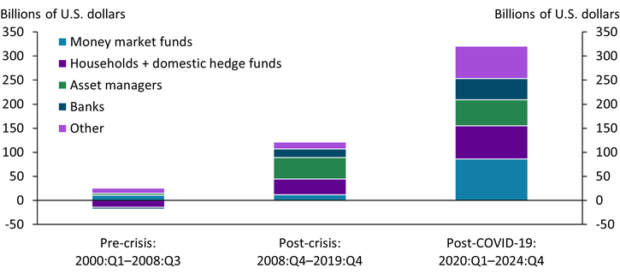
Source: Board of Governors of the Federal Reserve System (Haver Analytics)
Households began increasing their use of investments outside of the banking industry before the tech boom in financial services. Now, fintech is enabling people to be smarter and faster at finding and maintaining the best rate of return.
Wealthfront, for example, registered with the Securities and Exchange Commission to go public in September after reporting a net profit of $123 million on $339 million in revenue over the past year. The fintech can help any depositor with an “Automated Bond Ladder” into a “Range of current yields on Treasuries” at “3.82% – 4.04%.”
While banks have continued to compete with each other on price, fintechs are passing on the rate and benefits of U.S. Treasuries to depositors, and they’re becoming highly profitable in the process. The U.S. Treasury has become the backing of “the full faith and credit of the United States government” for fintech and nonbanks.
Every decline in CD usage across the Fed’s data correlates with increased household investment in U.S. Treasuries.
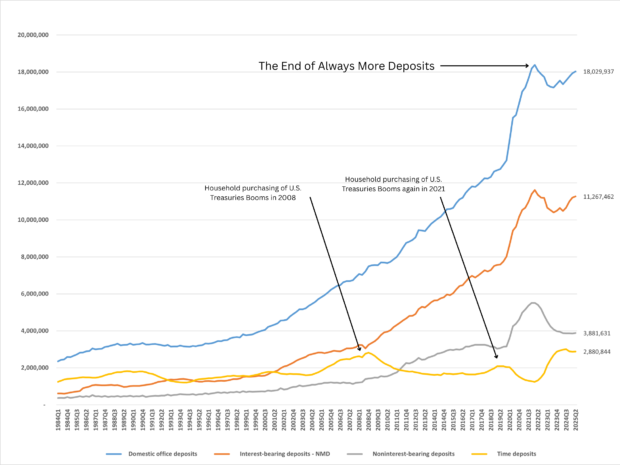
If dollar volume is a voting booth, then depositors are casting their support elsewhere. But is that just for now?
Dig deeper:
- The Midcap Banking Crisis: Why Retail Deposits Are the Key to Survival
- Banks Flirt With AI Deposits but Fear Dynamic Pricing Backlash
- Why Deposit Profitability, Not Deposit Volume, Should Be Your Goal
Savers Becoming Investors
Perhaps the decline in banks’ total domestic deposits, or in their CDs, is “just rates.” People, the theory suggests, are leaving because other places offer higher pay. But if that’s the case, why would lower rates bring deposit volumes back to banks? And, if they could get higher rates elsewhere before, why would that change because of Fed funds?
There is a deeper flaw in the “high rates are the problem” mindset, though it’s certainly not the only one. Many who espouse that position hope that lower fed funds will lower the tide for all boats, assuming it is only rates, and not also depositors who have changed. And that’s a sizeable assumption.
After 2008, it was very common at banking meetings to hear executives discuss how low interest rates were repricing their assets at lower and lower levels. They would observe the hard times of those living on fixed incomes – generated often from CD investing at the time – as well. Usually, these depositors were retirees. As interest rates on deposit products declined, many depositors were compelled to invest because interest income paid their rent. Only those with mountains of capital parked their savings in a bank.
Queue pandemic stimulus spending, alongside nearly 20 straight years of strong returns in the stock market, and both counterparties were happy. Banks were cash flush. People with discretionary capital earned much higher returns than in any bank deposit product without experiencing losses.
Fast-forward to today. The forced education in investing has changed the way depositors approach their deposits. And it’s not just retirees who’ve wandered off the banking ranch. Wealthfront has reached IPO with healthy profits by catering to tech workers and other well-off Millennials. Its average customer is 38 years old and earns more than $100,000 annually. The fintech had $88.2 billion in assets on its platform and served 1.3 million customers as of July 31, according to CNBC.
Money market mutual funds have also experienced significant growth, increasing by more than 35% in just two years, to $7.3 trillion today from $4.2 trillion in 2022.
Depositors are drawn to products that offer higher returns. That’s human. What has changed since 2008 is depositor familiarity with the broad menu of investment vehicles not typically provided by the traditional banking industry.
Risk in exchange for return is now commonplace for people with capital to invest.
Facing the Trouble with Deposits We All (Secretly) Know
Bankers know bank deposit products are flawed. Ask a bank executive what they think about CDs. Consider the decline in domestic deposits and how it aligns with the decline in interest-bearing non-maturing accounts, such as money markets and savings accounts, like a glove.
All the country’s charters are competing for the money that is either always being spent, from DDAs, or the money that is always repricing, such as money markets, savings accounts, and short CDs of 12 months or less.
The ascent of industry deposits has stalled. And it has stalled because the industry spends most of its time thinking about price, rather than assessing its product features.
How to Innovate Deposit Product Design
No bank can compete with stock market returns in a bull market, and certainly not in a bull market like the one we’ve seen since 2008. Few institutions can price above U.S. Treasury rates in terms much longer than a year. So, banks can’t compete only on price; they can’t push their prices high enough. That means prices aren’t going to fix the state of deposits, not alone.
Fortunately, pricing is not the only element for which deposit products run at a disadvantage. There are other examples to illustrate this, but let’s compare CDs to U.S. Treasuries, setting aside pricing considerations. (I have covered the challenges facing savings accounts and money markets in The Financial Brand as well.)
U.S. Treasuries:
- Are tax-exempt.
- Can be accessed simply through a broker, by opening a Wealthfront or similar fintech account, or by engaging with Treasury Direct.
- Require little understanding of bond investing, especially when engaging brokers or fintech.
- Can be sold to create liquid cash, but at the market value, for better or worse.
Certificates:
- Are not tax exempt.
- Are accessed directly from a counterparty or by a service listing CDs from counterparties.
- Are simple and straightforward.
- Charge a penalty for early withdrawal – meaning they are always punitive unless held to maturity.
Aside from their familiarity in structure, CDs offer no utility advantages in terms of product design. And now that other investments are more familiar, even the familiarity of CDs is not the advantage it once was. CDs should command less demand from depositors because their design lacks appeal.
Banks must assess deposit products… as products.
In the end, even though we give our offering names – such as money markets, savings accounts, and certificates – they are essentially combinations of features, including price, tax treatment, term, liquidity, fees, penalties, and convenience.
Banks control all these features. It is that control that offers them a way to compete when they can’t compete on price. The industry must study what’s drawing people away and shore up the feature deficits that make the industry’s products less desirable in the eyes of depositors.


