
Deposit Momentum is Back. Future Growth Requires Careful Nurturing
By Brian Pillmore, Founder & CEO, Visbanking
Simple Subscribe
Subscribe Now!
Executive Summary
- Deposit growth is finally in sustained recovery mode, although it still lags the highs of 2022. Widespread dependence on wholesale funding has faded.
- The stabilization can be attributed to deliberate pricing and portfolio strategies executed across many institutions. But banks also continue to benefit from customer inertia, particularly among older generations. Meanwhile, fintechs remain aggressive competitors for younger consumers.
- The next tranche of growth will be driven by institutions that blend trusted brand equity with competitive digital products.
In the aftermath of historic rate hikes and liquidity shifts, U.S. banks are now seeing a steady return of deposit momentum — a sign that consumer trust and institutional stability are quietly rebuilding.
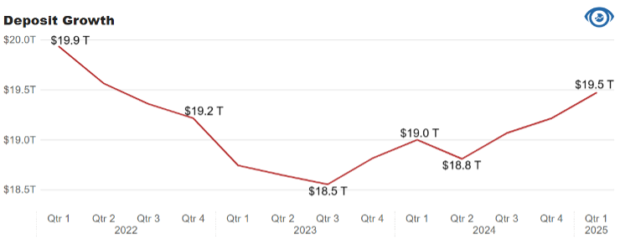
As Visbanking’s Q1 2025 Quarterly Banking Profile (QBP) reveals, total U.S. bank deposits rose by 1.32% in Q1 alone, with total deposit growth surging 72.56% quarter-over-quarter — marking the strongest recovery since 2022. This positive trend is reinforced by FDIC data, which reports $254.9 billion in deposit growth over the past quarter.
Banks that successfully navigated the outflows of 2022–2023 are now seeing early rewards, largely thanks to improved deposit pricing strategies, stabilized consumer behavior, and trusted banking relationships.
The Era of Outflows: Rate-Driven Deposit Flight
The story begins in 2022, when the Federal Reserve’s rapid rate hikes disrupted longstanding deposit patterns. In a matter of months, the Fed Funds target rate climbed from near-zero levels to over 5%, creating the fastest monetary tightening cycle in decades.
Deposit betas — the sensitivity of deposit costs to changes in market rates — lagged soaring Fed funds rates, creating significant gaps between what traditional banks offered and the yields available through Treasuries and money market funds (MMFs). For many banks, deposit betas rose more slowly than expected, with many institutions intentionally delaying increases to protect net interest margins (NIM).
At the height of this shift, MMFs saw an influx of over $777 billion from mid-2022 through Q2 2023. This drain impacted both large and regional banks, especially institutions slow to adjust pricing or lacking strong customer relationships.
Much of this dislocation can be attributed to consumer behaviors. Many retail and even small business customers sought out high-yield MMFs or short-term Treasuries as traditional bank rates remained below market-clearing levels. Institutional investors also rotated balances to alternative fixed-income vehicles, compounding pressure on bank liquidity.
As a result, industry-wide deposits declined sharply in 2022 and early 2023, forcing banks to re-evaluate pricing strategies and funding needs.

Rebuilding Momentum: A Return to Core Stability
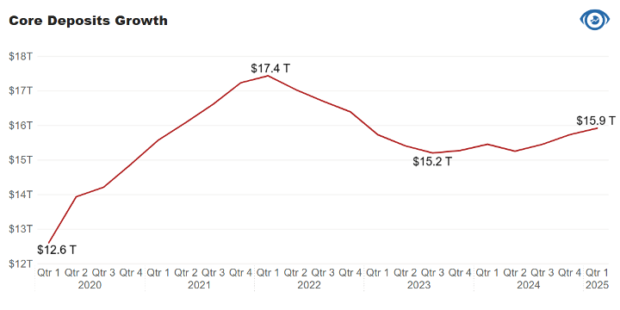
By late 2023 and into early 2025, as rate volatility eased and consumer confidence improved, banks saw renewed momentum. FDIC’s Quarterly Banking Profile showed three consecutive quarters of deposit gains, with brokered deposits declining while core deposits rose.
Visbanking’s analysis mirrors this trend: in Q1 2025 alone, core deposits increased while banks reduced reliance on expensive wholesale funding. This reflects not only market normalization but also deliberate pricing and portfolio strategies executed through ALCO (Asset-Liability Committee) governance across many institutions.
ALCO committees typically meet monthly or quarterly to assess balance sheet dynamics, rate scenarios, and funding costs. These forums enable banks to gradually adjust deposit pricing through tiered product offerings, targeted promotional campaigns, and relationship-based incentives.
ALCO meetings typically model multiple rate scenarios — parallel shifts, steepeners, or flatteners — alongside assumptions about deposit mix shifts and early withdrawal behavior. For many banks, the most powerful tools in deposit repricing are tiered-rate structures, relationship incentives (e.g., premium rates for bundled services), and targeted promotional offers. Instead of raising rates across the board, banks often selectively reprice CDs or MMDA tiers most at risk of attrition, while leaving more stable transaction accounts untouched. This intentional strategy protects net interest margin while managing churn risk.
Even so, banks must be cautious: Raise rates too little and customers leave; raise too much and margins collapse. Successful ALCOs strike a delicate balance between loyalty, market competitiveness, and capital planning.
Banks such as Huntington, Wintrust and U.S. Bank offer compelling examples of this discipline, illustrating how banks are managing rate sensitivity, loyalty, and funding cost structures.

The Mechanics of Repricing and Sticky Behaviors
Why haven’t deposits simply chased the highest available yield? The answer lies in a combination of pricing strategy, customer inertia, and relationship value.
Banks’ internal repricing occurs gradually through ALCO oversight, rate tiering, and relationship management, rather than instant market reaction. This results in a slower but more deliberate adjustment of rates, particularly for transactional and savings accounts.
For example, relationship-based non-interest checking remains remarkably stable at many regional banks. Bundled treasury services, core account benefits, and trust in FDIC insurance all contribute to this deposit stickiness.
Case Studies:
- Huntington Bancshares grew total deposits 1.8% QoQ ($2.8B) and 7.6% YoY ($12B), with net interest margins expanding by 15 basis points (bps).
- Wintrust Financial posted a 9% annualized QoQ deposit increase ($190M), while maintaining ~30% of total deposits in non-interest-bearing accounts ($2.5B) — a strong signal of loyalty.
- U.S. Bank National Association deposits were down slightly YoY (~3%) but this was a strategic approach that reduced total cost of funds through disciplined deposit pricing (61 bps down from 65 bps) delivering over $300M of reduced cost of funds.
Additionally, banks are managing a balancing act across deposit categories:
- CDs (time deposits) offer higher advertised yields but are often used strategically to lock in certain funding layers.
- Money Market Deposit Accounts (MMDA) remain sensitive to rate movements but still provide flexibility.
- Savings accounts tend to exhibit slow repricing and strong relationship loyalty.
Behavioral psychology also plays a role. Studies suggest that many retail depositors exhibit “rate apathy” unless rate differentials exceed 150–200 basis points. For many consumers, convenience, safety, and established relationships outweigh incremental yield.
Generational patterns are also emerging: Older consumers tend to prioritize security and personal service, while younger cohorts value mobile-first experiences and rewards ecosystems. Successful banks tailor offerings to these distinct expectations.
Customer segmentation has also become essential. Baby Boomers often demonstrate the highest average balances and strongest loyalty to traditional institutions — valuing safety, human interaction, and physical branches. Gen X and Millennials, by contrast, prioritize convenience, mobile access, and financial incentives. Gen Z — the newest wave of savers — expects real-time notifications, digital-only support, and hyper-personalized offers.
Leading banks are tailoring deposit strategies by segment: Using CRM and core data to push targeted offers, stagger promotional maturities, and reduce attrition risk. Behavioral segmentation is now as important as rate tables in driving deposit growth.

Dig deeper:
- Beyond Promotional Rates: Building a Sustainable Strategy for Deposit Growth
- Five Ways to Strengthen Your Institution for a Falling Rate Cycle
- Citizens Bank Insulates Against Economic Turmoil With Focus on Upmarket Consumers
Why Deposits Remain Fundamentally Stable
While outflows dominated headlines in 2023, the underlying stability of bank deposits is notable. Industry studies reveal that average deposit outflows typically remain below 1.2% per quarter, while inflows hover around 3–3.5%.
Behavioral economics plays an important role: the average bank customer is surprisingly “sticky.” Switching friction, perceived safety, convenience, and digital banking relationships all create retention strength.
Furthermore, many banks deepened their retail relationships through bundled service offerings: credit card rewards tied to deposits, fee waivers, loyalty perks, small business account synergies, and wealth advisory links.
Competitive Market Dynamics
Looking forward, deposit competition remains an evolving landscape. Large banks such as Wells Fargo and certain digital-only entrants have begun raising rates aggressively to rebuild deposit bases.
Online banks and fintech challengers have also captured share by offering high-yield savings linked to seamless digital experiences. According to Bankrate, the average online savings rate surpassed 4.5% in early 2025, significantly above the national brick-and-mortar average of 0.47%.
Notably, fintech players like SoFi, Ally Bank, and Marcus by Goldman Sachs have gained deposit share by offering rates north of 4.5% with no minimums and slick onboarding. Money market fund assets hit an all-time high of $7.02 trillion in mid-2025 — an indication that rate-sensitive money remains abundant and mobile.
Banks must contend with this dynamic, particularly for digital-native customers. The institutions that blend trusted brand equity with competitive digital products are those best positioned to retain market share.
Banks face the challenge of balancing deposit beta with net interest margin preservation. Many institutions are seeing pressure to avoid margin compression as funding costs climb while loan growth remains modest.
Regional banks and superregionals continue to invest in digital onboarding, relationship-driven cross-selling, and targeted pricing to differentiate beyond pure rate offers. Leading banks also leverage data-driven segmentation to match pricing with customer lifetime value.
Moreover, regulators and policymakers are keeping a close eye on market dynamics, including deposit insurance coverage debates and liquidity management standards. The recent FDIC proposal to explore expanded deposit insurance for transaction accounts could reshape customer behaviors and pricing norms.
Looking Ahead: Opportunities for Banks
Visbanking’s QBP tracking indicates that Q2 2025 is likely to show continued core deposit gains, though the competitive environment may intensify.
For banks able to fine-tune their pricing, deepen relationships, and communicate value beyond rate, this next cycle offers opportunity. Leveraging granular data, proactive ALCO management, and an enhanced understanding of behavioral drivers will be key.
AI-powered pricing engines now allow banks to model elasticity curves, segment depositors by behavioral traits, and instantly adjust rate offers based on competitor movements or funding gaps. Institutions deploying these tools within their ALCO processes can outperform peers still reliant on manual repricing cycles.
In short: the return of deposit momentum is real — but sustaining it will require both art and science.


