
The Lose-Lose CD Penalty That’s Ruining Deposit Profitability
By Neil Stanley, Chief Executive Officer and Founder, The CorePoint
Simple Subscribe
Subscribe Now!
One man’s trash is another man’s treasure. That’s usually how regulators look at “junk fees,” banks benefit, and consumers are “harmed.” But nearly everyone is neglecting the real junk fee that’s still charged by institutions: Penalties for early withdrawal on certificates of deposit.
How are CD penalties a junk fee?
Traditional CD penalties are actually even worse than the common targets for the term “junk” because they are often not beneficial to anyone – not the consumer, and not even to the banks and credit unions that charge them. They cost banks serious sums in profitability, often penalizing depositors for a withdrawal when it helps the bank.
Need to Know:
- Banking’s worst junk fees are traditional penalties for early withdrawal on certificates of deposit because they are bad for both banks and consumers.
- How are traditional penalties bad for banks? They actually make the least expensive –and more valuable – CDs vulnerable, and the most expensive CDs locked-in.
- Consumers also avoid CDs because of their penalty, which punishes them even when they withdraw funds from expense deposits that the bank can replace at a lower cost.
- Institutions don’t need no-penalty CDs; they need CDs structured with a rational, market-value-driven early withdrawal process.
Here’s why CD penalties ought to be the first fee on the “junk” list. They’re not fees that consumers hate, and banking loves. They’re a fee assessed for the worst reason: Because it’s always been done that way.
Here’s why banking can eliminate the old CD penalty without losing the benefits it was intended to provide, and why it could make the certificate portfolio considerably less expensive.
Not Tracked by CEOs
If you ask most bank executives, even presidents and CEOs, they don’t know how much their institution made on CD penalties last year. It’s not a revenue stream they’re keen to follow. Who is keenly aware of penalties, though? You’d be right if you guessed depositors.
Everyone knows putting money into a CD means locking it up, and the key feature that creates that lock is the penalty for early withdrawal. So, to entice depositors to enter a contractual structure, institutions pay high rates (usually at the top of their price offering) on CDs. The high rate is the sugar on the medicine for the depositor, who is giving up flexibility, and the penalty is supposed to protect the bank in return for paying a high price.
That would be all fine and good, except for one thing: No one ends up preferring a CD. Banking executives tend to disfavor them because of their cost, and depositors tend to choose more liquid alternatives if they can get a comparable rate. To quote one industry observer, “CDs just kind of [stink].” You can guess the word I edited out there.
Before executives conclude “I am ok with people not wanting CDs,” remember that no institution can fund itself entirely with deposits that can leave at any moment. Institutions need deposits contracted to stay and need CDs to fund their balance sheet. This isn’t about liking or disliking; it’s about figuring out why CDs “stink” and whether they could add more value.
So, is it objectively true that the old CD penalty is not beneficial to banks?
Why the Traditional CD Penalty is Junk, Part 1
The traditional CD penalty – which calculates an early withdrawal fee based on the CD’s interest rate – destroys deposit portfolio profitability, rather than protecting it. Institutions can see this at both the product design and balance sheet levels.
At the product design level, consider a depositor with 12 months remaining on a CD at 5.2% with a current balance of $100,000. If the CD matures, the institution will incur $5,200 in interest expense. Now, suppose the depositor needs the funds, and wholesale rates are now at 4.2%. If the depositor withdraws early, the total possible benefit to an institution is approximately $1,000 in saved interest expense.
Yet, many banks and credit unions assess a penalty in the above situation. Or, the penalty threatened by the CD’s disclosures disincentivizes an action that would save the bank over 19% of its interest expense.
Look at the funding portfolio as a whole, and the damage gets worse.
I wrote above that “executives tend to disfavor CDs for their cost.” That’s not completely true. They actually love certain CDs: The ones locked in at 1% or 2%. Yet, these are the least protected by the traditional penalty. Ten financial institutions studied in 2025 had $4.04 billion in certificates. And, they had some $112 million in CDs at rates below 1%. When deposit rates rose, depositors could eat the penalty and get a new CD at a higher rate for the same term, leaving the bank to replace the funds at higher rates.
That same portfolio has another $530 million in CDs with rates below 3% across all terms. At the time of the study, depositors could eat the penalty on these, keep their maturity date with another bank, and earn more interest, though the economics were less extreme.
The bank paid CD rates to get people to accept a penalty structure (one based on interest rate) that didn’t actually protect their best CDs when rates changed materially.
Why the Traditional CD Penalty is Junk, Part 2
Unfortunately, it gets worse. The ten-institution portfolio has nearly $2.66 billion in CDs with rates above 4%, all with remaining terms of 12 months or more. If we assume the portfolio is split evenly between 4%, 4.5%, 5%, and 5.5% CDs, then these ten institutions will pay the following amount if the CDs are held to maturity:

Some depositors may want to access all or part of the funds in a CD. A 2020 trial found that about 5% of depositors who were offered a no-penalty early withdrawal accepted the offer when the institution shared its cost savings. Applied to the portfolios of these ten institutions, an early withdrawal of 5% could create potential gross savings of $5.99 million. If all the funds are replaced with wholesale funds at 3.5%, the net savings are about $1.33 million.
That estimate is for CD volumes above 4%; it assumes that only 5% of depositors withdraw early – a result created in a world where no one expects CDs to allow penalty-free early withdrawal.
The old CD penalty does not protect banks’ best CDs and locks in expensive ones, costing the industry many millions in lost profits; it’s junk when it comes to protecting the cost of funds. Its biggest issue, though, is not its effect on deposit profits, or the traditional penalty’s poor interest-rate protection, it’s that the old way of doing it makes CDs so unappealing.
Why the Traditional CD Penalty is Junk, Part 3
Convenience has become so tightly linked to a deposit product’s appeal today; if a deposit is expensive, the first question to ask is: What is making it less convenient?
Consider the widespread appeal of money market and savings accounts. Why do depositors like them so much? You likely guessed it: They’re liquid, and they maintain the convenience of withdrawing at any time. It makes sense that banks must pay more to attract people to certificates. The rate is the sugar that makes the medicine go down.
It also makes sense that the entire industry would then compete for the same pool of savings accounts and money markets, leading to increasingly punitive price competition. And, even when an institution wins that competition, the prize is funding that can leave at any time. Aside from the old CD penalty not protecting cost of funds, liquid account competition is how banks got this kind of interest expense:
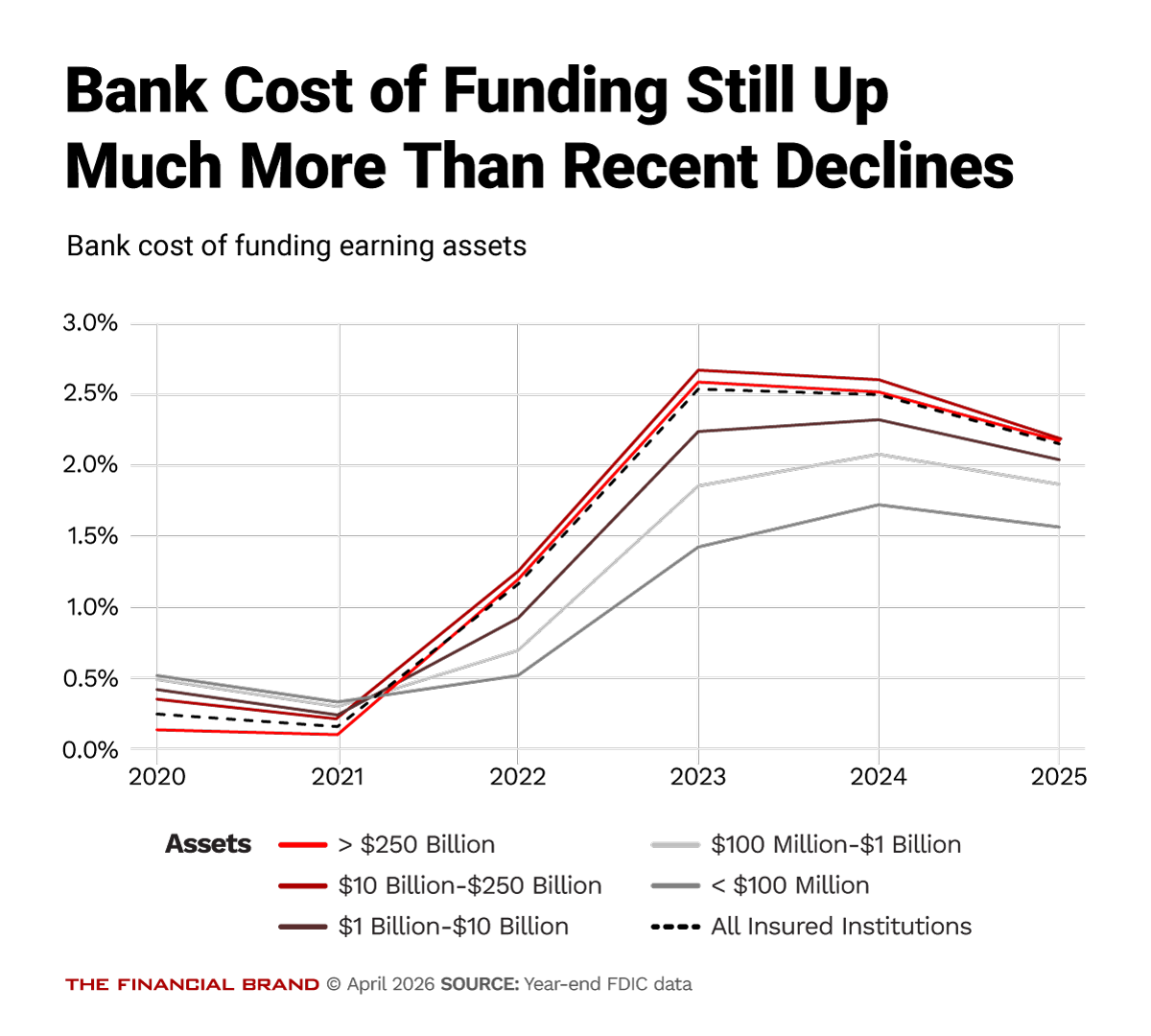
No one wants CDs, and they shouldn’t, not as they are; the always-done-that-way penalty “stinks” no matter which perspective is considered.
Stop Penalizing Early Withdrawal?
The next logical question is: Can banking really stop penalizing for early withdrawal? Yes and no.
No: The industry offers CDs without penalties, and they fail to address legitimate reasons for imposing a consequence for early termination, such as interest rate risk. (When depositors use savings accounts and callable CDs, the bank at least retains repricing control.) There are not many good reasons to pay a CD rate when giving away the option to reprice.
Yes: Banks can stop doing what makes the old CD penalty a junk fee:
- Use a transparent process to align early withdrawals with the damage or benefit they cause. Define it in terms of replacement cost, and banks can actually reward early withdrawal and make money. (Moves to month-based penalties help, but will soon create no market differentiation.)
- Continue to offer traditional CDs, but offer flexible withdrawal CDs alongside them.
- Then, begin customizing CDs (now a common practice among community institutions) for maturity, withdrawal, and bundling with other products.
Sometimes one man’s junk is another man’s treasure. But when something is junk for everyone, rather than paying depositors to take it from you, it’s probably time to reassess what made it junk in the first place.
The industry has the regulatory guidance, native core system capabilities, and marketing infrastructure to make the change. Some have already begun the shift; others must now decide whether to fix their CDs or continue compensating for the injured value of traditional CDs with higher interest rates.


