
How TD Bank is Using AI to Train Branch Bankers to be Better Humans
By Steve Cocheo, Senior Executive Editor at The Financial Brand
Simple Subscribe
Subscribe Now!
TD Bank is revamping what its branches are about, moving from an approach that stressed convenience towards a new focus on advice and guidance. But what does that actually look like in practice?
As a for-instance, zoom in to the first interaction between a branch banker and a TD customer.
For some time, TD bankers have used a tool called the “Customer Financial Assessment.” Paul Bajus, EVP and head of retail solutions and service, says the bank developed the tool a decade ago.
“It’s very product-centric,” says Bajus. It’s as much a financial census as a conversational guide. Visitors get quizzed on a slew of things, from “Where else do you bank?” to “Who currently holds your mortgage?”
The tool consists of 36 questions — an eternity in 2026.
Reality check: Interrogating customers just doesn’t cut it anymore. They are there for answers, not to serve as research subjects rendering answers to inquisitors.
Need to Know:
- TD Bank is migrating more transactions out of the branches, or stores, as TD has called them for years.
- This transition is both physical, as the floor plans change to deemphasize transactions, and as staffing and staff functions transition towards an advisory role.
- TD is phasing in its “Next Generation Store,” which includes the elimination of classic teller lines and adoption of the universal banker model.
- About 30% of the network has been converted and new builds follow the blueprint. One feature is a multipurpose customer line where bankers work at sit or stand desks that can change position as needed — high and standing for transactions, low and sitting for consultations.
Now TD Bank has been rolling out a new tool called “Client GPS.”
“It’s all about financial wellbeing and looking at how we can truly help the customer with their financial goals and objectives,” says Bajus.
What’s more, Client GPS consists of only eight focused questions.
“After a discussion, we might determine that your debt-to-income ratio is too high, and our recommendation would be to get that down and to improve your credit score,” says Bajus. He explains that conversations with customers will re-center on advice and away from product recommendations.
Behind the change is a realization that the way many customers seek advice is evolving. TD’s own research indicates that over half of consumers surveyed say they look to AI for advice and guidance these days, a massive shift even from its 2025 study.
Key insight: Bajus notes a critical factor seen in the research: “They are using AI for advice, but they want a human to validate what AI is saying,” says Bajus.
As a result, when they come into TD branches, he says, they are willing to give bankers the time to walk them through potential strategies. Early feedback has been positive, and the bank is scaling the new approach across its retail network.
In late June, Bajus gathered the entire TD Bank store manager force in one place for the bank’s first-ever “store summit,” at Disney World. That’s 1,049 store managers. (TD stores typically have seven and a half full-time staff equivalents at any given time.)
Previously managers gathered regionally, but the bank thought it important to bring everyone in. The occasion: Marking the continuing retraining of the entire retail store workforce, in part in cooperation with the Disney Institute.
Using AI to Train Store Bankers, Rather than to Run Conversations
Other banks have been exploring ways to integrate AI into the branch, some as a guide — a “sidekick” — right at each banker’s desk. Bajus says that’s not how TD prefers to use the technology in its branches, although the bank is using AI extensively behind the scenes, having acquired an AI developer, Layer 6, in 2018. That will show up on the digital side, notably the anticipated delivery of advice and guidance via mobile devices.
Key tactical insight: “The differentiator is having those tools available if the client wants them, but also a human who can have a meaningful conversation when you want one. We’re going to reserve the store for those human interactions where we can truly offer advice and guidance,” says Bajus. “That’s going to be our sweet spot.”
That said, TD is leaning hard into AI as a training tool to help branch staff learn how to handle numerous customer situations and challenges.
Under the bank’s Ascend program, underway for about a year, branch staff engage in conversations with AI “customers” in roleplay sessions. Formerly staff would have to do such exercises with co-workers or with their store managers.
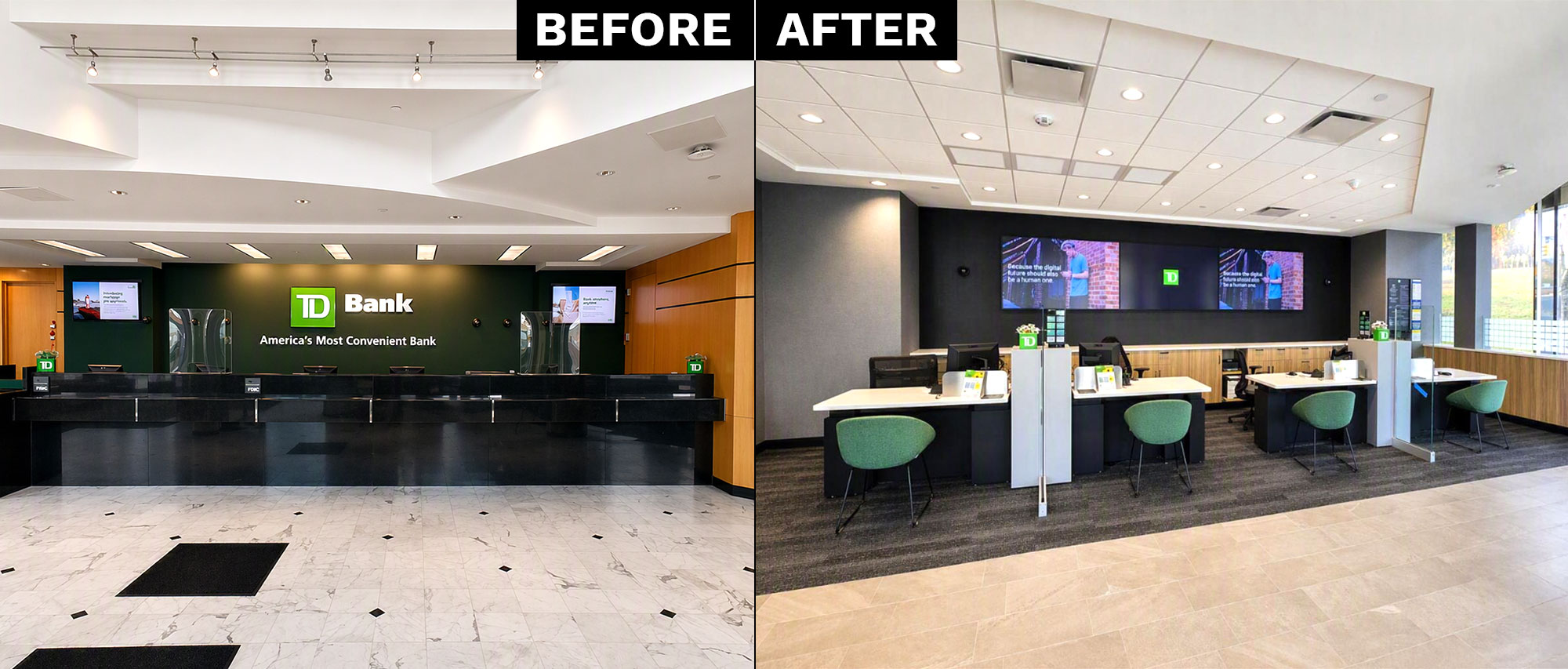
TD Bank’s “Next Generation” stores are phasing out traditional teller lines and replacing them with stations that can fulfill teller functions as well as sit-down conversations.
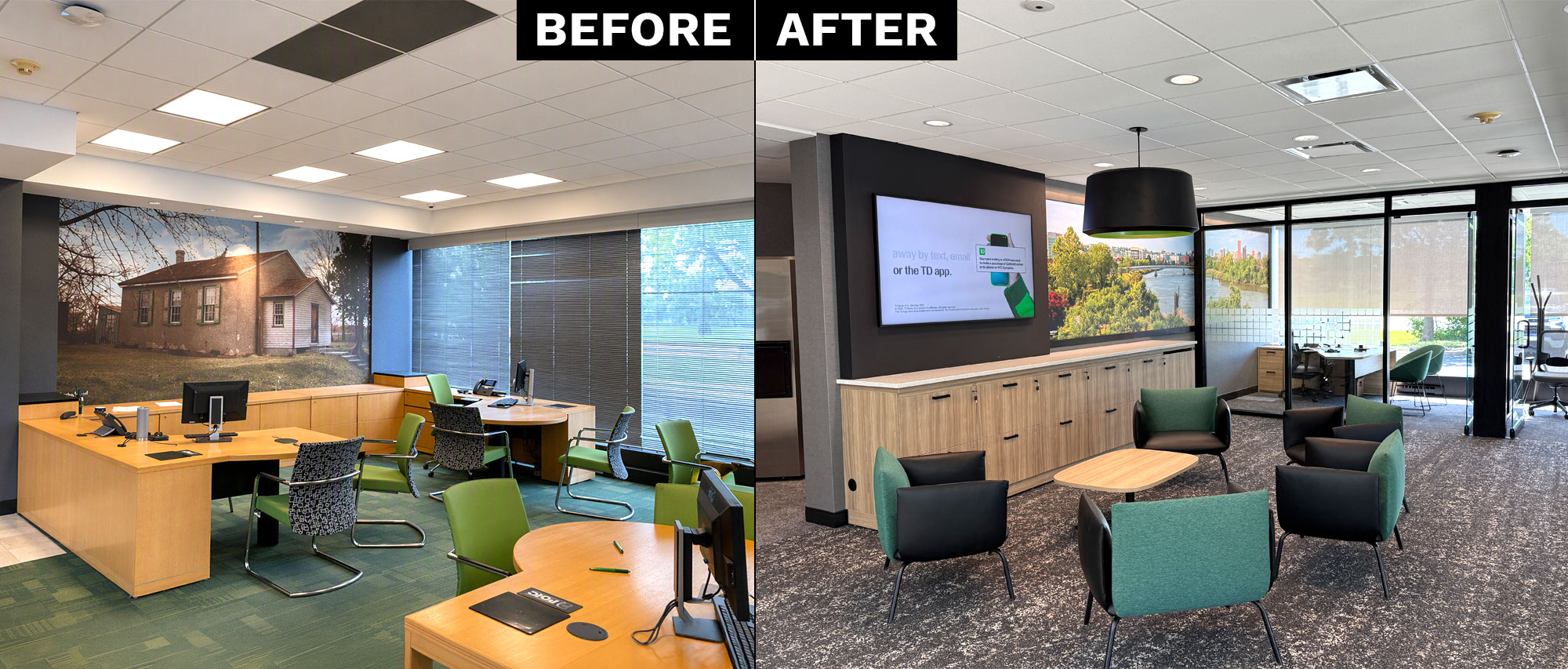
The emphasis in TD Bank locations is increasingly on consultations where customers receive advice, rather than sales pitches.
“Sometimes that’s awkward,” says Bajus. “Now, with the AI interface, the employee can have a simulated conversation. The AI will actually coach the colleague on things they might do better or other ways they might say things, better guidance they can provide to clients.”
How AI roleplaying works: The employees use a laptop to have an out-loud conversation with the AI. Corrections come in real time.
“The AI may say, ‘Let’s take a timeout. You might have said this differently. Let’s go back and try that again’,” says Bajus. “So it’s almost as if a human coach was working with you.” (The bank’s vendor for the system is Zenerate.)
The system is designed so the staffer can go through the scenario multiple times until they have mastered it. They can then send their completed unit to their manager. The manager, who generally assigned the unit to the employee, can see how many times the employee was corrected, what the corrections were, and what they need to focus on in the future, all provided by the AI.
Read more: ‘The Branch Is Dead’ … Is Dead: Have We Reached National Branch Equilibrium?
Changing the Banker-Customer Conversation
An example: A customer is changing jobs and has a 401 K plan from their old job. The bank would like to pick up that business, of course. The AI simulates the discussion the banker would have with a customer about switching the account via rollover to something at TD.
“The great thing is that they can go right out onto the banking floor and practice these conversations with live clients as soon as they’re done,” says Bajus. He says there are approximately 200 different scenarios available.
Bajus says staff have responded positively to the new training technique, in part because keeping the training between them and the technology gives them a sense of a “safe space.” Meanwhile, with overall responsibility, Bajus can review the branch force’s progress through the system.
“This is giving us a lot of consistency across our network that quite frankly didn’t exist before,” says Bajus.
Read more: Why the Rise of AI Makes Branches More Important than Ever. (At Least for Now)
Offering Consultation in a More-Welcoming Setting
The Disney training was driven by the bank’s belief that advice and guidance needed to be presented in a more hospitable atmosphere. Beyond retraining many tellers, the bank wants its stores to be more welcoming.
“Disney offers hospitality better than anybody,” says Bajus. The company’s training techniques form a key part of TD’s reformulated approach to consultation, which it calls Advice 360.
The thrust of the Disney training is service. The bank is looking to make that the foundation of its advisory emphasis, moving away from the industry’s stress on sales. During the runup to the stores summit, the bank and the Disney Institute have been training managers on building the foundation of the new approach. Specifically, managing performance, coaching and setting expectations for staff have been key focuses.
Bajus says the bank should be showing tangible results of its shift in the next six months or so. Sales of new products remains a key goal for TD, along with deepening of existing relationship. But Bajus says recasting stores into a greater advisory role comes with some adjustments in metrics. Customer satisfaction surveys will loom more significantly, for example.
The bank will also focus on how well employees carry out the new role, in part with an “advice scorecard” survey that will ask customers how well staff are doing in providing guidance.
Read next: Bricks Create Clicks: Branches and Digital Should Work Together


