
How Citizens Bank Will Amp Branch Performance with Human-AI Teamwork
By Steve Cocheo, Senior Executive Editor at The Financial Brand
Simple Subscribe
Subscribe Now!
Less than six months ago, Karen Swiatocha, a Citizens Bank veteran, stepped into a new role at the nation’s #17 bank, as head of branch distribution transformation. Among familiar challenges, there’s one that’s new to branch banking’s customer-facing role: the implementation of AI.
Swiatocha’s job encompasses multiple facets of the bank’s current branch network, including the look and feel of the offices as consultation becomes their main purpose, as well as the role and training of branch staff.
The new challenge for today and tomorrow. How to incorporate AI into the day-to-day work of branch staff, where human interaction continues to be the focal point.
Swiatocha is exploring multiple applications.
The bank already has experience with “CiZi,” its AI-based virtual assistant, introduced in 2024 as part of its banking app. The technology has been introduced to the bank’s contact center, and is being piloted as a new personality behind the bank’s interactive voice response system, beginning with its credit card operation. (Swiatocha, an EVP, was head of contact center and retail transformation immediately before taking on her present position.)
“We’ll be expanding it to enable better conversations and less transferring of customers to different experts in the bank,” says Swiatocha.
Key insight: As AI continues to be added to the in-branch recipe, what a Citizens branch is, and how it accomplishes that, will also evolve.
“It’s a matter of looking at how we show up inside the four walls, and what roles we’re going to need, and what skillsets those roles will demand,” says Swiatocha. The bank is determining how AI will be applied in-branch and examining how it can remove friction and improve customer experience.
Need to Know:
- During a March analyst briefing, Brendan Coughlin, president and head of consumer, private banking and wealth, said Citizens is in the midst of an “AI-fueled front-to-back zero-based transformation for the franchise.”
- Coughlin also said the bank will be “smartly adding branches in core locations to densify and create long-term outsized deposit growth for the retail franchise.”
- Over the last six years, Citizens has seen 29% growth in average deposit balances per household.
How Citizens is Putting AI into the Hands of Customer-Facing Branch Staff
Thus far AI has been helping operationally, enabling branch staff to seek answers on bank policy and procedures, questions like, “How do I put a stop payment on a check for a customer if the check is drawn on a home equity line of credit?”
Swiatocha says thus far this capability has functioned much like an internal Google search, with staff typing questions for the AI to look up. They receive a list of potentially relevant articles, much like classic search. On the horizon will be voice capability, where the branch staffer will ask a question and receive a voiced answer, along with an internal link to the supporting written internal procedure or policy should they want to read about the matter in detail.
Swiatocha says this capability is giving branch staff practice in using AI, which will lead to broader and deeper capabilities.
What’s next: Specifically, Citizens is weighing AI technology that will sit by the side of branch bankers as they prepare for consultations with customers.
Swiatocha gives three examples of the types of AI applications she is weighing:
1. Expanding on what’s already being done with AI in the branches, to remove routine, procedural aspects of branch bankers’ jobs that get between themselves and serving the customers in front of them.
2. Improving the ways that branch bankers give advice.
“Let’s say I have an appointment coming up with you,” says Swiatocha. “I could leverage AI tools internally to summarize for me everything we know about you.”
Instantaneously, the branch banker would learn how long the person has been a customer, how extensive their relationship with the bank already is, and how often and how recently the customer has actually been in a branch. Beyond that, the AI assistant could note recent life changes the customer has been through, such as becoming an empty nester with children who have graduated from college.
There’s more. Swiatocha envisions the AI alerting the banker to the fact, say, that the last contact the customer had with the bank was making a complaint. And suggesting that there still might be some heat there.
The payoff: “So the AI can tell us your sentiment, your experience and your history, and the banker can meet you where you’re at,” says Swiatocha.
3. Guiding branch bankers towards good “next steps” to take in many customer situations.
Let’s say someone comes into a Citizens branch to solve a problem. The banker solves it. But what comes next? Do they just let the customer walk away?
“AI could really help us by suggesting the next-best action at the next level, based on what we know about the customer,” says Swiatocha. With that assistance, she adds, there’s no need to memorize scripts and no wondering if a next step complies with bank policy. The advice would arrive already vetted.
She says that a branch banker prompted by assistive AI might ask:
“You came in here on a fraud issue. Did you know you can log a claim on the mobile app? Would you like me to teach you how to do it?”
Such prompts by AI to banker, says Swiatocha, “will be pretty cool.”
Read more: ‘The Branch Is Dead’ … Is Dead: Have We Reached National Branch Equilibrium?
Generating More Productivity Out of Citizens’ Branch Network
Consideration of AI tools comes at a time when Citizens is weighing the future of its branch system. Today it stands at 962 locations, down from 982 a year earlier, reflecting network optimization in the wake of multiple acquisitions and market expansion. Over the past five years, the bank has opened, relocated or refreshed close to 200 branches.
Now Citizens plans to open additional branches, with an emphasis on design for consultation, even as it improves digital services.
Why branches remain important. Swiatocha explains that while digital acquisition produces as much as a third of new accounts for large banks like Citizens, the quality isn’t as good as those produced through branches.
“The relationships tend not to stick as long, the balances aren’t as deep, and the relationships aren’t as fulsome,” says Swiatocha.
Read more: How U.S. Bank Drives Untapped Growth in Markets It Already Knows Well
Branch Networks Aren’t Only About Raw Numbers
There’s another wrinkle: According to Swiatocha, physical presence begets digital sales.
“About five times more customers are acquired digitally within a five-mile radius of our branches than outside of that radius,” Swiatocha adds. She believes that those people see those branches as a security blanket — not necessarily to visit regularly, but to cement trust in the bank simply by being there.
Thus, while customers visit branches less frequently, and they will travel further than they used to in order to talk to a live banker, today’s challenge is to find the right density to maximize customer service and production and retention of quality accounts.
Citizens entered the New York City metro area via the acquisition of Investors Bank and the purchase of branches of HSBC, both finalized in 2022.
Swiatocha says the branch density the bank has in that market now reflects that which it purchased. But now it is evaluating whether the bank has the right density there to meet the needs of the communities it wishes to serve.
“We might need to expand in some ways, to really capture the opportunity that we think is there for the taking,” Swiatocha says.
The related challenge is to find the right places to site new branches. Sheer numbers don’t create ideal density.
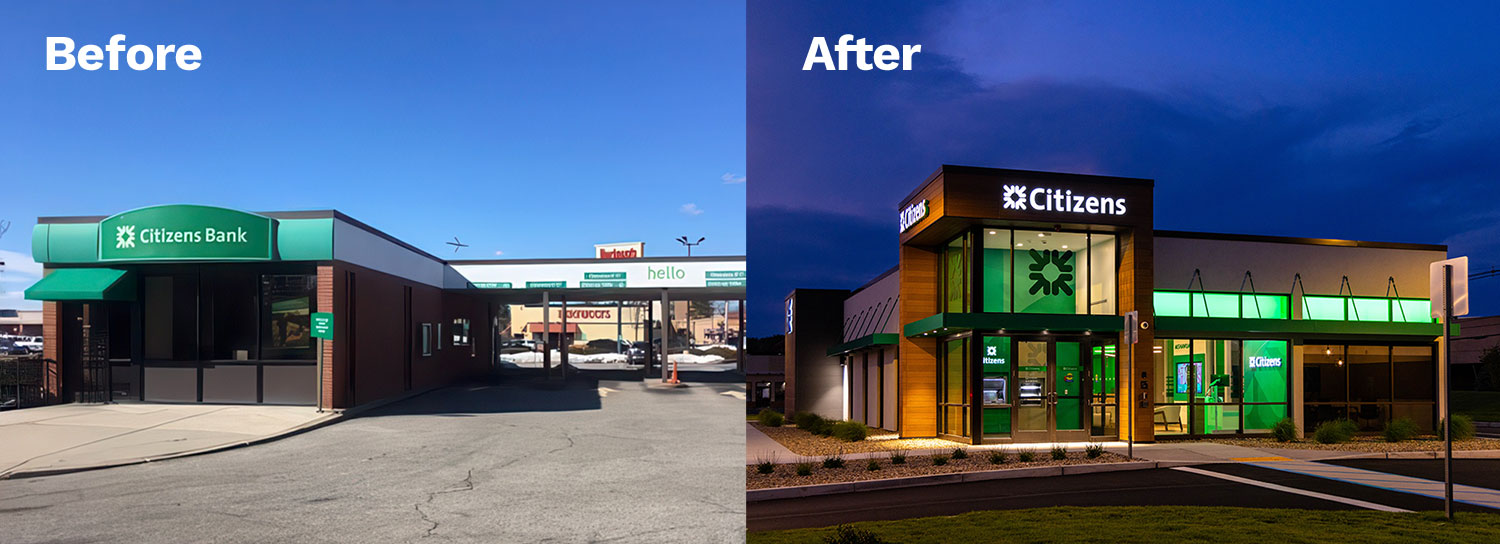
“Our properties need to be in premium locations, convenient for customers in terms of where they travel and to where they live, work and play,” Swiatocha says.
She says even where the bank has lowered the count in a particular area, “underneath that, we’re doing a ton of repositioning, relocating our branches to corridors that our customers frequent and which are A+ real estate.”
Read more: Why NYC is Still the Key Proving Ground for Branch Innovation
Designing for Trust and to be Taken Seriously
Swiatocha says Citizens’ branch design increasingly stresses the importance of providing a range of types of consultation space within each office.
Customer preferences differ. Swiatocha says some customers like formality with a high degree of privacy, but others actually find private meeting spaces stressful. She says the bank tries to provide everything from closed-door situations to little nooks that aren’t overly formal to simple benches where customers can take a load off while conferring with their banker.
Dress code matters. Swiatocha says Citizens has gone “from business casual to actual business attire.”
The pandemic led to a loosening of standards in dress that Swiatocha says fit that time for various reasons, but which no longer work.
“That time has come to an end,” she says. “If we’re going to ask people to take our brand seriously, and if we’re going to reflect the capabilities we have, we need to demonstrate that in how we show up as humans.”
“People will make a judgment about you as a human based on how you present yourself, and about your brand. We can say that’s good, that’s bad, that shouldn’t be,” says Swiatocha, “but I know that when I dress up, I sit a little taller.”
Read next: Why the Rise of AI Makes Branches More Important than Ever. (At Least for Now)


