
Banks Improved Customer UX, But Efficiency Ratios Paid the Price. Now What?
By Fabio Biasella, Director of Strategic Services at Engage fi
Simple Subscribe
Subscribe Now!
Since the 1960s, banking institutions have introduced new ways to transact, adding a new channel every decade. Call centers, ATMs, online banking, and mobile banking have each made banking more convenient, but the added operating and technology costs have not materially improved efficiency ratios.
That is because a better banking experience was not the destination; it was the first step in the industry’s adaptation to a new marketplace. Executive teams and boards must now take the next step: If the institution has the technology and the channels, it must become as good at “selling” as it was when the branch was the only channel.
Need to Know:
- Only 1,136 banks and 296 credit unions have efficiency ratios of 55% or less. Most—3,625 banks and 3,716 credit unions—operate at 65% or more.
- Institutions often added each new channel as a separate capability, increasing operating costs and handoffs without creating an integrated system for generating revenue.
- Institutions can improve efficiency by redefining branch roles, using excess capacity to absorb service demand, fixing fragmented digital workflows, and measuring each branch against its true market potential.
Here are the historical trends that brought the industry here, what they tell us about the efficiency ratio, and where institutions can start to scale revenue while controlling expense.
Lower Revenues, Higher Expenses, or Both?
Banking channels have experienced unprecedented expansion over the past several decades. What began as a branch-centered model has evolved into a complex ecosystem of call centers, ATMs, online banking, mobile banking, digital account opening, loan origination, payments, and mobile wallet capabilities.
Institutions made these investments for the right reasons: to make banking more convenient, accessible, and responsive. And in many ways, they succeeded. Depositors gained more choice, more control, and more ways to interact with their financial institution outside the traditional branch.
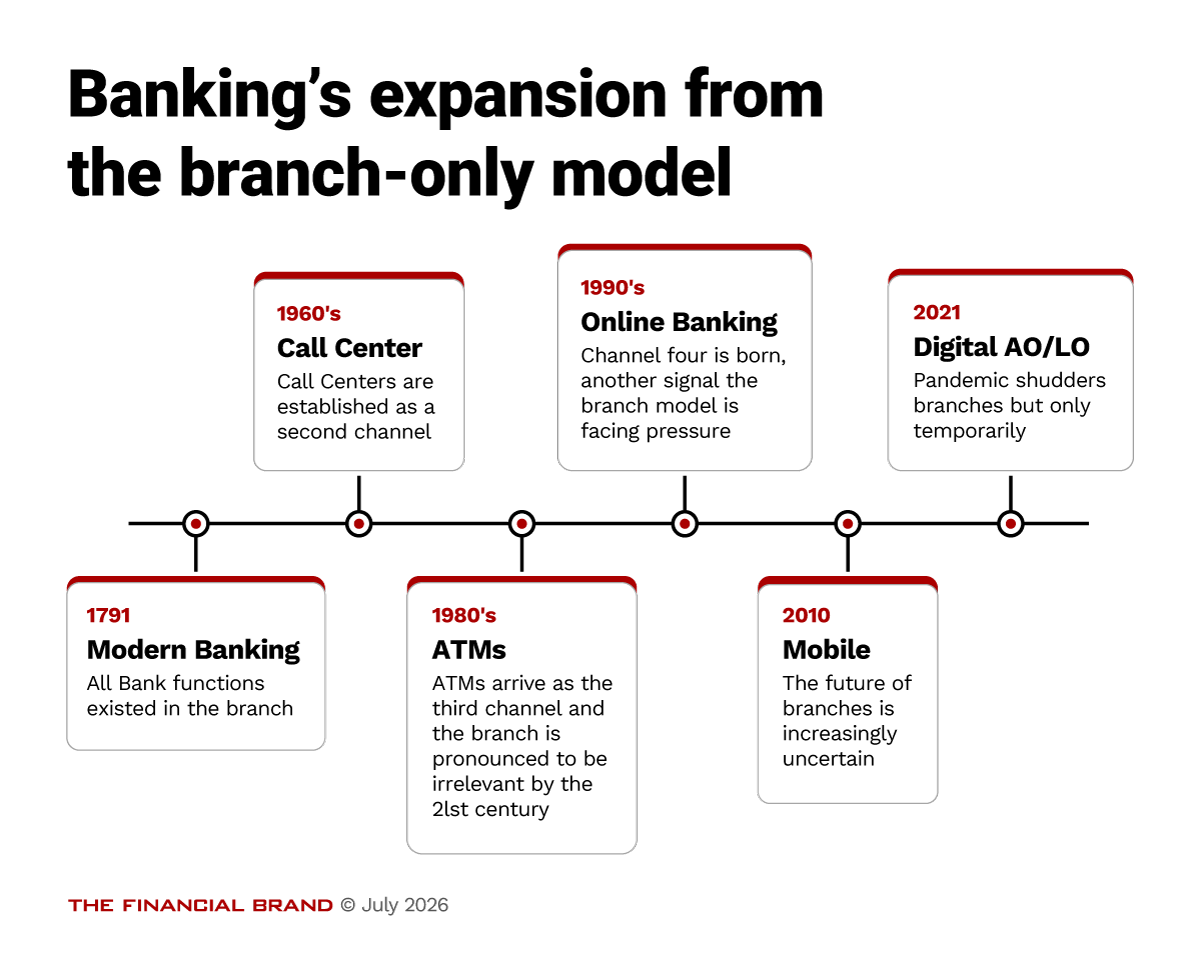
Graphic: Banking’s Expansion from the Branch-Only Model
But while the customer-facing experience improved and expanded across channels, the operating model behind those channels often did not evolve in the same integrated way. Many institutions added each new channel as a separate capability, supported by its own resources, processes, technology, and talent, expanding the overhead required to service accounts.
Yet sales, which branch staff had once handled seamlessly in a single interaction, were only loosely integrated into each new channel, if at all.
Key takeaway: Institutions spend more to run their operations and are less efficient when doing so. Convenience did translate into better service, but it did not translate directly into more revenue. In part, that was because further operational improvements would be needed to train channel-focused staff to promote relevant products and services effectively within each channel.
What happened inside the institution was not the only headwind affecting efficiency ratios.
A Changing Marketplace
Banking executives can easily see that economic, political, technological, competitive, and demographic trends are reshaping the landscape in which their institutions operate. But which trends offer opportunities to spend less and earn more?
Data suggests that channel costs and sales are now under pressure from the following four major trends. These trends form a starting point for improving an efficiency ratio.
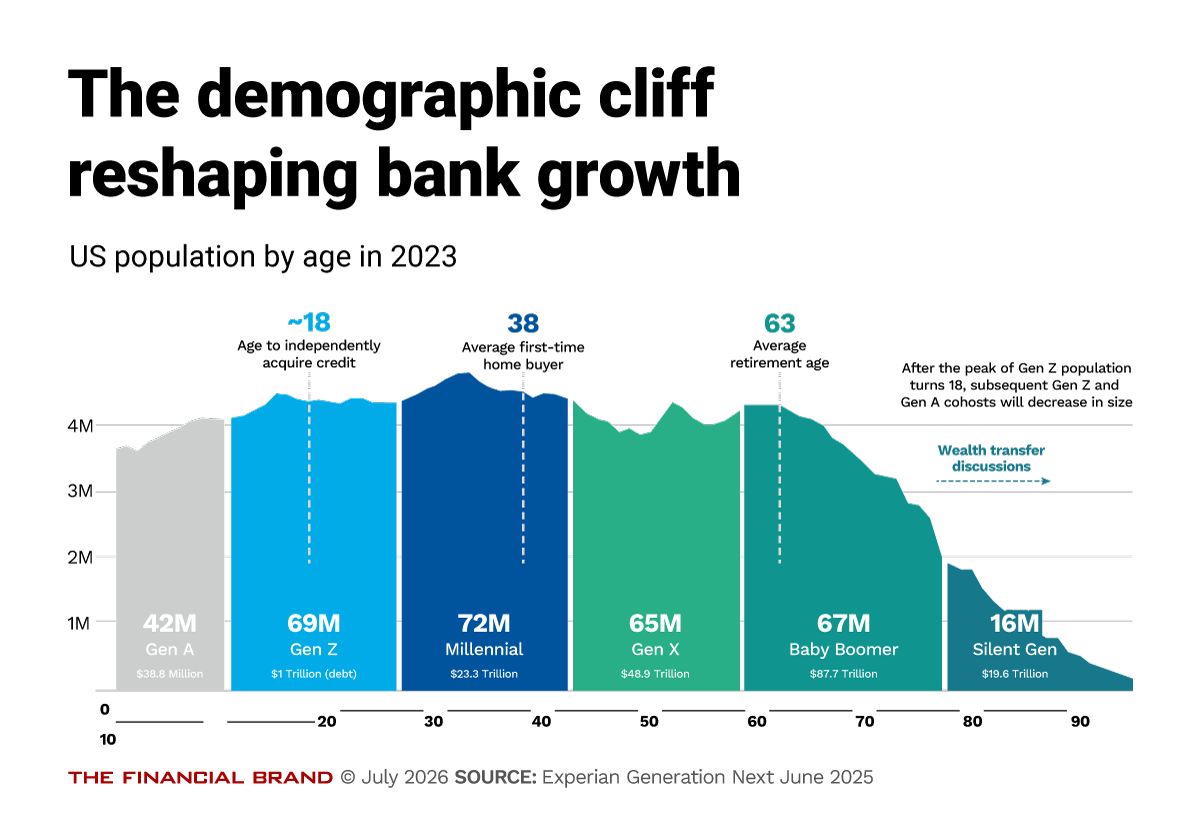
Trend #1: The Demographics of Age, Wealth, and Financial Milestones
For many community financial institutions, the customer base skews heavily toward baby boomers. That creates a difficult growth problem because this generation has largely finished accumulating wealth and will soon begin passing it on in greater volumes.
Trend #2: Channel Preferences Shifting
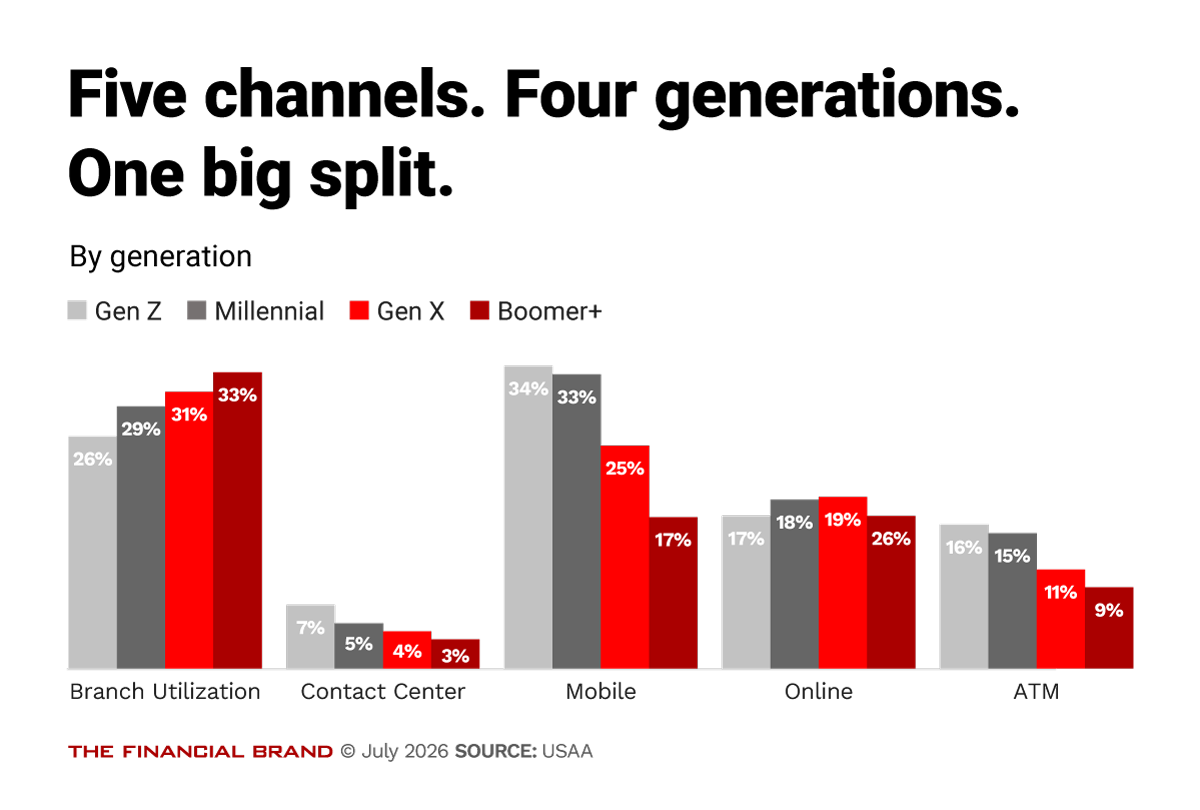
The way institutions invest in and support channels may look very different during the next 10 years than it has during the past 10 years.
Institutions can no longer treat “digital channels” as one thing that everyone wants. Younger customers are mobile-first, while older customers still rely on legacy and service-oriented channels. Depending on the makeup of their account base, institutions may be better able to fine-tune channel investments based on customer preferences.
Trend #3: Fee Income Declining as a Revenue Contributor
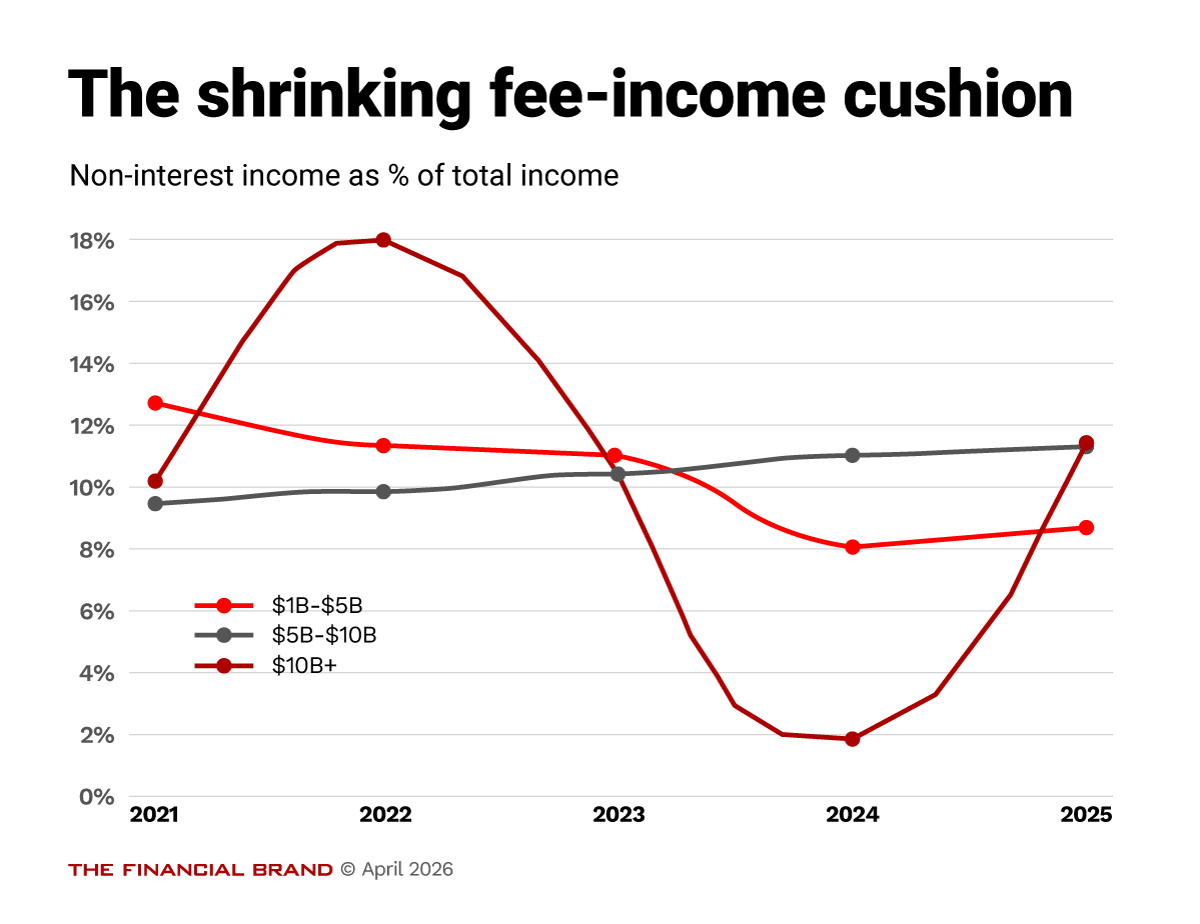
Institutions can no longer rely on fee income to carry as much of the revenue load as it once did. Across asset-size groups, banks have seen fee income fall as a share of total income, with the share at the largest institutions dropping from roughly 25.5% to about 21%. The share at smaller and mid-sized institutions also fell from the low-20% range to nearly 18%.
That puts more pressure on deposit pricing and growth, lending relationships, products or services per customer or member, and operational efficiency—especially for community financial institutions that already face higher cost-to-serve challenges.
Graphic: The Shrinking Fee-Income Cushion
Trend #4: Expense Pressures Are Rising, Especially for Community FIs
Community institutions are facing renewed expense pressure, especially those between $1 billion and $5 billion in assets. After overhead expense growth declined from roughly 10% in 2021 to nearly 6% in 2024, it began climbing again, rising to more than 8% in 2025.
These circumstances also point the way to reducing stubbornly high efficiency ratios.
How to Drive Efficiency Ratios Down
Where can institutions begin when looking to increase revenue and reduce expenses?
According to a recent guide published by Engage Fi, institutions have four steps that provide material reduction to the efficiency ratio. While the guide provides more details, institutions should:
- Redefine the branch. Treat branches as local-market assets, not just transaction centers. They continue to support customer needs, build visibility, and create opportunities for growth.
- Use branch staff across the institution. Redirect excess branch capacity toward calls and other service needs. This can improve customer service, increase staff utilization, and reduce vendor costs.
- Map the customer experience across every channel. Identify unnecessary handoffs, delays, and fragmented workflows, then redesign processes around how customers actually apply for and receive products. This reduces costs while improving completion rates and the customer experience.
- Evaluate each branch’s market potential. Compare actual performance with local opportunity, sales volume, customer mix, staffing costs, and staff utilization. This helps institutions decide where to invest, redeploy capacity, or make changes to the network.
Key takeaways: Reducing duplication and redeploying excess capacity can improve an efficiency ratio, but expense reductions alone will not create sustainable growth. Institutions must also determine how their people, channels, and market presence can generate more value and revenue from each customer relationship.
Cost Cutting Alone Does Not Create Growth
Community financial institutions cannot improve efficiency ratios by cutting expenses alone. To date, many institutions have layered those channels onto legacy operating models, creating higher costs, more handoffs, and less consistent revenue generation. As fee income declines, expenses rise, and younger consumers shift toward digital-first behavior, that model is becoming harder to sustain.
Institutions must now move on from the era of bolting a better banking experience onto traditional processes and infrastructure. The bigger opportunity is to rethink how branches, digital channels, staff, and back-office processes work together.
Bottom line: Technology is expensive, and innovation is almost always even more expensive. Yet both are likely required for institutions focused on continued independent operation. If a bank or credit union can realize the revenue gains from its past customer-experience upgrades while also finding cost savings where possible, the resulting retained earnings will be indispensable for funding the franchise’s future.


